|
|
|
|
|
|
CUPICH:
SYNODALITY;
GRACIAS:
ACCOUNTABILITY;
MARX:
TRANSPARENCY;
OPENIBO: OPENNESS;
ALAZRAKI: COMMUNICATION
|
|
|
Introduction: From Collegiality to Synodality
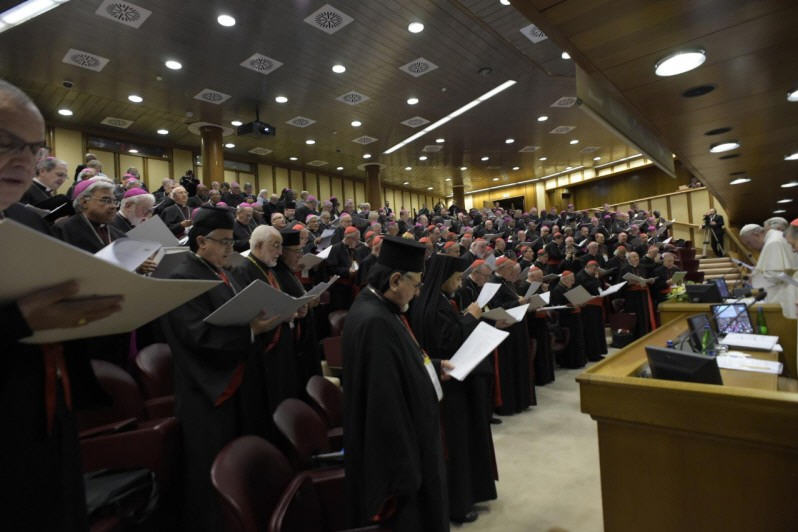
From what we just heard from Cardinal Gracias, we are to understand our gathering in these days as an exercise in collegiality. We are here, as the universal episcopate in affective and substantive union with the successor of Peter, to discern through spirited dialogue where our ministry as successors of the apostles calls us to confront effectively the scandal of clergy sexual abuse that has wounded so many little ones.
While we share a unique responsibility in this regard as the college of bishops, it is also imperative that we consider the challenge we face in the light of synodality, especially as we explore with the entire Church the structural, legal and institutional aspects of accountability. For synodality represents the participation of all the baptized at every level - in parishes, dioceses, national and regional ecclesial bodies - in a discernment and reform that penetrates throughout the Church. It is precisely such a penetrating discernment, so vital to the Church in this moment, that will give rise to the elements of truth, penitence and renewal of cultures that are essential to fulfilling the mandate of protecting the young within the Church, and in turn within the larger society. A process that merely changes policies, even if it is the fruit of the finest acts of collegiality, is not enough. It is the conversion of men and women throughout the entire Church — parents and priests, catechists and religious, parish leaders and bishops — and the conversion of ecclesial cultures on every continent that we must seek. Only a synodal vision, rooted in discernment, conversion and reform at every level can bring to the Church the comprehensive action in the defense of the most vulnerable in our midst to which God’s grace is calling us.
A Sacred Bond
With that in mind, I want to begin with a story. Sixty years ago, this past December, a fire raged through Our Lady of the Angels Catholic elementary school in Chicago, taking the lives of 92 children and three religious sisters. To mark that sad anniversary, I presided at a Memorial Mass, attended by many of the former students who survived the fire and family members of those who had died. One of the persons I greeted before the Mass was a ninety-five-year old mother of one of the children who died in the fire. She was an Italian immigrant, who told me in her native language, but also by the pitiful look in her tearful eyes, that the sting of her loss was still as sharp as the day her nine-year old daughter perished. She showed me the holy card with her daughter’s picture. She clutched it in her hand as something very precious. She had kept this santino for six decades since the day of her little girl’s funeral.
This moving story of a grieving mother, a modern-day Pietà, who lost her child many years ago puts us in touch on a profoundly human level with the sacred bond a parent has with a child. I believe that this sacred space of family life must be the point of reference and where we find our motivation as we commit ourselves in these days to build a culture of accountability with proper structures to radically alter our approach to child safeguarding. Sadly, many of our people, not just those abused or parents of the abused, but the faithful at large are wondering if we the leaders of the Church fully understand this sacred bound, this reality, particularly when they see little care given to abused children, or even worse, when it is covered up to protect the abuser or the institution. They are asking themselves, “If church leaders could act with so little care in giving pastoral attention in such obvious cases of a child being sexually molested, does that not reveal how detached they are from us as parents who treasure our children as the light of our lives? Can we really expect our leaders to care about us and our children in the ordinary circumstances of life, if they responded so callously in cases that would alarm any reasonable person?” This is the source of the growing mistrust in our leadership, not to mention the outrage of our people.
My point is simple. None of the structural elements we enact as a synodal Church, important as they are, can guide us forward faithfully in Christ unless we anchor all our deliberations in the piercing pain of those who have been abused and of the families who have suffered with them. The Church must become like the grieving mother, whom I encountered in Chicago; the Church must truly be Pietà, broken in suffering, consoling in enveloping love, constant in pointing to the divine tenderness of God amidst the pangs of desolation in those who have been crushed by clergy abuse.
Four Synodal Principles to Focus Structural Legal and Institutional Reform
For a Church seeking to be a loving mother in the face of clergy sexual abuse,four orientations, rooted in synodality, must shape every structural, legal and institutional reform designed to meet the enormous challenge which the reality of sexual abuse by clergy represents at this moment.
One: Radical Listening
The first orientation is a perpetual stance of radical listening to comprehend the deadening experience of those who have been sexually abused by clergy. This is how we are to understand the Holy Father’s request that we prepare for this meeting by entering personally into the experiences of survivors by visiting with them. The Church as a loving mother must continually open herself to the heartbreaking reality of children whose wounds will never heal. Such a stance of listening calls us to cast aside the institutional distance and relational blinders that insulate us from coming face to face with the raw destruction of the lives of children and vulnerable people that clergy sexual abuse brings. Our listening cannot be passive, waiting for those who have been abused to find a way to us. Rather, our listening must be active, searching out those who have been wounded, and seeking to minister to them. Our listening must be willing to accept challenge, and confrontation and yes, even condemnation for the Church’s past and present failures to keep safe the most precious of the Lord’s flock. Our listening must be vigilant, understanding that only by inquiry and perseverance and action in the face of signs of sexual abuse can we fulfill God’s mandate. Finally, our listening must bring with it the willingness to confront the past grave and callous errors of some bishops and religious superiors in addressing cases of clergy sexual abuse, and the discernment to understand how to establish just accountability for these massive failures.
Two: Lay Witness
The second foundation which must orient every structural reform to address clergy sexual abuse in a synodal Church is the affirmation that every member of the Church has an essential role in helping the Church to eliminate the horrific reality of clergy sexual abuse. In large part it is the witness of the laity, especially mothers and fathers with great love for the Church, who have pointed out movingly and forcefully how gravely incompatible the commission, cover-up and toleration of clergy sexual abuse is with the very meaning and essence of our Church. This witness of faith and justice by the laity represents not a confrontational challenge to the Church, but an ongoing and grace-filled testimony of faith and action that is essential for the pilgrim people of God to fulfill its salvific mission at this moment in history. Mothers and fathers have called us to account, for they simply cannot comprehend how we as bishops and religious have oftenbeen blinded to the scope and damage of sexual abuse of minors. They are witnessing to dual realities that must be pursued in our church today: an unceasing effort to eradicate clergy sexual abuse in the church, anda rejection of the clerical culture which so often bred that abuse.
True synodality in the Church calls us to see this broad lay witness as empowering and accelerating the mission for which we have come together from every nation in pursuit of the safety of God’s children. We must unswervingly incorporate broad lay participation into every effort to identify and construct structures of accountability for the prevention of clergy sexual abuse. For the history of the past decades demonstrates that the unique and graced perspective of lay men and women, mothers and fathers,informs our Church in so profound a manner on this tragedy that any pathway forward which excludes or diminishes it will inevitably deform the Church and dishonor our God.
Three: Collegiality
The third orientation for our work of reform and renewal was noted by Cardinal Gracias this morning — the stance of sustained collegiality that is necessary for genuine accountability regarding clergy sexual abuse. I know that at times the issue of sexual abuse can leave each of us feeling isolated or defensive in understanding how we should move forward. It is precisely for this reason that our efforts toward structural and legal reform in the Church must be rooted in a profoundly collegial vision. We are gathered here in this historic moment because the Holy Father has powerfully crystallized the drive for reform in a way that positions the Church to meet its responsibilities in protecting the young and to exercise its role as Pietà in a world which knows all too tragically the reality of sexual abuse.
An approach that is synodal and collegial is marked by the reciprocal exchange of mutual knowledge, in the Roman Curia, episcopal conferences and metropolitans, and among each of them for the purpose of discernment. Rather than operating in isolation, we need to communicate with one another in a spirit of trust, recognizing all the while that we are being faithful to the wishes of Christ who has united us as successors of the apostles in the gift of the same Spirit. This past year has taught us that the systematic failures in holding clerics of all rank responsible are due in large measure to flaws in the way we interact and communicate with each other in the college of bishops in union with the successor of Peter. But they also reveal in many cases an inadequate understanding and implementation of key theological realities such as the relationship between the pope and the bishops, bishops among themselves, bishops and religious superiors, bishops with their people and the role of bishops’ conferences.
Pope Francis reminded us in an address to the Congregation of Bishops: “No one can manage everything; each one in his own way, with humility and honesty, lays his own badge in a mosaic that belongs to God.” [1] In other words, accountability within the college of bishops, marked by synodality, can be shaped in a way that becomes a grounded network of guidance, grace and support that does not leave the individual leader alone in difficult situations nor rely on the false impression that the Holy See must come up with all the answers.
[1] Pope Francis, Address to the Congregation of Bishops, February 27, 2014.
Four: Accompaniment
The final orienting principle essential to effective structures of accountability for clergy sexual abuse is the call to accompaniment. If the Church is truly to embrace victim/survivors of clerical abuse in her arms as a loving mother, then every structure of accountability must include outreach and accompaniment that is truly compassionate. Accompaniment entails genuinely attempting to understand the experience and spiritual journey of the other. Thus, the structures of reporting, investigation and the evaluation of claims of abuse must always be designed and evaluated with an understanding of what survivors undergo as they approach the Church and seek justice. Each instance of a survivor approaching the Church, whether he or she is seeking solace or justice, retribution or peace, is an invitation for the Church to genuinely be Pietà, marked with tenderness and empathy.
Such structures of accountability must also be just and sure, producing sanctions to protect the vulnerable when the accused is guilty, and declarations of innocence when the accused is blameless. The call of the Church to accompany victims demands a mindset that categorically rejects cover-ups or the counsel to distance ourselves from survivors of abuse for legal reasons or out of a fear of scandal which blocks true accompaniment with those who have been victimized. It also demands that we erect structures and legal provisions that manifestly enshrine the duty to protect the young and the vulnerable as their first and overarching principle. Perhaps most importantly, the call to accompaniment demands that bishops and religious superiors reject a clerical worldview that sees charges of clergy sexual abuse cast against a backdrop of status and immunities for those in the clerical state. Authentic Christ-like accompaniment sees all as equal in the Lord, and structures rooted in accompaniment make all feel and appear equal in the Lord.
These four synodal principals of listening, lay witness, collegiality and accompaniment are constitutive of the Holy Father’s call to us to prepare for and open our hearts to the immensity and the importance of the task we undertake in these days.
Institutional and Legal Structures for Accountability: A Framework
The task before us is to focus these principles upon the design of specific institutional and legal structures for the purpose of creating genuine accountability in cases related to the misconduct of bishops and religious superiors, and their mishandling of cases of child abuse. But, this will demand that we call each other to an evangelical accountability, anchored in justice and in the sensitivity which Jesus showed when being “deeply moved by the sufferings of others, how much his heart was open to others.” [2] With all of that in mind we now turn to what the specific application of accountability through institutional and legal structures might look like in cases involving the misconduct of bishops and their mishandling of cases of child abuse.
[2] Pope Francis, Amoris Laetitia, 144.
Come Una Madre Amorevole
We already, of course, have a guide in the Apostolic Letter Come una madre amorevole [3], which sets forth procedures that address, among other things, bishops who mishandle abuse cases.
[3] Pope Francis, Apostolic Letter Come una madre, 2016.
Briefly stated, a bishop, eparch or major superior of religious institutes and societies of apostolic life of pontifical right can be removed if his lack of diligence in this regard is grave, even if there is no serious intentional fault on his part. The competent Rome congregation opens an inquiry in accord with Church law to determine if there is foundational proof. The accused will be informed and given the possibility of defending himself. Other bishops or eparchs of the respective bishops’ conference or synod may be consulted before the congregation takes a decision. If removal is the judgment, it is submitted to the Holy Father for approval, and if upheld, the congregation can issue a decree or ask the bishop to resign within fifteen days. Otherwise, the congregation can proceed with removal.[4] We need to read and re-read this letter.
[4] In addition, presently, an effort is underway to guarantee that the procedures are standardized among the congregations, but the law is already applicable and in force, as is evidenced in recent cases.
The Task Ahead
What remains to be enacted are clear procedures in cases which for “grave reasons” could justify the removal from office of a bishop, eparch or religious superior as defined in the motu proprio Sacramentorum sanctitatis tutela [5] and the motu proprio, Come una madre amorevole.
[5] See Norms on delicta graviora, arts. 1-6. Alternatives to the Metropolitan should be established if he is the accused or if the Metropolitan See is vacant. The alternate could be the nearest Metropolitan within the same episcopal conference, or one from a list created a priori by each episcopal conference.
What I offer here are relevant factors that must be considered as each episcopal conference adopts procedures that equips a synodal church to hold bishops involved in misconduct and mishandling accountable. My aim here is to offer a framework that is in keeping with our ecclesiological and canonical traditions in order to spark conversation among ourselves, knowing that there are differences in culture, civil and canonical laws and other factors that need to be considered, and yet aware of the urgency that we take decisive action without delay.
I will group my remarks under three headings: 1. Setting Standards for Investigation of Bishops, 2. Reporting Allegations and 3. Concrete Procedural Steps.
1. Setting Standards:
As episcopal conferences, provinces or dioceses collegially establish standards for conducting the investigations of bishops, they should involve and consult lay experts in accord with Canon Law and explore the use of the Metropolitan, given his traditional role in ordering ecclesial life. All of this should be done without prejudice to the authority of the Holy See. Wherever the civil law requires the reporting of abuse of minors that law must be followed and the policies should make clear those requirements.
2. Reporting Allegations:
All mechanisms for reporting allegations of abuse or mishandling of abuse cases against a bishop should be transparent and well known to the faithful. Attention should be given to establishing independent reporting mechanisms in the form of a dedicated telephone line and/or web portal service to receive and transmit the allegations directly to the Apostolic Nuncio, the Metropolitan [6] of the accused bishop, or as needed his alternate and any lay experts provided for in norms established by the episcopal conferences. The involvement of lay experts to assist from this point forward is for the good of the process and the value of transparency. Other requirements and procedures for reporting to appropriate ecclesiastical authorities by members of the clergy with knowledge of a bishop’s misconduct should also be established.
[6] Otherwise, the allegation could be forwarded to the senior suffragan bishop of the Province, who assumes the role of the Metropolitan in these cases. In the case of an allegation against a bishop of an Eastern Catholic Church, it could be forwarded to the Patriarch, the Major Archbishop, or the Metropolitan of the Metropolitan Churches sui iuris, depending on the structure of the Eastern Catholic Church, unless another provision is made by the Holy See.
3. Concrete Procedural Steps
In my view, it will be useful to adopt clear procedural steps that are both rooted in the traditions and structures of the Church, but at the same time fulfill modern needs to identify and investigate potentially illicit conduct by bishops. While universal laws can be issued by the Holy See with regard to this issue – and the Motu Proprio Come una madre amorevole is the perfect example – Episcopal Conferences, after appropriate consultations, should consider adopting special norms to address the particular needs of each Conference. I believe that our Church is best served if the following twelve principles find their way into any proposed legislation in this area:
a. Victims and their families, as well as persons who report the allegation, need to be treated with dignity and respect, and should receive appropriate pastoral care. Efforts should be made to ensure that victims receive psychological counseling and other support, which I believe should be funded by the diocese of the accused bishop.
b. The reporting of an offense should not by impeded by the official secret or confidentiality rules.
c. No person should be discriminated against, or retaliated against, based upon the reporting of an allegation against a bishop to ecclesiastical authorities.
d. Due attention should be given to including competent lay women and men with expertise in the process from beginning to end, out of respect for the principles of accountability and transparency that I have noted above. [7]
[7] It is recognized that lay professionals with specialized knowledge may be duly authorized to carry out an investigation, but all investigations must remain under the appropriate ecclesiastical authority. See e.g., CIC, c. 274 §1 (“Only clerics can obtain offices the exercise of which requires the power of order or the power of ecclesiastical governance.”); see also CIC, cc. 1405, 1717. This, however, does not impede the rights and duties of the laity in making their opinion known to the pastors and the rest of the Christian faithful on matters which pertain to the good of the Church, cf., CIC, c. 212 §3.
e. Whenever warranted, and at any time during the investigation, the Metropolitan should be able to recommend to the competent Roman congregation that appropriate precautionary measures, including temporary and public withdrawal of the accused from his office, be adopted.
f. If the allegation has even the semblance of truth, which the Metropolitan should be free to determine with the help of lay experts, the Metropolitan can request from the Holy See authorization to investigate. The exact nature of the investigation – whether penal or administrative – would depend on the allegations. [8] This request is to be forwarded without delay and the congregation should respond without delay.
[8] This would not always be a penal preliminary investigation under the Canon Law, since As a Loving Mother also covers non-penal misconduct (such as negligence).
g. After the Metropolitan receives authorization he should gather all relevant information expeditiously, in collaboration with lay experts to ensure the professional and rapid execution of the investigation and conclude the investigation promptly.
h. Any investigation should be conducted with due respect for the privacy and good name of all persons involved. This does not preclude, however, episcopal conference adopting norms for informing the faithful of the allegation against the bishop at any stage of the process. At the same time, it is important that the accused be accorded the presumption of innocence during the investigation. [9]
[9] All appropriate steps shall be taken to protect the exercise of the rights afforded under canon law. CIC, c. 221; see also As a Loving Mother, art. 2 § 2.
i. Upon completion of the investigation the Metropolitan would forward the acta, including all information gathered with the help of lay experts, along with his votum, if requested, to the Holy See.
j. A common fund may be established at the national, regional or provincial level to cover the costs of the investigations of bishops, [10] with due regard to the norms of canon law for its administration. [11]
[10] Cf. CIC, c. 1274 §§ 3-5.
[11] CIC, c. 1275. Lay people can be selected to administer funds. Cf., CIC, c., 1279. If funds are not available for the investigation, the Metropolitan shall make an immediate request for funding to the competent Roman congregation.
k. The competence of the Metropolitan would normally cease once the investigation is completed, [12] but could be extended to assure continuing pastoral care, or for other specific reasons. The processing of the case of a bishop proceeds from this point according to the norms of universal law. [13] In accordance with canon law, the Holy See will either take the case of a bishop to itself for purposes of resolution by an administrative or penal process or other disposition, or the Holy See may return the case to the Metropolitan with further directions as to how to proceed. [14]
[12] See CIC, c. 142 §1See CIC, c. 142 §1.
[13] Cf., Come una madre, arts. 2-5.
[14] Cf., CIC, c. 1718; cf., Come una madre, arts. 2-5.
l. And finally, of course, unless otherwise established by special law, it pertains to the Roman Pontiff to make a final decision. [15]
Concluding Remarks
What I present here is a framework for constructing new legal structures of accountability in the Church. This effort will require steadfast trust and openness in identifying with the aid of everyone in the Church, and with due regard for the diverse cultures and the universality of our Church, the legal and institutional pathways to safeguard young people in a just, compassionate and robust manner.
Saint John Paul II spoke to this reality in his groundbreaking Apostolic Letter Novo Millennio Ineunte, when he observed that we need the wisdom of the law to provide precise rules to guarantee the participation of all the baptized, that rejects any arbitrariness and is in keeping with our tradition of ordering Church life. At the same time, he emphasized, there is a correlative spirituality of communion that “supplies institutional reality with a soul.”
We must move to establish robust laws and structures regarding the accountability of bishops precisely to supply with a new soul the institutional reality of the Church’s discipline on sexual abuse.
In closing, I want to bring you back to that Memorial Mass that I celebrated in Chicago for the children and religious who had died in the fire at Our Lady of the Angels school. During the recessional hymn the elderly immigrant mother who had spoken to me earlier, still holding firmly the santino in her hand, stopped me to tell me how comforted she was by the celebration, consoled that the church had not forgotten her child. Then she did something quite extraordinary and so very symbolic. She placed the santino in my hands, entrusting her child to the church whom she recognized as Pietà, a loving mother. Sisters and brothers, we must work tirelessly in these days to justify that trust and honor such great faith.
Thank you for listening.
ACCOUNTABILITY in A COLLEGIAL and SYNODAL CHURCH
by Cardinal Oswald Gracias,
Archbishop of Bombay
Friday, 22 February 2019
1st Presentation
Most Holy Father, my brother bishops, friends in leadership positions in the Church,
Two days back we met with a group of victims. The meeting left a deep impression on me. I was numbed and could not speak. I could sense the anger, frustration, hurt, helplessness and bitterness that they felt. I share this with you as a background of our meeting these days. We met just 12, but there would be tens of thousands more whom we have not met. How do we respond to them? How do we help them? This is our challenge.
My dear brother bishops and friends, Sexual abuse in the Catholic Church and the subsequent failure to address it in an open, accountable, and effective way has caused a multifaceted crisis that has gripped and wounded the Church, not to speak of those who have been abused. And the Church wounded is you and me: our good people in the pews who come regularly for Mass; the elderly couples, the college students, the laity seeking earnestly to be missionary disciples of the Lord. Although the experience of abuse seems dramatically present in certain parts of the world, it is not just a limited phenomenon. Indeed, the entire Church must take an honest look, undertake rigorous discernment, and then act decisively to prevent abuse from occurring in the future and to do whatever possible to foster healing for victims. This is our duty, this is our calling.
The importance, urgency and universal scope of this challenge has prompted Pope Francis to summon us to this meeting, underscoring the Church’s commitment and his commitment to addressing this crisis. By inviting the presidents of national conferences of bishops, he is signalling how the Church must address this crisis. For him and for those of us gathered with him, it will be the path of collegiality and synodality. That way of being the Church will then—with God’s help—shape and define how the whole Church at the regional, national, local-diocesan, and even parochial levels will take up the task of addressing sexual abuse in the Church. Thus, synodality can truly be lived, by incorporating all decisions and the resulting measures at all these different levels. I will leave sinodality to cardinal Cupich in the next talk. I will focus on collegiality.
Permit me to frame this in a personal perspective. No bishop should say to himself, “I face these problems and challenges alone.” Because we belong to the college of bishops in union with the Holy Father, we all share accountability and responsibility, and we should feel the support of one another. We are strengthened by the presence of Peter with us. Be sure, Holy Father, of our total support, for any decision you may decide to take. But we also need to feel the support of one another, as a college of bishops. Collegiality is an essential context for addressing wounds of abuse inflicted on victims and on the Church at large. We bishops need to return to the teaching of the Second Vatican Council often, in order to find ourselves in the larger mission and ministry of the Church. Consider these words from Lumen gentium: “The individual bishops, who are placed in charge of particular churches, exercise their pastoral government over the People of God committed to their care…(b)ut each of them, as a member of the episcopal college and legitimate successor of the apostles, is obliged by Christ's institution and command to be solicitous for the entire Church.” (n.23)
The point is clear. No bishop may say to himself, “This problem of abuse in the Church does not concern me, because things are different in my part of the world.” This is just a problem for the Usa or Europe or Australia. This, brothers and sisters, is just not true. I dare say there are cases all over the world, also in Asia, also in Africa. But even if we are true, we are jointly responsible, all of us, in this Synod Hall this morning, are jointly responsible to tackle the problem of sexual abuse of minors by clerics all over the world. We, as a body, are called to examine ourselves. We need to acknowledge first of all the fact of sexual abuse, we need to acknowledge the inadequacy of preventive measures, we need to ask pardon for this. We need to commit ourselves resolutely to take steps that this will never happen in the Church again, that we have a Church that is free from the sexual abuse of minors. Is it possible? It should never be, because we in leadership roles did not do enough. We are each responsible for the whole church. We hold accountability and responsibility together. We extend our concern beyond our local Church to embrace all the churches with which we are in communion.
As we take up our collegial and collective sense of accountability and responsibility, we will inevitably encounter a certain dialectic. For our collegiality does indeed express the variety and universality of the People of God, but also the unity of the flock of Christ. There is, in other words, an abiding need to appreciate the great diversity in the lived experience of the churches spread throughout the world because of their history, culture, and customs. At the same time, we must appreciate and foster our unity, our single mission and purpose which is to be “…in the nature of sacrament—a sign and instrument of communion with God and of unity among all people.” (LG, n. 1).
Practically, this means that as we address the scourge of sexual abuse together, that is, collegially, we must do so with a singular and unified vision as well as with the flexibility and adaptiveness that stems from the diversity of people and situations in our universal care.
In this context, we must also ask ourselves fundamentally whether we adequately live what is meant by the concepts of collegiality and synodality. Collegiality and synodality must not only remain theoretical concepts extensively described but not put into practice. In this regard, I still see plenty of scope for further developments. Perhaps we can make progress, if we can clarify the following points.
If in such contexts we ourselves always refer back to Rome, we shouldn't wonder if a certain Roman centralism does not sufficiently take into account our diversity in our brotherhood, and our local church competencies and our skills as responsible shepherds of our local churches are not appropriately used, and thereby the practically lived collegiality suffers. If we want to and must revitalise our collegiality, then we also need to have a discussion between the Roman Curia and our bishops' conferences. I wonder why we cannot decentralize a bit, do most of the work at a national episcopal level of the study and investigation of cases. This will ensure speedier justice. We must have uniform jurisprudence, but this can be ensured.
I am convinced that there are no real alternatives to collegiality and synodality in the Church. But before I note some practical consequences for addressing sexual abuse from a collegial perspective, let’s summarise the challenge that we face together.
The Challenge of Sexual Abuse in the Church
The sexual abuse of minors and vulnerable adults in the Church reveals a complex web of interconnected factors including, as causes: psychopathology, sinful moral decisions, social environments that enable abuse to happen, and often inadequate or plainly harmful institutional and pastoral responses, or a lack of response. The abuse perpetrated by clerics (bishops, priests, deacons) and others serving in the Church (e.g. teachers, catechists, coaches) results in incalculable damage that is both direct and indirect. More importantly, abuse inflicts damage on the survivors. This direct damage can be physical. Inevitably, it is psychological with all the long-term consequences of any serious emotional trauma related to a profound betrayal of trust. Very often, it is a form of direct spiritual damage that shakes faith and severely disrupts the spiritual journey of those who suffer abuse, sometimes spiralling them into despair.
Some of the victims we met said: “I have lost faith in the Church. I have lost faith in God”. The indirect damage of abuse often results from a failed or inadequate institutional response to the sexual abuse. Included in that kind of indirect and damaging response might be: failure to listen to victims or to take their claims seriously, not extending care and support to victims and their families, giving priority to protecting institutional concerns over and above the care of victims, failing to withdraw abusers from situations that would enable them to abuse other victims, and not offering programmes of formation and screening for those who work with children and vulnerable adults.
(HERE IT IS SUGGESTED THE CARDINAL RELATE A STORY ABOUT HOW A VISIT WITH A VICTIM IMPACTED AND TRANSFORMED HIM)
Permit me to share with you some experiences of interaction with victims. Some years back, I met with a person holding a very senior position of responsibility in the secular world. He was very bitter, could not forgive. Thinking that he needed counselling for healing, I spent quite some time discussing the matter with him rationally. I made no headway. Only much later I realized, as I do now, the very long lasting, sometimes lifelong damage this abuse does to the person, to the psyche of the person. Couple of others I met were younger. It shocked me how this changed the personality of the person: could not study, distract, became close, could not relate normally with others at home … the person was destroyed. My brother bishops and sisters and brothers, I realize we can hardly ever get it right. We must have the humility to admit we make mistakes. We must learn. We learn from our mistakes how to do better the next time, how to deal with such cases better the next time.
Addressing sexual abuse in the Church represents a complex and multifaceted challenge, perhaps unprecedented in the Church’s history because of today’s communications and global connections. This makes collegiality even more decisive in our current situation. How ought a collegial Church respond to that challenge? If we use the elements of collegiality as a lens for viewing and addressing the crisis, we can perhaps begin to make some progress, we can see the way forward. Surely, addressing the crisis does not mean a quick or definitive solution. We will need to begin courageously and persevere resolutely on the road together, continuously improving, helping each other, learning from our mistakes which all of us make. This is collegiality.
For now, I want to indicate three themes that I consider especially important for our reflection: justice, healing, and pilgrimage.
Justice
The sexual abuse of others, most especially minors, is rooted in an unjust sense of entitlement: “I can claim this person for my use and abuse.” The abuser may not have thought about this initially, but gradually it leads to this mentality. We’ve seen that in testimonies. Although sexual abuse is many things, such as a breach of trust and a betrayal of confidence, it is at root an act of grave injustice. Victim-survivors speak of their sense of being unjustly violated. A fundamental task that belongs to all of us individually and collegially is to restore justice to those who have been violated. There are multiple levels at work in this process of restoration.
The sexual abuse of minors and other vulnerable people not only breaks divine and ecclesiastical law, but it is also public criminal behaviour. The Church does not only live in an isolated world of its own making. The Church lives in the world and with the world. Those who are guilty of criminal behaviour are justly accountable to civil authority for that behaviour. Although the Church is not an agent of the state, the Church recognises the legitimate authority of civil law and the state. Therefore, the Church fully cooperates with civil authorities in these matters to bring justice to survivors and to the civil order.
I know that complications ensue when there are antagonistic relations between the Church and the state or, even more dramatically, when as in some Countries the state persecutes or stands ready to persecute the Church. These kinds of circumstances underscore the importance of collegiality. Only in a network of strong relationships among the bishops and the local Churches working together can the Church navigate the turbulent waters of Church-state conflict and, at the same time, appropriately address the crime of sexual abuse. There is a double need that only collegiality can address: the need for shared wisdom and the need for supportive encouragement. As a college we should promote justice, repair damage and provide for justice.
Healing
In addition to standing for justice, a collegial Church stands for healing. Certainly, that healing must reach out to the victims of abuse. It must also extend to others who are affected including the communities whose trust was betrayed or severely tested.
For effective healing to happen, there must be clear, transparent, and consistent communication from a collegial Church to victims, members of the Church, and society at large. In a case like this there are so many who need healing: the victim first of all, and that should be our prime concern; so does the family, so does the community, so does the parish. But there is also the perpetrator, and his family, his parish, his presbiterium. The immensity of this hurt, the effects of it are so much! In that communication, the Church offers several messages.
The first message, directed especially to victims, is a respectful outreach and an honest acknowledgement of their pain and hurt. Although this would seem to be obvious, it has not always been communicated. Ignoring or minimising what victims have experienced only exacerbates their pain and delays their healing. Within a collegial Church, we can summon each other to attentiveness and compassion that enable us to make this outreach and acknowledgement. As I said from my encounters, I’m convinced we don’t fully comprehend the pain that they go through. We should never really even minimize it.
The second message must be an offer to heal. There are many paths to healing, from professional counselling to support groups of peers and other means as well. In a collegial Church, we can exercise our imagination and develop these various paths of healing which we can, in turn, communicate to those who are hurting.
A third important message is to identify and implement measure to protect young and vulnerable people from future abuse: preventive measures. Again, it takes a collective wisdom and a shared imagination to develop the ways of protecting young people and avoiding the tragedy of abuse. That can happen in a collegial Church which assumes responsibility for the future and plans together for the future.
A fourth and final message is directed to society at large. Our Holy Father has wisely and correctly said that abuse is a human problem. It is not, of course, limited to the Church. In fact, it is a pervasive and sad reality across all sectors of life. Out of this particularly challenging moment in the life of the Church, we—again in a collegial context—can draw on and develop resources which can be of great service to a larger world. The grace of this moment can actually be our ability to serve a great need in the world from our experience in the Church. In history the Church has often be in the forefront for the defence of values: defence of human rights, rights of migrants, rights of women, rights of the family, rights of the poor. Could the Church become a model and be in the forefront for protection of the rights of the child? And could this influence all of society?
Pilgrimage
As we face the tragedy of sexual abuse in the Church, as we encounter the suffering of victims, we are never more conscious of our status as the pilgrim people of God. We know that we have not yet arrived at our destination. We are aware that our journey has not been along a straight path. The Second Vatican Council captured this so well in Lumen gentium: “Already the final age of the world is with us and the renewal of the world is irrevocably under way; it is even now anticipated in a certain real way, for the Church on earth is endowed already with a sanctity that is real though imperfect.” (n. 48)
To be the pilgrim people of God does not simply mean that we have a certain unfinished status: that is although the case. To be the pilgrim people of God means that we are a community that is called to be continuously in repentance and continuously in discernment. We are a pilgrim Church, learning from our mistakes, constantly trying to improve, to be faithful to the Gospel. We all make mistakes and we need to learn from them. Complacency, feeling they’ve have arrived, that all is well is the worst enemy to a growth in spirituality, to growth in sanctity, to growth in wholeness. We must repent—and do so together, collegially—because along the way we have failed. We need to seek pardon. We must also be in a process of continuous discernment. In other words, together or collegially, we need to watch, wait, observe, and discover the direction that God is giving us in the circumstances of our times. There is more ahead of us. As the abuse crisis has unfolded, we have come to know that there is no easy or quick solution. We are summoned to move together step by step and together. That requires discernment.
Conclusion
Recently, in a very different context, the bishops of the Congo came together and acted collegially. With great courage and determination, they addressed the social and political challenges of their nation. They did so, not one by one but rather together, collegially. In their mutual and shared support, they brought forth a witness to what lived collegiality can mean and how effective it can be.
As we reflect on the abuse crisis which has afflicted the Church and afflicts the Church, we do well to draw from their example and recognise the power of collegiality and unity in addressing the most challenging issues that face us.
In order for us to move forward with a clear sense of accountability and responsibility in a context of collegiality, there are—as I see it—at least four requisites which I offer for your consideration.
To take up collegiality in order to address our accountability and responsibility, we must:
Above all, we need to have the humility to admit that we are not perfect. We do not have all the answers, we do not have all the wisdom. We listen to the Church, to our lay faithful as well as they pray for us, advise us and support us in our efforts tomake the Church what she is meant to be: the sacrament of Christ.
I began with quoting from victims; I want to end with this as well. A moment of consolation was when I told one of the victims: “Please, don’t stop loving the Church”. The reply I got was consoling: “I cannot. I will also do all I can for the Church: it is my family”.
And so, to conclude: if we do these things, we will be able to move forward collegially on a path of accountability and responsibility. We need to accept our mistakes. But notice that all these actions are not simply our actions, they are the work of the Holy Spirit: to claim identity or to know who we are, to live with courage and fortitude, to be discerning, and to be generous in service, let the last word therefore be Veni, Sancte Spiritus, veni. Thank you.
Transparency as a Community of Believers
by Reinhard Cardinal Marx
Archbishop of Munich and Freising
President of the German Bishops’ Conference
February 23, 2019:2nd Presentation
Holy
Father,
your Eminences, your Excellencies, dear sisters and brothers,
When we look on the dynamics of this congress, I would have preferred, perhaps, to change the text, but the text is prepared so I follow the prepared text titled about this issue: “Transparency as a community of believers”.
When I speak to you today about transparency, then I do this under two conditions. Firstly, on condition of a specific understanding of the concept of transparency. I understand this not as the greatest possible mass of diverse, uncoordinated information disclosed. For me, transparency means that actions, decisions, processes, procedures, etc. are understandable and traceable. I believe that traceability and transparency are inextricably linked.
Secondly, I speak to you about transparency in relation to traceability as a cardinal who is German and I know some ideas in your head when you think about Germans: “all these documents, regulations and burocracy”. So perhaps some of you will now immediately think: typical, actually one cannot expect anything else. Us Germans are known for a certain tendency towards administration, which includes these already-mentioned aspects of traceability and transparency. Files, documents, forms, guidelines, paragraphs, lists, procedural rules and the like - these seem to be handed down to Germans from birth, and anyone who somehow has to do with us also seems in some way to be confronted with all these things I have just mentioned. Some people may consider this as a certain quirkiness, and not pay further attention to it. Others - perhaps even the majority - may be opposed to all of this. They ask themselves seriously: Is this administration not contrary to the dynamics of life? Is it not clear to them, that administration puts files in focus, instead of people and their needs? Is it not true that administration only creates additional work, and distracts from the real tasks?
I would like to address these questions with you. And don't worry - this is not a problem just for Germans, Swiss or Americans. It is a fundamental problem, which we all have to face together as a Church, especially and specifically regarding appropriate handling of the topic of abuse. It is important to clarify how much administration the Church needs. And at first glance, it seems rather that less is required.
This assumption can be based on numerous aspects. Faith cannot be administered. The Spirit of God cannot possibly be captured in a file or folder. God’s love is reflected in specific acts of caring for the people, rather than in administrative documents. Prayer is much stronger than any number of administrative procedures. The sacraments convey true mercy, while administration remains part of the minutiae of this world. One could enumerate further arguments to show: administration doesn’t actually fit so well in the Church, and can more or less be neglected. But is that really true? Let us attempt to clarify this, by going through the following thought processes together, and becoming conscious of: what constitutes the Church; what role should administration play; how does administration fulfil its purpose; what must be attended to, so that the required prerequisites are in place, and what are the resulting tasks?
Even here, however, I cannot conceal what I am firmly convinced of, and what I think is essential: administration within the area of responsibility of the Church is not only a technical, specialist or functional issue. Such administration within the Church is closely related to theological fundamentals, is theologically and spiritually motivated, and closely linked with the specific actions of the Church. A fully-functional Church administration is an important building block in the fight against abuse, and in dealing with abuse. Why this is so, in my opinion, will be shown in the following sections.
The Church’s understanding of itself
The Church has a mission in this world. As the Dogmatic Constitution on the Church “Lumen Gentium” says right at the beginning: “the Church is in Christ like a sacrament or as a sign and instrument both of a very closely knit union with God and of the unity of the whole human race, the human family” (LG 1). This mission is fulfilled by specific people in specific locations under very specific conditions, which also requires appropriate, tangible worldly means. Therefore, it is for good reason that a little further in the text ofLumen Gentium it states: “Christ, the one Mediator, established and continually sustains here on earth His holy Church, the community of faith, hope and charity, as an entity with visible delineation (…). But, the society structured with hierarchical organs and the Mystical Body of Christ, are not to be considered as two realities, nor are the visible assembly and the spiritual community, nor the earthly Church and the Church enriched with heavenly things; rather they form one complex reality which coalesces from a divine and a human element.” (LG 8). I like the sentence of the famous cardinal Robert Bellarmine: “The Church is visible like the Republic of Venice”. And it then goes on - on the Lumen Gentium, the famous article 8 - to say: “For this reason, by no weak analogy, it [the church; RM] is compared to the mystery of the incarnate Word. As the assumed nature inseparably united to Him, serves the divine Word as a living organ of salvation, so, in a similar way, does the visible social structure of the Church serve the Spirit of Christ, who vivifies it, in the building up of the body (…).” End of quotation.
Briefly summarised, this means: the actions of the Church in this world cannot be strictly and solely spiritual. Neglecting the worldly aspects of the Church and its own laws, does not do justice to the reality of the Church. In an analogous way, the body of Christ and the human organisation of the church must be seen “without separation and without intermingling”. So to speculate of the Mystery of the Church, we do not say: “The Misery is above the reality of the Church” but “It is in the reality of the Church”, that is together. Therefore, all the basic principles for a good society and a people-serving organisation in the life of the Church cannot be ignored. And the social principles of the social doctrine of the Church are also fitting for the Church, that is subsidiarity, solidarity.
What is the purpose of administration?
The worldly aspects of the Church fundamentally include that many different people work together for the fulfilment of the Church's mission, and also require the appropriate material resources for their respective activities. Salaries must be paid, Church buildings maintained, parish halls constructed, cooperation coordinated, contracts fulfilled, catechetical material printed - the list goes on and on. But at the end of the day, all of these examples relate to one insight: In order to fulfil all of these tasks which arise from the mission of the Church - and thereby also the mission of the Church itself - there is a need for a good and fully-functional administration, which must be oriented towards the goal of the Church, and based on the principle of justice.
Administration standardises procedures and processes, so that it is not necessary to seek, ask and try out how something works every day, even though the same things need to be done repeatedly. This conserves resources, and uses them sparingly and efficiently for the mission. Administration documents what has been discussed, agreed and achieved; it prevents forgetfulness, and preserves matters beyond the moment, so that reliability and fidelity to one's own word are possible. Administration objectifies, by creating and enforcing rules and laws, and thus helps prevent arbitrariness. This is an active contribution to justice, since binding rules and laws ensure that decisions and judgements are not merely based on the whims of those carrying them out, or of superiors. Administration also orientates and sorts, by maintaining an overview of what happens, thereby recording it and making it available. Thus, it creates order, in which the individual can find their way, and understand or review the rationale of their own actions. Administration regulates, and sanctions infringements against the common interest, rules and laws, and thus acts as a counterweight to what can be commonly described as the sinfulness of humanity. Taken overall, administration stabilises cooperation between different people in institutions.
All that has been mentioned so far, including standardising, documenting, objectifying, orientating and sorting - as well as regulating - is of decisive importance for the success of joint actions, including also those of the Church.
What are the difficulties and problems
On the basis of all this that administration accomplishes, it is powerful and that it is clear. What it does or doesn’t do, has a significant impact on what can be achieved through joint actions - or not. This power of administration can also be misused. This is the case, for example, if administration forgets its function of serving the different people living together and cooperating to achieve higher goals; if the administration is only preoccupied with itself; if rules and regulations are only used to sustain the administration itself or the power of persons. This is abuse of power by the administration. What this can mean is clearly apparent at this time.
The sexual abuse of children and youths is in no small measure due to the abuse of power in the area of administration. In this regard, administration has not contributed to fulfilling the mission of the Church, but on the contrary, has obscured, discredited and made it impossible. Files that could have documented the terrible deeds and named those responsible were destroyed, or not even created. Instead of the perpetrators, the victims were regulated and silence imposed on them. The stipulated procedures and processes for the prosecution of offences were deliberately not complied with, but instead cancelled or overridden. The rights of victims were effectively trampled underfoot, and left to the whims of individuals. These are all events that sharply contradict what the Church should stand for. The way in which Church administration was structured and carried out, did not contribute to unifying the whole human race, and bringing mankind closer to God, but on the contrary, violated these aims.
Now, at the very latest, this highlights a difficult dilemma: on the one hand, administration is required to fulfil the mission of the Church, and on the other hand, it can directly oppose this mission. How should this be dealt with? What do we need to change, or pay more attention to?
Necessity of traceability and transparency
We urgently need an administration which not only contributes to fulfilling the mission of the Church, but to some extent even embodies what should be achieved with this mission. It must - just like the Church as a whole - not only be a tool but also a symbol for the unification of humanity, and the unity of mankind with God. It is not only about the functioning of administration for any purpose, but rather that administration should take place in such a way that people feel accepted in administrative procedures, that they feel appreciated, that they can trust the system of administration, that they feel secure and fairly treated, that they are listened to and their legitimate criticism is accepted. This would go a long way towards achieving what it really means to bring people together, and ultimately also to bring mankind closer to God - and that is, so to speak, the theological mission of Church administration.
How important it is that Church administration functions in this way, is clearly shown by the negative experiences in connection with the cases of abuse and I got the letters from victims still today, how they are used, how the administration of the Church is dealing them. The thoughts of some abuse victims can be summarised as follows: If the Church claims to act in the name of Jesus, yet I am treated so badly by the Church or its administration, then I would also like to have nothing to do with this Jesus.
In order for administration to act in accordance with the Church’s mission, and with the nature of the Church as a “symbol and instrument”, there needs to be transparency and traceability of administrative procedures. Administrative procedures become transparent, if it is understandable and traceable who has done what, when, why and what for, and what has been decided, rejected or assigned. Thus, people who experience transparent administration can uncover errors and mistakes in the administrative actions, and defend themselves against such actions. They can share their perspective in a binding way, and have it taken into account. The people encountering the administration are not faced with an anonymous, incomprehensible power structure, but can exercise self-determined control over administrative procedures. They are not mere objects of administration, but can perceive themselves instead as subjects. That is why – for example - the introduction of administrative jurisdiction in the Church is very appropriate and necessary and we have to speak about this.
Objections and fears
There are no alternatives to traceability and transparency, I think. However, there are objections which should be considered. They are mainly directed against violations of pontifical secrecy, as well as ruining the reputation of innocent priests or of the priesthood and the Church as a whole through false accusations, if these are spread. These objections to traceability and transparency are not particularly forceful, I think. Every objection based on pontifical secrecy would only be relevant if compelling reasons could be shown why pontifical secrecy should apply to the prosecution of criminal offences concerning the abuse of minors. As things stand, I know of no such reasons.
The principles of the presumption of innocence and the protection of personal rights, and the need for transparency, are not mutually exclusive. The opposite is the case. On the one hand, a transparent, clearly-regulated and defined procedure ensures that the correct steps must be taken, before those who should pass judgement actually do so. This is the best safety mechanism against prejudices or false judgements in the matter. On the other hand, a clearly-defined and public procedure establishes a degree of credibility, which enables restoring the reputation of a wrongly-accused person, who would otherwise be subjected to rumours, if the investigation is not appropriate, transparent or conclusive.
Transparency does not mean the uncritical acceptance and undisciplined dissemination of abuse allegations and has to respect that protection, that is clear. The goal is a transparent process, which clarifies and specifies the allegations, and follows generally accepted standards regarding when and how the public, the authorities and the Roman Curia should be informed. Such standard practices will make it clear that it is not transparency which damages the Church, but rather the acts of abuse committed, the lack of transparency, or the ensuing cover-up.
Tasks and challenges
Traceability and transparency do not simply appear out of the blue. They are a constant task, whose fulfilment can also be aided by support from relevant experts from outside the Church. What is decisive is always the personal attitude of those who work in administration, and those responsible for it. In essence, it is about the question of how far one is willing to justify one’s own actions to others, and to some extent also be checked by others, that is the problem. Developing such a positive attitude, and bringing it to bear in an appropriate manner, requires time and space for discussion, differentiation and clarification, practice and learning. However, in view of the urgency of the topic - also for others, we spoke about other difficulties in the Church, not only the sexual abuse - the most important measures should be initiated immediately. These may include the following:
1. Definition of the goal and the limits of pontifical secrecy:
The social changes of our time are increasingly characterised by changing communication patterns. In the age of social media, in which each and every one of us can almost immediately establish contact and exchange information via Facebook, Twitter, etc., it is necessary to redefine confidentiality and secrecy, and to distinguish them from data protection. If we do not succeed, we either squander the chance to maintain a level of selfdetermination regarding information, or we expose ourselves to the suspicion of covering up.
2. Transparent procedural norms and rules for ecclesiastical processes: Court proceedings as legal remedies are meaningless without adequate legal and procedural rules, as this would be tantamount to arbitrariness when it comes to passing judgements. This would represent a lack of transparency in relation to the specific actions. Establishing transparent procedural norms and rules for ecclesiastical processes is essential. Yesterday, in our group a bishop said - not from Europe - about that their civil law administration was better than others; it could be. The Church must not operate below the quality standards of public administration of justice, if it doesn’t want to face criticism that it has an inferior legal system, which is harmful to people.
3. Public announcement of statistics on the number of cases, and details thereof, as far as possible, and according also to the laws of the State:
Institutional mistrust leads to conspiracy theories regarding an organisation, and the formation of myths about an organisation. This can be avoided if the facts are set out transparently. We have to look on the legal framework on the data protection that is clear, but when you give the impression “we hide something”, in our culture that will not be successful at the end.
4. Publication of judicial proceedings:
Proper legal proceedings serve to establish the truth, and form the basis for imposing a punishment which is appropriate for the relevant offence. People in the Church have also to see how this judge comes to the sentence and what is the sentence; nearly all are secret, we can not see this. I think that in our situation it is not good. In addition, they establish trust in the organisation and its leadership. Lingering doubts about the proper conduct of court proceedings only harm the reputation and the functioning of an institution. This principle also applies to the Church.
And I end. If one takes a look at the other issues to be dealt with at our meeting, it is clear that traceability and transparency are only one topic among many –we have spoken about other things, but this is also an important aspect when we will regain credibility, traceability and transparency - to be taken into consideration in connection with abuse prevention and dealing with abuse.
Nevertheless, one should always be aware that traceability and transparency are also extremely important beyond the context of abuse – we have heard it today also - for example in the area of finances, another problem where scandals are in the Church. They are also a decisive factor in the trustworthiness and credibility of the Church. I think from this congress we have to learn what our responsibilities are in the dioceses, in the conferences of bishops, also in the Holy See. We have to look at what can we do to regain credibility also we look on a better form of transparency and traceability. That might be a task case also for other points. Let us take a courageous step in this direction. I hope this meeting will be such a step in a courageous future of the Church. Thank you very much.
|
|
|
http://www.vatican.va/resources/resources_suoropenibo-protezioneminori_20190223_en.html
ABUSE of ADULTS
Papa
Francesco,
My brothers and sisters, good morning.
I begin this talk with a quotation from Luke Chapter 4. For me “Openness to the world as a Consequence of the Ecclesial Mission” is the mission statement of Jesus, that we also follow.
The Spirit of the Lord is upon me and anointed me to preach good news to the poor. The Spirit has sent me to proclaim deliverance to the captives and recovery of sight to the blind, to release the oppressed, to proclaim the Lord’s year of favour. Luke 4:18-19
Abstract
For me, as a result of the self-understanding of her mission in the world today, the church needs to update and create new systems and practices that will promote action without fear of making mistakes. Clerical sex abuse is a crisis that has reduced the credibility of the church when transparency should be the hallmark of mission as followers of Jesus Christ. The fact that many accuse the Catholic Church today of negligence is disturbing. The church must do everything possible to protect its young and vulnerable members. The focus should not to be on fear or disgrace but rather on the church’s mission to serve with integrity and justice.
Introduction
The mission of the church flows directly from our deepest understanding of the Incarnation. Catholic Christianity is grounded in belief in a God who chose to be one with the human world.
The self-understanding of the mission of the church must be a manifestation of the Christ we know as both human and divine. The whole of Christ’s mission was to reveal who God is and who we can become. This implies a total acceptance of all that is human andall that the power of God’s grace does to transform us into being witnesses of the divine. Our world-view, if Christian, must be based on respect and dignity for each human being.
At the present time, we are in a state of crisis and shame. We have seriously clouded the grace of the Christ-mission. Is it possible for us to move from fear of scandal to truth? How do we remove the masks that hide our sinful neglect? What policies, programs and procedures will bring us to a new, revitalized starting point characterized by a transparency that lights up the world with God’s hope for us in building the Reign of God?
Throughout the time of writing this presentation, my eyes were cloudy and I wondered what this could mean. Then I remembered the first time I watched the movie Spotlight – you all…some of you know it - the 2016 American biographical drama about the investigation by the Boston Globe in the America’s Boston, the cover-up by ecclesial authorities.
At the end of the film was a long list of cases and the dioceses where they occurred and reading about the number of children affected (and also later seeing the vast amount of money spent on settlements), tears of sorrow flowed. How could the clerical church have kept silent, covering these atrocities? The silence, the carrying of the secrets in the hearts of the perpetrators, the length of the abuses – we had one last night – and the constant transfers of perpetrators are all unimaginable. Presumably there were significant signs in the confessional and in spiritual direction: I want to believe that. With a heavy and sad heart, I think of all the atrocities we have committed as members of the church: I am saying “we”, not “they”: “we”. The Constitutions of my own congregation reminds me: In Christ we unite ourselves to the whole of humanity, especially to the poor and suffering. We accept our share of responsibility for the sin of the world and so live that his love may prevail. (SHCJ Constitutions #6). I think all of us must acknowledge that our mediocrity, hypocrisy and complacency have brought us to this disgraceful and scandalous place that we find ourselves as a church. We pause to pray Lord have mercy on us!
In Gaudete
et Exsultate (164)
we read that Those who think they commit no grievous sins against God’s law
can fall into a state of dull lethargy. Since they see nothing serious to
reproach themselves with, they fail to realize that their spiritual life has
gradually turned lukewarm. They end up weakened and corrupted. Let us no say
“they”: it is all of us. So many aspects of this statement from Pope Francis
stand out for me on the issue of child abuse, as also these sentences from the
PCB Preparation Document: A church that is closed/shut off is no longer
church. Her mission would be thwarted. It's not about giving up principles and
secularizing the church, it's about living visibly and perceptibly what we claim
to be, or what and how we really are.
Yes, we proclaim the Ten Commandments and ‘parade ourselves’ as being the custodians of moral standards/values and good behaviour in society. Hypocrites at times? Yes! Why did we keep silent for so long? How can we turn this around for a time to evangelise, catechise and educate all the members of the church, including the clergy and religious? I often ask myself: Is it true that most bishops did nothing about the sexual abuse of children? I want to believe, and from that I have read, some did act and some did not out of fear or cover-up.
We might say the church is now taking steps to arrest the situation but also to be more transparent about all the steps it had been taking privately over two decades, such as meeting with victims of sexual abuse, reporting cases to the appropriate civil authorities and setting up commissions, and many other things. The question today is more about how to address the issue of the sexual abuse of minors more directly, transparently and courageously as a church. The hierarchical structure and systems in the church – I believe- should be a blessing for us to reach the whole world with very clear mechanisms to address this and many other issues. Why has this not happened enough? Why have other issues around sexuality not been addressed sufficiently, e.g. misuse of power, misuse of money, clericalism – we felt that many times –, gender discrimination, the role of women and the laity in general? Is it that the clerical structures and long protocols that negatively affected swift actions focused more on media reactions?
Reflection
I would
like to offer some reflections based on my experience as an African woman
religious. I have lived in Rome for fifteen years - as a nun - and studied in
America for three. So, I am familiar with these issues in the Global North.
Probably like many of you, I have heard some Africans and Asians say, many
Africans and Asians say that ‘this is not our issue in countries in Africa and
Asia, it is the problem in Europe, the Americas, Canada and Australia.’ However,
I worked throughout Nigeria in the area of sexuality education for nine years
and heard the stories and counselled many people. In fact, one of the bishops,
the first to invite me to his diocese, to speak with him, have a workshop with
him, and he is a priest, he is present here: our bishop Akubeze. So, he saw the
need and invited me. I realized how serious the issues were and still are and
sharing a few of my personal experiences emphasise this fact. In the early 90s a
priest told me there were sexual abuses in the convents and formation houses and
that, as president of the Nigeria Conference of Women Religious, I should,
please, do something to address the issue. A second priest in the early 2000s
said that a particular ethnic group practiced a lot of incest , what I
added to him: that from my personal experience incest is a world issue. A dying
old man revealed to me he was acting strangely because of the sexual abuse he
experienced as a teenager from the priests in his school. And recently I have
heard from somebody, “I know that person, I have the same experience”. So, it
must have been something that was going on in this school for years: the same
school. A thirteen-year-old girl met her priest attacker 25 years later and he
did not recognize her…
These are just short stories.
Transparency
- So, let us not hide such events anymore because of the fear of making mistakes. Too often we want to keep silent until the storm has passed! This storm will not pass. Our credibility as a Church is at stake. I think Jesus told us, gives us a very strong statement: “Whoever causes one of these little ones who believe [in me] to sin, it would be better for him if a great millstone were put around his neck and he were thrown into the sea.” Mark 9:42. So, my dear brothers and sisters, we must face this issue and seek healing for the victims of abuse. The normal process for clergy - in the past and still in the present in some areas – was and is to give support to ‘one of us’, to avoid exposing a scandal and bringing discredit to the church. I told my group yesterday. I used to use three “s”: “secrecy”; “silence”; and the last one is “solidarity” for men, and support for one of us. Women is the same, but the third one is different, you can ask me later… We must face this issue and seek healing for the victims of abuse. The normal process, as I said, is the support for men, but we find a way together. All offenders, I want to say, regardless of their clerical status, found guilty should be given the same penalty for the abuse of minors.
- Let us have courageous conversations rather than saying nothing to avoid making a mistake. I like this statement: We can make a mistake but we are not created to be a mistake and posterity will judge us for not taking action. The first step towards true transparency is to admit wrongdoing and then to publish what has been done – I repeat: we publish what has been done, and I think some of it has been published already. But we have to make it public – what has been done since the time of Pope John Paul II to heal the situation. It may not be enough or sufficient in the eyes of many but it will show that the church had not been totally silent.
- We must build more effective and efficient processes, based on research in human development - we use here human for mission -as well as civil and canon law, for the Safeguarding of Minors. Then give clear and comprehensive safeguarding policies and guidelines in every diocese that should be placed visibly in various parish offices and published on the internet. There must be better handling of the cases through face-to-face, transparent and courageous conversations with victims and offenders, where possible, as well as investigating groups. In many parts of the world, including countries in Africa and Asia, not saying anything is a terrible mistake as we have seen in many countries. The fact that there are huge issues of poverty, illness, war and violence in some countries in the Global South does not mean that the area of sexual abuse should be downplayed or ignored. The church has to be pro-active in facing it. I have read through some of the papers that were given out to us, in various parts of the world, many dioceses and conferences have written books. I didn’t see Nigeria in it. What I know, I worked with some of the booklets that the bishops produce in Nigeria: “call to love”, “I chose you”, “Guidelines for processing abuse of minors and vulnerable adults”. We need more of such in many parts of the world.
- The excuse that respect be given to some priests by virtue of their advanced years and hierarchical position is unacceptable. This argument states that many of the criminal offenders are old, some no longer alive, and that we should not hurt them or their reputations by taking away their priesthood in old age. We can feel sad for those who, when they were younger committed offences that are now being brought out to the open. But my heart bleeds for many of the victims who have lived with the misplaced shame – we had that yesterday - misplaced shame and guilt of repeated violations for years. In some of these areas the offenders did not even see these victims as persons but as objects.
- It is true, as a church, that we believe in repentance of the sinner, in conversion of hearts and the grace of transformation, as Jesus said to the woman caught in the very act of adultery: “Go and from now on do not sin any more.” says Jesus (John 8:1-11). This can create a strong dilemma for some, especially when we know that abusers have often been victims themselves. Do we need to probe deeply what we mean by justice with compassion? How can we help create the environment for prayer and discernment for the grace of God to enlighten us in the way of justice so that transformation and healing may take place for both victims and, I want to say, offenders? We would need to find out where throughout the world (not only in wealthier countries), are the best practices for doing this being developed and can we implement them? Many of these are to be found within the church. I think we have heard that in many of our small groups.
- In publishing the names of offenders, can we publish a complete set of information regarding these situations?
I want to suggest some strategic way forward
Strategic Way Forward
- It is becoming evident that victims that were listened to and helped psychologically and spiritually were healed. Can we train enough sensitive and compassionate people to offer this service in all countries including those places struggling to put food on the table? Are there ways of helping parishes heal victims using their traditional wisdom? Do we make use of preaching and other means to address sexual issues in society? How might dioceses share in a strategic way in providing culturally-sensitive education programs and training kits? Such materials, respecting the dignity of the human persons and emphasizing all unacceptable behaviours, could be used in parishes and schools, hospitals and other places of pastoral ministry. The UISG has promised that in the statement they made.
- How can we continue to address in very concrete ways the issues of prostitution and trafficking on an immense scale as well as personal infidelity and promiscuity around the world? There must be Catholics, alongside others with similar principles, in positions of influence in, for example, the film industry, TV and advertising. They could be encouraged to come together and reflect on their role in promoting a better view of the human person. Let there be a focus on society’s disservice to men in every patriarchal culture in the area of sexuality. From studies I have discovered, and many have discovered, that for a long time society has accepted promiscuity, infidelity, especially in marriage for men, what is changing… thanks God! Let us investigate how better to use social media to educate people on the whole area of sexuality and human relationships.
- I want to say here: essential, surely, is a clear and balanced education and training about sexuality and boundaries in the seminaries and formation houses; in the ongoing formation of priests, religious men and women and bishops. It worries me when I see in Rome, and elsewhere, our country included, the youngest seminarians being treated as though they are more special than everyone else, thus ideas about the status, exalted ideas about their status. This is encouraged because they assume they have already high status. The study of human development, human for mission, must give rise to a serious question about the existence of minor seminaries. I want to repeat that: the study of human development, human for mission, must give rise to a serious question about the existence of minor seminaries. The formation of young women religious, too, can often lead to a false sense of superiority over their lay sisters and brothers, that their calling is a ‘higher’ one. What damage has that thinking done to the mission of the church? Have we forgotten the reminder by Vatican II in Gaudium et Spes of the universal call to holiness? In addition, we need to ask responsible and sensitive lay people and women religious to give true and honest evaluation of candidates for episcopal appointments.
- Could each diocese be challenged to gather men and women of integrity: laity, including religious, and clergy, to form a joint commission sharing expertise about the documentary procedures and protocols, the legal and financial implications of allegations and the necessary channels of responsibility and accountability? A well-qualified person - lay, religious or priests is likely to be the best chairperson of such a group. In addition, they need to work out how best to face the serious issues of sexual abuse already exploding in some Asian and African countries in the same way that it has already elsewhere. Many people who were sexually abused by priests or others in pastoral positions will suffer as traumatic memories are evoked. Some people will be reminded that they could well be revealed as former or current abusers or accused of covering up such facts. Many in various forms of ministry will come across people, family members, adults and/or children, who have been or are being abused and need to know how to respond appropriately. Some allegations will be false which causes suffering of another kind. The impact of damaged faith in the church cannot be under-emphasized as a large number of Catholics are and will be angry and confused. We have seen that in some part of the world. People in positions of some authority also need to know what to say or do in terms of response when issues get to the media or to the press.
Conclusion
We know that the greatest issue is the proclamation of the gospel in a way that will touch the hearts of the young and old. We are called to proclaim the good news but we must BE good news to the people we serve today. No wonder Pope Francis has declared the month of October 2019 The Extra Ordinary Missionary Month. I come back to my opening passage: “The Spirit of the Lord is upon me and anointed me”.
The Spirit of the Lord is upon me and anointed me to preach good news to the poor. The Spirit has sent me to proclaim deliverance to the captives and recovery of sight to the blind, to release the oppressed, to proclaim the Lord’s year of favour. Luke 4:18-19
As an indicator or postscript, I emphasise the following:
The Spirit of the Lord is upon each one of us, and especially those present here.
has anointed all of us. We have heard that during the reports from groups that yes, we are here for serious business and issues have been taken care of.
to preach good news to the poor, the poor beingthe vulnerable, protecting especially defenceless children, seeking justice for the victims of abuse and taking steps to prevent this abuse from recurring.
to proclaim deliverance to the captives, for me the perpetrators are in need of deliverance, conversion and transformation, and we should not forget that.
and recovery of sight to the blind those who are not seeing the issues, even some of uspresent here, or focusing on protecting ‘our own’, or keeping silent or covering up need recovery of sight
to release the oppressed and to proclaim the Lord’s year of favour by taking the necessary steps and maintaining zero tolerance with regard to sexual abuse we will release the oppressed. This is our year of favour let us courageously take up the responsibility to be truly transparent and accountable.
Returning to the title of this conference, I just want to say one passage that has inspired me is:
You are the light of the world - I think we are the light like that this morning in the prayer - A city set on a mountain cannot be hidden. Nor do they light a lamp and then put it under a bushel basket; it is set on a lampstand, where it gives light to all in the house. Just so, your light must shine before others, that they may see your good deeds and glorify your heavenly Father.
I read with great interest many articles about the Pope’s reactions in the case of the Chilean bishops – I think you remember the story – from a denial of accusations, to anger because of deception, the Pope felt, and the cover up, to the acceptance of resignations of – I thought three, but I red again two of the bishops. I admire you, Brother Francis, for taking time as a true Jesuit, to discern and be humble enough to change your mind, to apologize and take action – this is an example for all of us.
Thank you, Pope Francis, for providing this opportunity for us to check and see where we have acted strangely, ignorantly, secretly and complacently. I believe we will change, with great determination, our total approach to reporting abuse, to supporting the victims, to getting the right people to mentor and give support to victims and, above all, to doing what we can to protect minors and vulnerable adults from any form of abuse. Thank you, too, for providing women religious, through the executive of the Union of Superiors General (UISG), an opportunity to participate in this conference. This is the first time ever that we have had all the members of the executing of the women come to a meeting like this. Usually the men come, but the women we were “pick three people and it must be this, this, this…”. Women have acquired a lot of useful experience to offer in this field and have already done much to support victims - there are women who are also offenders - and also to work creatively on their own use of power and authority.
I hope and pray that at the end of this conference we will choose deliberately to break any culture of silence and secrecy among us, to allow more light into our church, as a model Church. A model takes care of the children and continues to be a model to take care of the children. Let us acknowledge our vulnerability; be pro-active not reactive in combating the challenges facing the world of the young and the vulnerable, and look fearlessly into other issues of abuse in the church and society.
I want to end with this, by reminding ourselves of Pope Francis’ own words: A Christian who does not move forward has an identity that is ‘not well... The Gospel is clear: the Lord sent them out saying: ‘go, go forward’! The Christian walks, moves past difficulties and announces that the Kingdom of God is near.
I pray: we will move forward, pass these difficulties. Surely.
Thank you.
|
|
|
PREPARED TEXT:
WORKING TRANSLATION
http://www.vatican.va/resources/resources_alazraki-protezioneminori_20190223_sp.html
Introduction
First and foremost I would like to introduce myself. I am a correspondent in Rome and in the Vatican for Televisa, Mexican television. I followed the end of the Pontificate of St. Pope Paul VI, the 33 days of the Pontificate of John Paul I, the entire Pontificates of St. John Paul II, Benedict XVI and now Pope Francis. I have covered 150 journeys with the latter three Popes.
They invited me to speak to you about communication and, in particular, about how transparent communication is indispensable to fight the sexual abuse of minors by men of the Church.
At first glance, there is little in common between you, bishops and cardinals, and me, a Catholic lay woman with no particular position in the Church, and moreover a journalist. Yet we share something very powerful: we all have a mother; we are here because a woman gave birth to us. Compared to you, perhaps I have an additional privilege: I am a mother first and foremost.
Therefore I do not feel that I am a representative just of journalists, but also of mothers, families, civil society. I would like to share with you my experiences and my life and — if you will allow me — to add some practical advice.
My point of departure, motherhood
I would like to begin precisely with motherhood in order to develop the topic entrusted to me, which is to say: how the Church should communicate about this topic of abuse.
I doubt that anyone in this hall does not think the Church is, first of all, mother. Many of us present here have or have had a brother or sister. Let us also remember that our mothers, while loving us all in the same way, were especially devoted to the frailest, weakest children, to those who perhaps did not know how to move ahead in life on their own feet and needed a little push.
For a mother there are no first or second-class children; there are stronger children and more vulnerable ones. Nor are there first and second-class children for the Church. Her seemingly more important children, as are you, bishops and cardinals (I dare not say the Pope), are no more so than any other boy, girl or young person who has experienced the tragedy of being the victim of abuse by a priest.
What is the Church’s mission? To preach the Gospel. But to do so she needs a moral guide; coherence between what one preaches and what one lives is the basis of being a credible institution, worthy of trust and respect.
For this reason, in facing criminal conduct such as the abuse of minors, do you think that to be true to herself, an institution like the Church can have another way if not that of reporting this crime? That she can have another way if not that of being on the side of the victim and not that of the oppressor? Who is the weakest, most vulnerable child? The priest who abused, the bishop who abused and covered up, or the victim?
You may be certain that for journalists, mothers, families and the entire society, the abuse of minors is one of the main causes of anguish. The abuse of minors, the devastation of their lives, of their families’ lives, worry us. We believe such abuse is one of the most reprehensible crimes.
Ask yourselves: are you enemies, as determined as we are, of those who commit abuse or who cover them up?
We have decided which side to be on. Have you done so truly, or in word alone?
Allies or enemies
If you are against those who commit or cover up abuse, then we are on the same side. We can be allies, not enemies. We will help you to find the rotten apples and to overcome resistance in order to separate them from the healthy ones. But if you do not decide in a radical way to be on the side of the children, mothers, families, civil society, you are right to be afraid of us, because we journalists, who seek the common good, will be your worst enemies. I have been covering the Vatican for almost 45 years. Five different pontificates, extremely important for the life of the Church and of the world, with lights and shadows. In these four decades I have really seen it all.
How many times have I heard that the scandal of abuse is “the press’ fault, that it is a plot by certain media outlets to discredit the Church, that there are hidden powers backing it in order to put an end to this institution”.
We journalists know that there are reporters who are more thorough than others, and that there are media outlets more or less dependent on political, ideological or economic interests. But I believe that in no case can the mass media be blamed for having uncovered or reported on the abuse.
Abuses against minors are neither rumours nor gossip: they are crimes. I remember Pope Benedict XVI’s words during the flight to Lisbon, when he told us that the greatest persecution of the Church comes not from external enemies but arises from sins within her.
I would like you to leave this hall with the conviction that we journalist are neither those who abuse nor those who cover up. Our mission is to assert and defend a right, which is a right to information based on truth in order to obtain justice.
WE journalists know that abuse is not limited to the Catholic Church, but you must understand that we have to be more rigorous with you than with others, by virtue of your moral role.
Stealing, for example, is wrong, but if the one stealing is a police officer it seems more serious to us, because it is the opposite of what he or she should do, which is to protect the community from thieves.
If doctors or nurses poison their patients rather than take care of them, the act draws even more of our attention because it goes against their ethics, their professional code.
Lack of communication, another abuse
As a journalist, as a woman and mother, I would like to tell you that we think abusing a minor is as contemptible as is covering up the abuse. And you know better than I that abuses have been covered up systematically, from the ground up. I think you should be aware that the more you cover up, the more you play ostrich, fail to inform the mass media and thus, the faithful and public opinion, the greater the scandal will be. If someone has a tumour, it is not cured by hiding it from one’s family or friends; silence will not make it heal; in the end it will be the most highly recommended treatments that will prevent metastasis and lead to healing. Communicating is a fundamental duty because, if you fail to do so you automatically become complicit with the abusers. By not providing the information that could prevent these people from committing further abuse, you are not giving the children, young people and their families the tools to defend themselves against new crimes.
The faithful do not forgive the lack of transparency, because it is a new assault on the victims. Those who fail to inform encourage a climate of suspicion and incite anger and hatred against the institution.
I saw it with my own eyes during Pope Francis’ journey to Chile in 2108. There was no indifference: there was indignation and anger for the systematic concealment, for the silence, for the deception of the faithful and the suffering of victims who, for decades, had not been listened to, were not believed.
Victims have first and foremost the right to know what has happened, what you have done in order to distance and punish those who have committed abuse. Even if the guilty party is dead, the victim’s pain is not extinguished. Although the guilty party can no longer be punished, at least the victim, who perhaps has lived many years with that hidden wound, can be consoled. Additionally, other victims who remain in silence will dare to come out, and you will promote their healing and their consolation.
Take the initiative
In Spanish we say that he who strikes first, lands three strikes. Obviously, it is not a matter of striking but of informing.
I think it would be healthier, more positive and more helpful if the Church were the first to provide information, in a proactive and not reactive way, as normally happens. You should not wait to respond to legitimate questions from the press (or from the people, your people) when a journalistic investigation uncovers a case. In the age we live in, it is very difficult to hide a secret. With the prominence of social networks, the ease of posting photos, audio and video, and the rapid social and cultural changes, the Church has only one path: to concentrate on awareness and transparency, which go hand in hand.
Report things when you know them. Of course, it will not be pleasant, but it is the only way, if you want us to believe you when you say “from now on we will no longer tolerate cover-ups”. The first to benefit from transparency is the institution, because the focus is on the guilty party.
Learn from past mistakes
I am Mexican and cannot fail to mention perhaps the most terrible case that happened in the Church, that of Marcial Maciel, the Mexican founder of the Legion of Christ. I witnessed this grim case from beginning to end. Aside from the moral justice over the crimes committed by that man, who according to some was mentally ill and to others an evil genius, I assure you that at the basis of that scandal, which did so much harm to thousands of people, to the point of tarnishing the memory of one who is now a saint, there was unhealthy communication. One need not forget that in the Legion there was a fourth vow according to which if a Legionaries saw something he was uncertain of regarding a superior, he could neither criticize much less comment about it.
Without this censure, without this total concealment, had there been transparency, Marcial Maciel would not have been able, for decades, to abuse seminarians and to have three or four lives, wives and children, who came to accuse him of having abused his own children.
For me this is the most emblematic case of unhealthy, corrupt communication, from which various lessons can and must be learned. Pope Francis told the Curia that in other eras, in addressing these subjects, there was ignorance, lack of preparation, and disbelief. I dare say that there was also corruption.
Behind the silence, the lack of healthy, transparent communication, quite often there is not only the fear of scandal, concern for the institution’s good name, but also money, compensation, gifts, construction permits for schools and universities perhaps in areas where construction was not permitted. I am speaking of what I have seen and thoroughly investigated.
Pope Francis always reminds us that the devil enters through the pockets, and he is absolutely right. Transparency will help you to fight economic corruption. In processing internal information, from the ground up, we have learned even from various nuncios, and I can testify to this, that there have been cases of coverup, obstacles barring access to the Pope of the time, underestimating the gravity of the information or discrediting it, as if it were the fruit of obsessions or fantasies. Transparency will also help you to fight corruption in the government.
It was also thanks to some courageous victims, several courageous journalists and, I think I must say it, to a courageous Pope like Benedict XVI, that this scandal was made public and the tumour eradicated.
It is extremely important to learn the lesson and not to repeat the same mistake. Transparency will help you to be coherent with the Gospel message and to put into practice the principle according to which in the Church no one is above the law: we are all accountable to God and to others.
Avoid secrecy, embrace transparency
Secrecy, in the sense of an excessive tendency toward secrecy, is strictly tied to the abuse of power: it is like a safety net for those who abuse power. Today our societies have adopted transparency as a general rule, and the public believes that the only reason not to be transparent is the desire to conceal something negative or corrupt.
My sensation is that within the Church there is still more resistance to recognizing that the problem of abuse exists and it is imperative to address it with all the instruments possible. Some believe that it happens only in certain countries. I believe we can speak of a generalized situation, to a greater or lesser extent, which in any case must be dealt with and resolved.
Those who hide something are not necessarily corrupt, but all corrupt people are hiding something. Not all those who keep secrets are committing an abuse of power, but all those who abuse power are generally hiding things. Of course, transparency has its limitations.
For this reason, we do not expect you to inform us of just any accusation against a priest. We understand that there can and must be a prior investigation, but do so quickly, comply with the laws of the country you live in, and if envisaged, present the case to the civil justice system.
If the accusation is shown to be credible, you must provide information about the ongoing processes, about what you are doing; you must say that you have removed the guilty party from his parish or from where he was practicing; you must report it yourselves, both in the dioceses and in the Vatican. At times, the Bulletin of the Holy See Press Office provides information about a resignation without explaining the reasons. There are priests who have gone immediately to inform the faithful that they were ill and not that they were leaving because they had committed abuse. I think that the news about the resignation of a priest who has committed abuse should be released with clarity, in an explicit way. In Camera Caritatis, silence on these topics is permissible only if it injures no one, but never when it can do harm.
Three practical tips for living transparency
I have already told you that I think communication is indispensable to resolving this problem. Now allow me to suggest three ways for you to put transparency into practice at the moment of communicating about the sexual abuse of minors.
Put the victims in first place
If the Church wants to learn how to communicate about abuse, her first point of reference must be the victim.
Pope Francis has asked the participants in this meeting to meet the victims, to listen to them and to be available to them before coming to Rome. I will not ask you to raise your hand to see who has done so, but answer silently to yourselves.
Victims are not just numbers; they are not statistics. They are people whose lives, sexuality, emotions, trust in other human beings, perhaps even God, as well as the ability to love have been ruined.
And why is this important? Because it is difficult to inform and communicate something about which we have no direct knowledge. In the case of abuse it is even more obvious. We cannot spea k about this subject if we have not listened to the victims, if we have not shared their pain, if we have not touched by hand the wounds that abuse has caused not only in their bodies but also in their minds, in their hearts, in their faith. If you meet them, they will have a name; they will have a face, and the experience you have with them will be reflected not only in the way in which you confront the issue, but also in the way in which you communicate and resolve it.
The Pope has told us that he meets them regularly, at Santa Marta, that he considers them a of his priority. You should do the same; I do not believe you have less time than the Pope.
Remember, transparency is showing what you do. Only if you put the victims in first place will you be credible when you say you have decided to eradicate the scourge of abuse.
Allow yourselves to seek advice
The second thing is to let yourselves seek advice. Before making decisions, seek advice from people with sound judgment who can help you. There should always be communicators among these advisors. I think the Church should have, at all levels, communications experts, and should heed them when they tell her that it is always better to inform than to keep silent or even lie. It is an illusion to think that a scandal can be hidden today. It is like covering the sky with a finger. It cannot be done. It is no longer acceptable nor permissible. Thus, all of you must understand that silence is far more costly than facing reality and making it public.
I think it is essential that you invest in communications in all your ecclesiastical structures, with highly qualified and experienced individuals in order to address the demands for transparency in today’s world. The figure of the spokesperson is fundamental. Not only must it be a highly trained individual, but he or she must also be able to rely on the full trust of the bishop and have direct access to him 24 hours a day. This is not a 9 to 5 job. Everything can happen at any moment, and at any moment there can be a need to react, although, I repeat, it would be better if you were the first to provide the news. We journalists prefer to speak directly with the boss. But we accept speaking with a spokesperson, if we know that he or she has access to the boss and passes on what the boss, fully apprised, is thinking.
‘Professionalize’ your communications
In the third place, you must communicate better. What kind of transparency do journalists, mothers, families, the faithful, public opinion expect from an institution such as the Church? I think it is fundamental that, at every level, from the parish up to here, in the Vatican, there be structures perhaps standardized but very agile and flexible, that quickly offer accurate information.
It may be incomplete for lack of a deeper investigation, but the response cannot be silence or ‘no comment’, because then we will seek answers by asking others, and thus it will be third parties informing people in the way they wish to do so. If you do not have available all the necessary information, if there are doubts, if there is already an investigation, it is better to explain it in the best way possible so as not to give the impression that you do not want to respond because you are hiding something. It is important to follow up on the information at all times and it is especially important to react quickly. If information is not given in a timely manner, the response is no longer of interest; it will be too late and others will do so, perhaps incorrectly.
The risk is high and the price of this kind of conduct is even higher. Silence gives the impression that the accusations — be they true or false, partly true and partly false — are totally true and that there is fear of giving a response that can be immediately contradicted.
I have seen with my own eyes how bad information, or inadequate information, has caused tremendous damage, harmed the victims and their families, not allowed justice to be served, caused the faith of many people to waver. I assure you that investing in communications is a very profitable matter, and is not a short-term investment; it is a long-term investment.
Conclusion
I would like to conclude this speech by mentioning a different topic than that of the abuse of minors, but important for a woman journalist such as myself. We are at the threshold of another scandal, that of nuns and women religious as victims of sexual abuse by priests and bishops. L’Osservatore Romano’s women’s magazine has reported it and, during the return flight from Abu Dhabi, Pope Francis acknowledged that work has been underway on this subject for some time, that it is true that more needs to be done, and that there is a will to do more. I would like that on this occasion the Church play offense and not defense, as has happened in the case of the abuse of minors. It could be a great opportunity for the Church to take the initiative and be on the forefront of denouncing these abuses, which are not only sexual but also abuses of power.
As I take my leave I thank Pope Francis for having expressed his gratitude, before the Curia last December, for the work of journalists, who have been honest and objective in uncovering predatory priests and have made victims’ voices heard. I hope that after this meeting you will return home and not avoid us, but instead seek us out. That you will return to your dioceses thinking that we are not vicious wolves, but, on the contrary, that we can join our forces against the real wolves. Thank you.
This Webpage was created for a workshop held at Saint Andrew's Abbey, Valyermo, California in 2013