|
|
|
|
|
|
Abbey Website: http://www.abbaziasanpaolo.net/
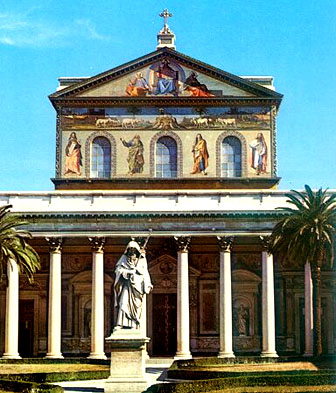
AN international, extra-congregational Benedictine abbey under the direct jurisdiction of the Benedictine Abbey Primate. In the early eighth century. Founded by the Emperor Constantine over the traditional burial-place of St. Paul, the basilica was consecrated in 324 by Pope Sylvester. In the early eighth century (c. 720) Pope Gregory II entrusted the the basilica to Benedictine monks, in whose care it has remained to the present time
The following is from the 1920 Catholic Encyclopedia
As early as 200 the burial place of the great Apostle in the Via Ostia was marked by a cella memoriæ, near which the Catacomb of Comodilla was established. Constantine, according to the “Liber Pontificalis”, transformed it into basilica; in 386 Theodosius began the erection of a much larger and more beautiful basilica, but the work including the mosaics was not completed till the pontificate of St. Leo the Great. The Christian poet, Proudentius, describes the splendours of the monument in a few, expressive lines. As it was dedicated also to Saints Taurinus and Herculanus, martyrs of Ostia in the fifth century, it was called the basilica trium Dominorum.
/
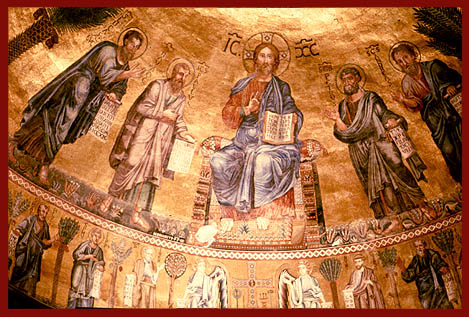
Of the ancient basilica there remain only the interior portion of the apse with the triumphal arch and the mosaics of the latter; the mosaics of the apse and the tabernacle of the confession of Arnolfo del Cambio belong to the thirteenth century.
|
|
|
|
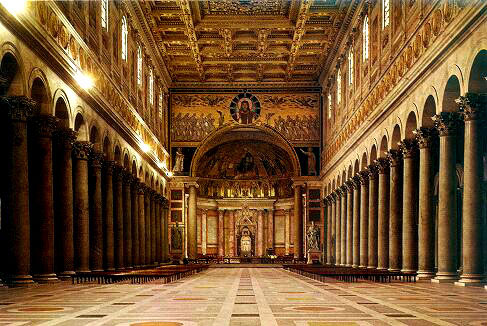
Basilica Nave |
Basilica, Apse |
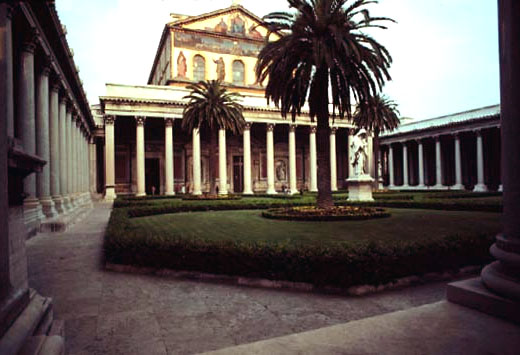
IN the old basilica each pope had his portrait in a frieze extending above the columns separating the four aisles and naves. In 1823 a fire, started through the negligence of a workman who was repairing the lead of the roof, resulted in the destruction of the basilica. Alone of all the churches of Rome, it had preserved its primitive character for one thousand four hundred and thirty-five years. The whole world contributed to its restoration. The Khedive of Egypt sent pillars of alabaster, the Emperor of Russia the precious malachite and lapis lazuli of the tabernacle. The work on the principal facade, looking toward the Tiber, was completed by the Italian Government, which declared the church a national monument. The interior of the walls of the nave are adorned with scenes from the life of St. Paul in two series of mosaics (Gagliardi, Podesti, Balbi, etc).
|
|
|
|
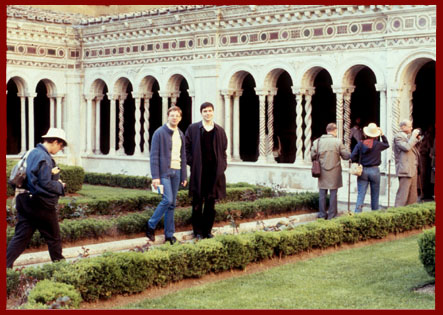
Cloister |
Cloister |
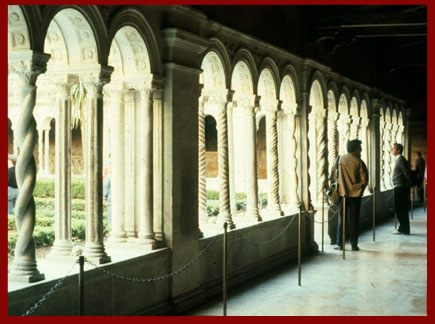
THE graceful cloister of the monastery was erected between 1220 and 1241. The sacristy contains a fine statue of Boniface IX. In the time of Gregory the Great there were two monasteries near the basilica: St. Aristus’s for men and St. Stefano’s for women. Services were carried out by a special body of clerics instituted by Pope Simplicius. In the course of time the monasteries and the clergy of the basilica declined; St. Gregory II restored the former and entrusted the monks with the care of the basilica. The popes continued their generosity toward the monastery; the basilica was again injured during the Saracen invasions in the ninth century. In consequence of this John VIII fortified the basilica, the monastery, and the dwellings of the peasantry, forming the town of Joannispolis, which was still remembered in the thirteenth century. In 937, when St. Odo of Cluny came to Rome, Alberico II, patrician of Rome, entrusted the monastery and basilica to his congregation [i.e. Cluny] and Odo placed Balduino of Monte Cassino in charge.
|
|
|
|
Sacristy Altar |
Basilica |
GREGORY VII (Hildebrand) was abbot of the monastery and in his time Pantaleone of Amalfi presented the bronze gates of the basilica, which were executed by Constantinopolitan artists. Martin V entrusted it to the monks of the Congregation of Monte Cassino. It was then made an abbey nullius. The jurisdiction of the abbot extended over the districts of Civitella San Paolo, Leprignano, and Nazzano, all of which formed parishes; the parish of San Paolo in Rome, however, is under the jurisdiction of the cardinal vicar.
In 2005 it was placed under the jurisdiction of the Abbot Primate as an extra-congregational international Benedictine community.
Add to St. Paul outside walls:
The basilica we visit today is the third. The first, built by Constantine in 324 soon after he legalized Christianity, was tiny, basically the area from the altar to the apse today. Starting in 384, the three emperors who made Christianity the official religion of the empire (Theodosius, Valentinian II and Arcadius) united to build for the “Apostle of the Nations” something considerably larger — the basic floor plan of today’s edifice — which was by far the largest church in Rome until the new St. Peter’s was built between 1506 and 1626.
The fire of 1823 was as traumatic to the Christian world as the fire that torched Notre Dame in Paris in April 2019.
The roof of the basilica was leaking during downpours, and Pope Pius VII, a Benedictine who earlier in his life studied and taught at the monastery attached to the basilica and loved it greatly, gave authorization for repairs to be done. On the evening of July 15, two workmen labored late into the night, extending copper gutters on the eaves of the roof toward the façade. After they left, embers that had not been fully extinguished in a pan they were using to heat and mold the copper, escaped to ignite a fire on the roof that would burn until the following morning.
Herdsmen grazing their cows early on July 16 saw the flames and quickly notified the Benedictine monks, two of whom risked their lives to ring the bell to call for help. When, two hours later, the fire brigade arrived with three horse-drawn carriages, carrying two fire pumps, they concluded they would not be able to stop the fire razing the basilica, and so worked, successfully, to save the monastery.
After the fire had burned itself out, it had destroyed the roof, which led to the collapse of the entire north (left) side of the basilica. The triumphal arch with its precious fifth-century mosaics, the altar area built over the apostle’s tomb, the transept and apse with its 13th-century mosaics were spared.
Nine days earlier, Pius VII had fractured his hip. Coupled with his rapidly declining health, he was bedridden, in and out of consciousness. Those around him couldn’t bring themselves to hasten his demise by telling him of the destruction of his beloved Basilica. He died on Aug. 20.
The cardinals elected Annibale della Genga to succeed him, and he took the name Leo XII. He knew that the Jubilee of 1825 was coming, and he hoped to do something to open up for pilgrims the area of the basilica that hadn’t been destroyed. The damage, however, was too extensive. So, instead, he sought to use the jubilee to help the whole world contribute to the rebuilding of the basilica.
On Jan. 25, 1825, the feast of the Conversion of St. Paul during the Jubilee Year, he wrote an encyclical, Ad Plurimas, to the bishops of the world, asking them and the flocks entrusted to them to help in the reconstruction. Saying that he had been inspired by God to make the request, and drawing hope from the contributions from across the world that had helped rebuild St. Peter’s Basilica a few centuries earlier, he said that their collective efforts would be the least they could do to honor the “vessel of election” who brought Christ’s name to the nations and who had suffered poverty, vigils, hunger, shipwrecks, scourging, stoning and martyrdom to confirm the truth of the Gospel to win all for Christ.
“We owe him so much,” he wrote. “Will anyone be so ungrateful not to feel obliged to contribute as much as he can to the glory of the Apostle?” Just as St. Paul used to raise money for the faithful in Jerusalem, he urged them to gather alms for him, confident the Christian people would respond like the widow with her mite in the Gospel so that “the Basilica will rise from the rubble with that magnificence that suits the name and memory of the Doctor of the Gentiles.”
As happened after the fire that severely damaged Notre Dame in Paris in 2019, the people of the world responded with enormous generosity to the desire to rebuild. Catholics dioceses and individuals were, as expected, the most generous contributors, but they weren’t the only ones. Czar Nicholas I of Russia donated priceless malachite and lapus lazuli used for some altars. King Faoud I of Egypt, and his viceroy, Muhammad Ali Pasha, contributed alabaster columns and windows.
The Pope decided that the basilica would be rebuilt, as closely as possible, according to the paleo-Christian fourth-century design, retaining the precious elements saved from the fire, but eliminating most of the Byzantine, Gothic, Renaissance and Baroque embellishments across the centuries.
The reconstruction took three decades and four popes. Finally, on Dec. 10, 1854, two days after solemnly proclaiming the dogma of the Immaculate Conception, Pope Blessed Pius IX led a procession of 50 cardinals and the faithful of Rome from the Vatican to the Ostian Way, where he consecrated the new basilica.
Entering it today, it’s hard not to sense one is entering back into the late fourth century, greeted on the triumphal arch by a mosaic of the Triumphant Christ done under Pope Leo the Great (440-461). Leo started the tradition of depicting the popes in medallion-shaped portraits along the basilica, and what were formerly frescoes are now mosaics of all the popes from St. Peter to Francis.
There are now 36 oil paintings to summarize the dramatic life of St. Paul that run high up throughout the basilica; scenes include St. Paul’s entrance into Rome and his martyrdom. The highlight is always the “confession” before and underneath the high altar, where it is possible, after excavations in 2006, to see part of St. Paul’s sarcophagus.
The history of St. Paul’s Outside the Walls is a chronicle of resilience. It has overcome earthquakes (442 and 1349), plunderings (739 and 847), sacking (1527), a severe flood (1700), and two devastating fires (1115 and 1823). But after each, it was repaired and rebuilt, and is therefore a good image of not only the holy persistence of the holy namesake buried within, but of the Church he helped build and which, in turn, starting 200 years ago,
This Webpage was created for a workshop held at Saint Andrew's Abbey, Valyermo, California in 1990