|
|
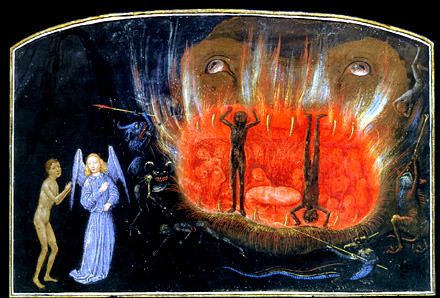
The Mouth of Hell |
|
|
The Mouth of Hell |
Gratian's Corpus juris canonici of c. 1140 (Decretum Gratiani, causa 26, quaestio 5, canon 12)
|
That the bishops and their ministers should endeavor to work with all their might, so as to completely eradicate from their parishes the pernicious art of sorcery and evil invented by the devil; and if they find any man or woman a follower of this kind of crime, let them cast them out of their parishes disgracefully disgraced. |
Ut episcopi eorumque ministri omnibus viribus elaborare studeant, ut perniciosam et a diabolo inventam sortilegam et maleficam artem penitus ex parochiis suis eradicent: et si aliquem virum aut feminam hujuscemodi sceleris sectatorem invenerint, turpiter dehonestatum de parochiis suis ejiciant. |
|
For the apostle says: Avoid first the heretic and second [his] admonitions, knowing that he who is of that kind is subverted. |
Ait enim Apostolus: Haereticum post unam et secundam admonitionem devita, sciens quia subversus est, qui ejusmodi est. |
|
They have been overthrown and are held captive by the devil, who, having abandoned their creator, seek favors from the devil, and therefore the holy Church must be cleansed from such a pestilence. |
Subversi sunt, et a diabolo capti tenentur, qui, derelicto creatore suo, a diabolo suffragia quaerunt, et ideo a tali peste mundari debet sancta Ecclesia. |
|
It must also not be omitted, that certain wicked women, turned back after Satan, seduced by the illusions and phantasms of demons, believe themselves and profess to ride in the hours of the night, with Diana, the goddess of the heathen, or with Herodias and an innumerable multitude of women, upon certain beasts, over many stormy places of the earth, to pass the night in silence and to obey his commands like a lady and to be summoned to his service on certain nights. |
Illud etiam non omittendum, quod quaedam sceleratae mulieres retro post Satanam conversae, daemonum illusionibus, et phantasmatibus seductae, credunt se et profitentur nocturnis horis, cum Diana paganorum dea, vel cum Herodiade et innumera multitudine mulierum equitare super quasdam bestias, et multa terrarum spatia intempestae noctis silentio pertransire ejusque jussionibus velut dominae obedire et certis noctibus ad ejus servitium evocari. |
|
But would that these alone had perished in their perfidy, and had not dragged many with them into the destruction of unbelief. |
Sed utinam hae solae in perfidia sua perissent, et non multos secum in infidelitatis interitum pertraxissent. |
|
For an innumerable multitude, deceived by this false opinion, believes that these things are true, and by believing it deviates from the right faith, and turns back to the error of the pagans, when they think that there is some divinity or deity apart from the one God. |
Nam innumera multitudo hac falsa opinione decepta haec vera esse credit, et credendo a recta fide deviat, et in errore paganorum revolvitur, cum aliquid divinitatis, aut numinis extra unum Deum esse arbitratur. |
|
For this reason the priests must preach to the people through the churches entrusted to them with all urgency, so that they may know that these things are false in every way, and that such phantasms are injected into the minds of unbelievers, not by the divine, but by an evil spirit. |
Quapropter sacerdotes per Ecclesias sibi commissas populo omni instantia praedicare debent, ut noverint haec omnimodis falsa esse, et non a divino, sed a maligno spiritu talia phantasmata mentibus infidelium irrogari. |
|
For Satan himself, who transfigures himself into an angel of light, when he has seized the mind of any woman, and has subjugated it to himself through infidelity and unbelief, immediately transforms himself into the appearances and likenesses of different persons, and deceives the mind which he holds captive in dreams, sometimes happy, sometimes sad , pointing out persons just known, just unknown, leads him through each detour. |
Siquidem ipse Satanas, qui transfigurat se in angelum lucis, cum mentem cujuscunque mulierculae ceperit, et hanc sibi per infidelitatem et incredulitatem subjugaverit, illico transformat se in diversarum personarum species atque similitudines, et mentem quam captivam tenet in somnis deludens, modo laeta, modo tristia, modo cognitas, modo incognitas personas, ostendens, per devia quaeque deducit. |
|
And since only the spirit suffers this, the unbelieving mind thinks that these things do not happen in the mind, but in the body. |
Et cum solus spiritus hoc patitur, infidelis mens haec non in animo, sed in corpore evenire opinatur. |
|
For who is not led out of himself in dreams and night visions, and sees many things while sleeping which he had never seen while awake? But who is so stupid and dull, who thinks that all these things which happen in the spirit alone, also happen in the body? Thus the prophet Ezekiel saw visions of the Lord in the spirit and not in the body. |
Quis enim non in somnis et nocturnis visionibus extra seipsum educitur, et multa videt dormiendo, quae nunquam viderat vigilando? Quis vero tam stultus et hebes sit, qui haec omnia quae in solo spiritu fiunt, etiam in corpore accidere arbitretur? Cum Ezechiel propheta visiones Domini in spiritu non in corpore vidit. |
|
And John the Apostle of the Apocalypse beheld the mysteries in the spirit, not in the body, and heard as he himself says: Immediately, he says, I was in the spirit. |
Et Joannes apostolus Apocalypsis sacramenta in spiritu non in corpore vidit, et audivit sicut ipse dicit: Statim, inquit, fui in spiritu. |
|
And Paul does not dare to say that he was caught up in the body. |
Et Paulus non audet se dicere raptum in corpore. |
|
It must therefore be publicly announced to all that whoever believes in such and similar things loses his faith, and whoever does not have a right faith in God, this is not his, but that of him in whom he believes, namely, the devil. |
Omnibus itaque publice annuntiandum est, quod qui talia et his similia credit, fidem perdit, et qui fidem rectam in Deo non habet, hic non est ejus, sed illius in quem credit, id est diaboli. |
|
For it is written of our Lord: All things were made by him. |
Nam de Domino nostro scriptum est: Omnia per ipsum facta sunt. |
|
Whoever, therefore, believes that anything [of this kind] can take place, or that any creature can be changed for the better or for the worse, or transformed into another species or likeness, except by the Creator himself who made all things and by whom all things were made, is beyond doubt an unbeliever and worse than a heathen. |
Quisquis ergo aliquid credit posse fieri, aut aliquam creaturam in melius aut in deterius immutari, aut transformari in aliam speciem, vel similitudinem, nisi ab ipso Creatore qui omnia fecit et per quem omnia facta sunt, procul dubio infidelis est et pagano deterior. |
This Webpage was created for a workshop held at Saint Andrew's Abbey, Valyermo, California in 2022