 |
|
 |
|
|
|
|
|
MESSAGE
of
THE
HOLY
FATHER
LEO
XIV TO
THE
PARTICIPANTS
in |
MENSAJE DEL SANTO PADRE LEÓN XIV |
|
DEAR brothers and sisters: |
Queridos hermanos y hermanas: |
|
I greet you cordially and thank you for your reflection on the sign of perfect inculturation that the Lord bestowed upon his people in Our Lady of Guadalupe. In reflecting on the inculturation of the Gospel, it is fitting to recognize the way in which God himself has revealed himself and offered us salvation. |
Los saludo cordialmente y agradezco su trabajo de reflexión en torno al signo de perfecta inculturación que, en Santa María de Guadalupe, el Señor quiso regalar a su pueblo. Al reflexionar sobre la inculturación del Evangelio, conviene reconocer el modo mediante el cual Dios mismo se ha manifestado y nos ha ofrecido la salvación. |
|
He has chosen to reveal himself not as an abstract entity nor as a truth imposed from without, but by progressively entering into history and engaging in dialogue with human freedom. “After speaking long ago to our ancestors through the prophets at many times and in various ways” ( Heb 1:1), God revealed himself fully in Jesus Christ, in whom he not only communicates a message, but also communicates himself. Therefore, as St. John of the Cross teaches, after Christ there is no other word to expect, nothing more to say, for everything has been said in him (cf. Ascent of Mount Carmel , II, 22, 3-5). Evangelizing consists, above all, in making Jesus Christ present and accessible. Every action of the Church must seek to introduce human beings into a living relationship with him, a relationship that illuminates existence, challenges freedom, and opens a path of conversion, preparing them to receive the gift of faith as a response to the Love that gives meaning to and sustains life in all its dimensions. |
Él ha querido revelarse no como un ente abstracto ni como una verdad impuesta desde fuera, sino entrando progresivamente en la historia y dialogando con la libertad del hombre. «Después de haber hablado antiguamente a nuestros padres por medio de los Profetas, en muchas ocasiones y de diversas maneras» (Hb 1,1), Dios se reveló plenamente en Jesucristo, en quien no sólo comunica un mensaje, sino que se comunica Él mismo; por eso, como enseña san Juan de la Cruz, después de Cristo no queda otra palabra por esperar, no hay nada más que decir, pues todo ha sido dicho en Él (cf. Subida al Monte Carmelo, II, 22, 3-5). Evangelizar consiste, ante todo, en hacer presente y accesible a Jesucristo. Toda acción de la Iglesia debe buscar introducir al ser humano en una relación viva con Él, que ilumina la existencia, interpela la libertad y abre a un camino de conversión, disponiendo a acoger el don de la fe como respuesta al Amor que da sentido y sostiene la vida en todas sus dimensiones. |
|
However, the proclamation of the Good News always takes place within a concrete experience. Bearing this in mind is to recognize and imitate the logic of the mystery of the Incarnation, by which Christ “became flesh and dwelt among us” ( Jn 1:14), assuming our human condition, with all that it entails in its temporal configuration. It follows, then, that the cultural reality of those who receive the proclamation cannot be ignored, and it is understood that inculturation is not a secondary concession or a mere pastoral strategy, but an intrinsic requirement of the Church’s mission. As Saint Paul VI pointed out , the Gospel—and, consequently, evangelization—is not identified with any particular culture, but is capable of permeating them all without submitting to any ( Apostolic Exhortation Evangelii Nuntiandi , 20). |
Sin embargo, el anuncio de la Buena Nueva acontece siempre dentro de una experiencia concreta. Tener eso en cuenta es reconocer e imitar la lógica del misterio de la Encarnación, por el cual Cristo «se hizo carne y habitó entre nosotros» (Jn 1,14), asumiendo nuestra condición humana, con todo lo que ella comporta en su configuración temporal. Se sigue entonces que no puede ignorarse la realidad cultural de quienes reciben el anuncio y se comprende que la inculturación no es una concesión secundaria ni una mera estrategia pastoral, sino una exigencia intrínseca de la misión de la Iglesia. Como señaló san Pablo VI, el Evangelio —y, por consiguiente, la evangelización— no se identifica con ninguna cultura en particular, pero es capaz de impregnarlas a todas sin someterse a ninguna (Exhort. ap. Evangelii nuntiandi, 20). |
|
From this conviction, inculturating the Gospel means following the same path that God has traveled: entering with respect and love into the concrete history of peoples so that Christ may be truly known, loved, and welcomed from within their own human and cultural experience. This implies embracing the languages, symbols, ways of thinking, feeling, and expressing themselves of each people, not only as external vehicles for the proclamation, but as real places where grace desires to dwell and act. |
Inculturar el Evangelio es, desde esta convicción, seguir el mismo camino que Dios ha recorrido: entrar con respeto y amor en la historia concreta de los pueblos para que Cristo pueda ser verdaderamente conocido, amado y acogido desde dentro de su propia vivencia humana y cultural. Esto implica asumir las lenguas, los símbolos, las formas de pensar, de sentir y de expresarse de cada pueblo, no sólo como vehículos externos del anuncio, sino como lugares reales en los que la gracia desea habitar y actuar. |
|
However, it is necessary to clarify that inculturation does not equate to the sacralization of cultures or their adoption as the decisive interpretive framework for the Gospel message. Nor can it be reduced to a relativistic accommodation or a superficial adaptation of the Christian message, since no culture, however valuable, can simply identify with Revelation or become the ultimate criterion of faith. To legitimize everything culturally given or to justify practices, worldviews, or structures that contradict the Gospel and the dignity of the person would be to ignore that every culture—like every human reality—must be illuminated and transformed by the grace that flows from the Paschal Mystery of Christ. |
Con todo, es necesario aclarar que la inculturación no equivale a una sacralización de las culturas ni a su adopción como marco interpretativo decisivo del mensaje evangélico, ni puede reducirse a una acomodación relativista o a una adaptación superficial del mensaje cristiano, pues ninguna cultura, por valiosa que sea, puede identificarse sin más con la Revelación ni convertirse en criterio último de la fe. Legitimar todo lo culturalmente dado o justificar prácticas, visiones del mundo o estructuras que contradicen el Evangelio y la dignidad de la persona sería desconocer que toda cultura —como toda realidad humana— debe ser iluminada y transformada por la gracia que brota del misterio pascual de Cristo. |
|
Inculturation is, rather, a demanding and purifying process, through which the Gospel, remaining whole in its truth, recognizes, discerns, and embraces the seeds of the Word present in cultures, and at the same time purifies and elevates their authentic values, freeing them from that which obscures or distorts them. These seeds of the Word , as traces of the prior action of the Spirit, find in Jesus Christ their criterion of authenticity and their fullness. |
La inculturación es, más bien, un proceso exigente y purificador, mediante el cual el Evangelio, permaneciendo íntegro en su verdad, reconoce, discierne y asume las semina Verbi presentes en las culturas, y al mismo tiempo purifica y eleva sus valores auténticos, liberándolos de aquello que los oscurece o los desfigura. Estas semillas del Verbo, como huellas de la acción previa del Espíritu, encuentran en Jesucristo su criterio de autenticidad y su plenitud. |
|
From this perspective, Our Lady of Guadalupe is a lesson in divine pedagogy regarding the inculturation of salvific truth. She does not canonize a culture nor absolutize its categories, but neither does she ignore or despise them: they are embraced, purified, and transfigured to become a place of encounter with Christ. The Virgin of Guadalupe reveals God’s way of approaching his people: respectful in its starting point, intelligible in its language, and firm yet gentle in its guidance toward the encounter with the fullness of Truth, with the blessed Fruit of her womb. |
Desde esta perspectiva, Santa María de Guadalupe es una lección de la pedagogía divina sobre la inculturación de la verdad salvífica. En ella no se canoniza una cultura ni se absolutizan sus categorías, pero tampoco se las ignora o se las desprecia: son asumidas, purificadas y transfiguradas para convertirse en un lugar de encuentro con Cristo. La Morenita manifiesta el modo de Dios para acercarse a su pueblo; respetuoso en su punto de partida, inteligible en su lenguaje y firme y delicado en su conducción hacia el encuentro con la Verdad plena, con el Fruto bendito de su vientre. |
|
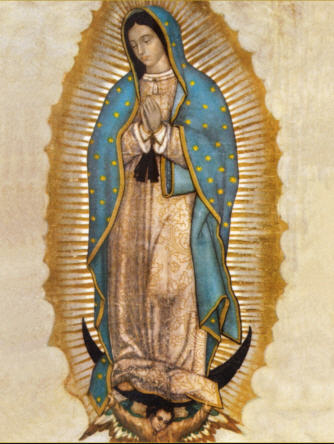
On the tilma, amidst painted roses , the Good News enters the symbolic world of a people and makes its closeness visible, offering its newness without violence or coercion. Thus, what happened at Tepeyac is not presented as a theory or a tactic, but as a permanent criterion for discerning the evangelizing mission of the Church, called to proclaim the True God for whom we live , without imposing him, but also without diluting the radical newness of his saving presence. |
En la tilma, entre rosas pintadas, la Buena Noticia entra en el mundo simbólico de un pueblo y hace visible su cercanía, ofreciendo su novedad sin violencia ni coacción. Así, lo sucedido en el Tepeyac no se presenta como una teoría ni como una táctica, sino como un criterio permanente para el discernimiento de la misión evangelizadora de la Iglesia, llamada a anunciar al Verdadero Dios por quien se vive sin imponerlo, pero también sin diluir la radical novedad de su presencia salvadora. |
|
Today, in many regions of the Americas and the world, the transmission of faith can no longer be taken for granted, particularly in large urban centers and pluralistic societies marked by views of humanity and life that tend to relegate God to the private sphere or to disregard Him altogether. In this context, strengthening pastoral processes requires an inculturation capable of engaging in dialogue with these complex cultural and anthropological realities, without uncritically accepting them, so as to foster a mature and adult faith, sustained in demanding and often adverse contexts. This implies conceiving the transmission of faith not as a fragmented repetition of content nor as a merely functional preparation for the sacraments, but as a true path of discipleship, in which a living relationship with Christ forms believers capable of discerning, of giving an account of their hope, and of living the Gospel with freedom and consistency. |
Hoy, en muchas regiones del continente americano y del mundo, la transmisión de la fe ya no puede darse por supuesta, particularmente en los grandes centros urbanos y en sociedades plurales, marcadas por visiones del hombre y de la vida que tienden a relegar a Dios al ámbito de lo privado o a prescindir de Él. En este contexto, fortalecer los procesos pastorales exige una inculturación capaz de dialogar con estas realidades culturales y antropológicas complejas, sin asumirlas acríticamente, de modo que suscite una fe adulta y madura, sostenida en contextos exigentes y a menudo adversos. Esto implica concebir la transmisión de la fe no como una repetición fragmentaria de contenidos ni como una preparación meramente funcional para los sacramentos, sino como un verdadero camino de discipulado, en el que la relación viva con Cristo forme creyentes capaces de discernir, de dar razón de su esperanza y de vivir el Evangelio con libertad y coherencia. |
|
Therefore, catechesis becomes an indispensable priority for all pastors (cf. CELAM, Aparecida Document , 295-300). It is called to occupy a central place in the Church’s activity, to accompany in a continuous and profound way the process of maturation that leads to a faith truly understood, embraced, and lived personally and consciously, even when this means going against the grain of dominant cultural discourses. |
Por ello, la catequesis se vuelve una prioridad irrenunciable para todos los pastores (cf. CELAM, Documento de Aparecida, 295-300). Está llamada a ocupar un lugar central en la acción de la Iglesia, a acompañar de forma continua y profunda el proceso de maduración que conduce a una fe realmente comprendida, asumida y vivida de manera personal y consciente, incluso cuando ello suponga ir a contracorriente de los discursos culturales dominantes. |
|
In this Congress, you have sought to rediscover and understand how to properly disseminate the theological content of the Guadalupe event and, consequently, of the Gospel itself. May the example and intercession of so many holy evangelists and pastors who faced this same challenge in their time—Toribio de Mogrovejo, Junípero Serra, Sebastián de Aparicio, Mamá Antula, José de Anchieta, Juan de Palafox, Pedro de San José de Betancur, Roque González, Mariana de Jesús, Francisco Solano, among so many others—grant you light and strength to continue proclaiming the Gospel today. And may Our Lady of Guadalupe, Star of the New Evangelization, accompany and inspire every initiative leading up to the 500th anniversary of her apparition. I wholeheartedly impart my blessing upon you. |
En este Congreso, ustedes han querido redescubrir y comprender cómo difundir adecuadamente el contenido teológico del acontecimiento guadalupano y, por ende, del Evangelio mismo. Que el ejemplo y la intercesión de tantos santos evangelizadores y pastores que se enfrentaron a ese mismo desafío en su tiempo —Toribio de Mogrovejo, Junípero Serra, Sebastián de Aparicio, Mamá Antula, José de Anchieta, Juan de Palafox, Pedro de San José de Betancur, Roque González, Mariana de Jesús, Francisco Solano, entre tantos otros— les concedan luz y fortaleza para proseguir el anuncio hoy. Y que Santa María de Guadalupe, Estrella de la Nueva Evangelización, acompañe e inspire cada iniciativa rumbo a los 500 años de su aparición. De corazón les imparto la Bendición. |
|
Vatican City, February 5, 2026. Memorial of Saint Philip of Jesus, Mexican protomartyr. |
Vaticano, 5 de febrero de 2026. Memoria de san Felipe de Jesús, protomártir mexicano. |
|
LEÓN PP. XIV |
LEÓN PP. XIV |
This Webpage was created for a workshop held at Saint Andrew's Abbey, Valyermo, California in 1990