|
|
|
|
|
|
The following is adapted from the Oxford Dictionary of the Christian Church
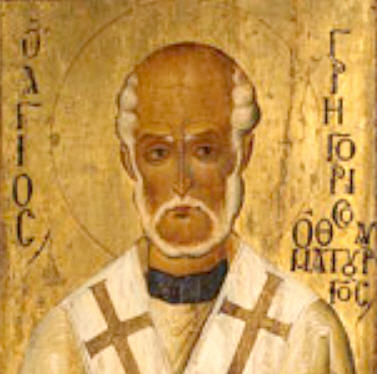
GREGORY THAUMATURGUS, (c.213–c.270). Greek Church Father. He came from a prosperous pagan family of Neocaesarea in Pontus, and studied law and rhetoric. About 233 he went to Caesarea in Palestine, where he became a disciple of Origen, who converted him to the Christian faith and with whom he remained for five, or perhaps eight, years. Soon after his return to his native city he was made its bishop, and during his episcopate converted its pagan population. The wealth of legends and miracles which were attributed to him in later times and to which he owes his surname of Thaumaturgus or wonder-worker, testify to his uncommon strength of character as well as to his popularity. In 253–4 he witnessed the Goths devastating Pontus, as described in his so-called ‘Canonical Letter’. In 264–5 he took part in the first Synod of Antioch against Paul of Samosata; he also fought Sabellianism and Tritheism. Acc. to Suidas he died in the reign of the Emp. Aurelian (270–5).
St Gregory was a practical Churchman rather than a speculative theologian. He based his teaching on Origen, but his terminology is still undeveloped and often equivocal. His name has been affixed to a number of treatises, only a few of which are authentic. His first extant work is, his panegyric on Origen, Εἰς Ὠριγένην … Προσφωνητικός, delivered when he took leave of his master. It contains much autobiographical material as well as an account of Origen’s teaching methods.
His Ἔκθεσις τῆς Πίστεως is a Trinitarian exposition of belief, the basis of his instructions to catechumens. According to St Gregory of Nyssa, whose grandmother St Macrina had been instructed by Gregory Thaumaturgus, it was given to him in a vision by St John the Apostle, at the command of the Blessed Virgin Mary, the first known instance of a record of a Marian apparition.
His Ἐπιστολὴ Κανονική contains much information on the penitential discipline of the early Church. His Μετάφρασις εἰς τὸν Ἐκκλησιαστήν is a paraphrase of Ecciesiastes, and his letter to Theopompus, extant only in a Syriac translation, is a philosophical colloquy on the impassibility (apatheia) of God. Feast day, 17 Nov.
Life, by Gregory of Nyssa, in J. P. Migne, PG 46. 893–958. There also exist Syr., Armen., and Lat. Lives, all of little value. Works (incl. several dubia and spuria) pub. by G. Voss (Mainz, 1604) and others; repr. from A. Gallandi in J. P. Migne, PG 10. 963–1232. Crit. text of Gregory’s address to Origen ed. P. Koet-schau (Sammlung ausgewählter Quellenschriften, 9; 1894), repr., with Fr. tr., introd. and notes by H. Crouzel, SJ (SC 148; 1969). Eng. tr. of his ‘Canonical Letter’ in P. [J.] Heather and J. [F.] Matthews, The Goths in the Fourth Century (Translated Texts for Historians, 11; Liverpool, 1991), pp. 5–11. V. Ryssel, Gregorius Thaumaturgus: Sein Leben und seine Schriften (1880). M. Jugie, AA, ‘Les Homélies mariales attribuées à S. Grégoire le Thaumaturge’, Anal. Boll. 43 (1925), pp. 86–95. On his Creed, cf. L. Froidevaux, ‘Le Symbole de Saint Grégoire le Thaumaturge’, Rech. S.R. 19 (1929), pp. 193–247. A. Poncelet, SJ, ‘La Vie latine de Saint Grégoire le Thaumaturge’, ibid. 1 (1910), pp. 132–60. W. Telfer, ‘The Cultus of St Gregory Thaumaturgus’, HTR 29 (1936), pp. 225–344. R. van Dam, ‘Hagiography and History: The Life of Gregory Thaumaturgus’, Classical Antiquity, 1 (1982), pp. 272–308. R. Lane Fox, Pagans and Christians (1986), pp. 516–42. CPG 1 (1983), pp. 238–47 (nos. 1763–94), and Suppl. (1998), pp. 39–41. Bardenhewer, 2, pp. 315–32; Altaner and Stuiber (1978), pp. 211 f. and 591. H. Crouzel in Dict. Sp. 6 (1967), cols. 1014–20, s.v. ‘Grégoire (19), le Thaumaturge’; id. in NCE 6 (1967), pp. 797 f., s.v.; id. and H. Brakmann in RAC 12 (1983), cols. 779–93, s.v. ‘Gregor I (Gregor der Wundertäter)’.
Rech. Recherches de Science Religieuse (Paris, 1910 ff.).
HTR Harvard Theological Review (New York, 1908 f.; Cambridge, Mass., 1910 ff.).
Bardenhewer, O. *Bardenhewer, Geschichte der altkirchlichen Literatur, 2 (2nd edn., 1914).
Altaner and Stuiber B. *Altaner, Patrologie: Leben, Schriften and Lehre der Kirchenväter (8th edn. revised by A. Stuiber, 1978).
A DECLARATION OF FAITH.
The title as it stands has this addition: “which he had by revelation from the blessed John the evangelist, by the mediation of the Virgin Mary, Parent of God.” Gallandi, Veterum Patrum Biblioth., Venice, 1766, p. 385.
|
CONFESSION of FAITH |
Ἔκθεσις Πίστεως, PG 10, 984-985 |
|
THERE is one God, the Father of the living Word, who is His subsistent Wisdom and Power and Eternal Image: perfect Begetter of the perfect Begotten, Father of the only-begotten Son. |
«Εἷς Θεός, Πατήρ Λόγου ζῶντος, σοφίας ὑφεστώσης, καί δυνάμεως, καί χαρακτῆρος ἀϊδίου. Τέλειος τελείου γεννήτωρ, Πατήρ Υἱοῦ μονογενοῦς. |
|
THERE is one Lord, Only of the Only, God of God, Image and Likeness of Deity, Efficient Word, Wisdom comprehensive of the constitution of all things, and Power formative of the whole creation, true Son of true Father, Invisible of Invisible, and Incorruptible of Incorruptible, and Immortal of Immortal, and Eternal of Eternal. |
Εἷς Κύριος μόνος ἐκ μόνου, Θεός ἐκ Θεοῦ’ χαρακτήρ και εἰκών τῆς θεότητος’ λόγος ἐνεργός’ Σοφία τῆς τῶν ὅλων συστάσεως περιεκτική’ καί δύναμις τῆς ὅλης κτίσεως ποιητική’ Υἱός ἀληθινός, ἀληθινοῦ Πατρός, ἀόρατος ἀοράτου’ καί ἄφθαρτος ἀφθάρτου’ καί ἀθάνατος ἀθανάτου, καί ἀΐδιος ἀϊδίου». |
|
And THERE is One Holy Spirit, having His subsistence from God, and being made manifest by the Son, to wit to men: Image of the Son, Perfect [Image] of the Perfect; Life, the Cause of the living; Holy Fount; Sanctity, the Supplier, [or Leader,] of Sanctification; in whom is manifested God the Father, who is above all and in all, and God the Son, who is through all. |
Καί ἕν Πνεῦμα ἅγιον, ἐκ Θεοῦ τήν ὕπαρξιν ἔχον’ καί διά Υἱοῦ πεφηνός, δηλαδή τοῖς ἀνθρώποις’ εἰκών τοῦ Υἱοῦ’ τελείου τελεία’ ζωή, ζώντων αἰτία’ πηγή ἁγία’ ἁγιότης, ἁγιασμοῦ χορηγός. Ἐν ὧ φανεροῦται Θεός ὁ Πατήρ, ὁ ἐπί πάντων καί ἐν πᾶσι’ καί Θεός ὁ Υἱός, ὁ διά πάντων. |
|
THERE is a perfect Trinity, in glory and eternity and sovereignty, neither divided nor estranged. Wherefore there is nothing either created or in servitude in the Trinity; nor anything superinduced, as if at some former period it was non-existent, and at some later period it was introduced. |
Τριάς τελεία, δόξῃ, καί ἀϊδιότητι καί βασιλείᾳ μή μεριζομένη μηδέ ἀπαλλοτριουμένη’ οὔτε οὖν κτιστόν τι ἤ δοῦλον ἐν τῇ Τριάδι οὔτε ἐπείσακτον, ὡς πρότερον μέν οὐχ ὑπᾶρχον, |
|
And thus neither was the Son ever wanting to the Father, nor the Spirit to the Son; but without variation and without change, the same Trinity [abiding] eternally. |
. ὕστερον δ’ὑπεισελθόν’ οὔτε γάρ ἐνέλιπέ ποτε υἱός πατρί οὔτε υἱῷ πνεῦμα’ ἀλλ’ἄτρεπτος καί ἀναλλοίωτος ἡ αὐτή Τριάς ἀεί». |
|
|
|
This Webpage was created for a workshop held at Saint Andrew's Abbey, Valyermo, California in 1998