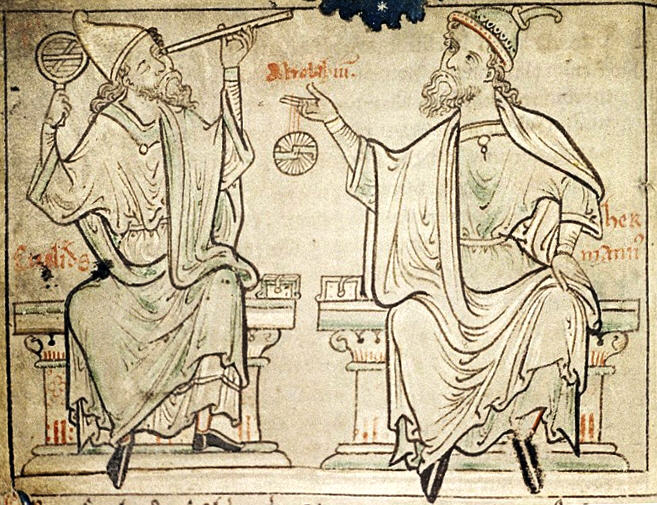
The following is adapted from a variety of sources, including: Calcidius, On Plato’s Timaeus, Ed. & tr. John Magee, (Harv.Univ. Press. 2016)
CALCIDIUS, (var. Chalcidius), 4th-century translator of the first part (to 53c) of Plato’s Timaeus from Greek into Latin around the year 321 and provided with it an extensive commentary. This was likely done for Bishop Hosius of Córdoba. Almost nothing is otherwise known of him. His significance lies in the fact that his translation of the Timaeus was the only extensive text of Plato known to scholars in the Latin West for approximately 800 years. His commentary also contained useful accounts of Greek astronomical knowledge. In the 12th century commentaries on this work were written by Christian scholars and philosophers of the Chartres School, such as Thierry of Chartres and William of Conches. Interpreting it in the light of the Christian faith, the academics in the School of Chartres understood the dialogue to refer to creatio ex nihilo.
Calcidius’ commentaries suggest the influence of Middle Platonism. He makes no explicit link between the Christian creation narrative found in Genesis and the Platonic one in the Timaeus dialogue, but he contrasts Christian/Jewish notions of angels and demons with the daemons of middle Platonism.
“In a cultural context that was often dominated by a fierce polemic between Christian and non-Christian thinkers, Calcidius’ voice shows a distinctive attempt at a non-polemical encounter between these two formidable cultural forces from the point of view of a Platonism that firmly adheres to what is presented as Plato’s truth, against some rival positions and interpretations of Plato’s work, and with a confidence that appears to require no justification. For Calcidius the Timaeus and Plato constitute the ultimate frame of reference, but in Osius and through him Calcidius also addresses a Christian audience.”
Calcidius on Plato’s Timaeus Greek Philosophy, Latin Reception, and Christian Contexts, Gretchen Reydams-Schils (Cambr.Univ.Press, 2020), p. 220.
This Webpage was created for a workshop held at Saint Andrew's Abbey, Valyermo, California in 1998
FIND and REFRENCE:
There is also another recorded tale, one more holy and venerable, according to which with the rising of a certain star there was portended, not disease and death, but the descent of a venerable God to bestow the grace of salvation upon mankind and mortal beings. Men from among the Chaldeans who were undoubtedly wise and skilled in the observation of celestial phenomena are said, on having observed the star during a night journey, to have gone in search of the new birth of God and, on discovering the child in the state of majesty, to have venerated Him and offered prayers befitting a God of such greatness. These matters are much better known to you than to others (pg.331).