|
|
|
|
|
|
The Following is adapted from: The Oxford Dictionary of the Christian Church, ed. Cross, Livingstone; (OUP, 1983).
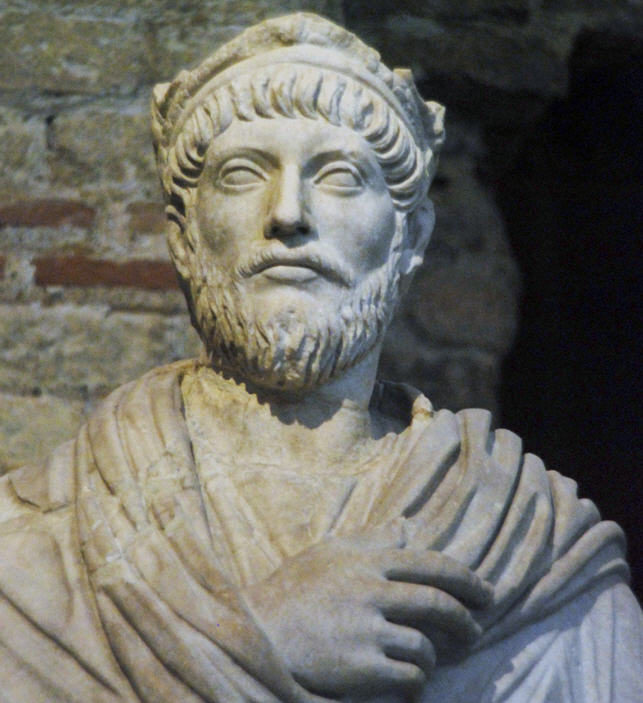
JULIAN the APOSTATE (332–63), ‘Flavius Claudius Julianus’, Roman Emperor from 361. He was born at Constantinople, the nephew of Constantine the Great (Emp. 311–37) and cousin of Constantius II (Emp. 337–361). In 337, after the murder of all his near male relations except his half-brother Gallus, Julian, a very precocious child, was entrusted to the care of a eunuch, Mardonius, and Eusebius of Nicomedia. Already possessing strong pagan leanings, he was banished with Gallus in 345 to the remote fortress of Macellum in Cappadocia, where efforts were made to bring him under Christian influences. In 351, when Gallus was made Caesar, Julian became free to leave Cappadocia. He went first to Constantinople and then to Nicomedia, where before long he was won to Neoplatonism, mainly through the influence of the Sophist, Maximus of Ephesus.
After Gallus’ execution (end of 354), Julian was held captive at Milan; but in 355 he gained permission to visit the schools at Athens, where he was initiated into the Eleusinian mysteries. Among his fellow-students at Athens was St Gregory of Nazianzus.
On 6 Nov. 355 he was presented to the army as Caesar. He soon justified his nomination by his successes in a difficult military situation, in Aug. 357 inflicting a decisive defeat on the Alamanni at Strasbourg. He also carried through some drastic administrative reforms in Gaul. When Constantius, jealous of Julian’s popularity, sought to take over the flower of Julian’s army for his Persian campaigns, the soldiers resisted and proclaimed Julian Emperor (360). Civil war was prevented only by Constantius’ death in Nov. 361.
Now that he was sole Emperor, Julian embarked on an ambitious programme for reform. With regard to the Church, his policy was to degrade Christianity and promote paganism by every means short of open persecution. He sought to re-establish the heathen worship throughout the empire; ordered all instruction in the Imperial schools to be completely paganized; retracted the legal and financial privileges accorded to the Christians by his predecessors; published polemical treatises against Christian doctrine; and even inflicted barbarous sentences on persons guilty only of Christian faith and practice. He also attempted to weaken the Church internally by allowing all exiled Bishops to return to their sees with a view to creating dissensions.
At the same time he attempted to reform the morals and elevate the theology of paganism, himself giving (it must be allowed) a conspicuous example of austerity and purpose.
Having spent the winter of 361–2 at Constantinople, in May 362 he set out for Antioch in preparation for a campaign against the Persians. In Asia Minor and Syria his strict discipline and strong anti-Christian policy made him very unpopular. In March 363 he set out for Mesopotamia. On 26 June 363 he was struck by an arrow and died the same night. The well-known story that he died with the words ‘Vicisti Galilaee’ (‘Thou hast conquered, Galilean!’) is a late embellishment of a passage in Theodoret (HE 3. 25).
Julian was an extensive author. His chief writings are
(1) a set of eight Orations, including two panegyrics on Constantius, two on true and false cynicism, and theosophical orations on King Helios and on the Mother of the Gods;
(2) a set of letters, more than 80 of which have come down under Julian’s name (some perhaps spurious);
(3) ‘Symposium’ or ‘Caesares’, a satire on the vices of past Emperors;
(4) ‘Misopogon’ (the ‘Beard Hater’), a satire written at Antioch on the licentiousness of the inhabitants;
(5) some epigrams.
Unique interest attaches to (6) his ‘Adversus Christianos’, written during the Persian campaign. Though no MS of this last survives, nearly the whole text can be recovered from Cyril of Alexandria’s refutation of the work.
Collected edns. by E. Spanheim (Leipzig, 1696), F. C. Hertlein (2 vols., Teub., 1875–6), W. C. Wright (with Eng. tr., 3 vols., Loeb, 1913–23), and crit. edn., incorporating six new letters discovered by A. Papadopoulos-Kerameus at Halki in 1884, by J. Bidez, G. Rochefort, and C. Lacombrade (Collection Guillaume Budé, 2 vols. in 4, 1924–64, with Fr. tr.). His work against the Christians, reconstructed from Cyril of Alexandria (not included in edns. of Hertlein or Bidez, etc.), ed. C. J. Neumann (Scriptorum Graecorum qui Christianam impugnaverunt religionem quae supersunt, fasc. 3; Leipzig, 1880). The chief ancient authority for his life is Ammianus Marcellinus (Hist. 15. 8–25). Other pagan sources are Libanius, Eunapius, and Claudius Mamertinus. Christian writers (naturally all very hostile) incl., besides the Church Historians and Chroniclers, some poems of St Ephraem Syrus, two invectives of St Gregory of Nazianzus, and St Cyril of Alexandria’s reply already mentioned. Convenient Eng. tr. of a panegyric by Claudius Mamertinus and a homily and hymns against Julian by St John Chrysostom and Ephraem Syrus respectively, ed., with introd. and bibl., by S. N. C. Lieu (Translated Texts for Historians, 2; Liverpool, 1986; 2nd edn., 1989). The study of J. Bidez, La Vie de l’empereur Julien (Collection des Études anciennes publiée sous le patronage de l’Association Guillaume Budé, 1930), supersedes all earlier works. Other studies by G. Ricciotti (Milan, 1946; Eng. tr., Milwaukee [1960]), R. Browning (London, 1975), G. W. Bowersock (ibid., 1978), P. Athanassiadi-Fowden (Oxford, 1981), J. Long and R. J. Penella (eds.) (The Ancient World, 24, No. 1; Chicago, 1993), and M. Giebel (Dusseldorf, 2002). R. Braun and J. Richer (eds.), L’Empereur Julien: De l’histoire à la legende (2 vols., 1978). W. J. Malley, SJ, Hellenism, and Christianity: The Conflict between Hellenic and Christian Wisdom in the Contra Galilaeos of Julian the Apostate and the Contra Julianum of St Cyril of Alexandria (Analecta Gregoriana, 210; Rome, 1978). R. Smith, Julian’s Gods: Religion and philosophy in the thought and action of Julian the Apostate (1995). B. de Gaiffier, SJ, ‘ “Sub Iuliano Apostata” dans le Martyrologe Romain’, Anal. Boll. 74 (1956), pp. 5–49. J. Wordsworth in DCB 3 (1882), pp. 483–525; E. von Borries in PW 10 (pt. 1; 1917), cols. 26–91; A. Lippold in RAC 19 (2001), cols. 442–83, all s.v.
This Webpage was created for a workshop held at Saint Andrew's Abbey, Valyermo, California in 1998