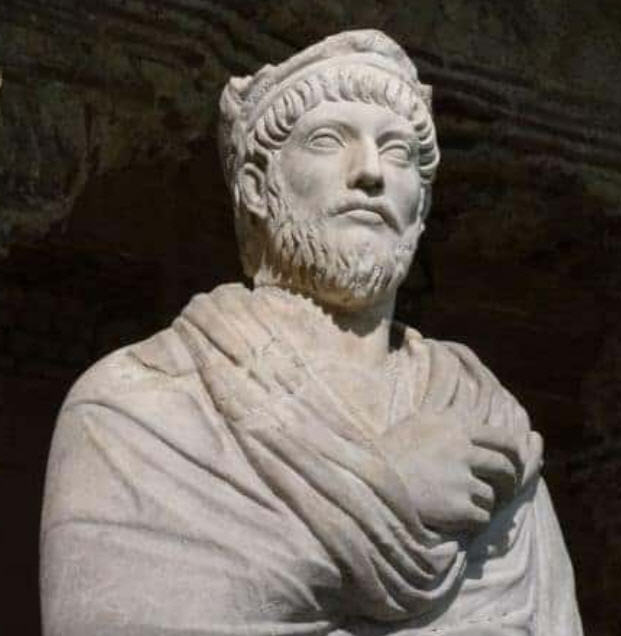
AGAINST THE GALILAEANS, Transl. Wilmer Cave WRIGHT, PH.D. Greek: Book I Juliani imperatoris librorum contra Christianos quae supersunt (Teubner,Leipzig, 1880) ed. Neumann, C.J.
|
JULIAN
the
EMPEROR |
ΙΟΥΛΙΑΝΟΥ
ΑΥΤΟΚΡΑΤΟΡΟΣ
|
| It is, I think, expedient to set forth to all mankind the reasons by which I was convinced that the fabrication of the Galilaeans is a fiction of men composed by wickedness. Though it has in it nothing divine, by making full use of that part of the soul which loves fable and is childish and foolish, it has induced men to believe that the monstrous tale is truth. |
[163] Καλῶς ἔχειν ἔμοιγε φαίνεται τὰς αἰτίας ἐκθέσθαι πᾶσιν ἀνθρώποις, ὑφ' ὧν ἐπείσθην, ὅτι τῶν Γαλιλαίων ἡ σκευωρία πλάσμα ἐστὶν ἀνθρώπων ὑπὸ κακουργίας συντεθέν. ἔχουσα μὲν οὐδὲν θεῖον, ἀποχρησαμένη δὲ τῷ φιλομύθῳ καὶ παιδαριώδει καὶ ἀνοήτῳ τῆς ψυχῆς μορίῳ τὴν τερατολογίαν εἰς πίστιν ἤγαγεν ἀληθείας. |
| Now since I intend to treat of all their first dogmas, as they call them, I wish to say in the first place that if my readers desire to try to refute me they must proceed as if they were in a court of law and not drag in irrelevant matter, or, as the saying is, bring counter-charges until they have defended their own views. For thus it will be better and clearer if, when they wish to censure any views of mine, they undertake that as a separate task, but when they are defending themselves against my censure, they bring no counter-charges. |
Μέλλων δὲ ὑπὲρ τῶν παρ' αὐτοῖς λεγομένων δογμάτων ἁπάντων ποιεῖσθαι τὸν λόγον, ἐκεῖνο βούλομαι πρῶτον εἰπεῖν, ὅτι χρὴ τοὺς ἐντυγχάνοντας, εἴπερ ἀντιλέγειν ἐθέλοιεν, ὥσπερ ἐν δικαστηρίῳ μηδὲν ἔξωθεν πολυπραγμονεῖν μηδὲ, τὸ λεγόμενον, [164] ἀντικατηγορεῖν, ἕως ἂν ὑπὲρ τῶν παρ' αὐτοῖς ἀπολογήσωνται. ἄμεινον μὲν γὰρ οὕτω, καὶ σαφέστερον ἰδίαν μὲν ἐνστήσασθαι πραγματείαν, ὅταν τι τῶν παρ' ἡμῖν εὐθύνειν θέλωσιν, ἐν οἷς δὲ πρὸς τὰς παρ' ἡμῶν εὐθύνας ἀπολογοῦνται, μηδὲν ἀντικατηγορεῖν. |
| It is worth while to recall in a few words whence and how we first arrived at a conception of God; next to compare what is said about the divine among the Hellenes and Hebrews; and finally |321 to enquire of those who are neither Hellenes nor Jews, but belong to the sect of the Galilaeans, why they preferred the belief of the Jews to ours; and what, further, can be the reason why they do not even adhere to the Jewish beliefs but have abandoned them also and followed a way of their own. For they have not accepted a single admirable or important doctrine of those that are held either by us Hellenes or by the Hebrews who derived them from Moses; but from both religions they have gathered what has been engrafted like powers of evil, as it were, on these nations----atheism from the Jewish levity, and a sordid and slovenly way of living from our indolence and vulgarity; and they desire that this should be called the noblest worship of the gods. |
Μικρὸν δὲ ἀναλαβεῖν ἄξιον, ὅθεν ἡμῖν ἥκει καὶ ὅπως ἔννοια θεοῦ τὸ πρῶτον, εἶτα παραθεῖναι τὰ παρὰ τοῖς Ἕλλησι καὶ παρὰ τοῖς Ἑβραίοις ὑπὲρ τοῦ θείου λεγόμενα, καὶ μετὰ τοῦτο ἐπανερέσθαι τοὺς οὔτε Ἕλληνας οὔτε Ἰουδαίους, ἀλλὰ τῆς Γαλιλαίων ὄντας αἱρέσεως, ἀνθ' ὅτου πρὸ τῶν ἡμετέρων εἵλοντο τὰ παρ' ἐκείνοις, καὶ ἐπὶ τούτῳ, τί δή ποτε μηδ' ἐκείνοις ἐμμένουσιν, ἀλλὰ κἀκείνων ἀποστάντες ἰδίαν ὁδὸν ἐτράποντο. ὁμολογήσαντες μὲν οὐδὲν τῶν καλῶν οὐδὲ τῶν σπουδαίων οὔτε τῶν παρ' ἡμῖν τοῖς Ἕλλησιν οὔτε τῶν παρὰ τοῖς ἀπὸ Μωυσέως Ἑβραίοις, ἀπ' ἀμφοῖν δὲ τὰς παραπεπηγυίας ‹τούτοις› τοῖς ἔθνεσιν ὥσπερ τινὰς Κῆρας δρεπόμενοι, τὴν ἀθεότητα μὲν ἐκ τῆς Ἰουδαϊκῆς ῥᾳδιουργίας, φαῦλον δὲ καὶ ἐπισεσυρμένον βίον ἐκ τῆς παρ' ἡμῖν ῥᾳθυμίας καὶ χυδαιότητος, τοῦτο τὴν ἀρίστην θεοσέβειαν ἠθέλησαν ὀνομάζεσθαι. |
| Now that the human race possesses its knowledge of God by nature and not from teaching is proved to us first of all by the universal yearning for the divine that is in all men whether private persons or communities, whether considered as individuals or as races. For all of us, without being taught, have attained to a belief in some sort of divinity, though it is not easy for all men to know the precise truth about it, nor is it possible for those who do know it to tell it to all men. . . .1 Surely, besides this conception which is common to all men, there is another also. I mean that we are all by nature so closely dependent on the heavens and the gods that are visible therein, that even if any man conceives of another god besides these, he in every case assigns to him the heavens as his dwelling-place; not that he thereby separates him from the earth, but he so to speak establishes the King of |323 the All in the heavens 2 as in the most honourable place of all, and conceives of him as overseeing from there the affairs of this world. |
[165] Ὅτι δὲ οὐ διδακτὸν, ἀλλὰ φύσει ‹τὸ εἰδέναι θεὸν› τοῖς ἀνθρώποις ὑπάρχει, τεκμήριον ἡμῖν ἔστω πρῶτον ἡ κοινὴ πάντων ἀνθρώπων ἰδίᾳ καὶ δημοσίᾳ καὶ κατ' ἄνδρα καὶ ἔθνη περὶ τὸ θεῖον προθυμία. ἅπαντες γὰρ ἀδιδάκτως θεῖόν τι πεπιστεύκαμεν, ὑπὲρ οὗ τὸ μὲν ἀκριβὲς οὔτε πᾶσι ῥᾴδιον ‹γινώσκειν› οὔτε τοῖς ἐγνωκόσιν εἰπεῖν εἰς πάντας δυνατόν ..... ταύτῃ δὴ τῇ κοινῇ πάντων ἀνθρώπων ἐννοίᾳ πρόσεστι καὶ ἄλλη. πάντες γὰρ [ἄνθρωποι] οὐρανῷ καὶ τοῖς ἐν αὐτῷ φαινομένοις θεοῖς οὕτω δή τι φυσικῶς προσηρτήμεθα, ὡς καὶ εἴ τις ἄλλον ὑπέλαβε παρ' αὐτοὺς τὸν θεὸν, οἰκητήριον αὐτῷ πάντως τὸν οὐρανὸν ἀπένειμεν, οὐκ ἀποστήσας αὐτὸν τῆς γῆς, ἀλλ' οἷον ὡς εἰς τιμιώτερον τοῦ παντὸς ἐκεῖνο τὸν βασιλέα καθίσας τῶν ὅλων ἐφορᾶν ἐκεῖθεν ὑπολαμβάνων τὰ τῇδε. |
| What need have I to summon Hellenes and Hebrews as witnesses of this? There exists no man who does not stretch out his hands towards the heavens when he prays; and whether he swears by one god or several, if he has any notion at all of the divine, he turns heavenward. And it was very natural that men should feel thus. For since they observed that in what concerns the heavenly bodies there is no increase or diminution or mutability, and that they do not suffer any unregulated influence, but their movement is harmonious and their arrangement in concert; and that the illuminations of the moon are regulated, and that the risings and settings of the sun are regularly defined, and always at regularly defined seasons, they naturally conceived that the heaven is a god and the throne of a god.3 For a being of that sort, since it is not subject to increase by addition, or to diminution by subtraction, and is stationed beyond all change due to alteration and mutability, is free from decay and generation, and inasmuch as it is immortal by nature and indestructible, it is pure from every sort of stain. Eternal and ever in movement, as we see, it travels in a circuit about the great Creator, whether it be impelled by a nobler and more divine soul that dwells therein, just as, I mean, our bodies are by the soul in us, or having received its motion from God Himself, it wheels in its boundless circuit, in an unceasing and eternal career. |325 | τί δεῖ μοι καλεῖν Ἕλληνας καὶ Ἑβραίους ἐνταῦθα μάρτυρας; οὐδεὶς ἔστιν, ὃς οὐκ ἀνατείνει μὲν εἰς οὐρανὸν τὰς χεῖρας εὐχόμενος, ὀμνύων ‹δὲ› θεὸν ἤτοι θεοὺς, ἔννοιαν ὅλως τοῦ θείου λαμβάνων, ἐκεῖσε φέρεται. καὶ τοῦτο οὐκ ἀπεικότως ἔπαθον. ὁρῶντες γὰρ οὔτε ἐλαττούμενόν τι τῶν περὶ τὸν οὐρανὸν οὔτε τρεπόμενον οὔτε πάθος ὑπομένον τι τῶν ἀτάκτων, ἀλλ' ἐναρμόνιον μὲν [166] αὐτοῦ τὴν κίνησιν, ἐμμελῆ δὲ τὴν τάξιν, ὡρισμένους δὲ φωτισμοὺς σελήνης, ἡλίου δὲ ἀνατολὰς καὶ δύσεις ὡρισμένας ἐν ὡρισμένοις ἀεὶ καιροῖς, εἰκότως θεὸν καὶ θεοῦ θρόνον ὑπέλαβον. τὸ γὰρ τοιοῦτον, ἅτε μηδεμιᾷ προσθήκῃ πληθυνόμενον μηδὲ ἐλαττούμενον ἀφαιρέσει, τῆς τε κατ' ἀλλοίωσιν καὶ τροπὴν ἐκτὸς ἱστάμενον μεταβολῆς πάσης καθαρεύει φθορᾶς καὶ γενέσεως, ἀθάνατον δὲ ὂν φύσει καὶ ἀνώλεθρον παντοίας ἐστὶ καθαρὸν κηλῖδος· ἀΐδιον δὲ καὶ ἀεικίνητον, ὡς ὁρῶμεν, ἤτοι παρὰ ψυχῆς κρείττονος καὶ θειοτέρας ἐνοικούσης αὐτῷ, ὥσπερ, οἶμαι, τὰ ἡμέτερα σώματα παρὰ τῆς ἐν ἡμῖν ψυχῆς, φέρεται κύκλῳ περὶ τὸν μέγαν δημιουργὸν, ἢ πρὸς αὐτοῦ τοῦ θεοῦ τὴν κίνησιν παραδεξάμενον τὸν ἄπειρον ἐξελίττει κύκλον ἀπαύστῳ καὶ αἰωνίῳ φορᾷ. |
| Now it is true that the Hellenes invented their myths about the gods, incredible and monstrous stories. For they said that Kronos swallowed his children and then vomited them forth; and they even told of lawless unions, how Zeus had intercourse with his mother, and after having a child by her, married his own daughter,4 or rather did not even marry her, but simply had intercourse with her and then handed her over to another.5 Then too there is the legend that Dionysus was rent asunder and his limbs joined together again. This is the sort of thing described in the myths of the Hellenes. Compare with them the Jewish doctrine, how the garden was planted by God and Adam was fashioned by Him, and next, for Adam, woman came to be. For God said, “It is not good that the man should be alone. Let us make him an help meet like, him.” 6 Yet so far was she from helping him at all that she deceived him, and was in part the cause of his and her own fall from their life of ease in the garden. | [167] Οὐκοῦν Ἕλληνες μὲν τοὺς μύθους ἔπλασαν ὑπὲρ τῶν θεῶν ἀπίστους καὶ τερατώδεις. καταπιεῖν γὰρ ἔφασαν τὸν Κρόνον τοὺς παῖδας ‹καὶ› εἶτ' αὖθις ἐμέσαι. καὶ γάμους ἤδη παρανόμους· μητρὶ γὰρ ὁ Ζεὺς ἐμίχθη καὶ παιδοποιησάμενος ἐξ αὐτῆς ἔγημε μὲν αὐτὸς τὴν αὑτοῦ θυγατέρα, μᾶλλον δὲ οὐδὲ ἔγημεν [αὐτὸς τὴν αὐτοῦ θυγατέρα], ἀλλὰ μιχθεὶς ἁπλῶς ἄλλῳ παραδέδωκεν αὐτήν. εἶτα οἱ Διονύσου σπαραγμοὶ καὶ μελῶν κολλήσεις. τοιαῦτα οἱ μῦθοι τῶν Ἑλλήνων φασίν. τούτοις παράβαλλε τὴν Ἰουδαϊκὴν διδασκαλίαν, καὶ τὸν φυτευόμενον ὑπὸ τοῦ θεοῦ παράδεισον καὶ τὸν ὑπ' αὐτοῦ πλαττόμενον Ἀδὰμ, εἶτα τὴν γινομένην αὐτῷ γυναῖκα. λέγει γὰρ ὁ θεός "οὐ καλὸν εἶναι τὸν ἄνθρωπον μόνον· ποιήσωμεν αὐτῷ βοηθὸν κατ' αὐτὸν", πρὸς οὐδὲν μὲν αὐτῷ τῶν ὅλων βοηθήσασαν, ἐξαπατήσασαν δὲ καὶ γενομένην παραίτιον αὐτῷ τε ἐκείνῳ καὶ ἑαυτῇ τοῦ πεσεῖν ἔξω τῆς τοῦ παραδείσου τρυφῆς. |
| This is wholly fabulous. For is it probable that God did not know that the being he was creating as a help meet would prove to be not so much a blessing as a misfortune to him who received her? Again, what sort of language are we to say that the serpent used when he talked with Eve? Was it the language of human beings? And in what do such legends as these differ from the myths that were invented by the Hellenes? Moreover, is it not excessively strange that God should deny to the human beings whom he had fashioned the power to distinguish between good |327 and evil? What could be more foolish than a being unable to distinguish good from bad? For it is evident that he would not avoid the latter, I mean things evil, nor would he strive after the former, I mean things good. And, in short, God refused to let man taste of wisdom, than which there could be nothing of more value for man. For that the power to distinguish between good and less good is the property of wisdom is evident surely even to the witless; so that the serpent was a benefactor rather than a destroyer of the human race. Furthermore, their God must be called envious. For when he saw that man had attained to a share of wisdom, that he might not, God said, taste of the tree of life, he cast him out of the garden, saying in so many words, “Behold, Adam has become as one of us, because he knows good from bad; and now let him not put forth his hand and take also of the tree of life and eat and thus live forever.” 7 | ταῦτα γάρ ἐστι μυθώδη παντελῶς. ἐπεὶ πῶς εὔλογον ἀγνοεῖν τὸν θεὸν, ὅτι τὸ γινόμενον [168] ὑπ' αὐτοῦ πρὸς βοήθειαν οὐ πρὸς καλοῦ μᾶλλον, ἀλλὰ πρὸς κακοῦ τῷ λαβόντι γενήσεται; τὸν γὰρ ὄφιν τὸν διαλεγόμενον πρὸς τὴν Εὔαν ποδαπῇ τινι χρῆσθαι φήσομεν διαλέκτῳ; ἆρα ἀνθρωπείᾳ; καὶ τί διαφέρει τῶν παρὰ τοῖς Ἕλλησι πεπλασμένων μύθων τὰ τοιαῦτα; τὸ δὲ καὶ τὸν θεὸν ἀπαγορεύειν τὴν διάγνωσιν καλοῦ τε καὶ φαύλου τοῖς ὑπ' αὐτοῦ πλασθεῖσιν ἀνθρώποις ἆρ' οὐχ ὑπερβολὴν ἀτοπίας ἔχει; τί γὰρ ἂν ἠλιθιώτερον γένοιτο τοῦ μὴ δυναμένου διαγινώσκειν καλὸν καὶ πονηρόν; δῆλον γὰρ, ὅτι τὰ μὲν οὐ φεύξεται, λέγω δὲ τὰ κακὰ, τὰ δὲ οὐ μεταδιώξει, λέγω δὲ τὰ καλά. κεφάλαιον δὲ, φρονήσεως ἀπηγόρευσεν ὁ θεὸς ἀνθρώπῳ γεύσασθαι, ἧς οὐδὲν ἂν εἴη τιμιώτερον αὐτῷ· ὅτι γὰρ ἡ τοῦ καλοῦ καὶ τοῦ χείρονος διάγνωσις οἰκεῖόν ἐστιν ἔργον φρονήσεως, πρόδηλόν ἐστί που καὶ τοῖς ἀνοήτοις· ὥστε τὸν ὄφιν εὐεργέτην μᾶλλον, ἀλλ' οὐχὶ λυμεῶνα τῆς ἀνθρωπίνης γενέσεως εἶναι. ἐπὶ τούτοις ὁ θεὸς δεῖ λέγεσθαι βάσκανος. ἐπειδὴ γὰρ εἶδε μετασχόντα τῆς φρονήσεως τὸν ἄνθρωπον, ἵνα μὴ, φησὶ, γεύσηται τοῦ ξύλου τῆς ζωῆς, ἐξέβαλεν αὐτὸν τοῦ παραδείσου διαρρήδην εἰπών· "ἰδοὺ, Ἀδὰμ γέγονεν ὡς εἷς ἐξ ἡμῶν τοῦ γινώσκειν καλὸν καὶ [169] πονηρόν. καὶ νῦν μήποτε ἐκτείνῃ τὴν χεῖρα καὶ λάβῃ ἀπὸ τοῦ ξύλου τῆς ζωῆς καὶ φάγῃ καὶ ζήσεται εἰς τὸν αἰῶνα." |
|
[καὶ ἐξαπέστειλεν αὐτὸν κύριος ὁ θεὸς ἐκ τοῦ παραδείσου τῆς τρυφῆς.] |
|
| Accordingly, unless every one of these legends is a myth that involves some secret interpretation, as I indeed believe, 8 they are filled with many blasphemous sayings about God. For in the first place to be ignorant that she who was created as a help meet would be the cause of the fall; secondly to refuse the knowledge of good and bad, which knowledge alone seems to give coherence to the mind of man; and lastly to be jealous lest man should take of the |329 tree of life and from mortal become immortal,---- this is to be grudging and envious overmuch. |
τούτων τοίνυν ἕκαστον εἰ μὴ μῦθος ἔχων θεωρίαν ἀπόρρητον εἴη, ὅπερ ἐγὼ νενόμικα πολλῆς γέμουσιν οἱ λόγοι περὶ τοῦ θεοῦ βλασφημίας. τὸ γὰρ ἀγνοῆσαι μὲν, ὡς ἡ γινομένη βοηθὸς αἰτία τοῦ πτώματος ἔσται καὶ τὸ ἀπαγορεῦσαι καλοῦ καὶ πονηροῦ γνῶσιν, ὃ μόνον ἔοικε συνέχειν τὸν νοῦν τὸν ἀνθρώπινον, καὶ προσέτι τὸ ζηλοτυπῆσαι, μὴ ‹τοῦ ξύλου› τῆς ζωῆς μεταλαβὼν ‹ἄνθρωπος› ἀθάνατος ἐκ θνητοῦ γένηται, φθονεροῦ καὶ βασκάνου λίαν ἐστίν. |
| Next to consider the views that are correctly held by the Jews, and also those that our fathers handed down to us from the beginning. Our account has in it the immediate creator of this universe, as the following shows. . . .9 Moses indeed has said nothing whatsoever about the gods who are superior to this creator, nay, he has not even ventured to say anything about the nature of the angels. But that they serve God he has asserted in many ways and often; but whether they were generated or un-generated, or whether they were generated by one god and appointed to serve another, or in some other way, he has nowhere said definitely. But he describes fully in what manner the heavens and the earth and all that therein is were set in order. In part, he says, God ordered them to be, such as light and the firmament, and in part, he says, God made them, such as the heavens and the earth, the sun and moon, and that all things which already existed but were hidden away for the time being, he separated, such as water, I mean, and dry land. But apart from these he did not venture to say a word about the generation or the making of the Spirit, but only this, “And the Spirit of God moved upon the face of the waters.” But whether that spirit was ungenerated or had been generated he does not make at all clear. |
Ὑπὲρ δὲ ὧν ἐκεῖνοί τε ἀληθῶς [ὑπὲρ θεοῦ] δοξάζουσιν ἡμῖν τε ἐξ ἀρχῆς οἱ πατέρες παρέδοσαν, ὁ μὲν ἡμέτερος ἔχει λόγος οὐδὲ τὸν προσεχῆ τοῦ κόσμου τούτου δημιουργόν. ὑπὲρ γὰρ ‹θεῶν› τῶν ἀνωτέρω τούτου Μωυσῆς μὲν εἴρηκεν οὐδὲν ὅλως, ὅς γε οὐδὲ ὑπὲρ τῆς τῶν ἀγγέλων ἐτόλμησέ τι φύσεως· ἀλλ' ὅτι μὲν λειτουργοῦσι τῷ θεῷ πολλαχῶς καὶ πολλάκις εἶπεν, [170] εἴτε δὲ γεγονότες, εἴτε ἀγένητοι, εἴτε ὑπ' ἄλλου μὲν γεγονότες, ἄλλῳ δὲ λειτουργεῖν τεταγμένοι, εἴτε ἄλλως πως, οὐδαμόθεν διώρισται. περὶ δὲ οὐρανοῦ καὶ γῆς καὶ τῶν ἐν αὐτῇ [καὶ] τίνα τρόπον διεκοσμήθη διέξεισι. καὶ τὰ μέν φησι κελεῦσαι τὸν θεὸν γενέσθαι, ὥσπερ [ἡμέραν καὶ] φῶς καὶ στερέωμα, τὰ δὲ ποιῆσαι, ὥσπερ οὐρανὸν καὶ γῆν, ἥλιόν τε καὶ σελήνην, τὰ δὲ ὄντα, κρυπτόμενα δὲ, τέως διακρῖναι, καθάπερ ὕδωρ, οἶμαι, καὶ τὴν ξηράν. πρὸς τούτοις δὲ οὐδὲ περὶ γενέσεως ἢ περὶ ποιήσεως τοῦ πνεύματος εἰπεῖν ἐτόλμησεν, ἀλλὰ μόνον "καὶ πνεῦμα θεοῦ ἐπεφέρετο ἐπάνω τοῦ ὕδατος"· πότερον δὲ ἀγένητόν ἐστιν ἢ γέγονεν, οὐδὲν διασαφεῖ. |
| Now, if you please, we will compare the utterance of Plato.10 Observe then what he says about the creator, and what words he makes him speak |331 at the time of the generation of the universe, in order that we may compare Plato’s account of that generation with that of Moses. For in this way it will appear who was the nobler and who was more worthy of intercourse with God, Plato who paid homage to images, or he of whom the Scripture says that God spake with him mouth to mouth.11 |
Ἐνταῦθα παραβάλωμεν, εἰ βούλεσθε, τὴν Πλάτωνος φωνήν. τί τοίνυν οὗτος ὑπὲρ τοῦ δημιουργοῦ λέγει καὶ τίνας περιτίθησιν αὐτῷ φωνὰς ἐν τῇ κοσμογενείᾳ σκόπησον, ἵνα τὴν Πλάτωνος καὶ Μωυσέως κοσμογένειαν ἀντιπαραβάλωμεν ἀλλήλαις. οὕτω γὰρ ἂν φανείη, τίς ὁ κρείττων καὶ τίς ἄξιος τοῦ θεοῦ μᾶλλον, ἆρ' ὁ τοῖς εἰδώλοις λελατρευκὼς Πλάτων ἢ περὶ οὗ φησιν ἡ γραφὴ, ὅτι στόμα κατὰ στόμα ὁ θεὸς ἐλάλησεν αὐτῷ. |
| “In the beginning God created the heaven and the earth. And the earth was invisible and without form, and darkness was upon the face of the deep. And the spirit of God moved upon the face of the waters. And God said, Let there be light; and there was light. And God saw the light that it was good; and God divided the light from the darkness. And God called the light Day, and the darkness he called Night. And the evening and the morning were the first day. And God said, Let there be a firmament in the midst of the waters. And God called the firmament Heaven. And God said, Let the waters under the heaven be gathered together unto one place, and let the dry land appear; and it was so. And God said, Let the earth bring forth grass for fodder, and the fruit tree yielding fruit. And God said, Let there be lights in the firmament of the heaven that they may be for a light upon the earth. And God set them in the firmament of the heaven to rule over the day and over the night.” 12 |
"Ἐν ἀρχῇ ἐποίησεν ὁ θεὸς τὸν οὐρανὸν καὶ τὴν γῆν. ἡ δὲ γῆ ἦν ἀόρατος καὶ ἀκατασκεύαστος, καὶ σκότος ἐπάνω τῆς ἀβύσσου, καὶ πνεῦμα θεοῦ ἐπεφέρετο ἐπάνω τοῦ ὕδατος. καὶ εἶπεν ὁ θεός ""γενηθήτω φῶς"" καὶ ἐγέντο φῶς. καὶ εἶδεν ὁ [171] θεὸς τὸ φῶς, ὅτι καλόν. καὶ διεχώρισεν ὁ θεὸς ἀνὰ μέσον τοῦ φωτὸς καὶ ἀνὰ μέσον τοῦ σκότους. καὶ ἐκάλεσεν ὁ θεὸς τὸ φῶς ἡμέραν καὶ τὸ σκότος ἐκάλεσε νύκτα. καὶ ἐγένετο ἑσπέρα καὶ ἐγένετο πρωὶ, ἡμέρα μία. καὶ εἶπεν ὁ θεός· γενηθήτω στερέωμα ἐν μέσῳ τοῦ ὕδατος. καὶ ἐκάλεσεν ὁ θεὸς τὸ στερέωμα οὐρανόν. καὶ εἶπεν ὁ θεός· συναχθήτω τὸ ὕδωρ τὸ ὑποκάτω τοῦ οὐρανοῦ εἰς συναγωγὴν μίαν καὶ ὀφθήτω ἡ ξηρά. καὶ ἐγένετο οὕτως. καὶ εἶπεν ὁ θεός· βλαστησάτω ἡ γῆ βοτάνην χόρτου καὶ ξύλον κάρπιμον. καὶ εἶπεν ὁ θεός· γενηθήτωσαν φωστῆρες ἐν τῷ στερεώματι τοῦ οὐρανοῦ, ἵνα ὦσιν εἰς φαῦσιν ἐπὶ τῆς γῆς. καὶ ἔθετο αὐτοὺς ὁ θεὸς ἐν τῷ στερεώματι τοῦ οὐρανοῦ, ὥστε ἄρχειν τῆς ἡμέρας καὶ τῆς νυκτός." |
| In all this, you observe, Moses does not say that the deep was created by God, or the darkness or the waters. And yet, after saying concerning light |333 that God ordered it to be, and it was, surely he ought to have gone on to speak of night also, and the deep and the waters. But of them he says not a word to imply that they were not already existing at all, though he often mentions them. Furthermore, he does not mention the birth or creation of the angels or in what manner they were brought into being, but deals only with the heavenly and earthly bodies. It follows that, according to Moses, God is the creator of nothing that is incorporeal, but is only the disposer of matter that already existed. For the words, “And the earth was invisible and without form” can only mean that he regards the wet and dry substance as the original matter and that he introduces God as the disposer of this matter. |
Ἐν δὴ τούτοις ‹Μωυσῆς› οὔτε τὴν ἄβυσσον πεποιῆσθαί φησιν ὑπὸ τοῦ θεοῦ οὔτε τὸ σκότος οὔτε τὸ ὕδωρ· καίτοι χρῆν δήπουθεν εἰπόντα περὶ τοῦ φωτὸς, ὅτι προστάξαντος θεοῦ γέγονεν, εἰπεῖν ἔτι καὶ περὶ τῆς νυκτὸς καὶ περὶ τῆς ἀβύσσου καὶ περὶ τοῦ ὕδατος. ὁ δὲ οὐδὲν εἶπεν ὡς περὶ γεγονότων ὅλως, καίτοι πολλάκις ἐπιμνησθεὶς αὐτῶν. πρὸς τούτοις οὔτε τῆς τῶν ἀγγέλων μέμνηται γενέσεως ἢ ποιήσεως οὐδ' ὅντινα τρόπον παρήχθησαν, ἀλλὰ τῶν περὶ τὸν οὐρανὸν μόνον καὶ περὶ τὴν γῆν σκηνωμάτων, ὡς εἶναι τὸν θεὸν κατὰ τὸν Μωυσέα ἀσωμάτων μὲν οὐδενὸς ποιητὴν, ὕλης δὲ ὑποκειμένης κοσμήτορα. τὸ γὰρ "ἡ δὲ γῆ ἦν ἀόρατος καὶ ἀκατασκεύαστος" οὐδὲν ἕτερόν [172] ἐστιν ἢ τὴν μὲν ὑγρὰν καὶ ξηρὰν οὐσίαν ὕλην ποιοῦντος, κοσμήτορα δὲ αὐτῆς τὸν θεὸν εἰσάγοντος. |
| Now on the other hand hear what Plato says about the universe : “Now the whole heaven or the universe,----or whatever other name would be most acceptable to it, so let it be named by us,----did it exist eternally, having no beginning of generation, or has it come into being starting from some beginning? It has come into being. For it can be seen and handled and has a body; and all such things are the objects of sensation, and such objects of sensation, being apprehensible by opinion with the aid of sensation are things that came into being, as we saw, and have been generated. . . 13 It follows, therefore, according to the reasonable theory, that we ought to affirm that this universe came into being as a living creature possessing soul and intelligence in very truth, both by the providence of God.” 14 |
Ὅ γε μὴν Πλάτων ἄκουε περὶ τοῦ κόσμου τί φησιν. "ὁ δὴ πᾶς οὐρανὸς ἢ κόσμος ‑ ἢ καὶ ἄλλο, ὅ τί ποτε ὀνομαζόμενος μάλιστα ἂν δέχοιτο, τοῦτο ἡμῖν ὠνομάσθω ‑ πότερον ἦν ἀεὶ, γενέσεως ἀρχὴν ἔχων οὐδεμίαν, ἢ γέγονεν, ἀπ' ἀρχῆς τινος ἀρξάμενος; γέγονεν· ὁρατὸς γὰρ ἁπτός τέ ἐστι καὶ σῶμα ἔχων. πάντα δὲ τὰ τοιαῦτα αἰσθητὰ, ‹τὰ δὲ αἰσθητὰ›, δόξῃ περιληπτὰ μετὰ αἰσθήσεως, ‹γιγνόμενα καὶ γεννητὰ ἐφάνη› .... οὕτως οὖν κατὰ τὸν λόγον τὸν εἰκότα δεῖ λέγειν τόνδε τὸν κόσμον ζῷον ἔμψυχον ἔννουν τε τῇ ἀληθείᾳ διὰ τὴν τοῦ θεοῦ γενέσθαι πρόνοιαν." |
| Let us but compare them, point by point. What |335 and what sort of speech does the god make in the account of Moses, and what the god in the account of Plato? |
Ἓν δὲ ἑνὶ παραβάλωμεν μόνον· τίνα καὶ ποδαπὴν ποιεῖται δημηγορίαν ὁ θεὸς ὁ παρὰ Μωυσῇ καὶ ποδαπὴν ὁ παρὰ Πλάτωνι; |
| “And God said, Let us make man in our image, and our likeness; and let them have dominion over the fish of the sea, and over the fowl of the air, and over the cattle, and over all the earth, and over every creeping thing that creepeth upon the earth. So God created man, in the image of God created he him; male and female created he them, and said, Be fruitful and multiply and replenish the earth, and subdue it; and have dominion over the fish of the sea, and over the fowl of the air, and over all the cattle and over all the earth.” 15 |
"Καὶ εἶπεν ὁ θεός· ποιήσωμεν ἄνθρωπον κατ' εἰκόνα ἡμετέραν καὶ καθ' ὁμοίωσιν. καὶ ἀρχέτωσαν τῶν ἰχθύων τῆς θαλάσσης καὶ τῶν πετεινῶν τοῦ οὐρανοῦ καὶ τῶν κτηνῶν καὶ πάσης τῆς γῆς καὶ πάντων τῶν ἑρπετῶν τῶν ἑρπόντων ἐπὶ τῆς γῆς. καὶ ἐποίησεν ὁ θεὸς τὸν ἄνθρωπον, κατ' εἰκόνα θεοῦ [173] ἐποίησεν αὐτόν· ἄρσεν καὶ θῆλυ ἐποίησεν αὐτοὺς λέγων· αὐξάνεσθε καὶ πληθύνεσθε καὶ πληρώσατε τὴν γῆν καὶ κατακυριεύσατε αὐτῆς. καὶ ἀρχέτωσαν τῶν ἰχθύων τῆς θαλάσσης καὶ τῶν πετεινῶν τοῦ οὐρανοῦ καὶ πάντων τῶν κτηνῶν καὶ πάσης τῆς γῆς." |
| Now, I say, hear also the speech which Plato puts in the mouth of the Artificer of the All. |
Ἄκουε δὴ οὖν καὶ τῆς Πλατωνικῆς δημηγορίας, ἣν τῷ τῶν ὅλων περιτίθησι δημιουργῷ. |
| “Gods of Gods! Those works whose artificer and father I am will abide indissoluble, so long as it is my will. Lo, all that hath been fastened may be loosed, yet to will to loose that which is harmonious and in good case were the act of an evil being. | "Θεοὶ θεῶν, ὧν ἐγὼ δημιουργὸς πατήρ τε ἔργων ἄλυτα ἔσται ἐμοῦ γε ἐθέλοντος. τὸ μὲν δὴ δεθὲν πᾶν λυτὸν, τό γε μὴν καλῶς ἁρμοσθὲν καὶ ἔχον εὖ λύειν ἐθέλειν κακοῦ. |
| Wherefore, since ye have come into being, ye are not immortal or indissoluble altogether, nevertheless ye shall by no means be loosed or meet with the doom of death, since ye have found in my will a bond more mighty and more potent than those wherewith ye were bound when ye came into being. | διὸ ἐπείπερ γεγένησθε, οὐκ ἀθάνατοι μέν ἐστε οὐδὲ ἄλυτοι τὸ πάμπαν, οὔτι γε μὴν λυθήσεσθε οὐδὲ τεύξεσθε θανάτου μοίρας, τῆς ἐμῆς βουλήσεως μείζονος ἔτι δεσμοῦ καὶ κυριωτέρου λαχόντες ἐκείνων, οἷς ὅτε ἐγίνεσθε ξυνεδεῖσθε. |
| Now therefore hearken to the saying which I proclaim unto you : Three kinds of mortal beings still remain unborn, and unless these have birth the heaven will be incomplete. For it will not have within itself all the kinds of living things. Yet if these should come into being and receive a share of life at |337 my hands they would become equal to gods. Therefore in order that they may be mortal, and that this All may be All in very truth, turn ye according to your nature to the contriving of living things, imitating my power even as I showed it in generating you. |
νῦν οὖν ὃ λέγω πρὸς ὑμᾶς ἐνδεικνύμενος μάθετε. θνητὰ ἔτι γένη λοιπὰ τρία ἀγέννητα, τούτων δὲ μὴ γενομένων οὐρανὸς ἀτελὴς ἔσται. τὰ γὰρ πάντα ἐν αὑτῷ γένη ζῴων οὐχ ἕξει· ὑπ' ἐμοῦ δὲ ταῦτα γενόμενα καὶ βίου μετασχόντα θεοῖς ἰσάζοιτο ἄν. ἵν' οὖν θνητά τε ᾖ τό τε πᾶν τόδε ὄντως ἅπαν ᾖ, τρέπεσθε κατὰ φύσιν [174] ὑμεῖς ἐπὶ τὴν τῶν ζῴων δημιουργίαν, μιμούμενοι τὴν ἐμὴν δύναμιν περὶ τὴν ὑμετέραν γένεσιν. |
| And such part of them as is fitted to receive the same name as the immortals, which is called divine and the power in them that governs all who are willing ever to follow justice and you, this part I, having sowed it and originated the same, will deliver to you. | καὶ καθ' ὅσον μὲν αὐτῶν ἀθανάτοις ὁμώνυμον εἶναι προσήκει, θεῖον λεγόμενον ἡγεμονοῦν τε ἐν αὐτοῖς τῶν ἀεὶ δίκῃ καὶ ὑμῖν ἐθελόντων ἕπεσθαι, σπείρας καὶ ὑπαρξάμενος ἐγὼ παραδώσω. |
| For the rest, do you, weaving the mortal with the immortal, contrive living beings and bring them to birth; then by giving them sustenance increase them, and when they perish receive them back again.” 16 | τὸ δὲ λοιπὸν ὑμεῖς, ἀθανάτῳ θνητὸν προσυφαίνοντες ἀπεργάζεσθε ζῷα καὶ γεννᾶτε τροφήν τε διδόντες αὐξάνετε καὶ φθίνοντα πάλιν δέχεσθε." |
| But since ye are about to consider whether this is only a dream, do ye learn the meaning thereof. Plato gives the name gods to those that are visible, the sun and moon, the stars and the heavens, but these are only the likenesses of the invisible gods. The sun which is visible to our eyes is the likeness of the intelligible and invisible sun,17 and again the moon which is visible to our eyes and every one of the stars are likenesses of the intelligible.18 Accordingly Plato knows of those intelligible and invisible gods which are immanent in and coexist with the creator himself and were begotten and proceeded from him. Naturally, therefore, the creator in Plato’s account says “gods” when he is addressing the invisible beings, and “of gods,” meaning by this, evidently, the visible gods. And the common creator of both these is he who fashioned the heavens and |339 the earth and the sea and the stars, and begat in the intelligible world the archetypes of these. |
Ἀλλ' ἆρα μὴ τοῦτο ὄναρ ἐστὶν ἐννοήσοντες αὐτὸ μαθέτε. θεοὺς ὀνομάζει Πλάτων τοὺς ἐμφανεῖς, ἥλιον καὶ σελήνην, ἄστρα καὶ οὐρανὸν, ἀλλ' οὗτοι τῶν ἀφανῶν εἰσιν εἰκόνες· ὁ φαινόμενος τοῖς ὀφθαλμοῖς ἡμῶν ἥλιος τοῦ νοητοῦ καὶ μὴ φαινομένου, καὶ πάλιν ἡ φαινομένη τοῖς ὀφθαλμοῖς ἡμῶν σελήνη καὶ τῶν ἄστρων ἕκαστον εἰκόνες εἰσὶ τῶν νοητῶν. ἐκείνους οὖν τοὺς νοητοὺς καὶ ἀφανεῖς θεοὺς ἐνυπάρχοντας καὶ συνυπάρχοντας καὶ ἐξ αὐτοῦ τοῦ δημιουργοῦ γεννηθέντας καὶ προελθόντας ὁ Πλάτων οἶδεν. εἰκότως οὖν φησιν ὁ δημιουργὸς ὁ παρ' αὐτῷ "θεοὶ", πρὸς τοὺς ἀφανεῖς λέγων, "θεῶν", τῶν ἐμφανῶν δηλονότι. κοινὸς δὲ ἀμφοτέρων δημιουργὸς οὗτός ἐστιν ὁ τεχνησάμενος οὐρανὸν καὶ γῆν καὶ θάλασσαν καὶ ἄστρα ‹καὶ› γεννήσας ἐν τοῖς νοητοῖς τὰ τούτων ἀρχέτυπα. |
| Observe then that what follows is well said also. “For,” he says, “there remain three kinds of mortal things,” meaning, evidently, human beings, animals and plants; for each one of these has been denned by its own peculiar definition. “Now,” he goes on to say, “if each one of these also should come to exist by me, it would of necessity become immortal.” And indeed, in the case of the intelligible gods and the visible universe, no other cause for their immortality exists than that they came into existence by the act of the creator. When, therefore, he says, “Such part of them as is immortal must needs be given to these by the creator,” he means the reasoning soul. “For the rest,” he says, “do ye weave mortal with immortal.” It is therefore clear that the creative gods received from their father their creative power and so begat on earth all living things that are mortal. For if there were to be no difference between the heavens and mankind and animals too, by Zeus, and all the way down to the very tribe of creeping things and the little fish that swim in the sea, then there would have had to be one and the same creator for them all. But if there is a great gulf fixed between immortals and mortals, and this cannot become greater by addition or less by subtraction, nor can it be mixed with what is mortal and subject to fate, it follows that one set of gods were the creative cause of mortals, and another of immortals. |
σκόπει οὖν, ὅτι καὶ τὰ ἐπὶ τούτοις καλῶς. "λείπει" γάρ [175] φησι "τρία θνητὰ γένη", δηλονότι τὸ τῶν ἀνθρώπων καὶ τὸ τῶν ζῴων καὶ τὸ τῶν φυτῶν· τούτων γὰρ ἕκαστον ἰδίοις ὥρισται λόγοις. "εἰ μὲν οὖν" φησι "καὶ τούτων ἕκαστον ὑπ' ἐμοῦ γένοιτο, παντάπασιν ἀναγκαῖον ἀθάνατον αὐτὸ γενέσθαι." καὶ γὰρ τοῖς ‹νοητοῖς› θεοῖς οὐδὲν ἄλλο τῆς ἀθανασίας αἴτιον καὶ τῷ φαινομένῳ κόσμῳ ἢ τὸ ὑπὸ τοῦ δημιουργοῦ γενέσθαι. ὅτι οὖν φησιν "ὁπόσον ἐστὶν ἀθάνατον, ἀναγκαῖόν ἐστι[ν ἐν] τούτοις [εἶναι] παρὰ τοῦ δημιουργοῦ δεδόσθαι", τοῦτο δέ ἐστιν ἡ λογικὴ ψυχή. [τῶν οὖν ἀεὶ δὴ καὶ ὑμῶν ἐθελόντων σπείρας καὶ ὑπαρξάμενος ἐγὼ παραδώσω.] "τὸ δὲ λοιπόν" ‹φησιν› "ὑμεῖς ἀθανάτῳ θνητὸν προσυφαίνετε." δῆλον οὖν ὅτι παραλαβόντες οἱ δημιουργοὶ θεοὶ παρὰ τοῦ σφῶν πατρὸς τὴν δημιουργικὴν δύναμιν, ἀπεγέννησαν ἐπὶ τῆς γῆς τὰ θνητὰ τῶν ζώων. εἰ γὰρ μηδὲν ἔμελλε διαφέρειν οὐρανὸς ἀνθρώπου καὶ ναὶ μὰ Δία θηρίου καὶ τελευταῖον αὐτῶν τῶν ἑρπετῶν καὶ τῶν ἐν τῇ θαλάσσῃ νηχομένων ἰχθυδίων, ἔδει τὸν δημιουργὸν ἕνα καὶ τὸν αὐτὸν εἶναι πάντων. εἰ δὲ πολὺ τὸ μέσον ἐστὶν ἀθανάτων καὶ θνητῶν, οὐδεμιᾷ προσθήκῃ μεῖζον οὐδὲ ἀφαιρέσει μειούμενον [πρὸς τὰ θνητὰ καὶ ἐπίκηρα], αἴτιον εἶναι προσήκει τούτων μὲν ἄλλους, ἑτέρων δὲ ἑτέρους. |
| Accordingly, since Moses, as it seems, has failed |341 also to give a complete account of the immediate creator of this universe, let us go on and set one against another the opinion of the Hebrews and that of our fathers about these nations. |
Οὐκοῦν ἐπειδήπερ οὐδὲ περὶ τοῦ προσεχοῦς τοῦ κόσμου [176] τούτου δημιουργοῦ πάντα διειλεγμένος Μωυσῆς φαίνεται, τήν τε Ἑβραίων καὶ τὴν τῶν ἡμετέρων πατέρων δόξαν ὑπὲρ ἐθνῶν τούτων ἀντιπαραθῶμεν ἀλλήλαις. |
| Moses says that the creator of the universe chose out the Hebrew nation, that to that nation alone did he pay heed and cared for it, and he gives him charge of it alone. But how and by what sort of gods the other nations are governed he has said not a word,----unless indeed one should concede that he did assign to them the sun and moon.19 However of this I shall speak a little later. Now I will only point out that Moses himself and the prophets who came after him and Jesus the Nazarene, yes and Paul also, who surpassed all the magicians and charlatans of every place and every time, assert that he is the God of Israel alone and of Judaea, and that the Jews are his chosen people. Listen to their own words, and first to the words of Moses: “And thou shalt say unto Pharaoh, Israel is my son, my firstborn. And I have said to thee, Let my people go that they may serve me. But thou didst refuse to let them go.” 20 |
Ὁ Μωυσῆς φησι τὸν τοῦ κόσμου δημιουργὸν ἐκλέξασθαι τὸ τῶν Ἑβραίων ἔθνος καὶ προσέχειν ἐκείνῳ μόνῳ καὶ ἐκείνου φροντίσαι καὶ δίδωσιν αὐτῷ τὴν ἐπιμέλειαν αὐτοῦ μόνου. τῶν δὲ ἄλλων ἐθνῶν, ὅπως ἢ ὑφ' οἷστισι διοικοῦνται θεοῖς, οὐδ' ἡντινοῦν μνείαν πεποίηται· πλὴν εἰ μή τις ἐκεῖνα συγχωρήσειεν, ὅτι τὸν ἥλιον αὐτοῖς καὶ τὴν σελήνην ἀπένειμεν. ἀλλ' ὑπὲρ μὲν τούτων καὶ μικρὸν ὕστερον. πλὴν ὅτι τοῦ Ἰσραὴλ αὐτὸν μόνου θεὸν καὶ τῆς Ἰουδαίας καὶ τούτους ἐκλεκτούς φησιν [εἶναι] αὐτός τε καὶ οἱ μετ' ἐκεῖνον προφῆται καὶ Ἰησοῦς ὁ Ναζωραῖος ἐπιδείξω, ἀλλὰ καὶ τὸν πάντας πανταχοῦ τοὺς πώποτε γόητας καὶ ἀπατεῶνας ὑπερβαλλόμενον Παῦλον. ἀκούετε δὲ τῶν λέξεων αὐτῶν, ‹καὶ› πρῶτον μὲν τῶν Μωυσέως· "σὺ δὲ ἐρεῖς τῷ Φαραῷ· υἱὸς πρωτότοκός μου Ἰσραήλ. εἶπον δέ· ἐξαπόστειλον τὸν λαόν μου, ἵνα μοι λατρεύσῃ. σὺ δὲ οὐκ ἐβούλου [177] ἐξαποστεῖλαι αὐτόν." |
| And a little later, “And they say unto him, The God of the Hebrews hath summoned us; we will go therefore three days’ journey into the desert, that we may sacrifice unto the Lord our God.” 21 | καὶ μικρὸν ὕστερον· "καὶ λέγουσιν αὐτῷ· ὁ θεὸς τῶν Ἑβραίων προσκέκληται ἡμᾶς. πορευσόμεθα οὖν εἰς τὴν ἔρημον ὁδὸν ἡμερῶν τριῶν, ὅπως θύσωμεν κυρίῳ τῷ θεῷ ἡμῶν." |
| And soon he speaks again in the same way, “The Lord the God of the Hebrews hath sent |343 me unto thee, saying, Let my people go that they may serve me in the wilderness.” 22 | καὶ μετ' ὀλίγα πάλιν ὁμοίως· "κύριος ὁ θεὸς τῶν Ἑβραίων ἐξαπέσταλκέ με πρὸς σὲ λέγων· ἐξαπόστειλον τὸν λαόν μου, ἵνα μοι λατρεύσωσιν ἐν τῇ ἐρήμῳ." desunt verba prophetarum et Jesu. |
| But that from the beginning God cared only for the Jews and that He chose them out as his portion, has been clearly asserted not only by Moses and Jesus but by Paul as well; though in Paul’s case this is strange. For according to circumstances he keeps changing his views about God, as the polypus changes its colours to match the rocks,23 and now he insists that the Jews alone are God’s portion, and then again, when he is trying to persuade the Hellenes to take sides with him, he says : “Do not think that he is the God of Jews only, but also of Gentiles : yea of Gentiles also.” 24 Therefore it is fair to ask of Paul why God, if he was not the God of the Jews only but also of the Gentiles, sent the blessed gift of prophecy to the Jews in abundance and gave them Moses and the oil of anointing, and the prophets and the law and the incredible and monstrous elements in their myths? For you hear them crying aloud: “Man did eat angels’ food.” 25 And finally God sent unto them Jesus also, but unto us no prophet, no oil of anointing, no teacher, no herald to announce his love for man which should one day, though late, reach even unto us also. Nay he even looked on for myriads, or if you prefer, for thousands of years, while men in extreme ignorance served idols, as you call them, from where the sun rises to where he sets, yes and from North to South, save only that |345 little tribe which less than two thousand years before had settled in one part of Palestine. For if he is the God of all of us alike, and the creator of all, why did he neglect us? Wherefore it is natural to think that the God of the Hebrews was not the begetter of the whole universe with lordship over the Avhole, but rather, as I said before, that he is confined within limits, and that since his empire has bounds we must conceive of him as only one of the crowd of other gods. Then are we to pay further heed to you because you or one of your stock imagined the God of the universe, though in any case you attained only to a bare conception of Him? Is not all this partiality? God, you say, is a jealous God. But why is he so jealous, even avenging the sins of the fathers on the children? 26 |
ἀλλ' ὅτι μὲν Ἰουδαίων μόνων ἐμέλησε τῷ θεῷ τὸ ἐξ ἀρχῆς καὶ κλῆρος αὐτοῦ γέγονεν οὗτος ἐξαίρετος, οὐ Μωυσῆς μόνον καὶ Ἰησοῦς, ἀλλὰ καὶ Παῦλος εἰρηκὼς φαίνεται· καίτοι τοῦτο ἄξιον θαυμάσαι περὶ τοῦ Παύλου. πρὸς γὰρ τύχας, ὥσπερ ‹χρῶτα› οἱ πολύποδες πρὸς τὰς πέτρας, ἀλλάττει τὰ περὶ θεοῦ δόγματα, ποτὲ μὲν Ἰουδαίους μόνον τὴν τοῦ θεοῦ κληρονομίαν εἶναι διατεινόμενος, πάλιν δὲ τοὺς Ἕλληνας ἀναπείθων αὑτῷ προστίθεσθαι, λέγων· "μὴ Ἰουδαίων ὁ θεὸς μόνον, ἀλλὰ καὶ ἐθνῶν· ναὶ καὶ ἐθνῶν". δίκαιον οὖν ἐρέσθαι τὸν Παῦλον, εἰ μὴ τῶν Ἰουδαίων ἦν ὁ θεὸς μόνον, ἀλλὰ καὶ τῶν ἐθνῶν, τοῦ χάριν πολὺ μὲν εἰς τοὺς Ἰουδαίους [178] ἔπεμπε τὸ προφητικὸν χάρισμα καὶ τὸν Μωυσέα καὶ τὸ χρῖσμα καὶ τοὺς προφήτας καὶ τὸν νόμον καὶ τὰ παράδοξα καὶ τὰ τεράστια τῶν μύθων; ἀκούεις γὰρ αὐτῶν βοώντων· "ἄρτον ἀγγέλων ἔφαγεν ἄνθρωπος." ἐπὶ τέλους δὲ καὶ τὸν Ἰησοῦν ἔπεμψεν ἐκείνοις, ἡμῖν δὲ οὐ προφήτην, οὐ χρῖσμα, οὐ διδάσκαλον, οὐ κήρυκα περὶ τῆς μελλούσης ὀψέ ποτε γοῦν ἔσεσθαι καὶ εἰς ἡμᾶς ἀπ' αὐτοῦ φιλανθρωπίας. ἀλλὰ καὶ περιεῖδεν ἐτῶν μυριάδας, εἰ δὲ ὑμεῖς βούλεσθε, χιλιάδας ἐν ἀγνωσίᾳ τοιαύτῃ τοῖς εἰδώλοις, ὥς φατε, λατρεύοντας τοὺς ἀπὸ ἀνίσχοντος ἡλίου μέχρι δυομένου καὶ τοὺς ἀπὸ [μέσων] τῶν ἄρκτων ἄχρι μεσημβρίας ἔξω καὶ μικροῦ γένους οὐδὲ πρὸ δισχιλίων ὅλων ἐτῶν ἑνὶ μέρει συνοικισθέντος τῆς Παλαιστίνης. εἰ γὰρ πάντων ἡμῶν ἐστι θεὸς καὶ πάντων δημιουργὸς ὁμοίως, τί περιεῖδεν ἡμᾶς; προσήκει ‹τοίνυν› τὸν τῶν Ἑβραίων θεὸν οὐχὶ δὴ παντὸς κόσμου γενεσιουργὸν ὑπάρχειν οἴεσθαι καὶ κατεξουσιάζειν τῶν ὅλων, [179] συνεστάλθαι δὲ, ὡς ἔφην, καὶ πεπερασμένην ἔχοντα τὴν ἀρχὴν ἀναμὶξ τοῖς ἄλλοις νοεῖσθαι θεοῖς. ἔτι προσέξομεν ὑμῖν, ὅτι τὸν τῶν ὅλων θεὸν ἄχρι ψιλῆς γοῦν ἐννοίας ὑμεῖς ἢ τῆς ὑμετέρας τις ἐφαντάσθη ῥίζης; οὐ μερικὰ πάντα ταῦτά ἐστι; θεὸς ζηλωτής· ζηλοῖ γὰρ διὰ τί καὶ [θεὸς] ἁμαρτίας ἐκδικῶν πατέρων ἐπὶ τέκνα; |
| But now consider our teaching in comparison with this of yours. Our writers say that the creator is the common father and king of all things, but that the other functions have been assigned by him to national gods of the peoples and gods that protect the cities; every one of whom administers his own department in accordance with his own nature. For since in the father all things are complete and all things are one, while in the separate deities one quality or another predominates, therefore Ares rules over the warlike nations, Athene over those that are wise as well as warlike, Hermes over those that are more shrewd than adventurous; and in short the nations over which the gods preside follow each the essential character of their proper god. Now if experience does not bear witness to the truth of our teachings, let us grant that our traditions are a figment and a misplaced |347 attempt to convince, and then we ought to approve the doctrines held by you. If, however, quite the contrary is true, and from the remotest past experience bears witness to our account and in no case does anything appear to harmonise with your teachings, why do you persist in maintaining a pretension so enormous? |
Ἀλλὰ δὴ σκοπεῖτε πρὸς ταῦτα πάλιν τὰ παρ' ἡμῶν. οἱ γὰρ ἡμέτεροι τὸν δημιουργόν φασιν ἁπάντων μὲν εἶναι κοινὸν πατέρα καὶ βασιλέα, νενεμῆσθαι δὲ ὑπ' αὐτοῦ τὰ λοιπὰ τῶν ἐθνῶν ἐθνάρχαις καὶ πολιούχοις θεοῖς, ὧν ἕκαστος ἐπιτροπεύει τὴν ἑαυτοῦ λῆξιν οἰκείως ἑαυτῷ. ἐπειδὴ γὰρ ἐν μὲν τῷ πατρὶ πάντα τέλεια καὶ ἓν πάντα, ἐν δὲ τοῖς μεριστοῖς ἄλλη παρ' ἄλλῳ κρατεῖ δύναμις, Ἄρης μὲν ἐπιτροπεύει τὰ πολεμικὰ τῶν ἐθνῶν, Ἀθηνᾶ δὲ τὰ μετὰ φρονήσεως πολεμικὰ, Ἑρμῆς δὲ τὰ [180] συνετώτερα μᾶλλον ἢ τολμηρότερα, καὶ καθ' ἑκάστην οὐσίαν τῶν οἰκείων θεῶν ἕπεται καὶ τὰ ἐπιτροπευόμενα παρὰ σφῶν ἔθνη. εἰ μὲν οὖν οὐ μαρτυρεῖ τοῖς ἡμετέροις λόγοις ἡ πεῖρα, πλάσμα μὲν ἔστω τὰ παρ' ἡμῶν καὶ πιθανότης ἄκαιρος, τὰ παρ' ὑμῖν δὲ ἐπαινείσθω· εἰ δὲ πᾶν τοὐναντίον οἷς μὲν ἡμεῖς λέγομεν, ἐξ αἰῶνος ἡ πεῖρα μαρτυρεῖ, τοῖς ὑμετέροις δὲ λόγοις οὐδὲν οὐδαμοῦ φαίνεται σύμφωνον, τί τοσαύτης τῆς φιλονεικίας ἀντέχεσθε; |
| Come, tell me why it is that the Celts and the Germans are fierce,27 while the Hellenes and Romans are, generally speaking, inclined to political life and humane, though at the same time unyielding and warlike? Why the Egyptians are more intelligent and more given to crafts, and the Syrians unwarlike and effeminate, but at the same time intelligent, hot-tempered, vain and quick to learn? For if there is anyone who does not discern a reason for these differences among the nations, but rather declaims that all this so befell spontaneously, how, I ask, can he still believe that the universe is administered by a providence? But if there is any man who maintains that there are reasons for these differences, let him tell me them, in the name of the creator himself, and instruct me. As for men’s laws, it is evident that men have established them to correspond with their own natural dispositions; that is to say, constitutional and humane laws were established by those in whom a humane disposition had been fostered above all else, savage and inhuman laws by those in whom there lurked and was inherent the contrary disposition. For lawgivers have succeeded in adding but little by their discipline to the natural characters and aptitudes of men. Accordingly the Scythians would not receive Anacharsis 28 among them when he |349 was inspired by a religious frenzy, and with very few exceptions you will not find that any men of the Western nations 29 have any great inclination for philosophy or geometry or studies of that sort, although the Roman Empire has now so long been paramount. But those who are unusually talented delight only in debate and the art of rhetoric, and do not adopt any other study; so strong, it seems, is the force of nature. | λεγέσθω γάρ μοι, τίς αἰτία τοῦ Κελτοὺς μὲν εἶναι καὶ Γερμανοὺς θρασεῖς, Ἕλληνας δὲ καὶ Ῥωμαίους ὡς ἐπίπαν πολιτικοὺς καὶ φιλανθρώπους μετὰ τοῦ στερροῦ τε καὶ πολεμικοῦ, συνετωτέρους δὲ καὶ τεχνικωτέρους Αἰγυπτίους, ἀπολέμους δὲ καὶ τρυφηλοὺς Σύρους μετὰ τοῦ συνετοῦ καὶ θερμοῦ καὶ κούφου καὶ εὐμαθοῦς. ταύτης γὰρ τῆς ἐν τοῖς ἔθνεσι διαφορᾶς εἰ μὲν οὐδεμίαν τις αἰτίαν συνορῴη, μᾶλλον δὲ αὐτά φησι καὶ ἐκ τοῦ αὐτομάτου συμπεσεῖν, πῶς ἔτι προνοίᾳ διοικεῖσθαι τὸν κόσμον οἴεται; εἰ δὲ τούτων αἰτίας εἶναί τις τίθεται, λεγέτω μοι πρὸς αὐτοῦ τοῦ δημιουργοῦ καὶ διδασκέτω. τοὺς μὲν γὰρ νόμους εὔδηλον, ὡς ἡ τῶν ἀνθρώπων ἔθετο φύσις οἰκείους ἑαυτῇ, πολιτικοὺς μὲν καὶ φιλανθρώπους, οἷς ἐπὶ πλεῖστον ἐντέθραπτο τὸ φιλάνθρωπον, ἀγρίους δὲ καὶ ἀπανθρώπους, οἷς ἐναντία φύσις ὑπῆν καὶ ἐνυπῆρχε τῶν ἠθῶν. οἱ γὰρ νομοθέται μικρὰ ταῖς φύσεσι καὶ ταῖς ἐπιτηδειότησι διὰ [181] τῆς ἀγωγῆς προσέθεσαν. οὔκουν Ἀνάχαρσιν οἱ Σκύθαι βακχεύοντα παρεδέξαντο· οὐδὲ τῶν Ἑσπερίων ἐθνῶν εὕροις ἄν τινας εὐκόλως πλὴν ὀλίγων σφόδρα ἐπὶ τὸ φιλοσοφεῖν ἢ γεωμετρεῖν ἤ τι τῶν τοιούτων ηὐτρεπισμένους, καίτοι κρατούσης ἐπὶ τοσοῦτον ἤδη τῆς Ῥωμαίων ἡγεμονίας. ἀλλ' ἀπολαύουσι μόνον τῆς διαλέξεως καὶ τῆς ῥητορείας οἱ λίαν εὐφυεῖς, ἄλλου δὲ οὐδενὸς μεταλαμβάνουσι μαθήματος. οὕτως ἴσχυρον ἔοικεν ἡ φύσις εἶναι. |
| Whence then come these differences of character and laws among the nations | τίς οὖν ἡ διαφορὰ τῶν ἐθνῶν ἐν τοῖς ἤθεσι καὶ τοῖς νόμοις; |
| ? Now of the dissimilarity of language Moses has given a wholly fabulous explanation. For he said that the sons of men came together intending to build a city, and a great tower therein, but that God said that he must go down and confound their languages. And that no one may think I am falsely accusing him of this, I will read from the book of Moses what follows: “And they said, Go to, let us build us a city and a tower, whose top may reach unto heaven; and let us make us a name, before we be scattered abroad upon the face of the whole earth. And the Lord came down to see the city and the tower, which the children of men had builded. And the Lord said, Behold, the people is one, and they have all one language; and this they have begun to do; and now nothing will be withholden from them which they purpose to do. Go to, let us go down, and there confound their language, that no man may understand the speech of his neighbour. So the Lord God scattered them abroad upon the face of all the earth : and they left off to build the city and the tower.” 30 And then you demand that we should |351 believe this account, while you yourselves disbelieve Homer’s narrative of the Aloadae, namely that they planned to set three mountains one on another, “that so the heavens might be scaled.” 31 For my part I say that this tale is almost as fabulous as the other. But if you accept the former, why in the name of the gods do you discredit Homer’s fable? For I suppose that to men so ignorant as you I must say nothing about the fact that, even if all men throughout the inhabited world ever employ one speech and one language, they will not be able to build a tower that will reach to the heavens, even though they should turn the whole earth into bricks. For such a tower will need countless bricks each one as large as the whole earth, if they are to succeed in reaching to the orbit of the moon. For let us assume that all mankind met together, employing but one language and speech, and that they made the whole earth into bricks and hewed out stones, when would it reach as high as the heavens, even though they spun it out and stretched it till it was finer than a thread? Then do you, who believe that this so obvious fable is true, and moreover think that God was afraid of the brutal violence of men, and for this reason came down to earth to confound their languages, do you, I say, still venture to boast of your knowledge of God? |
Ὁ μὲν γὰρ Μωυσῆς αἰτίαν ἀποδέδωκε κομιδῇ μυθώδη τῆς περὶ τὰς διαλέκτους ἀνομοιότητος. ἔφη γὰρ τοὺς υἱοὺς τῶν ἀνθρώπων συνελθόντας πόλιν ἐθέλειν οἰκοδομεῖν καὶ πύργον ἐν αὐτῇ μέγαν, φάναι δὲ τὸν θεὸν, ὅτι χρὴ κατελθεῖν καὶ τὰς διαλέκτους αὐτῶν συγχέαι. καὶ ὅπως μή τίς με νομίσῃ ταῦτα συκοφαντεῖν, καὶ ἐκ τῶν Μωυσέως ἀναγνωσόμεθα τὰ ἐφεξῆς. "καὶ εἶπον· δεῦτε, οἰκοδομήσωμεν ἑαυτοῖς πόλιν καὶ πύργον, οὗ ἔσται ἡ κεφαλὴ ἕως τοῦ οὐρανοῦ, καὶ ποιήσωμεν ἑαυτοῖς ὄνομα πρὸ τοῦ διασπαρῆναι ἐπὶ προσώπου πάσης τῆς γῆς. καὶ κατέβη κύριος ἰδεῖν τὴν πόλιν καὶ τὸν πύργον, ὃν ᾠκοδόμησαν οἱ υἱοὶ τῶν ἀνθρώπων. καὶ εἶπε κύριος· ἰδοὺ, γένος ἓν καὶ χεῖλος ἓν πάντων, καὶ τοῦτο ἤρξαντο ποιῆσαι καὶ νῦν οὐκ ἐκλείψει ἀπ' αὐτῶν πάντα, ὅσα ἂν ἐπίθωνται ποιεῖν. δεῦτε, καταβάντες ἐκεῖ συγχέωμεν αὐτῶν τὴν γλῶσσαν, [182] ἵνα μὴ ἀκούωσιν ἕκαστος τῆς φωνῆς τοῦ πλησίον. καὶ διέσπειρεν αὐτοὺς κύριος ὁ θεὸς ἐπὶ πρόσωπον πάσης τῆς γῆς καὶ ἐπαύσαντο οἰκοδομοῦντες τὴν πόλιν καὶ τὸν πύργον." εἶτα τούτοις ἀξιοῦτε πιστεύειν ἡμᾶς, ἀπιστεῖτε δὲ ὑμεῖς τοῖς ὑφ' Ὁμήρου λεγομένοις ὑπὲρ τῶν Ἀλωαδῶν, ὡς ἄρα τρία ἐπ' ἀλλήλοις ὄρη θεῖναι διενοοῦντο, "ἵν' οὐρανὸς ἀμβατὸς εἴη". φημὶ μὲν γὰρ ἐγὼ καὶ τοῦτο παραπλησίως ἐκείνῳ μυθῶδες εἶναι. ὑμεῖς δὲ, ἀποδεχόμενοι τὸ πρότερον, ἀνθ' ὅτου πρὸς θεῶν ἀποδοκιμάζετε τὸν Ὁμήρου μῦθον; ἐκεῖνο γὰρ οἶμαι δεῖν σιωπᾶν πρὸς ἄνδρας ἀμαθεῖς, ὅτι κἂν μιᾷ φωνῇ καὶ γλώσσῃ πάντες οἱ κατὰ πᾶσαν τὴν οἰκουμένην ἄνθρωποι χρήσωνται, πύργον οἰκοδομεῖν οὐ δυνήσονται πρὸς τὸν οὐρανὸν ἀφικνούμενον, κἂν ἐκπλινθεύσωσι τῆν γῆν πᾶσαν· ἀπείρων γὰρ δεήσει πλίνθων ἰσομεγεθῶν τῇ γῇ ξυμπάσῃ τῶν δυνησομένων [ἰσχύι] ἄχρι τῶν σελήνης ἐφικέσθαι κύκλων. ὑποκείσθω γὰρ πάντας μὲν ἀνθρώπους συνεληλυθέναι γλώσσῃ καὶ φωνῇ μιᾷ κεχρημένους, πᾶσαν δὲ ἐκπλινθεῦσαι τὴν γῆν καὶ ἐκλατομῆσαι, πότε [183] ἂν μέχρις οὐρανοῦ φθάσειεν, εἰ καὶ λεπτότερον ἁρπεδόνος ἐκμηρυομένων αὐτῶν ἐκταθείη; τοῦτον οὖν οὕτω φανερὸν ὄντα τὸν μῦθον ἀληθῆ νενομικότες καὶ περὶ τοῦ θεοῦ δοξάζοντες, ὅτι πεφόβηται τῶν ἀνθρώπων τὴν μιαιφονίαν τούτου τε χάριν ‹καταπεφοίτηκεν› αὐτῶν συγχέαι τὰς διαλέκτους, ἔτι τολμᾶτε θεοῦ γνῶσιν αὐχεῖν; |
| But I will go back again to the question how God confounded their languages. The reason why he did so Moses has declared: namely, that God was afraid that if they should have one language and were of one mind, they would first construct for themselves a path to the heavens and then do some |353 mischief against him. But how he carried this out Moses does not say at all, but only that he first came down from heaven,----because he could not, as it seems, do it from on high, without coming down to earth. But with respect to the existing differences in characters and customs, neither Moses nor anyone else has enlightened us. And yet among mankind the difference between the customs and the political constitutions of the nations is in every way greater than the difference in their language. What Hellene, for instance, ever tells us that a man ought to marry his sister or his daughter or his mother? Yet in Persia this is accounted virtuous. But why need I go over their several characteristics, or describe the love of liberty and lack of discipline of the Germans, the docility and tameness of the Syrians, the Persians, the Parthians, and in short of all the barbarians in the East and the South, and of all nations who possess and are contented with a somewhat despotic form of government? Now if these differences that are greater and more important came about without the aid of a greater and more divine providence, why do we vainly trouble ourselves about and worship one who takes no thought for us? For is it fitting that he who cared nothing for our lives, our characters, our manners, our good government, our political constitution, should still claim to receive honour at our hands? Certainly not. You see to what an absurdity your doctrine comes. For of all the blessings that we behold in the life of man, those that relate to the soul come first, and those that relate to the body are secondary. If, therefore, he paid no heed to our spiritual blessings, neither took thought for our physical conditions, and moreover, |355 did not send to us teachers or lawgivers as he did for the Hebrews, such as Moses and the prophets who followed him, for what shall we properly feel gratitude to him? |
Ἐπάνειμι δὲ αὖθις πρὸς ἐκεῖνο, τὰς μὲν γὰρ διαλέκτους ὅπως ὁ θεὸς συνέχεεν. εἴρηκεν ὁ Μωυσῆς τὴν μὲν αἰτίαν, ὅτι φοβηθεὶς μή τι κατ' αὐτοῦ πράξωσι προσβατὸν ἑαυτοῖς τὸν οὐρανὸν κατεργασάμενοι, ὁμόγλωττοι ὄντες καὶ ὁμόφρονες ἀλλήλοις· τὸ δὲ πρᾶγμα ὅπως ἐποίησεν ‹οὐδαμῶς, ἀλλὰ μόνον›, ὅτι κατελθὼν ἐξ οὐρανοῦ ‑ μὴ δυνάμενος ἄνωθεν αὐτὸ ποιεῖν, ὡς ἔοικεν, εἰ μὴ κατῆλθεν ἐπὶ τῆς γῆς. ὑπὲρ δὲ τῆς κατὰ τὰ ἤθη καὶ τὰ νόμιμα διαφορᾶς οὔτε Μωυσῆς οὔτε ἄλλος ἀπεσάφησέ [184] τις. καίτοι τῷ παντὶ μείζων ἐστὶν ἡ περὶ τὰ νόμιμα καὶ τὰ πολιτικὰ τῶν ἐθνῶν ἐν τοῖς ἀνθρώποις τῆς περὶ τὰς διαλέκτους διαφορᾶς. τίς γὰρ Ἑλλήνων ἀδελφῇ, τίς δὲ θυγατρὶ, τίς δὲ μητρί φησι δεῖν μίγνυσθαι; τοῦτο δὲ ἀγαθὸν ἐν Πέρσαις κρίνεται. τί με χρῆ καθ' ἕκαστον ἐπιέναι, τὸ φιλελεύθερόν τε καὶ ἀνυπότακτον Γερμανῶν ἐπεξιόντα, τὸ χειρόηθες καὶ τιθασὸν Σύρων καὶ Περσῶν καὶ Πάρθων καὶ πάντων ἁπλῶς τῶν πρὸς ἕω καὶ πρὸς μεσημβρίαν βαρβάρων καὶ ὅσα καὶ τὰς βασιλείας ἀγαπᾷ κεκτημένα δεσποτικωτέρας; εἰ μὲν οὖν ἄνευ προνοίας μείζονος καὶ θειοτέρας ταῦτα συνηνέχθη τὰ μείζω καὶ τιμιώτερα, τί μάτην περιεργαζόμεθα καὶ θεραπεύομεν τὸν μηδὲν προνοοῦντα; ᾧ γὰρ οὔτε βίων οὔτε ἠθῶν οὔτε τρόπων οὔτε εὐνομίας οὔτε πολιτικῆς ἐμέλησε καταστάσεως, ἆρ' ἔτι προσήκει μεταποιεῖσθαι τῆς παρ' ἡμῶν τιμῆς; οὐδαμῶς. ὁρᾶτε, εἰς ὅσην ὑμῶν ἀτοπίαν ὁ λόγος ἔρχεται. τῶν γὰρ ἀγαθῶν ὅσα περὶ τὸν ἀνθρώπινον θεωρεῖται βίον, ἡγεῖται μὲν τὰ τῆς ψυχῆς, ἕπεται δὲ τὰ τοῦ σώματος. εἰ τοίνυν τῶν ψυχικῶν ἡμῶν ἀγαθῶν κατωλιγώρησεν, οὐδὲ τῆς φυσικῆς ἡμῶν κατασκευῆς προνοησάμενος, οὔτε ἡμῖν ἔπεμψε διδασκάλους ἢ νομοθέτας ὥσπερ τοῖς Ἑβραίοις κατὰ τὸν Μωυσέα καὶ τοὺς ἐπ' ἐκείνῳ προφήτας, ὑπὲρ τίνος ἕξομεν αὐτῷ καλῶς εὐχαριστεῖν; |
| But consider whether God has not given to us also gods 32 and kindly guardians of whom you have no knowledge, gods in no way inferior to him who from the beginning has been held in honour among the Hebrews of Judaea, the only land that he chose to take thought for, as Moses declared and those who came after him, down to our own time. But even if he who is honoured among the Hebrews really was the immediate creator of the universe, our beliefs about him are higher than theirs, and he has bestowed on us greater blessings than on them, with respect both to the soul and to externals. Of these, however, I shall speak a little later. Moreover, he sent to us also lawgivers not inferior to Moses, if indeed many of them were not far superior. |
Ἀλλ' ὁρᾶτε, μή ποτε καὶ ἡμῖν ἔδωκεν ὁ θεὸς οὓς ὑμεῖς[185]ἠγνοήκατε θεούς τε καὶ προστάτας ἀγαθοὺς, οὐδὲν ἐλάττονας τοῦ παρὰ τοῖς Ἐβραίοις ἐξ ἀρχῆς τιμωμένου τῆς Ἰουδαίας, ἧσπερ ἐκεῖνος προνοεῖν ἔλαχε μόνης, ὥσπερ ὁ Μωυσῆς ἔφη καὶ οἱ μετ' ἐκεῖνον ἄχρις ἡμῶν. εἰ δὲ ὁ προσεχὴς εἴη τοῦ κόσμου δημιουργὸς ὁ παρὰ τοῖς Ἑβραίοις τιμώμενος, ἔτι καὶ βέλτιον ὑπὲρ αὐτοῦ διενοήθημεν ἡμεῖς ἀγαθά τε ἡμῖν ἔδωκεν ἐκείνων μείζονα τά τε περὶ ψυχὴν καὶ τὰ ἐκτὸς, ὑπὲρ ὧν ἐροῦμεν ὀλίγου ὕστερον, ἔστειλέ τε καὶ ἐφ' ἡμᾶς νομοθέτας οὐδὲν Μωυσέως χείρονας, εἰ μὴ τοὺς πολλοὺς μακρῷ κρείττονας. |
| Therefore, as I said, unless for every nation separately some presiding national god (and under him an angel,33 a demon, a hero, and a peculiar order of spirits which obey and work for the higher powers) established the differences in our laws and characters, you must demonstrate to me how these differences arose by some other agency. Moreover, it is not sufficient to say, “God spake and it was so.” For the natures of things that are created ought to harmonise with the commands of God. I will say more clearly what I mean. Did God ordain that fire should mount upwards by chance and earth |357 sink down? Was it not necessary, in order that the ordinance of God should be fulfilled, for the former to be light and the latter to weigh heavy? And in the case of other things also this is equally true. . . . 34 Likewise with respect to things divine. But the reason is that the race of men is doomed to death and perishable. Therefore men’s works also are naturally perishable and mutable and subject to every kind of alteration. But since God is eternal, it follows that of such sort are his ordinances also. And since they are such, they are either the natures of things or are accordant with the nature of things. For how could nature be at variance with the ordinance of God? How could it fall out of harmony therewith? Therefore, if he did ordain that even as our languages are confounded and do not harmonise with one another, so too should it be with the political constitutions of the nations, then it was not by a special, isolated decree that he gave these constitutions their essential characteristics, or framed us also to match this lack of agreement.35 For different natures must first have existed in all those things that among the nations were to be differentiated. This at any rate is seen if one observes how very different in their bodies are the Germans and Scythians from the Libyans and Ethiopians. Can this also be due to a bare decree, and does not the climate or the country have a joint influence with the gods in determining what sort of complexion they have? |
Ὅπερ οὖν ἐλέγομεν, εἰ μὴ καθ' ἕκαστον ἔθνος ἐθνάρχης τις θεὸς ἐπιτροπεύων [ἦν] ἄγγελός τε ὑπ' αὐτῷ καὶ δαίμων καὶ ψυχῶν ἰδιάζον γένος ὑπηρετικὸν καὶ ὑπουργικὸν τοῖς κρείττοσιν ἔθετο τὴν ἐν τοῖς νόμοις καὶ τοῖς ἤθεσι διαφορότητα, δεικνύσθω, παρ' ἄλλου πῶς γέγονε ταῦτα. καὶ γὰρ οὐδὲ ἀπόχρη λέγειν· "εἶπεν ὁ θεὸς καὶ ἐγένετο"· ὁμολογεῖν γὰρ χρὴ τοῖς ἐπιτάγμασι τοῦ θεοῦ τῶν γινομένων τὰς φύσεις. ὃ δὲ λέγω, σαφέστερον ἐρῶ. ἐκέλευσεν ὁ θεὸς ἄνω φέρεσθαι τὸ πῦρ, εἰ [186] τύχοι, κάτω δὲ τὴν γῆν; οὐχ ἵνα τὸ πρόσταγμα γένηται τοῦ θεοῦ, τὸ μὲν ἐχρῆν εἶναι κοῦφον, τὸ δὲ βρίθειν; οὕτω καὶ ἐπὶ τῶν ἑτέρων ὁμοίως. Parva lacuna. τὸν αὐτὸν τρόπον καὶ ἐπὶ τῶν θείων. αἴτιον δὲ, ὅτι τὸ μὲν τῶν ἀνθρώπων ἐπίκηρόν ἐστι καὶ φθαρτὸν γένος. εἰκότως οὖν αὐτοῦ φθαρτὰ καὶ τὰ ἔργα καὶ μεταβλητὰ καὶ παντοδαπῶς τρεπόμενα· τοῦ θεοῦ δὲ ὑπάρχοντος ἀϊδίου, καὶ τὰ προστάγματα τοιαῦτ' εἶναι προσήκει. τοιαῦτα δὲ ὄντα ἤτοι φύσεις εἰσὶ τῶν ὄντων ἢ τῇ φύσει τῶν ὄντων ὁμολογούμενα. πῶς γὰρ ἂν ἡ φύσις τῷ προστάγματι μάχοιτο τοῦ θεοῦ; πῶς δ' ἂν ἔξω πίπτοι τῆς ὁμολογίας; οὐκοῦν εἰ καὶ προσέταξεν ὥσπερ τὰς γλώσσας συγχυθῆναι καὶ μὴ συμφωνεῖν ἀλλήλαις, οὕτω δὲ καὶ τὰ πολιτικὰ τῶν ἐθνῶν, οὐκ ἐπιτάγματι δὲ μόνον ἐποίησε τοιαῦτα καὶ πεφυκέναι οὐδὲ ἡμᾶς πρὸς ταύτην κατεσκεύασε τὴν διαφωνίαν. ἐχρῆν γὰρ πρῶτον διαφόρους ὑπεῖναι φύσεις τοῖς ἐν τοῖς ἔθνεσι διαφόρως ἐσομένοις. ὁρᾶται γοῦν τοῦτο, καὶ τοῖς σώμασιν εἴ τις ἀπίδοι Γερμανοὶ καὶ Σκύθαι Λιβύων καὶ Αἰθιόπων ὁπόσον διαφέρουσιν. ἆρα καὶ τοῦτό ἐστι ψιλὸν ἐπίταγμα, καὶ οὐδὲν ὁ ἀὴρ οὐδὲ ἡ χώρα τῷ πῶς ἔχειν πρὸς τὸ χρῶμα θεοῖς συμπράττει; |
| Furthermore, Moses also consciously drew a veil over this sort of enquiry, and did not assign the |359 confusion of dialects to God alone. For he says 36 that God did not descend alone, but that there descended with him not one but several, and he did not say who these were. But it is evident that he assumed that the beings who descended with God resembled him. If, therefore, it was not the Lord alone but his associates with him who descended for the purpose of confounding the dialects, it is very evident that for the confusion of men’s characters, also, not the Lord alone but also those who together with him confounded the dialects would reasonably be considered responsible for this division. | ἔτι δὲ καὶ ὁ Μωυσῆς ἐπεκάλυπτε τὸ τοιοῦτον εἰδὼς οὐδὲ τὴν τῶν διαλέκτων [187] σύγχυσιν ἀνατέθεικε τῷ θεῷ μόνῳ. φησὶ γὰρ αὐτὸν οὐ μόνον κατελθεῖν οὐ μὴν οὐδὲ ἕνα συγκατελθεῖν αὐτῷ, πλείονας δὲ, καὶ τούτους οἵτινές εἰσιν οὐκ εἶπεν· εὔδηλον δὲ, ὅτι παραπλησίους αὐτῷ τοὺς συγκατιόντας ὑπελάμβανεν. εἰ τοίνυν πρὸς τὴν σύγχυσιν τῶν διαλέκτων οὐχ ὁ κύριος μόνος, ἀλλὰ καὶ οἱ σὺν αὐτῷ κατέρχονται, πρόδηλον, ὅτι καὶ πρὸς τὴν σύγχυσιν τῶν ἠθῶν οὐχ ὁ κύριος μόνος, ἀλλὰ καὶ οἱ σὺν αὐτῷ τὰς διαλέκτους συγχέοντες εἰκότως ἂν ὑπολαμβάνοιντο ταύτης εἶναι τῆς διαστάσεως αἴτοι. |
| Now why have I discussed this matter at such length, though it was my intention to speak briefly? For this reason: If the immediate creator of the universe be he who is proclaimed by Moses, then we hold nobler beliefs concerning him, inasmuch as we consider him to be the master of all things in general, but that there are besides national gods who are subordinate to him and are like viceroys of a king, each administering separately his own province; and, moreover, we do not make him the sectional rival of the gods whose station is subordinate to his. But if Moses first pays honour to a sectional god, and then makes the lordship of the whole universe contrast with his power, then it is better to believe as we do, and to recognise the God of the All, though not without apprehending also the God of Moses; this is better, I say, than to honour one who has been assigned the lordship over a very small portion, instead of the creator of all things. |
Τί οὖν, ‹οὐκ› ἐν μακροῖς εἰπεῖν βουλόμενος, τοσαῦτα ἐπεξῆλθον; ὡς, εἰ μὲν ὁ προσεχὴς εἴη τοῦ κόσμου δημιουργὸς ὁ ὑπὸ τοῦ Μωυσέως κηρυττόμενος, ἡμεῖς ὑπὲρ αὐτοῦ βελτίους ἔχομεν δόξας οἱ κοινὸν μὲν ἐκεῖνον ὑπολαμβάνοντες ἁπάντων δεσπότην, ἐθνάρχας δὲ ἄλλους, οἳ τυγχάνουσι μὲν ὑπ' ἐκεῖνον, εἰσὶ δὲ ὥσπερ ὕπαρχοι βασιλέως, ἕκαστος τὴν ἑαυτοῦ διαφερόντως ἐπανορθούμενος φροντίδα· καὶ οὐ καθίσταμεν αὐτὸν οὐδὲ [188] ἀντιμερίτην τῶν ὑπ' αὐτὸν θεῶν καθισταμένων. εἰ δὲ μερικόν τινα τιμήσας ἐκεῖνος ἀντιτίθησιν αὐτῷ τὴν τοῦ παντὸς ἡγεμονίαν, ἄμεινον τὸν τῶν ὅλων θεὸν ἡμῖν πειθομένους ἐπιγνῶναι μετὰ τοῦ μηδὲ ἐκεῖνον ἀγνοῆσαι, ἢ τὸν τοῦ ἐλαχίστου μέρους εἰληχότα τὴν ἡγεμονίαν ἀντὶ τοῦ πάντων τιμᾶν δημιουργοῦ. |
| That is a surprising law of Moses, I mean the |361 famous decalogue! “Thou shalt not steal.” “Thou shalt not kill.” “Thou shalt not bear false witness.” But let me write out word for word every one of the commandments which he says were written by God himself. |
Ὁ νόμος ἐστὶν ὁ τοῦ Μωυσέως θαυμαστὸς, ἡ δεκάλογος ἐκείνη· "οὐ κλέψεις, οὐ φονεύσεις, οὐ ψευδομαρτυρήσεις." γεγράφθω δὲ αὐτοῖς ῥήμασιν ἑκάστη τῶν ἐντολῶν, ἃς ὑπ' αὐτοῦ φησι γεγράφθαι τοῦ θεοῦ. |
| “I am the Lord thy God, which have brought thee out of the land of Egypt.” 37 Then follows the second: “Thou shalt have no other gods but me.” “Thou shalt not make unto thee any graven image.” 38 And then he adds the reason : “ For I the Lord thy God am a jealous God, visiting the iniquity of the fathers upon the children unto the third generation.” “Thou shalt not take the name of the Lord thy God in vain.” “Remember the sabbath day.” “Honour thy father and thy mother.” “ Thou shalt not commit adultery.” “Thou shalt not kill.” “Thou shalt not steal.” “Thou shalt not bear false witness.” “Thou shalt not covet anything that is thy neighbour’s.” 39 |
"Ἐγώ εἰμι κύριος ὁ θεός σου, ὃς ἐξήγαγέ σε ἐκ γῆς Αἰγύπτου." δευτέρα μετὰ τοῦτο· "οὐκ ἔσονταί σοι θεοὶ ἕτεροι πλὴν ἐμοῦ. οὐ ποιήσεις σεαυτῷ εἴδωλον." καὶ τὴν αἰτίαν προστίθησιν· "ἐγὼ γάρ εἰμι κύριος ὁ θεός σου, θεὸς ζηλωτὴς, ἀποδιδοὺς πατέρων ἁμαρτίας ἐπὶ τέκνα ἕως τρίτης γενεᾶς." "οὐ λήψῃ τὸ ὄνομα κυρίου τοῦ θεοῦ σου ἐπὶ ματαίῳ." "μνήσθητι τὴν ἡμέραν τῶν σαββάτων." "τίμα σου τὸν πατέρα καὶ τὴν μητέρα." "οὐ μοιχεύσεις." "οὐ φονεύσεις." "οὐ κλέψεις." "οὐ ψευδομαρτυρήσεις." "οὐκ ἐπιθυμήσεις τὰ τοῦ πλησίον σου." |
| Now except for the command “Thou shalt not worship other gods,” and “Remember the sabbath day,” what nation is there, I ask in the name of the gods, which does not think that it ought to keep the other commandments? So much so that penalties have been ordained against those who transgress them, sometimes more severe, and sometimes similar to those enacted by Moses, though they are sometimes more humane. |
Ποῖον ἔθνος ἐστὶ, πρὸς τῶν θεῶν, ἔξω τοῦ "οὐ προσκυνήσεις θεοῖς ἑτέροις" καὶ τοῦ "μνήσθητι τῆς ἡμέρας τῶν σαββάτων", [189] ὃ μὴ τὰς ἄλλας οἴεται χρῆναι φυλάττειν ἐντολάς, ὡς καὶ τιμωρίας κεῖσθαι τοῖς παραβαίνουσιν, ἐνιαχοῦ μὲν σφοδροτέρας, ἐνιαχοῦ δὲ παραπλησίας ταῖς παρὰ Μωυσέως νομοθετείσαις, ἔστι δὲ ὅπου καὶ φιλανθρωποτέρας; |
| But as for the commandment “Thou shalt not worship other gods,” to this surely he adds a terrible libel upon God. “For I am a jealous God,” he says, and in another place again, “Our God is a consuming fire.” 40 Then if a man is jealous and envious you think him blameworthy, whereas if God |363 is called jealous you think it a divine quality? And yet how is it reasonable to speak falsely of God in a matter that is so evident? For if he is indeed jealous, then against his will are all other gods worshipped, and against his will do all the remaining nations worship their gods. Then how is it that he did not himself restrain them, if he is so jealous and does not wish that the others should be worshipped, but only himself? Can it be that he was not able to do so, or did he not wish even from the beginning to prevent the other gods also from being worshipped? However, the first explanation is impious, to say, I mean, that he was unable; and the second is in accordance with what we do ourselves. |
Ἀλλὰ τὸ "οὐ προσκυνήσεις θεοῖς ἑτέροις" ‑ ὃ δὴ μετὰ μεγάλης περὶ τὸν θεόν φησι διαβολῆς. "θεὸς γὰρ ζηλωτής" φησι· καὶ ἐν ἄλλοις πάλιν· "ὁ θεὸς ἡμῶν πῦρ καταναλίσκον." εἶτα ἄνθρωπος ζηλωτὴς καὶ βάσκανος ἄξιος εἶναί σοι φαίνεται μέμψεως, ἐκθειάζεις δὲ, εἰ ζηλότυπος ὁ θεὸς λέγεται; καίτοι πῶς εὔλογον οὕτω φανερὸν πρᾶγμα τοῦ θεοῦ καταψεύδεσθαι; καὶ γὰρ εἰ ζηλότυπος, ἄκοντος αὐτοῦ πάντες οἱ θεοὶ προσκυνοῦνται καὶ πάντα τὰ λοιπὰ τῶν ἐθνῶν τοὺς θεοὺς προσκυνεῖ. εἶτα πῶς οὐκ ἀνέστειλεν αὐτὸς ζηλῶν οὕτω καὶ μὴ βουλόμενος προσκυνεῖσθαι τοὺς ἄλλους, ἀλλὰ μόνον ἑαυτόν; ἆρ' οὖν οὐχ οἷός τε ἦν ἢ οὐδὲ τὴν ἀρχὴν ἠβουλήθη κωλῦσαι μὴ προσκυνεῖσθαι καὶ τοὺς ἄλλους θεούς; ἀλλὰ τὸ μὲν πρῶτον ἀσεβὲς, τὸ δὴ λέγειν ὡς οὐκ ἠδύνατο· τὸ δεύτερον δὲ τοῖς ἡμετέροις ἔργοις ὁμολογεῖ. |
| Lay aside this nonsense and do not draw down on yourselves such terrible blasphemy. For if it is God’s will that none other should be worshipped, why do you worship this spurious son of his whom he has never yet recognised or considered as his own? |
ἄφετε τοῦτον τὸν λῆρον καὶ μὴ τηλικαύτην ἐφ' ὑμᾶς αὐτοὺς ἕλκετε βλασφημίαν. εἰ γὰρ οὐδένα θέλει προσκυνεῖσθαι, τοῦ χάριν αὐτοῦ τὸν νόθον υἱὸν τοῦτον προσκυνεῖτε καὶ ὃν [190] ἐκεῖνος ἴδιον οὔτε ἐνόμισεν οὐθ' ἡγήσατο πώποτε. |
| This I shall easily prove. You, however, I know not why, foist on him a counterfeit son. . . .41 |
καὶ δείξω γε τοῦτο ῥᾳδίως. ὑμεῖς δὲ, οὐκ οἶδ' ὅθεν, ὑπόβλητον αὐτῷ προστίθετε. |
|
γράφεται (sc. ὁ Ἰουλιανὸς) πάλιν ἡμᾶς (sc. τοὺς Χριστιανοὺς), ἀνθ' ὅτου δὴ, λέγων, τῆς Ἑλληνικῆς εὐεπείας ἀπονοστήσαντες τοῖς τῆς ἀληθείας λόγοις προσκεχωρήκαμεν. .... |
|
| Nowhere 42 is God shown as angry, or resentful, or wroth, or taking an oath, or inclining first to this side, then suddenly to that, or as turned from his purpose, as Moses tells us happened in the case of Phinehas. If any of you has read the Book of Numbers he knows what I mean. For when Phinehas had seized with his own hand and slain the man who had dedicated himself to Baal-peor, and with him the woman who had persuaded him, striking her with a shameful and most painful wound through |365 the belly, as Moses tells us, then God is made to say : |
οὐδαμοῦ χαλεπαίνων ὁ θεὸς φαίνεται οὐδὲ ἀγανακτῶν οὐδὲ ὀργιζόμενος οὐδὲ ὀμνύων οὐδ' ἐπ' ἀμφότερα ταχέως ῥέπων .., ὡς ὁ Μωυσῆς φησιν ἐπὶ τοῦ Φινεές. εἴ τις ὑμῶν ἀνέγνω τοὺς ἀριθμοὺς, οἶδεν ὃ λέγω. ἐπειδὴ γὰρ Φινεὲς τὸν τελεσθέντα τῷ Βεελφεγὼρ μετὰ τῆς ἀναπεισάσης αὐτὸν γυναικὸς αὐτοχειρίᾳ λαβὼν ἀπέκτεινεν αἰσχρῷ καὶ ὀδυνηροτάτῳ τραύματι, διὰ τῆς μήτρας, φησὶ, παίσας τὴν γυναῖκα, πεποίηται λέγων ὁ θεός· |
| “Phinehas, the son of Eleazar, the son of Aaron the priest, hath turned my wrath away from the children of Israel, in that he was jealous with my jealousy among them; and I consumed not the children of Israel in my jealousy.’’ 43 What could be more trivial than the reason for which God was falsely represented as angry by the writer of this passage? What could be more irrational, even if ten or fifteen persons, or even, let us suppose, a hundred, for they certainly will not say that there were a thousand,----however, let us assume that even as many persons as that ventured to transgress some one of the laws laid down by God; was it right that on account of this one thousand, six hundred thousand should be utterly destroyed? | "Φινεὲς υἱὸς Ἐλεάζαρ υἱοῦ Ἀαρὼν τοῦ ἱερέως κατέπαυσε τὸν θυμόν μου ἀπὸ υἱῶν Ἰσραὴλ ἐν τῷ ζηλῶσαί μου τὸν ζῆλον ἐν αὐτοῖς. καὶ οὐκ ἐξανήλωσα [191] τοὺς υἱοὺς Ἰσραὴλ ἐν τῷ ζήλῳ μου." τί κουφότερον τῆς αἰτίας, δι' ἣν θεὸς ὀργισθεὶς οὐκ ἀληθῶς ὑπὸ τοῦ γράψαντος ταῦτα πεποίηται; τί δὲ ἀλογώτερον, εἰ δέκα ἢ πεντεκαίδεκα, κείσθω δὲ καὶ ἑκατὸν, οὐ γὰρ δὴ χιλίους ἐροῦσι ‑ θῶμεν δὲ ἡμεῖς καὶ τοσούτους τολμήσαντάς τι τῶν ὑπὸ τοῦ θεοῦ τεταγμένων νόμων παραβῆναι· ἑξακοσίας ἐχρῆν διὰ τοὺς ἅπαξ χιλίους ἀναλωθῆναι χιλιάδας; |
| For my part I think it would be better in every way to preserve one bad man along with a thousand virtuous men than to destroy the thousand together with that one. . . .44 | ὡς ἔμοιγε κρεῖττον εἶναι τῷ παντὶ φαίνεται χιλίοις ἀνδράσι βελτίστοις ἕνα συνδιασῶσαι πονηρὸν ἢ συνδιαφθεῖραι τοὺς χιλίους ἑνί. |
| εἶτα τούτοις μακροὺς προσυφαίνει (sc. ὁ Ἰουλιανὸς) λόγους, μὴ δὴ χρῆναι λέγων τὸν οὐρανοῦ καὶ γῆς ποιητὴν ἀγρίοις οὕτω κεχρῆσθαι θυμοῖς, ὡς ἅπαν ἐθελῆσαι πολλάκις τὸ τῶν Ἰουδαίων δαπανῆσαι γένος. | |
| For if the anger of even one hero or unimportant demon is hard to bear for whole countries and cities, who could have endured the wrath of so mighty a God, whether it were directed against demons or angels or mankind? It is worth while to compare his behaviour with the mildness of Lycurgus and the forbearance of Solon, or the kindness and benevolence of the Romans towards transgressors. But observe also from what follows how far superior are our teachings to theirs. The philosophers bid us imitate the gods so far as we can, and they teach us that this imitation consists in the contemplation of realities. And that this sort of study is remote from passion and is indeed based on freedom from passion, |367 is, I suppose, evident, even without my saying it. In proportion then as we, having been assigned to the contemplation of realities, attain to freedom from passion, in so far do we become like God. But what sort of imitation of God is praised among the Hebrews? Anger and wrath and fierce jealousy. For God says : “Phinehas hath turned away my wrath from the children of Israel, in that he was jealous with my jealousy among them.” For God, on finding one who shared his resentment and his grief, thereupon, as it appears, laid aside his resentment. These words and others like them about God Moses is frequently made to utter in the Scripture. | εἰ γὰρ καὶ ἑνὸς ἡρώων καὶ οὐκ ἐπισήμου δαίμονος δύσοιστος ἡ ὀργὴ χώραις τε καὶ πόλεσιν ὁλοκλήροις, τίς ἂν ὑπέστη τοσούτου θεοῦ δαίμοσιν ἢ ἀγγέλοις ἢ καὶ ἀνθρώποις ἐπιμηνίσαντος; ἄξιόν γέ ἐστι παραβαλεῖν αὐτὸν [192] τῇ Λυκούργου πραότητι καὶ τῇ Σόλωνος ἀνεξικακίᾳ ἢ τῇ Ῥωμαίων πρὸς τοὺς ἠδικηκότας ἐπιεικείᾳ καὶ χρηστότητι. πόσῳ δὲ δὴ τὰ παρ' ἡμῖν τῶν παρ' αὐτοῖς κρείττονα, καὶ ἐκ τῶνδε σκοπεῖτε. μιμεῖσθαι κελεύουσιν ἡμᾶς οἱ φιλόσοφοι κατὰ δύναμιν τοὺς θεοὺς, εἶναι δὲ ταύτην τὴν μίμησιν ἐν θεωρίᾳ τῶν ὄντων. ὅτι δὲ τοῦτο δίχα πάθους ἐστὶ καὶ ἐν ἀπαθείᾳ κεῖται, πρόδηλόν ἐστί που, κἂν ἐγὼ μὴ λέγω· καθ' ὅσον ἄρα ἐν ἀπαθείᾳ γινόμεθα, τεταγμένοι περὶ τῶν ὄντων θεωρίαν, κατὰ τοσοῦτον ἐξομοιούμεθα τῷ θεῷ. τίς δὲ ἡ παρ' Ἑβραίοις ὑμνουμένη τοῦ θεοῦ μίμησις; ὀργὴ καὶ θυμὸς καὶ ζῆλος ἄγριος. "Φινεὲς" γάρ φησι "κατέπαυσε τὸν θυμόν μου ἀπὸ υἱῶν Ἰσραὴλ ἐν τῷ ζηλῶσαι τὸν ζῆλόν μου ἐν αὐτοῖς." εὑρὼν γὰρ ὁ θεὸς τὸν συναγανακτοῦντα καὶ συναλγοῦντα ἀφεὶς τὴν ἀγανάκτησιν φαίνεται. ταῦτα καὶ τὰ τοιαῦτα περὶ θεοῦ ἕτερα πεποίηται λέγων ὁ Μωυσῆς οὐκ ὀλιγαχοῦ τῆς γραφῆς. |
| Furthermore observe from what follows that God did not take thought for the Hebrews alone, but though he cared for all nations, he bestowed on the Hebrews nothing considerable or of great value, whereas on us he bestowed gifts far higher and surpassing theirs. For instance the Egyptians, as they reckon up the names of not a few wise men among themselves, can boast that they possess many successors of Hermes, I mean of Hermes who in his third manifestation visited Egypt; 45 while the Chaldaeans and Assyrians can boast of the successors of Oannes 46 and Belos;47 the Hellenes can boast of countless successors of Cheiron.48 For thenceforth all Hellenes were born with an aptitude for the mysteries and theologians, in the very way, you observe, which the Hebrews claim as their own peculiar boast. . . .49 |369 |
[193] Ὅτι δὲ οὖχ Ἑβραίων μόνον ἐμέλησε τῷ θεῷ, πάντων δὲ ἐθνῶν κηδόμενος ἔδωκεν ἐκείνοις μὲν οὐδὲν σπουδαῖον ἢ μέγα, ἡμῖν δὲ μακρῷ κρείττονα καὶ διαφέροντα, σκοπεῖτε λοιπὸν τὸ ἐντεῦθεν. ἔχουσι μὲν εἰπεῖν καὶ Αἰγύπτιοι, παρ' ἑαυτοῖς ἀπαριθμούμενοι σοφῶν οὐκ ὀλίγων ὀνόματα, πολλοὺς ἐσχηκέναι τοὺς ἀπὸ τῆς Ἑρμοῦ διαδοχῆς, Ἑρμοῦ δέ φημι τοῦ τρίτου ἐπιφοιτήσαντος τῇ Αἰγύπτῳ, Χαλδαῖοι δὲ καὶ Ἀσσύριοι τοὺς ἀπ' Ὠάννου καὶ Βήλου, μυρίους δὲ Ἕλληνες τοὺς ἀπὸ Χείρωνος. ἐκ τούτου γὰρ πάντες ἐγένοντο τελεστικοὶ φύσει καὶ θεολογικοὶ, καθὸ δὴ δοκοῦσι μόνον Ἑβραῖοι τὰ ἑαυτῶν ἀποσεμνύνειν. |
| Syrilli verba: εἶτα κατασκώπτει (sc. ὁ Ἰουλιανὸς) τὸν μακάριον Δαβὶδ καὶ Σαμψὼν καὶ οὐ σφόδρα γενέσθαι φησὶν αὐτοὺς ἐν ταῖς μάχαις ἀλκιμωτάτους, ἀλλὰ τῆς Ἑλλήνων καὶ Αἰγυπτίων εὐσθενείας ἡττῆσθαι παρὰ πολὺ καὶ μόλις μέχρι τῶν τῆς Ἰουδαίας τερμάτων τὸ τῆς βασιλείας αὐτοῖς ὡρίσθαι μέτρον. | |
| But has God granted to you to originate any science or any philosophical study? |
Ἀλλ' ἀρχὴν ἔδωκεν ὑμῖν ἐπιστήμης ἢ μάθημα φιλόσοφον; |
| Why, what is it? For the theory of the heavenly bodies was perfected among the Hellenes, after the first observations had been made among the barbarians in Babylon.50 And the study of geometry took its rise in the measurement of the land in Egypt, and from this grew to its present importance. Arithmetic began with the Phoenician merchants, and among the Hellenes in course of time acquired the aspect of a regular science. These three the Hellenes combined with music into one science, for they connected astronomy with geometry and adapted arithmetic to both, and perceived the principle of harmony in it. Hence they laid down the rules for their music, since they had discovered for the laws of harmony with reference to the sense of hearing an agreement that was infallible, or something very near to it.51 |
[194] καὶ ποῖον; ἡ μὲν γὰρ περὶ τὰ φαινόμενα θεωρία παρὰ τοῖς Ἕλλησιν ἐτελειώθη, τῶν πρώτων τηρήσεων παρὰ τοῖς βαρβάροις ἐν Βαβυλῶνι γενομένων· ἡ δὲ περὶ τὴν γεωμετρίαν ἀπὸ τῆς γεωδαισίας τῆς ἐν Αἰγύπτῳ τὴν ἀρχὴν λαβοῦσα πρὸς τοσοῦτον μέγεθος ηὐξήθη· τὸ δὲ περὶ τοὺς ἀριθμοὺς ἀπὸ τῶν Φοινίκων ἐμπόρων ἀρξάμενον τέως εἰς ἐπιστήμης παρὰ τοῖς Ἕλλησι κατέστη πρόσχημα. τὰ δὴ τρία †μετὰ τῆς †συναρίθμου μουσικῆς Ἕλληνες εἰς ἓν συνῆψαν, ἀστρονομίαν γεωμετρίᾳ προσυφήναντες, ἀμφοῖν δὲ προσαρμόσαντες τοὺς ἀριθμοὺς καὶ τὸ ἐν τούτοις ἐναρμόνιον κατανοήσαντες. ἐντεῦθεν ἔθεντο τῇ παρὰ σφίσι μουσικῇ τοὺς ὅρους, εὑρόντες τῶν ἁρμονικῶν λόγων πρὸς τὴν αἴθησιν τῆς ἀκοῆς ἄπταιστον ὁμολογίαν ἢ ὅτι τούτου μάλιστα ἐγγύς. |
| Need I tell over their names man by man, or under their professions? I mean, either the individual men, as for instance Plato, Socrates, Aristeides, Cimon, Thales, Lycurgus, Agesilaus, Archidamus,----or should I rather speak of the class of philosophers, of generals, of artificers, of lawgivers? For it will be found that even the most wicked and most brutal of the generals behaved more mildly to the greatest offenders than Moses did to those who had done no wrong. |
Πότερον οὖν χρή με κατ' ἄνδρα ὀνομάζειν ἢ κατ' ἐπιτηδεύματα; ἢ τοὺς ἀνθρώπους, οἷον Πλάτωνα, Σωκράτην, Ἀριστείδην, Κίμωνα, Θαλῆν, Λυκοῦργον, Ἀγησίλαον, Ἀρχίδαμον ‑ ἢ μᾶλλον τὸ τῶν φιλοσόφων γένος, τὸ τῶν στρατηγῶν, τὸ τῶν δημιουργῶν, τὸ τῶν νομοθετῶν; εὑρεθήσονται γὰρ οἱ μοχθηρότατοι καὶ βδελυρώτατοι τῶν στρατηγῶν ἐπιεικέστερον χρησάμενοι τοῖς ἠδικηκόσι τὰ μέγιστα ἢ Μωυσῆς τοῖς οὐδὲν ἐξημαρτηκόσιν. |
| And now of what monarchy shall I report to you? Shall it be that of Perseus, or Aeacus, or Minos of Crete, who purified the sea |371 of pirates, and expelled and drove out the barbarians as far as Syria and Sicily, advancing in both directions the frontiers of his realm, and ruled not only over the islands but also over the dwellers along the coasts? And dividing with his brother Rhadamanthus, not indeed the earth, but the care of mankind, he himself laid down the laws as he received them from Zeus, but left to Rhadamanthus to fill the part of judge. . . .52 | [195] τίνα οὖν ὑμῖν ἀπαγγείλω βασιλείαν; πότερα τὴν Περσέως ἢ τὴν Αἰακοῦ ἢ Μίνω τοῦ Κρητὸς, ὃς ἐκάθηρε μὲν λῃστευομένην τὴν θάλασσαν, ἐκβαλὼν καὶ ἐξελάσας τοὺς βαρβάρους ἄχρι Συρίας καὶ Σικελίας, ἐφ' ἑκάτερα προβὰς τοῖς τῆς ἀρχῆς ὁρίοις, οὐ μόνων δὲ τῶν νήσων, ἀλλὰ καὶ τῶν παραλίων ἐκράτει; καὶ διελόμενος πρὸς τὸν ἀδελφὸν Ῥαδάμανθυν, οὔτι τὴν γῆν, ἀλλὰ τὴν ἐπιμέλειαν τῶν ἀνθρώπων, αὐτὸς μὲν ἐτίθει παρὰ τοῦ Διὸς λαμβάνων τοὺς νόμους, ἐκείνῳ δὲ τὸ δικαστικὸν ἠφίει μέρος ἀναπληροῦν. |
| Cyrilli verba: μετὰ δέ γε τοὺς περὶ τοῦ Μίνω λόγους εἰς πλατὺ διηγημάτων ἀπαίρει (sc. ὁ Ἰουλιανὸς) πέλαγος, καὶ ἱστοριῶν Ἑλληνικῶν ποιεῖται μνήμην, τὸν Δάρδανον λέγων Διὸς μὲν ἐκφῦναι καὶ τῆς Ἀτλαντίδος Ἠλέκτρας, οἰκιστὴν δὲ τῆς Δαρδανίας γενέσθαι καὶ μὴν τεθνεῶτα συμβασιλεῦσαι τῷ Διΐ. ἀποπεράνας δὲ κατὰ τὸ αὐτῷ δοκοῦν τὸ κενὸν ἐπὶ Δαρδάνῳ ῥαψῴδημα μέτεισιν εὐθὺς ἐπὶ τὴν Αἰνείου φυγὴν, καὶ τὴν ἐκ Τροίας ἄπαρσιν ἐπὶ τὰ τῶν Ἰταλῶν ἔθνη διηγεῖται σαφῶς, Ῥώμου τε καὶ προσέτι Ῥωμύλου ποιεῖται μνήμην καὶ τίνα τρόπον ἡ Ῥώμη συνῴκισται. | |
| But when after her 53 foundation many wars encompassed her, she won and prevailed in them all; and since she ever increased in size in proportion to her very dangers and needed greater security, then Zeus set over her the great philosopher Numa.54 This then was the excellent and upright Numa who dwelt in deserted groves and ever communed with the gods in the pure thoughts of his own heart. . . .55 It was he who established most of the laws concerning temple worship. Now these blessings, derived from a divine possession and inspiration which proceeded both from the Sibyl and others who at that time uttered oracles in their native tongue, were manifestly bestowed on the city by Zeus. And the shield which fell from the clouds 56 and the head which appeared on the hill,57 from which, I suppose, |373 the seat of mighty Zeus received its name, are we to reckon these among the very highest or among secondary gifts? And yet, ye misguided men, though there is preserved among us that weapon which flew down from heaven, which mighty Zeus or father Ares sent down to give us a warrant, not in word but in deed, that he will forever hold his shield before our city, you have ceased to adore and reverence it, but you adore the wood of the cross and draw its likeness on your foreheads and engrave it on your housefronts. |
ἀλλ' ἐπειδὴ κτισθεῖσαν αὐτὴν πολλοὶ μὲν περιέστησαν πόλεμοι, πάντων δὲ ἐκράτει καὶ κατηγωνίζετο καὶ, παρ' αὐτὰ μᾶλλον αὐξανομένη τὰ δεινὰ, τῆς ἀσφαλείας ἐδεῖτο μείζονος, αὖθις ὁ Ζεὺς τὸν φιλοσοφώτατον αὐτῇ Νουμᾶν ἐφίστησιν. οὗτος ἦν ὁ καλὸς καὶ ἀγαθὸς ὁ Νουμᾶς, ἄλσεσιν ἐρήμοις ἐνδιατρίβων καὶ συνὼν ἀεὶ τοῖς θεοῖς κατὰ τὰς ἀκραιφνεῖς αὐτοῦ νοήσεις. parva lacuna. οὗτος τοὺς πλείστους τῶν ἱερατικῶν κατέστησε νόμους. ταῦτα μὲν οὖν ἐκ κατοχῆς [196] καὶ ἐπιπνοίας θείας ἔκ τε τῶν τῆς Σιβύλλης καὶ τῶν ἄλλων, οἳ δὴ γεγόνασι ‹κατ' ἐκεῖνον τὸν χρόνον› κατὰ τὴν πάτριον φωνὴν χρησμολόγοι, φαίνεται δοὺς ὁ Ζεὺς τῇ πόλει. τὴν δὲ ἐξ ἀέρος πεσοῦσαν ἀσπίδα καὶ τὴν ἐν τῷ λόφῳ κεφαλὴν φανεῖσαν, ὅθεν, οἶμαι, καὶ τοὔνομα προσέλαβεν ἡ τοῦ μεγάλου Διὸς ἕδρα, πότερον ἐν τοῖς πρώτοις ἢ τοῖς δευτέροις ἀριθμήσωμεν τῶν δώρων; εἶτα, ὦ δυστυχεῖς ἄνθρωποι, σωζομένου τοῦ παρ' ἡμῖν ὅπλου διοπετοῦς, ὃ κατέπεμψεν ὁ μέγας Ζεὺς ἤτοι πατὴρ Ἄρης, ἐνέχυρον διδοὺς οὐ λόγον, ἔργον δὲ, ὅτι τῆς πόλεως ἡμῶν εἰς τὸ διηνεκὲς προασπίσει, προσκυνεῖν ἀφέντες καὶ σέβεσθαι, τὸ τοῦ σταυροῦ προσκυνεῖτε ξύλον, εἰκόνας αὐτοῦ σκιαγραφοῦντες ἐν τῷ μετώπῳ καὶ πρὸ τῶν οἰκημάτων ἐγγράφοντες. |
| Would not any man be justified in detesting the more intelligent among you, or pitying the more foolish, who, by following you, have sunk to such depths of ruin that they have abandoned the ever-living gods and have gone over to the corpse of the Jew.58 . . . For I say nothing about the Mysteries of the Mother of the Gods, and I admire Marius. . . . For the spirit that comes to men from the gods is present but seldom and in few, and it is not easy for every man to share in it or at every time. Thus it is that the prophetic spirit has ceased among the Hebrews also, nor is it maintained among the Egyptians, either, down to the present. And we see that the indigenous oracles 59 of Greece have also fallen silent and yielded to the course of time. Then lo, our gracious lord and father Zeus took thought of this, and that we might not be wholly deprived of communion with the gods has granted us through the sacred arts 60 a means of enquiry by which we may obtain the aid that suffices for our needs. |375 | ἆρα ἀξίως ἄν τις τοὺς συνετωτέρους ὑμῶν μισήσειεν ἢ τοὺς ἀφρονεστέρους ἐλεήσειεν, οἳ κατακολουθοῦντες ὑμῖν, εἰς τοσοῦτον ἦλθον ὀλέθρου, ὥστε τοὺς αἰωνίους ἀφέντες θεοὺς ἐπὶ τὸν Ἰουδαίων μεταβῆναι νεκρόν; παρίημι γὰρ τὰ τῆς μητρὸς τῶν θεῶν μυστήρια καὶ ζηλῶ τὸν Μάριον. τὸ γὰρ ἐκ θεῶν εἰς ἀνθρώπους [197] ἀφικνούμενον πνεῦμα σπανιάκις μὲν καὶ ἐν ὀλίγοις γίνεται καὶ οὔτε πάντα ἄνδρα τούτου μετασχεῖν ῥᾴδιον οὔτε ἐν παντὶ καιρῷ. ταύτῃ τοι καὶ τὸ παρ' Ἑβραίοις ‹προφητικὸν πνεῦμα› ἐπέλιπεν, οὐκοῦν οὐδὲ παρ' Αἰγυπτίοις εἰς τοῦτο σώζεται. φαίνεται δὲ καὶ τὰ αὐτοφυῆ χρηστήρια ‹σιγῆσαι› ταῖς τῶν χρόνων εἴκοντα περιόδοις. ὁ δὴ φιλάνθρωπος ἡμῶν δεσπότης καὶ πατὴρ Ζεὺς ἐννοήσας, ὡς ἂν μὴ παντάπασι τῆς πρὸς τοὺς θεοὺς ἀποστερηθῶμεν κοινωνίας, δέδωκεν ἡμῖν διὰ τῶν ἱερῶν τεχνῶν ἐπίσκεψιν, ὑφ' ἧς πρὸς τὰς χρείας ἕξομεν τὴν ἀποχρῶσαν βοήθειαν. |
| I had almost forgotten the greatest of the gifts of Helios and Zeus. But naturally I kept it for the last. And indeed it is not peculiar to us Romans only, but we share it, I think, with the Hellenes our kinsmen. I mean to say that Zeus engendered Asclepius from himself among the intelligible gods,61 and through the life of generative Helios he revealed him to the earth. Asclepius, having made his visitation to earth from the sky, appeared at Epidaurus singly, in the shape of a man; but afterwards he multiplied himself, and by his visitations stretched out over the whole earth his saving right hand. He came to Pergamon, to Ionia, to Tarentum afterwards; and later he came to Rome. And he travelled to Cos and thence to Aegae. Next he is present everywhere on land and sea. He visits no one of us separately, and yet he raises up souls that are sinful and bodies that are sick. |
Ἔλαθέ με μικροῦ τὸ μέγιστον τῶν Ἡλίου καὶ Διὸς δώρων. εἰκότως δὲ αὐτὸ ἐφύλαξα ἐν τῷ τέλει. καὶ γὰρ οὐκ ἴδιόν ἐστιν ἡμῶν μόνον, ἀλλ', οἶμαι, κοινὸν πρὸς Ἕλληνας, τοὺς ἡμετέρους συγγενεῖς. ὁ γάρ τοι Ζεὺς ἐν μὲν τοῖς νοητοῖς ἐξ ἑαυτοῦ τὸν Ἀσκληπιὸν ἐγέννησεν, εἰς δὲ τὴν γῆν διὰ τῆς Ἡλίου γονίμου ζωῆς ἐξέφηνεν. οὗτος ἐπὶ γῆς ἐξ οὐρανοῦ ποιησάμενος τὴν πρόοδον, ἑνοειδῶς μὲν ἐν ἀνθρώπου μορφῇ περὶ τὴν Ἐπίδαυρον ἀνεφάνη, πληθυνόμενος δὲ ἐντεῦθεν ταῖς προόδοις ἐπὶ [198] πᾶσαν ὤρεξε τὴν γῆν τὴν σωτήριον ἑαυτοῦ δεξιάν. ἦλθεν εἰς Πέργαμον, εἰς Ἰωνίαν, εἰς Τάραντα μετὰ ταῦθ', ὕστερον ἦλθεν εἰς τὴν Ῥώμην. ᾤχετο ‹δὲ› εἰς Κῶ, ἐνθένδε εἰς Αἰγάς. εἶτα πανταχοῦ γῆς ἐστι καὶ θαλάσσης. οὐ καθ' ἕκαστον ἡμῶν ἐπιφοιτᾷ, καὶ ὅμως ἐπανορθοῦται ψυχὰς πλημμελῶς διακειμένας καὶ τὰ σώματα ἀσθενῶς ἔχοντα. |
| But what great gift of this sort do the Hebrews boast of as bestowed on them by God, the Hebrews who have persuaded you to desert to them? If you had at any rate paid heed to their teachings, you would not have fared altogether ill, and though worse than you did before, when you were with us, still your condition would have been bearable and supportable. For you would be worshipping one god instead of many, not a man, or rather many wretched men.62 And though you would be following a law that is harsh and stern and contains much that is savage and barbarous, instead of our mild and humane laws, |377 and would in other respects be inferior to us, yet you would be more holy and purer than now in your forms of worship. But now it has come to pass that like leeches you have sucked the worst blood from that source and left the purer. Yet Jesus, who won over the least worthy of you, has been known by name for but little more than three hundred years: and during his lifetime he accomplished nothing worth hearing of, unless anyone thinks that to heal crooked and blind men and to exorcise those who were possessed by evil demons in the villages of Bethsaida and Bethany can be classed as a mighty achievement. As for purity of life you do not know whether he so much as mentioned it; but you emulate the rages and the bitterness of the Jews, overturning temples and altars,63 and you slaughtered not only those of us who remained true to the teachings of their fathers, but also men who were as much astray as yourselves, heretics,64 because they did not wail over the corpse 65 in the same fashion as yourselves. But these are rather your own doings; for nowhere did either Jesus or Paul hand down to you such commands. The reason for this is that they never even hoped that you would one day attain to such power as you have; for they were content if they could delude maidservants and slaves, and through them the women, and men like Cornelius 66 and Sergius.67 But if you can show me that one of these men is mentioned by the well-known writers of that time,----these events happened in the reign of Tiberius or Claudius,----then you may consider that I speak falsely about all matters. |379 |
Τί δὲ τοιοῦτον ‹ἑαυτοῖς› Ἑβραῖοι καυχῶνται παρὰ τοῦ θεοῦ δεδόσθαι, πρὸς οὓς ὑμεῖς ἀφ' ἡμῶν αὐτομολήσαντες πείθεσθε; εἰ τοῖς ἐκείνων γοῦν προσείχετε λόγοις, οὐκ ἂν παντάπασιν ἐπεπράγειτε δυστυχῶς, ἀλλὰ χεῖρον μὲν ἢ πρότερον, ὁπότε σὺν ἡμῖν ἦτε, οἰστὰ δὲ ὅμως ἐπεπόνθειτε ἂν καὶ φορητά. ἕνα γὰρ ἀντὶ πολλῶν θεῶν ἐσέβεσθε ἂν οὐκ ἄνθρωπον, μᾶλλον δὲ πολλοὺς ἀνθρώπους δυστυχεῖς. καὶ νόμῳ σκληρῷ μὲν καὶ τραχεῖ καὶ πολὺ τὸ ἄγριον ἔχοντι καὶ βάρβαρον ἀντὶ τῶν παρ' ἡμῖν ἐπιεικῶν καὶ φιλανθρώπων χρώμενοι τὰ μὲν ἄλλα χείρονες ἂν ἦτε, ἁγνότεροι δὲ καὶ καθαρώτεροι τὰς ἁγιστείας. νῦν δὲ ὑμῖν συμβέβηκεν ὥσπερ ταῖς βδέλλαις τὸ χείριστον ἕλκειν [199] αἷμα ἐκεῖθεν, ἀφεῖναι δὲ τὸ καθαρώτερον. ὁ δὲ Ἰησοῦς ἀναπείσας τὸ χείριστον τῶν παρ' ὑμῖν, ὀλίγους πρὸς τοῖς τριακοσίοις ἐνιαυτοῖς ὀνομάζεται, ἐργασάμενος παρ' ὃν ἔζη χρόνον οὐδὲν ἀκοῆς ἄξιον, εἰ μή τις οἴεται τοὺς κυλλοὺς καὶ τυφλοὺς ἰάσασθαι καὶ δαιμονῶντας ἐφορκίζειν ἐν Βηθσαιδᾷ καὶ ἐν Βηθανίᾳ ταῖς κώμαις τῶν μεγίστων ἔργων εἶναι. ἁγνείας μὲν οὐδὲ γὰρ εἰ πεποίηται μνήμην ἐπίστασθε· ζηλοῦτε δὲ Ἰουδαίων τοὺς θυμοὺς καὶ τὴν πικρίαν, ἀνατρέποντες ἱερὰ καὶ βωμοὺς καὶ ἀπεσφάξατε οὐχ ἡμῶν μόνον τοὺς τοῖς πατρῴοις ἐμμένοντας, ἀλλὰ καὶ τῶν ἐξ ἴσης ὑμῶν πεπλανημένων αἱρετικοὺς τοὺς μὴ τὸν αὐτὸν τρόπον ὑμῶν τὸν νεκρὸν θρηνοῦντας. ἀλλὰ ταῦτα ὑμέτερα μᾶλλόν ἐστιν. οὐδαμοῦ γὰρ οὔτε Ἰησοῦς αὐτὰ παραδέδωκε κελεύων ὑμῖν οὔτε Παῦλος. αἴτιον δὲ, ὅτι μηδὲ ἤλπισαν εἰς τοῦτο ἀφίξεσθαί ποτε δυνάμεως ὑμᾶς· ἠγάπων γὰρ, εἰ θεραπαίνας ἐξαπατήσουσι καὶ δούλους καὶ διὰ τούτων τὰς γυναῖκας [200] ἄνδρας τε, οἵους Κορνήλιος καὶ Σέργιος. ὧν εἷς ἐὰν φανῇ τῶν τηνικαῦτα γνωριζομένων ἐπιμνησθεὶς ‑ ἐπὶ Τιβερίου γὰρ ἤτοι Κλαυδίου ταῦτα ἐγίνετο ‑ , περὶ πάντων ὅτι ψεύδομαι νομίζετε. |
| But I know not whence I was as it were inspired to utter these remarks. However, to return to the point at which I digressed,68 when I asked, “Why were you so ungrateful to our gods as to desert them for the Jews?” Was it because the gods granted the sovereign power to Rome, permitting the Jews to be free for a short time only, and then forever to be enslaved and aliens? Look at Abraham : was he not an alien in a strange land? And Jacob : was he not a slave, first in Syria, then after that in Palestine, and in his old age in Egypt? Does not Moses say that he led them forth from the house of bondage out of Egypt “with a stretched out arm”? 69 And after their sojourn in Palestine did they not change their fortunes more frequently than observers say the chameleon changes its colour, now subject to the judges,70 now enslaved to foreign races? And when they began to be governed by kings,----but let me for the present postpone asking how they were governed: for as the Scripture tells us,71 God did not willingly allow them to have kings, but only when constrained by them, and after protesting to them beforehand that they would thus be governed ill,----still they did at any rate inhabit their own country and tilled it for a little over three hundred years. After that they were enslaved first to the Assyrians, then to the Medes, later to the Persians, and now at last to ourselves. Even Jesus, who was proclaimed among you, was one of Caesar’s subjects. And if you do not believe me I will prove it a little later, or rather let me simply assert it now. However, you admit that with his father and mother he registered his name in the governorship of Cyrenius.72 |381 | Ἀλλὰ τοῦτο μὲν οὐκ οἶδ' ὅθεν ὥσπερ ἐπιπνεόμενος ἐφθεγξάμην, ὅθεν δὲ ἐξέβην, ὅτι "πρὸς τοὺς Ἰουδαίους ηὐτομολήσατε, τί τοῖς ἡμετέροις ἀχαριστήσαντες θεοῖς;" ἆρ' ὅτι βασιλεύειν ἔδοσαν οἱ θεοὶ τῇ Ῥώμῃ, τοῖς Ἰουδαίοις ὀλίγον μὲν χρόνον ἐλευθέρους εἶναι, δουλεῦσαι δὲ ἀεὶ καὶ παροικῆσαι; σκόπει τὸν Ἁβραάμ· οὐχὶ πάροικος ἦν ἐν [γῇ] ἀλλοτρίᾳ; τὸν Ἰακώβ· οὐ πρότερον μὲν Σύροις, ἑξῆς δὲ ἐπὶ τούτοις Παλαιστινοῖς, ἐν γήρᾳ δὲ Αἰγυπτίοις ἐδούλευσεν; οὐκ ἐξ οἴκου δουλείας ἐξαγαγεῖν αὐτοὺς ὁ Μωυσῆς ‹φησιν› ἐξ Αἰγύπτου ἐν βραχίονι ὑψηλῷ; κατοικήσαντες δὲ τὴν Παλαιστίνην, οὐ πυκνότερον ἤμειψαν τὰς τύχας ἢ τὸ χρῶμά φασιν οἱ τεθεαμένοι τὸν χαμαιλέοντα, νῦν μὲν ὑπακούοντες τοῖς κριταῖς, νῦν δὲ τοῖς ἀλλοφύλοις δουλεύοντες; ἐπειδὴ δὲ ἐβασιλεύθησαν ‑ ἀφείσθω δὲ νῦν ὅπως· οὔτε [201] γὰρ ὁ θεὸς ἑκὼν αὐτοῖς τὸ βασιλεύεσθαι συνεχώρησεν, ὡς ἡ γραφή φησιν, ἀλλὰ βιασθεὶς ὑπ' αὐτῶν καὶ προδιαστειλάμενος, ὅτι ἄρα φαύλως βασιλευθήσονται. πλὴν ἀλλ' ᾤκησαν γοῦν τὴν ἑαυτῶν καὶ ἐγεώργησαν ὀλίγα πρὸς τοῖς τριακοσίοις ἔτεσιν. ἐξ ἐκείνου πρῶτον Ἀσσυρίοις, εἶτα Μήδοις, ὕστερον Πέρσαις ἐδούλευσαν, εἶτα νῦν ἡμῖν αὐτοῖς. ‹καὶ› ὁ παρ' ὑμῖν κηρυττόμενος Ἰησοῦς εἷς ἦν τῶν Καίσαρος ὑπηκόων. εἰ δὲ ἀπιστεῖτε, μικρὸν ὕστερον ἀποδείξω· μᾶλλον δὲ ἤδη λεγέσθω. φατὲ μέντοι μετὰ τοῦ πατρὸς αὐτὸν ἀπογράψασθαι καὶ τῆς μητρὸς ἐπὶ Κυρηνίου. |
| But when he became man what benefits did he confer on his own kinsfolk? Nay, the Galilaeans answer, they refused to hearken unto Jesus. What? How was it then that this hardhearted 73 and stubborn-necked people hearkened unto Moses; but Jesus, who commanded the spirits 74 and walked on the sea, and drove out demons, and as you yourselves assert made the heavens and the earth,----for no one of his disciples ventured to say this concerning him, save only John, and he did not say it clearly or distinctly; still let us at any rate admit that he said it----could not this Jesus change the dispositions of his own friends and kinsfolk to the end that he might save them? | ἀλλὰ γενόμενος τίνων ἀγαθῶν αἴτιος κατέστη τοῖς ἑαυτοῦ συγγενέσιν; οὐ γὰρ ἠθέλησαν, φασὶν, ὑπακοῦσαι τῷ Ἰησοῦ. τί δέ; ὁ σκληροκάρδιος καὶ λιθοτράχηλος ἐκεῖνος λαὸς πῶς ὑπήκουσε τοῦ Μωυσέως; Ἰησοῦς δὲ, ὁ τοῖς πνεύμασιν ἐπιτάττων καὶ βαδίζων ἐπὶ τῆς θαλάσσης καὶ τὰ δαιμόνια ἐξελαύνων, ὡς δὲ ὑμεῖς λέγετε, τὸν οὐρανὸν καὶ τὴν γῆν ἀπεργασάμενος ‑ οὐ γὰρ δὴ ταῦτα τετόλμηκέ τις εἰπεῖν περὶ αὐτοῦ τῶν μαθητῶν, εἰ μὴ μόνος Ἰωάννης οὐδὲ αὐτὸς σαφῶς οὐδὲ τρανῶς· ἀλλ' εἰρηκέναι γε συγκεχωρήσθω ‑ οὐκ ἠδύνατο τὰς προαιρέσεις ἐπὶ [202] σωτηρίᾳ τῶν ἑαυτοῦ φίλων καὶ συγγενῶν μεταστῆσαι; |
| However, I will consider this again a little later when I begin to examine particularly into the miracle-working and the fabrication of the gospels. But now answer me this. Is it better to be free continuously and during two thousand whole years to rule over the greater part of the earth and the sea, or to be enslaved and to live in obedience to the will of others? No man is so lacking in self-respect as to choose the latter by preference. Again, will anyone think that victory in war is less desirable than defeat? Who is so stupid? But if this that I assert is the truth, point out to me among the Hebrews a single general like Alexander or Caesar! You have no such man. And indeed, by the gods, I am well aware that I am insulting these heroes by the question, but I mentioned them because they are well known. For the generals who are inferior to them are unknown to the multitude, and yet every one of them deserves |383 more admiration than all the generals put together whom the Jews have had. |
ταῦτα μὲν οὖν καὶ μικρὸν ὕστερον, ὅταν ἰδίᾳ περὶ τῆς τῶν εὐαγγελίων τερατουργίας καὶ σκευωρίας ἐξετάζειν ἀρξώμεθα. νυνὶ δὲ ἀποκρίνεσθέ μοι πρὸς ἐκεῖνο. πότερον ἄμεινον τὸ διηνεκῶς μὲν ἐλεύθερον εἶναι, ἐν δισχιλίοις ‹δὲ› ὅλοις ἐνιαυτοῖς ἄρξαι τὸ πλεῖον γῆς καὶ θαλάσσης, ἢ τὸ δουλεύειν καὶ πρὸς ἐπίταγμα ζῆν ἀλλότριον; οὐδεὶς οὕτως ἐστὶν ἀναίσχυντος, ὡς ἑλέσθαι μᾶλλον τὸ δεύτερον. ἀλλὰ τὸ πολέμῳ κρατεῖν οἰήσεταί τις τοῦ κρατεῖσθαι χεῖρον; οὕτω τίς ἐστιν ἀναίσθητος; εἰ δὲ ταῦτα ἀληθῆ φαμεν, ἕνα μοι κατὰ Ἀλέξανδρον δείξατε στρατηγὸν, ἕνα κατὰ Καίσαρα παρὰ τοῖς Ἑβραίοις. οὐ γὰρ δὴ παρ' ὑμῖν. καίτοι, μὰ τοὺς θεοὺς, εὖ οἶδ' ὅτι περιυβρίζω τοὺς ἄνδρας, ἐμνημόνευσα δὲ αὐτῶν ὡς γνωρίμων. οἱ γὰρ δὴ τούτων ἐλάττους ὑπὸ τῶν πολλῶν ἀγνοοῦνται, ὧν ἕκαστος πάντων ὁμοῦ τῶν παρ' Ἑβραίοις γεγονότων ἐστὶ θαυμαστότερος. |
| Further, as regards the constitution of the state and the fashion of the law-courts, the administration of cities and the excellence of the laws, progress in learning and the cultivation of the liberal arts, were not all these things in a miserable and barbarous state among the Hebrews? And yet the wretched Eusebius 75 will have it that poems in hexameters are to be found even among them, and sets up a claim that the study of logic exists among the Hebrews, since he has heard among the Hellenes the word they use for logic. | Ἀλλ' ὁ τῆς πολιτείας θεσμὸς καὶ τύπος τῶν δικαστηρίων, ἡ δὲ περὶ τὰς πόλεις οἰκονομία καὶ ... τὸ κάλλος, ἡ δὲ ἐν τοῖς μαθήμασιν ἐπίδοσις, ἡ δὲ ἐν ταῖς ἐλευθερίοις τέχναις ἄσκησις [203] οὐχ Ἑβραίων μὲν ἦν ἀθλία καὶ βαρβαρική; καίτοι βούλεται ὁ μοχθηρὸς Εὐσέβιος εἶναί τινα καὶ παρ' αὐτοῖς ἑξάμετρα, καὶ φιλοτιμεῖται λογικὴν εἶναι πραγματείαν παρὰ τοῖς Ἑβραίοις, ἧς τοὔνομα ἀκήκοε παρὰ τοῖς Ἕλλησι. |
| What kind of healing art has ever appeared among the Hebrews, like that of Hippocrates among the Hellenes, and of certain other schools that came after him? Is their “wisest” man Solomon at all comparable with Phocylides or Theognis or Isocrates among the Hellenes? Certainly not. | ποῖον ἰατρικῆς εἶδος ἀνεφάνη παρὰ τοῖς Ἑβραίοις, ὥσπερ ἐν Ἕλλησι τῆς Ἱπποκράτους καί τινων ἄλλων μετ' ἐκεῖνον αἱρέσεων; ὁ σοφώτατος Σολομῶν παρόμοιός ἐστι τῷ παρ' Ἕλλησι Φωκυλίδῃ ἢ Θεόγνιδι ἢ Ἰσοκράτει; πόθεν; |
| At least, if one were to compare the exhortations of Isocrates with Solomon’s proverbs, you would, I am very sure, find that the son of Theodoras is superior to their “wisest” king. “But,” they answer, “Solomon was also proficient in the secret cult of God.” What then? Did not this Solomon serve our gods also, deluded by his wife, as they assert? 76 What great virtue! What wealth of wisdom! He could not rise superior to pleasure, and the arguments of a woman led him astray! Then if he was deluded by a woman, do not call this man wise. But if you are convinced that he was wise, do not believe that he was deluded by a woman, but that, trusting to his |385 own judgement and intelligence and the teaching that he received from the God who had been revealed to him, he served the other gods also. For envy and jealousy do not come even near the most virtuous men, much more are they remote from angels and gods. But you concern yourselves with incomplete and partial powers,77 which if anyone call daemonic he does not err. For in them are pride and vanity, but in the gods there is nothing of the sort. |
εἰ γοῦν παραβάλοις τὰς Ἰσοκράτους παραινέσεις ταῖς ἐκείνου παροιμίαις, εὕροις ἂν, εὖ οἶδα, τὸν τοῦ Θεοδώρου κρείττονα τοῦ σοφωτάτου βασιλέως. ἀλλ' ἐκεῖνος, φασὶ, καὶ περὶ θεουργίαν ἤσκητο. τί οὖν; οὐχὶ καὶ ὁ Σολομῶν οὗτος τοῖς ἡμετέροις ἐλάτρευσε θεοῖς, ὑπὸ τῆς γυναικὸς, ὡς [204] λέγουσιν, ἐξαπατηθείς; ὢ μέγεθος ἀρετῆς. ὦ σοφίας πλοῦτος. οὐ περιγέγονεν ἡδονῆς, καὶ γυναικὸς λόγοι τοῦτον παρήγαγον. εἴπερ οὖν ὑπὸ γυναικὸς ἠπατήθη, τοῦτον σοφὸν μὴ λέγετε. εἰ δὲ πεπιστεύκατε [εἶναι] σοφὸν, μή τοι παρὰ γυναικὸς αὐτὸν ἐξηπατῆσθαι νομίζετε, κρίσει δὲ οἰκείᾳ καὶ συνέσει καὶ τῇ παρὰ τοῦ φανέντος αὐτῷ θεοῦ διδασκαλίᾳ πειθόμενον λελατρευκέναι καὶ τοῖς ἄλλοις θεοῖς. φθόνος γὰρ καὶ ζῆλος οὐδὲ ἄχρι τῶν ἀρίστων ἀνθρώπων ἀφικνεῖται, τοσοῦτον ἄπεστιν ἀγγέλων καὶ θεῶν. ὑμεῖς δὲ ἄρα περὶ τὰ μέρη τῶν δυνάμεων στρέφεσθε, ἃ δὴ δαιμόνιά τις εἰπὼν οὐκ ἐξαμαρτάνει. τὸ γὰρ φιλότιμον ἐνταῦθα καὶ κενόδοξον, ἐν δὲ τοῖς θεοῖς οὐδὲν ὑπάρχει καὶ τοιοῦτον. |
| If the reading of your own scriptures is sufficient for you, why do you nibble at the learning of the Hellenes? And yet it were better to keep men away from that learning than from the eating of sacrificial meat. For by that, as even Paul says,78 he who eats thereof is not harmed, but the conscience of the brother who sees him might be offended according to you, O most wise and arrogant men! But this learning of ours has caused every noble being that nature has produced among you to abandon impiety. Accordingly everyone who possessed even a small fraction of innate virtue has speedily abandoned your impiety. It were therefore better for you to keep men from learning rather than from sacrificial meats. But you yourselves know, it seems to me, the very different effect on the intelligence of your writings as compared with ours; and that from studying yours no man could attain to excellence or even to ordinary goodness, whereas from studying ours every man would become better than before, even though he were altogether without natural fitness. But when a man is naturally well endowed, and |387 moreover receives the education of our literature, he becomes actually a gift of the gods to mankind, either by kindling the light of knowledge, or by founding some kind of political constitution, or by routing numbers of his country’s foes, or even by travelling far over the earth and far by sea, and thus proving himself a man of heroic mould. . . 79 | Τοῦ χάριν ὑμεῖς τῶν παρ' Ἕλλησι παρεσθίετε μαθημάτων, εἴπερ αὐτάρκης ὑμῖν ἐστιν ἡ τῶν ὑμετέρων γραφῶν ἀνάγνωσις; καίτοι κρεῖττον ἐκείνων εἴργειν τοὺς ἀνθρώπους ἢ τῆς τῶν ἱεροθύτων ἐδωδῆς. ἐκ μὲν γὰρ ἐκείνης, καθὰ καὶ ὁ Παῦλος [205] λέγει, βλάπτεται μὲν οὐδὲν ὁ προσφερόμενος, ἡ δὲ συνείδησις τοῦ βλέποντος ἀδελφοῦ σκανδαλισθείη ἂν καθ' ὑμᾶς, ὦ σοφώτατοι ‑ †φάναι. διὰ δὲ τῶν μαθημάτων τούτων ἀπέστη τῆς ἀθεότητος πᾶν ὅτι περ παρ' ὑμῖν ἡ φύσις ἤνεγκε γενναῖον. ὅτῳ οὖν ὑπῆρξεν εὐφυΐας κἂν μικρὸν μόριον, τούτῳ τάχιστα συνέβη τῆς παρ' ὑμῖν ἀθεότητος ἀποστῆναι. βέλτιον οὖν εἴργειν μαθημάτων, οὐχ ἱερείων τοὺς ἀνθρώπους. ἀλλ' ἴστε καὶ ὑμεῖς, ὡς ἐμοὶ φαίνεται, τὸ διάφορον εἰς σύνεσιν τῶν παρ' ὑμῖν ‹γραφῶν πρὸς τὰς ἡμετέρας κακὸν, καὶ ὡς ἐκ τῶν παρ' ὑμῖν› οὐδεὶς ἂν γένοιτο γενναῖος ἀνὴρ, μᾶλλον δὲ οὐδὲ ἐπιεικὴς, ἐκ δὲ τῶν παρ' ἡμῖν αὐτὸς αὑτοῦ πᾶς ἂν γένοιτο καλλίων, εἰ καὶ παντάπασιν ἀφυής τις εἴη. φύσεως δὲ ἔχων εὖ καὶ τὰς ἐκ τούτων προσλαχὼν παιδείας ἀτεχνῶς γίνεται τῶν θεῶν τοῖς ἀνθρώποις δῶρον, ἤτοι φῶς ἀνάψας ἐπιστήμης ἢ πολιτείας γένος ... ἢ πολεμίους πολλοὺς τρεψάμενος ‹ἢ› καὶ πολλὴν μὲν γῆν, πολλὴν δὲ ἐπελθὼν θάλασσαν καὶ τούτῳ φανεὶς ἡρωικός. |
| Now this would be a clear proof: Choose out children from among you all and train and educate them in your scriptures, and if when they come to manhood they prove to have nobler qualities than slaves, then you may believe that I am talking nonsense and am suffering from spleen. Yet you are so misguided and foolish that you regard those chronicles of yours as divinely inspired, though by their help no man could ever become wiser or braver or better than he was before; while, on the other hand, writings by whose aid men can acquire courage, wisdom and justice, these you ascribe to Satan and to those who serve Satan! | Lacuna, ubi fuerunt etiam ea Iuliani verba, de quibus Cyrillus: ἐνισταμένῳ δὲ μετὰ τοῦτο καὶ τὴν ἁγίαν τε καὶ θεόπνευστον κατασκώπτοντι [206] γραφὴν, ἐπεί τοι τῇ Ἑβραίων συντέθειται γλώττῃ, φαίη ἂν οἶμαί τις κτἑ. τεκμήριον δὲ τοῦτο σαφές· ἐκ πάντων ὑμῶν ἐπιλεξάμενοι παιδία ταῖς γραφαῖς ἐμμελετῆσαι παρασκευάσατε, κἂν φανῇ τῶν ἀνδραπόδων εἰς ἄνδρα τελέσαντα σπουδαιότερα, ληρεῖν ἐμὲ καὶ μελαγχολᾶν νομίζετε. εἶτα οὕτως ἐστὲ δυστυχεῖς καὶ ἀνόητοι, ὥστε νομίζειν θείους μὲν ἐκείνους τοὺς λόγους, ὑφ' ὧν οὐδεὶς ἂν γένοιτο φρονιμώτερος οὐδὲ ἀνδρειότερος οὐδ' ἑαυτοῦ κρείττων· ὑφ' ὧν δὲ ἔνεστιν ἀνδρείαν, φρόνησιν, δικαιοσύνην προσλαβεῖν, τούτους ἀποδίδοτε τῷ σατανᾷ καὶ τοῖς τῷ σατανᾷ λατρεύουσιν. |
| Asclepius heals our bodies, and the Muses with the aid of Asclepius and Apollo and Hermes, the god of eloquence, train our souls; Ares fights for us in war and Enyo also; Hephaistus apportions and administers the crafts, and Athene the Motherless Maiden with the aid of Zeus presides over them all. Consider therefore whether we are not superior to you in every single one of these things, I mean in the arts and in wisdom and intelligence; and this is true, whether you consider the useful arts or the imitative arts whose end is beauty, such as the statuary’s art, |389 painting, or household management, and the art of healing derived from Asclepius whose oracles are found everywhere on earth, and the god grants to us a share in them perpetually. At any rate, when I have been sick, Asclepius has often cured me by prescribing remedies; and of this Zeus is witness. Therefore, if we who have not given ourselves over to the spirit of apostasy, fare better than you in soul and body and external affairs, why do you abandon these teachings of ours and go over to those others? |
Ἰᾶται Ἀσκληπιὸς ἡμῶν τὰ σώματα, παιδεύουσιν ἡμῶν αἱ Μοῦσαι σὺν Ἀσκληπιῷ καὶ Ἀπόλλωνι καὶ Ἑρμῇ λογίῳ τὰς ψυχὰς, Ἄρει δὲ καὶ Ἐνυὼ τὰ πρὸς τὸν πόλεμον συναγωνίζεται, τὰ δὲ εἰς τέχνας Ἥφαιστος ἀποκληροῖ καὶ διανέμει, ταῦτα δὲ πάντα Ἀθηνᾶ μετὰ τοῦ Διὸς παρθένος ἀμήτωρ πρυτανεύει. σκοπεῖτε οὖν, εἰ μὴ καθ' ἕκαστον τούτων ἡμῶν ἐσμεν κρείττους, λέγω δὲ τὰ περὶ τὰς τέχνας καὶ σοφίαν καὶ σύνεσιν· εἴτε γὰρ τὰς πρὸς τὴν χρείαν σκοπήσειας, εἴτε τὰς τοῦ καλοῦ χάριν [207] μιμητικὰς, οἷον ἀγαλματοποιητικὴν, γραφικὴν, ‹ἢ› οἰκονομικὴν, ἰατρικὴν τὴν ἐξ Ἀσκληπιοῦ, οὗ πανταχοῦ γῆς ἐστι χρηστήρια, ἃ δίδωσιν ἡμῖν ὁ θεὸς μεταλαγχάνειν διηνεκῶς. ἐμὲ γοῦν ἰάσατο πολλάκις Ἀσκληπιὸς κάμνοντα ὑπαγορεύσας φάρμακα· καὶ τούτων μάρτυς ἐστὶ Ζεύς. εἰ τοίνυν οἱ προσνείμαντες ἑαυτοὺς τῷ τῆς ἀποστασίας πνεύματι τὰ περὶ ψυχὴν ἄμεινον ἔχομεν καὶ περὶ σῶμα καὶ τὰ ἐκτὸς, τίνος ἕνεκεν ἀφέντες ταῦτα ἐπ' ἐκεῖνα βαδίζετε; |
| And why is it that you do not abide even by the traditions of the Hebrews or accept the law which God has given to them? Nay, you have forsaken their teaching even more than ours, abandoning the religion of your forefathers and giving yourselves over to the predictions of the prophets? For if any man should wish to examine into the truth concerning you, he will find that your impiety is compounded of the rashness of the Jews and the indifference and vulgarity of the Gentiles.80 For from both sides you have drawn what is by no means their best but their inferior teaching, and so have made for yourselves a border 81 of wickedness. For the Hebrews have precise laws concerning religious worship, and countless sacred things and observances which demand the priestly life and profession. But though their lawgiver forbade them to serve all the gods save only that one, whose “portion is Jacob, and Israel an allotment of his inheritance “; 82 though he did not say this only, but methinks added also “Thou shalt not revile the |391 gods”;83 yet the shamelessness and audacity of later generations, desiring to root out all reverence from the mass of the people, has thought that blasphemy accompanies the neglect of worship. This, in fact, is the only thing that you have drawn from this source; for in all other respects you and the Jews have nothing in common. | Ἀνθ' ὅτου ‹δὲ› μηδὲ τοῖς Ἑβραϊκοῖς λόγοις ἐμμένετε μήτε ἀγαπᾶτε τὸν νόμον, ὃν δέδωκεν ὁ θεὸς ἐκείνοις, ἀπολιπόντες δὲ τὰ πάτρια καὶ δόντες ἑαυτοὺς οἷς ἐκήρυξαν οἱ προφῆται, πλέον ἐκείνων ἢ τῶν παρ' ἡμῖν ἀπέστητε; τὸ γὰρ ἀληθὲς εἴ τις ὑπὲρ ὑμῶν ἐθέλοι σκοπεῖν, εὑρήσει τὴν ὑμετέραν ἀσέβειαν ἔκ τε τῆς Ἰουδαϊκῆς τόλμης καὶ τῆς παρὰ τοῖς ἔθνεσιν ἀδιαφορίας καὶ χυδαιότητος συγκειμένην. ἐξ ἀμφοῖν γὰρ οὔτι τὸ κάλλιστον, ἀλλὰ τὸ χεῖρον ἑλκύσαντες παρυφὴν κακῶν εἰργάσασθε. τοῖς μὲν γὰρ Ἑβραίοις ἀκριβῆ τὰ περὶ θρησκείαν ἐστὶ [208] νόμιμα καὶ τὰ σεβάσματα καὶ [τὰ] φυλάγματα μυρία καὶ δεόμενα βίου καὶ προαιρέσεως ἱερατικῆς. ἀπαγορεύσαντος δὲ τοῦ νομοθέτου τὸ πᾶσι μὴ δουλεύειν τοῖς θεοῖς, ἑνὶ δὲ μόνον, οὗ "μερίς ἐστιν Ἰακὼβ καὶ σχοίνισμα κληρονομίας Ἰσραὴλ", οὐ τοῦτο δὲ μόνον εἰπόντος, ἀλλὰ γὰρ, οἶμαι, καὶ προσθέντος "οὐ κακολογήσεις θεούς", ἡ τῶν ἐπιγινομένων βδελυρία τε καὶ τόλμα, βουλομένη πᾶσαν εὐλάβειαν ἐξελεῖν τοῦ πλήθους, ἀκολουθεῖν ἐνόμισε τῷ μὴ θεραπεύειν τὸ βλασφημεῖν, ὃ δὴ καὶ ὑμεῖς ἐντεῦθεν εἱλκύσατε μόνον· ὡς τῶν γε ἄλλων οὐθὲν ὑμῖν τέ ἐστι κἀκείνοις παραπλήσιον. |
| Nay, it is from the new-fangled teaching of the Hebrews that you have seized upon this blasphemy of the gods who are honoured among us; but the reverence for every higher nature, characteristic of our religious worship, combined with the love of the traditions of our forefathers, you have cast off, and have acquired only the habit of eating all things, “even as the green herb.” 84 But to tell the truth, you have taken pride in outdoing our vulgarity, (this, I think, is a thing that happens to all nations, and very naturally) and you thought that you must adapt your ways to the lives of the baser sort, shopkeepers,85 tax-gatherers, dancers and libertines. | Ὅτι δὲ οὐχ οἱ νῦν, ἀλλὰ καὶ οἱ ἐξ ἀρχῆς, οἱ πρῶτοι[209]παραδεξάμενοι τὸν λόγον παρὰ τοῦ Παύλου τοιοῦτοί τινες γεγόνασιν, εὔδηλον ἐξ ὧν αὐτὸς ὁ Παῦλος μαρτυρεῖ πρὸς αὐτοὺς γράφων. οὐ γὰρ ἦν οὕτως ἀναίσχυντος, οἶμαι, ὡς μὴ συνειδὼς αὐτοῖς ὀνείδη τοσαῦτα πρὸς αὐτοὺς ἐκείνους ὑπὲρ αὐτῶν γράφειν, ἐξ ὧν, εἰ καὶ ἐπαίνους ἔγραψε τοσούτους αὐτῶν, εἰ καὶ ἀληθεῖς ἐτύγχανον, ἐρυθριᾶν ἦν, εἰ δὲ ψευδεῖς καὶ πεπλασμένοι, καταδύεσθαι φεύγοντα τὸ μετὰ θωπείας λάγνου καὶ ἀνελευθέρου κολακείας ἐντυγχάνειν δοκεῖν. |
| But that not only the Galilaeans of our day but also those of the earliest time, those who were the first to receive the teaching from Paul, were men of this sort, is evident from the testimony of Paul himself in a letter addressed to them. For unless he actually knew that they had committed all these disgraceful acts, he was not, I think, so impudent as to write to those men themselves concerning their conduct, in language for which, even though in the same letter he included as many eulogies of them, he ought to have blushed, yes, even if those |393 eulogies were deserved, while if they were false and fabricated, then he ought to have sunk into the ground to escape seeming to behave with wanton flattery and slavish adulation. But the following are the very words that Paul wrote concerning those who had heard his teaching, and were addressed to the men themselves : “Be not deceived : neither idolaters, nor adulterers, nor effeminate, nor abusers of themselves with men, nor thieves, nor covetous, nor drunkards, nor revilers, nor extortioners, shall inherit the kingdom of God. And of this ye are not ignorant, brethren, that such were you also; but ye washed yourselves, but ye were sanctified in the name of Jesus Christ.” 86 Do you see that he says that these men too had been of such sort, but that they “had been sanctified” and “had been washed,” water being able to cleanse and winning power to purify when it shall go down into the soul? And baptism does not take away his leprosy from the leper, or scabs, or pimples, or warts, or gout, or dysentery, or dropsy, or a whitlow, in fact no disorder of the body, great or small, then shall it do away with adultery and theft and in short all the transgressions of the soul? . . .87 |
ἃ δὲ γράφει περὶ τῶν ἀκροασαμένων αὐτοῦ Παῦλος πρὸς αὐτοὺς ἐκείνους, ἐστὶ ταῦτα· "μὴ πλανᾶσθε· οὔτε εἰδωλολάτραι, οὔτε μοιχοὶ, οὔτε μαλακοὶ, οὔτε ἀρσενοκοῖται, οὔτε κλέπται, οὔτε πλεονέκται, οὐ μέθυσοι, οὐ λοίδοροι, οὐχ ἅρπαγες βασιλείαν θεοῦ κληρονομήσουσι. καὶ ταῦτα οὐκ ἀγνοεῖτε, ἀδελφοὶ, ὅτι καὶ ὑμεῖς τοιοῦτοι ἦτε· ἀλλ' ἀπελούσασθε, ἀλλ' ἡγιάσθητε ἐν τῷ ὀνόματι Ἰησοῦ Χριστοῦ." ὁρᾷς, ὅτι καὶ τούτους γενέσθαι φησὶ τοιούτους, ἁγιασθῆναι δὲ καὶ ἀπολούσασθαι, ῥύπτειν ἱκανοῦ καὶ διακαθαίρειν ὕδατος εὐπορήσαντος, ὃ μέχρι ψυχῆς εἰσδύσεται; καὶ τοῦ μὲν λεπροῦ τὴν λέπραν οὐκ ἀφαιρεῖται τὸ βάπτισμα, οὐδὲ λειχῆνας [210] οὐδὲ ἀλφοὺς οὔτε ἀκροχορδῶνας οὐδὲ ποδάγραν οὐδὲ δυσεντερίαν, οὐχ ὕδερον, οὐ παρωνυχίαν, οὐ μικρὸν, οὐ μέγα τῶν τοῦ σώματος ἁμαρτημάτων, μοιχείας δὲ καὶ ἁρπαγὰς καὶ πάσας ἁπλῶς τῆς ψυχῆς παρανομίας ἐξελεῖ; Cyrilli verba: τοὺς διὰ πίστεως τῆς ἐν Χριστῷ σεσαγηνευμένους εἰς ἐπίγνωσιν καὶ λατρείαν τοῦ κατὰ ἀλήθειαν ὄντος θεοῦ προσεοικέναι φησὶν (sc. ὁ Ἰουλιανὸς) ἀνδραπόδοις, ἃ τῆς τῶν δεσποτῶν ἑστίας ἀπαίροντα δεδυσφορηκότα τε λίαν περὶ τὸν τῇς δουλείας ζυγὸν πρὸς καλοῦ μὲν ἔσεσθαι σφίσιν αὐτοῖς τὸ ἀποδρᾶναι νομίζουσιν, ἡμαρτηκόσι δὲ τῆς ἐλπίδος οὐδὲν ὧν ἐσχήκασιν ἐκβῆναι [τὸ] χεῖρον. |
| Now since the Galilaeans say that, though they are different from the Jews, they are still, precisely speaking, Israelites in accordance with their prophets, and that they obey Moses above all and the prophets who in Judaea succeeded him, let us see in what respect they chiefly agree with those prophets. And let us begin with the teaching of Moses, who himself also, as they claim, foretold the birth of |395 Jesus that was to be. Moses, then, not once or twice or thrice but very many times says that men ought to honour one God only, and in fact names him the Highest; but that they ought to honour any other god he nowhere says. He speaks of angels and lords and moreover of several gods, but from these he chooses out the first and does not assume any god as second, either like or unlike him, such as you have invented. And if among you perchance you possess a single utterance of Moses with respect to this, you are bound to produce it. For the words “A prophet shall the Lord your God raise up unto you of your brethren, like unto me; to him shall ye hearken,” 88 were certainly not said of the son of Mary. And even though, to please you, one should concede that they were said of him, Moses says that the prophet will be like him and not like God, a prophet like himself and bom of men, not of a god. And the words “ The sceptre shall not depart from Judah, nor a leader from his loins,” 89 were most certainly not said of the son of Mary, but of the royal house of David, which, you observe, came to an end with King Zedekiah. And certainly the Scripture can be interpreted in two ways when it says “until there comes what is reserved for him “; but you have wrongly interpreted it “until he comes for whom it is reserved.” 90 But it is very clear that not one of these sayings relates to Jesus; for he is not even from Judah. How could he be when according to you he was not born of Joseph but of the Holy Spirit? For though in your genealogies you trace Joseph back to Judah, you could not invent |397 even this plausibly. For Matthew and Luke are refuted by the fact that they disagree concerning his genealogy.91 However, as I intend to examine closely into the truth of this matter in my Second Book, I leave it till then.92 But granted that he really is “a sceptre from Judah,” then he is not “God born of God,” as you are in the habit of saying, nor is it true that “All things were made by him; and without him was not any thing made.” 93 But, say you, we are told in the Book of Numbers also : “There shall arise a star out of Jacob, and a man out of Israel.” 94 It is certainly clear that this relates to David and to his descendants; for David was a son of Jesse. |
Ἐπειδὴ δὲ πρὸς μὲν τοὺς νυνὶ Ἰουδαίους διαφέρεσθαί φασιν, εἶναι δὲ ἀκριβῶς Ἰσραηλῖται κατὰ τοὺς προφήτας αὐτῶν, καὶ τῷ Μωυσῇ μάλιστα πείθεσθαι καὶ τοῖς ἀπ' ἐκείνου περὶ τὴν Ἰουδαίαν ἐπιγενομένοις προφήταις, ἴδωμεν, κατὰ τί μάλιστα ὁμολογοῦσιν αὐτοῖς. ἀρκτέον δὲ ἡμῖν ἀπὸ τῶν Μωυσέως, ὃν δὴ καὶ αὐτόν φασι προκηρύξαι τὴν ἐσομένην Ἰησοῦ γέννησιν. ὁ τοίνυν Μωυσῆς οὐχ ἅπαξ οὐδὲ δὶς οὐδὲ τρὶς, ἀλλὰ πλειστάκις [211] ἕνα θεὸν μόνον ἀξιοῖ τιμᾶν, ὃν δὴ καὶ ἐπὶ πᾶσιν ὀνομάζει, θεὸν δὲ ἕτερον οὐδαμοῦ· ἀγγέλους δὲ ὀνομάζει καὶ κυρίους καὶ μέντοι καὶ θεοὺς πλείονας, ἐξαίρετον δὲ τὸν πρῶτον, ἄλλον δὲ οὐχ ὑπείληφε δεύτερον οὔτε ὅμοιον οὔτε ἀνόμοιον, καθάπερ ὑμεῖς ἐπεξείργασθε. εἰ δέ ἐστί που παρ' ὑμῖν ὑπὲρ τούτων μία Μωυσέως ῥῆσις, ταύτην ἐστὲ δίκαιοι προφέρειν. τὸ γὰρ "προφήτην ὑμῖν ἀναστήσει κύριος ὁ θεὸς ἡμῶν ἐκ τῶν ἀδελφῶν ὑμῶν ὡς ἐμέ· αὐτοῦ ἀκούσεσθε" μάλιστα μὲν οὖν οὐκ εἴρηται περὶ τοῦ γεννηθέντος ἐκ Μαρίας. εἰ δέ τις ὑμῶν ἕνεκα συγχωρήσειεν, ἑαυτῷ φησιν αὐτὸν ὅμοιον γενήσεσθαι καὶ οὐ τῷ θεῷ, προφήτην ὥσπερ ἑαυτὸν καὶ ἐξ ἀνθρώπων, ἀλλ' οὐκ ἐκ θεοῦ. καὶ τὸ "οὐκ ἐκλείψει ἄρχων ἐξ Ἰούδα οὐδὲ ἡγούμενος [212] ἐκ τῶν μηρῶν αὐτοῦ" μάλιστα μὲν οὐκ εἴρηται περὶ τούτου, ἀλλὰ περὶ τῆς τοῦ Δαβὶδ βασιλείας, ἣ δὴ κατέληξεν εἰς Σεδεκίαν τὸν βασιλέα. καὶ δὴ ἡ γραφὴ διπλῶς πως ἔχει "ἕως ἔλθῃ τὰ ἀποκείμενα αὐτῷ", παραπεποιήκατε δὲ ὑμεῖς "ἕως ἔλθῃ ᾧ ἀπόκειται". ὅτι δὲ τούτων οὐ δὲν τῷ Ἰησοῦ προσήκει, πρόδηλον· οὐδὲ γάρ ἐστιν ἐξ Ἰούδα. πῶς γὰρ ὁ καθ' ὑμᾶς οὐκ ἐξ Ἰωσὴφ, ἀλλ' ἐξ ἁγίου πνεύματος γεγονώς; τὸν Ἰωσὴφ γὰρ γενεαλογοῦντες εἰς τὸν Ἰούδαν ἀναφέρετε καὶ οὐδὲ τοῦτο ἐδυνήθητε πλάσαι καλῶς. ἐλέγχονται γὰρ Ματθαῖος καὶ Λουκᾶς περὶ τῆς γενεαλογίας αὐτοῦ διαφωνοῦντες πρὸς ἀλλήλους. ἀλλὰ περὶ μὲν τούτου μέλλοντες ἐν τῷ δευτέρῳ συγγράμματι τὸ ἀληθὲς ἀκριβῶς ἐξετάζειν, ὑπερτιθέμεθα. συγκεχωρήσθω δὲ καὶ ἄρχων ἐξ Ἰούδα, οὐ "θεὸς ἐκ θεοῦ" κατὰ τὰ παρ' ὑμῶν λεγόμενα οὐδὲ "τὰ πάντα δι' αὐτοῦ ἐγένετο καὶ χωρὶς αὐτοῦ ἐγένετο οὐδὲ ἕν." ἀλλ' εἴρηται καὶ ἐν τοῖς ἀριθμοῖς· "ἀνατελεῖ ἄστρον ἐξ Ἰακὼβ καὶ ἄνθρωπος ἐξ †Ἰσραήλ." τοῦθ' ὅτι τῷ Δαβὶδ [213] προσήκει καὶ τοῖς ἀπ' ἐκείνου, πρόδηλόν ἐστί που. τοῦ γὰρ Ἰεσσαὶ παῖς ἦν ὁ Δαβίδ. |
| If therefore you try to prove anything from these writings, show me a single saying that you have drawn from that source whence I have drawn very many. But that Moses believed in one God, the God of Israel, he says in Deuteronomy: “So that thou mightest know that the Lord thy God he is one God; and there is none else beside him.” 95 And moreover he says besides, “And lay it to thine heart that this the Lord thy God is God in the heaven above and upon the earth beneath, and there is none else.” 96 And again, “Hear, O Israel: the Lord our God is one Lord.” 97 And again, “See that I am and there is no God save me.” 98 These then are the words of Moses when he insists that there is only one God. But perhaps the Galilaeans will reply: “But we do not assert that there are two gods or three.” But I will show that they do assert this |399 also, and I call John to witness, who says : “In the beginning was the Word, and the Word was with God and the Word was God.” 99 You see that the Word is said to be with God? Now whether this is he who was born of Mary or someone else,----that I may answer Photinus 100 at the same time,----this now makes no difference; indeed I leave the dispute to you; but it is enough to bring forward the evidence that he says “with God,” and “in the beginning.” How then does this agree with the teachings of Moses? | εἴπερ οὖν ἐκ τούτων ἐπιχειρεῖτε συμβιβάζειν, ἐπιδείξατε μίαν ἐκεῖθεν ἑλκύσαντες ῥῆσιν, ὅποι πολλὰς πάνυ ἐγώ. ὅτι δὲ θεὸν τὸν ἕνα τὸν τοῦ Ἰσραὴλ νενόμικεν, ἐν τῷ Δευτερονομίῳ φησίν· "ὥστε εἰδέναι σε, ὅτι κύριος ὁ θεός σου, οὗτος ‹θεὸς› εἷς ἐστι, καὶ οὐκ ἔστιν ἄλλος πλὴν αὐτοῦ." καὶ ἔτι πρὸς τούτῳ· "καὶ ἐπιστραφήσῃ τῇ διανοίᾳ σου, ὅτι κύριος ὁ θεός σου οὗτος θεὸς ἐν τῷ οὐρανῷ ἄνω καὶ ἐπὶ τῆς γῆς κάτω καὶ οὐκ ἔστι πλὴν αὐτοῦ." καὶ πάλιν· "ἄκουε, Ἰσραὴλ, κύριος ὁ θεὸς ἡμῶν κύριος εἷς ἐστι." καὶ πάλιν· "ἴδετε, ὅτι ἐγώ εἰμι καὶ οὐκ ἔστι θεὸς πλὴν ἐμοῦ." ταῦτα μὲν οὖν ὁ Μωυσῆς ἕνα διατεινόμενος μόνον εἶναι θεόν. ἀλλ' οὗτοι τυχὸν ἐροῦσιν· οὐδὲ ἡμεῖς δύο λέγομεν οὐδὲ τρεῖς. ἐγὼ δὲ λέγοντας μὲν αὐτοὺς καὶ τοῦτο δείξω, μαρτυρόμενος Ἰωάννην λέγοντα· "ἐν ἀρχῇ ἦν ὁ λόγος καὶ ὁ λόγος ἦν πρὸς τὸν θεὸν καὶ θεὸς ἦν ὁ λόγος." ὁρᾷς, ὅτι πρὸς τὸν θεὸν εἶναι λέγεται; εἴτε ὁ ἐκ Μαρίας γεννηθεὶς εἴτε ἄλλος τίς ἐστιν ‑ ἵν' ὁμοῦ καὶ πρὸς [214] Φωτεινὸν ἀποκρίνωμαι ‑ , διαφέρει τοῦτο νῦν οὐδέν· ἀφίημι δῆτα τὴν μάχην ὑμῖν. ὅτι μέντοι φησὶ "πρὸς θεὸν" καὶ "ἐν ἀρχῇ", τοῦτο ἀπόχρη μαρτύρασθαι. πῶς οὖν ὁμολογεῖ ταῦτα τοῖς Μωυσέως; |
| “But,” say the Galilaeans, “it agrees with the teachings of Isaiah. For Isaiah says, ‘Behold the virgin shall conceive and bear a son.’ “101 Now granted that this is said about a god, though it is by no means so stated; for a married woman who before her conception had lain with her husband was no virgin,----but let us admit that it is said about her,---- does Isaiah anywhere say that a god will be born of the virgin? But why do you not cease to call Mary the mother of God, if Isaiah nowhere says that he that is born of the virgin is the “only begotten Son of God “ 102 and “the firstborn of all creation”? 103 But as for the saying of John, “All things were made by him; and without him was not any thing made that was made,” 104 can anyone point this out among the utterances of the prophets? But now listen to the sayings that I point out to you from those same prophets, one after another. “O Lord our God, make us thine; we know none other beside thee.” 105 And Hezekiah the king has been represented by |401 them as praying as follows : “O Lord God of Israel, that sittest upon the Cherubim, thou art God, even thou alone.” 106 Does he leave any place for the second god? But if, as you believe, the Word is God born of God and proceeded from the substance of the Father, why do you say that the virgin is the mother of God? For how could she bear a god since she is, according to you, a human being? And moreover, when God declares plainly “I am he, and there is none that can deliver beside me,” 107 do you dare to call her son Saviour? |
Ἀλλὰ τοῖς Ἡσαΐου, φασὶν, ὁμολογεῖ. λέγει γὰρ Ἡσαΐας· "ἰδοὺ ἡ παρθένος ἐν γαστρὶ ἕξει καὶ τέξεται υἱόν." ἔστω δὴ καὶ τοῦτο λεγόμενον ὑπὲρ θεοῦ, καί τοι μηδαμῶς εἰρημένον· οὐ γὰρ ἦν παρθένος ἡ γεγαμημένη καὶ πρὶν ἀποκυῆσαι συγκατακλιθεῖσα τῷ γήμαντι. δεδόσθω δὲ λέγεσθαι περὶ ταύτης ‑ μή τι θεόν φησιν ἐκ τῆς παρθένου τεχθήσεσθαι; θεοτόκον δὲ ὑμεῖς οὐ παύεσθε Μαρίαν καλοῦντες, εἰ μή πού φησι τὸν ἐκ τῆς παρθένου γεννώμενον "υἱὸν θεοῦ μονογενῆ" καὶ "πρωτότοκον πάσης κτίσεως"; ἀλλὰ τὸ λεγόμενον ὑπὸ Ἰωάννου "πάντα δι' αὐτοῦ ἐγένετο καὶ χωρὶς αὐτοῦ ἐγένετο οὐδὲ ἓν" ἔχει τις ἐν ταῖς προφητικαῖς δεῖξαι φωναῖς; ἃ δὲ ἡμεῖς δείκνυμεν, ἐξ αὐτῶν ἐκείνων ἑξῆς ἀκούετε· "κύριε, ὁ θεὸς ἡμῶν, κτῆσαι ἡμᾶς, ἐκτὸς σοῦ ἄλλον οὐκ οἴδαμεν"· πεποίηται δὲ παρ' αὐτῶν καὶ Ἑζεκίας ὁ βασιλεὺς εὐχόμενος· "κύριε, ὁ θεὸς Ἰσραὴλ, ὁ καθήμενος ἐπὶ τῶν Χερουβὶμ, σὺ εἶ ὁ θεὸς μόνος." μή τι τῷ δευτέρῳ καταλείπει χώραν; ἀλλ' εἰ θεὸς ἐκ θεοῦ καθ' ὑμᾶς ὁ λόγος ἐστὶ καὶ τῆς οὐσίας ἐξέφυ τοῦ πατρὸς, θεοτόκον ὑμεῖς ἀνθ' ὅτου τὴν παρθένον εἶναί φατε; πῶς γὰρ ἂν τέκοι θεὸν ἄνθρωπος οὖσα καθ' ὑμᾶς; καὶ πρός γε τούτῳ λέγοντος ἐναργῶς θεοῦ "ἐγώ εἰμι καὶ οὐκ ἔστι πάρεξ ἐμοῦ σώζων", ὑμεῖς σωτῆρα τὸν ἐξ αὐτῆς εἰπεῖν τετολμήκατε; |
| And that Moses calls the angels gods you may hear from his own words, “The sons of God saw the daughters of men that they were fair; and they took them wives of all which they chose.” 108 And a little further on: “And also after that, when the sons of God came in unto the daughters of men, and they bare children to them, the same became the giants which were of old, the men of renown.” 109 Now that he means the angels is evident, and this has not been foisted on him from without, but it is clear also from his saying that not men but giants were born from them. For it is clear that if he had thought that men and not beings of some higher and more powerful nature were their fathers, he would not have said that the giants were their offspring. For it seems to me that he declared that the race of giants arose from the mixture of mortal and immortal. Again, when Moses speaks of many sons of God and calls them not men but angels, would he not then have revealed to mankind, if he had known thereof, God |403 the “only begotten Word,” or a son of God or however you call him? But is it because he did not think this of great importance that he says concerning Israel, “Israel is my firstborn son?” 110 Why did not Moses say this about Jesus also? He taught that there was only one God, but that he had many sons who divided the nations among themselves. But the Word as firstborn son of God or as a God, or any of those fictions which have been invented by you later, he neither knew at all nor taught openly thereof. You have now heard Moses himself and the other prophets. Moses, therefore, utters many sayings to the following effect and in many places: “Thou shalt fear the Lord thy God and him only shalt thou serve.” 111 How then has it been handed down in the Gospels that Jesus commanded : “Go ye therefore and teach all nations, baptising them in the name of the Father, and of the Son, and of the Holy Ghost,” 112 if they were not intended to serve him also? And your beliefs also are in harmony with these commands, when along with the Father you pay divine honours to the son. . . .113 |
[215] Ὅτι δὲ Μωυσῆς ὀνομάζει θεοὺς τοὺς ἀγγέλους, ἐκ τῶν ἐκείνου λόγων ἀκούσατε· "ἰδόντες δὲ οἱ υἱοὶ τοῦ θεοῦ τὰς θυγατέρας τῶν ἀνθρώπων ὅτι καλαί εἰσιν, ἔλαβον ἑαυτοῖς γυναῖκας ἀπὸ πασῶν ὧν ἐξελέξαντο." καὶ μικρὸν ὑποβὰς· "καὶ μετ' ἐκεῖνο ὡς ἂν εἰσεπορεύοντο οἱ υἱοὶ τοῦ θεοῦ πρὸς τὰς θυγατέρας τῶν ἀνθρώπων, καὶ ἐγεννῶσαν ἑαυτοῖς· ἐκεῖνοι ἦσαν οἱ γίγαντες οἱ ἀπ' αἰῶνος οἱ ὀνομαστοί." ὅτι τοίνυν τοὺς ἀγγέλους φησὶν, εὔδηλόν ἐστι καὶ ἔξωθεν οὐ προσπαρακείμενον, ἀλλὰ καὶ δῆλον ἐκ τοῦ φάναι, οὐκ ἀνθρώπους, ἀλλὰ γίγαντας γεγονέναι παρ' ἐκείνων. δῆλον γὰρ, ὡς, εἴπερ ἀνθρώπους ἐνόμιζεν αὐτῶν εἶναι τοὺς πατέρας, ἀλλὰ μὴ κρείττονος καὶ ἰσχυροτέρας τινὸς φύσεως, οὐκ ἂν ἀπ' αὐτῶν εἶπε γεννηθῆναι τοὺς γίγαντας· ἐκ γὰρ θνητοῦ καὶ ἀθανάτου μίξεως ἀποφήνασθαί μοι δοκεῖ τὸ τῶν γιγάντων ὑποστῆναι γένος. ὁ δὴ πολλοὺς υἱοὺς ὀνομάζων θεοῦ καὶ τούτους οὐκ ἀνθρώπους, ἀγγέλους δὲ, τὸν μονογενῆ λόγον θεὸν ἢ υἱὸν θεοῦ ἢ ὅπως [216] ἂν αὐτὸν καλεῖτε εἴπερ ἐγίνωσκεν, οὐκ ἂν εἰς ἀνθρώπους ἐμήνυσεν; ὅτι δὲ οὐ μέγα τοῦτο ἐνόμιζεν, ὑπὲρ τοῦ Ἰσραήλ φησιν· "υἱὸς πρωτότοκός μου Ἰσραήλ"; τί οὐχὶ καὶ περὶ τοῦ Ἰησοῦ ταῦτ' ἔφη Μωυσῆς; ἕνα καὶ μόνον ἐδίδασκε θεὸν, υἱοὺς δὲ αὐτοῦ πολλοὺς τοὺς κατανειμαμένους τὰ ἔθνη. πρωτότοκον δὲ υἱὸν ‹θεοῦ› ἢ θεὸν λόγον ἤ τι τῶν ὑφ' ὑμῶν ὕστερον ψευδῶς συντεθέντων οὔτε ᾔδει κατ' ἀρχὴν οὔτε ἐδίδασκε φανερῶς. αὐτοῦ τε Μωυσέως καὶ τῶν ἄλλων ἐπηκούσατε προφητῶν. ὁ οὖν Μωυσῆς πολλὰ τοιαῦτα καὶ πολλαχοῦ λέγει· "κύριον τὸν θεόν σου φοβηθήσῃ καὶ αὐτῷ μόνῳ λατρεύσεις." πῶς οὖν ὁ Ἰησοῦς ἐν τοῖς εὐαγγελίοις παραδέδοται προστάττων "πορευθέντες μαθητεύσατε πάντα τὰ ἔθνη, βαπτίζοντες αὐτοὺς εἰς τὸ ὄνομα τοῦ πατρὸς καὶ τοῦ υἱοῦ καὶ τοῦ ἁγίου πνεύματος", εἴπερ καὶ αὐτῷ λατρεύειν ἔμελλον; ἀκόλουθα δὲ τούτοις καὶ ὑμεῖς διανοούμενοι μετὰ τοῦ πατρὸς θεολογεῖτε τὸν υἱόν. |
|
?? |
|
|
ἀπὸ μὲν οὖν τῆς Ἑβραίων καινοτομίας τὸ βλασφημεῖν ‹τοὺς παρ' ἡμῖν› τιμωμένους θεοὺς ἡρπάσατε. ἀπὸ δὲ τῆς παρ' ἡμῖν θρησκείας τὸ μὲν εὐσεβές τε ὁμοῦ πρὸς ἅπασαν τὴν κρείττονα φύσιν καὶ τῶν πατρίων ἀγαπητικὸν ἀπολελοίπατε, μόνον δ' ἐκτήσασθε τὸ πάντα ἐσθίειν ὡς λάχανα χόρτου. καὶ εἰ χρὴ τἀληθὲς εἰπεῖν, ἐπιτεῖναι τὴν παρ' ἡμῖν ἐφιλοτιμήθητε χυδαιότητα. τοῦτο δὲ, οἶμαι, καὶ μαλ' εἰκότως, συμβαίνει πᾶσιν ἔθνεσιν· καὶ ‹γὰρ› βίοις ἀνθρώπων ἑτέρων, καπήλων, τελωνῶν, ὀρχηστῶν, ἑταιροτρόφων καὶ ἁρμόττειν ᾠήθητε τὰ παρ' ὑμῖν. |
|
|
?? |
|
|
Cyrilli verba: οὐ γάρ τοι φησὶ (sc. ὁ Ἰουλιανὸς) τοῖς Μωυσέως νόμοις ὁμολογεῖν τὰ Χριστιανῶν οὔτε μὴν ‹αὐτοὺς› τοῖς Ἰουδαίων ἔθεσι διαζῆν ἀξιοῦν, καίτοι τῶν παρ' Ἕλλησιν αὐτοῖς συμπεφωνηκότων. ἔθεσι γὰρ καὶ νόμοις οὐχ ἑτέροις μᾶλλον, ἀλλὰ τοῖς αὐτοῖς κεχρῆσθαί φησι τούτους τε κἀκείνους, πλὴν δύο που μόλις ἢ τριῶν, τοῦ μὴ εἰδέναι θεοὺς ἑτέρους καὶ τῆς παρ' αὐτοῖς ἡπατοσκοπικῆς ὠνομασμένης θυσίας. ‹τί δὲ› [217] τὸ χρῆμα, ἐπεὶ τά γε ἕτερα κοινὰ καὶ ἀπαραλλάκτως ἔχειν ἀμφοῖν διατείνεται; παρὰ μὲν γὰρ τοῖς Ἰουδαίοις ἄριστον ἡ περιτομή· Αἰγυπτίων δὲ τοὺς ἱερωτέρους τῶν τεμενιτῶν καὶ πρός γε τούτοις Χαλδαίους καὶ Σαρακηνοὺς οὐκ ἀπαράδεκτον ποιεῖσθαί φησιν αὐτήν. τετιμῆσθαι δὲ καὶ τῶν θυσιῶν τοὺς τρόπους ἐν ἴσῳ φησὶν, οἷον ἀπαρχὰς, ὁλοκαυτισμοὺς, ὁμολογίας, χαριστήρια καὶ, κατά γε τὸ αὐτῷ δοκοῦν, τιμητήρια, καθαρισμοὺς καὶ ὑπὲρ ἁγνείας. καὶ γοῦν τὸν ἱεροφάντην ᾠήθη Μωυσέα μιαροῖς καὶ ἀποτροπαίοις δαίμοσι θυσίας ἐπιτελεῖν καὶ, τὸ ἔτι τούτων ἀφορητότερον, αὐτὸν ἔφη τὸν νομοθέτην ἐφεῖναι ἱερεῖ τοῦτο δρᾶν, ἵν' αὐτὸς ἑαυτῷ τἀναντία θεσμοθετῶν ἁλίσκηται πρὸς ἡμῶν. ἔφη μὲν γὰρ· "ὁ θυσιάζων θεοῖς ἑτέροις ἐξολοθρευθήσεται, πλὴν κυρίῳ μόνῳ." |
|
| And now observe again how much Moses says about the deities that avert evil: |
εἰ δὲ, καθά φησιν αὐτὸς, ὁρᾶται προστεταχὼς καὶ ἀποτροπαίοις δαίμοσι καθιεροῦν τὰ νενομισμένα, τίνα τρόπον ἡμᾶς ἐξίστησι τοῦ κακοῦ καὶ οὐχὶ δὴ μᾶλλον αὐτὸς ταῖς εἰς τοῦτο σαφῶς ἐφίστησι τρίβοις; |
|
ὑπὲρ δὲ ἀποτροπαίων ἐπάκουσον πάλιν ὅσα λέγει· |
|
| “And he shall take two he-goats of the goats for a sin-offering, and one ram for a burnt offering. |
"καὶ λήψεται δύο τράγους ἐξ αἰγῶν περὶ ἁμαρτίας καὶ κριὸν ἕνα εἰς ὁλοκαύτωμα. |
| And Aaron shall bring also his bullock of the sin-offering, which is for |405 himself, and make an atonement for himself and for his house. And he shall take the two goats and present them before the Lord at the door of the tabernacle of the covenant. And Aaron shall cast lots upon the two goats; one lot for the Lord and the other lot for the scape-goat’’ 114 so as to send him forth, says Moses, as a scape-goat, and let him loose into the wilderness. Thus then is sent forth the goat that is sent for a scape-goat. And of the second goat Moses says: “Then shall he kill the goat of the sin-offering that is for the people before the Lord, and bring his blood within the vail, and shall sprinkle the blood upon the altar-step,115 and shall make an atonement for the holy place, because of the uncleanness of the children of Israel and because of their transgressions in all their sins.” 116 Accordingly it is evident from what has been said, that Moses knew the various methods of sacrifice. And to show that he did not think them impure as you do, listen again to his own words. “But the soul that eateth of the flesh of the sacrifice of peace-offerings that pertain unto the Lord, having his uncleanness upon him, even that soul shall be cut off from his people.” 117 So cautious is Moses himself with regard to the eating of the flesh of sacrifice. |
καὶ προσάξει ὁ Ἀαρὼν τὸν μόσχον τὸν περὶ τῆς ἁμαρτίας τὸν περὶ ἑαυτοῦ καὶ ἐξιλάσεται περὶ αὐτοῦ καὶ τοῦ οἴκου αὐτοῦ. καὶ λήψεται τοὺς δύο τράγους καὶ στήσει αὐτοὺς ἔναντι κυρίου παρὰ τὴν θύραν τῆς σκηνῆς τοῦ μαρτυρίου. καὶ ἐπιθήσει Ἀαρὼν ἐπὶ τοὺς δύο τράγους κλῆρον ἕνα τῷ κυρίῳ καὶ κλῆρον ἕνα τῷ ἀποπομπαίῳ", ὥστε ἐκπέμψαι αὐτὸν, φησὶν, ἀποπομπὴν, ‹καὶ› ἀφεῖναι αὐτὸν εἰς τὴν ἔρημον. ὁ μὲν οὖν τῷ [218] ἀποπομπαίῳ πεμπόμενος οὕτως ἐκπέμπεται. τὸν δέ γε ἕτερον τράγον φησί· "καὶ σφάξει τὸν τράγον τὸν περὶ τῆς ἁμαρτίας τοῦ λαοῦ ἔναντι κυρίου, καὶ εἰσοίσει τοῦ αἵματος αὐτοῦ ἐσώτερον τοῦ καταπετάσματος, καὶ ῥανεῖ τὸ αἷμα ἐπὶ τὴν βάσιν τοῦ θυσιαστηρίου, καὶ ἐξιλάσεται ἐπὶ τῶν ἁγίων ἀπὸ τῶν ἀκαθαρσιῶν τῶν υἱῶν Ἰσραὴλ καὶ ἀπὸ τῶν ἀδικημάτων αὐτῶν περὶ πασῶν τῶν ἁμαρτιῶν αὐτῶν." ὡς μὲν οὖν τοὺς τῶν θυσιῶν ἠπίστατο τρόπους Μωυσῆς, εὔδηλόν ἐστί που διὰ τῶν ῥηθέντων. ὅτι δὲ οὐχ ὡς ὑμεῖς ἀκάθαρτα ἐνόμισεν αὐτὰ [εἶναι], πάλιν ἐκ τῶν ἐκείνου ῥημάτων ἐπακούσατε· "ἡ δὲ ψυχὴ, ἥτις ἐὰν φάγῃ ἀπὸ τῶν κρεῶν τῆς θυσίας τοῦ σωτηρίου, ὅ ἐστι κυρίου, καὶ ἡ ἀκαθαρσία αὐτοῦ ἐπ' αὐτῷ, ἀπολεῖται ἡ ψυχὴ ἐκείνη ἐκ τοῦ λαοῦ αὐτῆς." αὐτὸς οὕτως εὐλαβὴς ὁ Μωυσῆς περὶ τὴν τῶν ἱερῶν ἐδωδήν. |
| But now I had better remind you of what I said earlier,118 since on account of that I have said this also. Why is it, I repeat, that after deserting us you do not accept the law of the Jews or abide by the sayings of Moses? No doubt some sharp-sighted |407 person will answer, “The Jews too do not sacrifice.” But I will convict him of being terribly dull-sighted, for in the first place I reply that neither do you also observe any one of the other customs observed by the Jews; and, secondly, that the Jews do sacrifice in their own houses, and even to this day everything that they eat is consecrated; and they pray before sacrificing, and give the right shoulder to the priests as the firstfruits; but since they have been deprived of their temple, or, as they are accustomed to call it, their holy place, they are prevented from offering the firstfruits of the sacrifice to God.119 But why do you not sacrifice, since you have invented your new kind of sacrifice and do not need Jerusalem at all? And yet it was superfluous to ask you this question, since I said the same thing at the beginning, when I wished to show that the Jews agree with the Gentiles, except that they believe in only one God. That is indeed peculiar to them and strange to us; since all the rest we have in a manner in common with them----temples, sanctuaries, altars, purifications, and certain precepts. For as to these we differ from one another either not at all or in trivial matters. . . .120 | προσήκει δὴ λοιπὸν ἀναμνησθῆναι [219] τῶν ἔμπροσθεν, ὧν ἕνεκεν ἐρρήθη καὶ ταῦτα. διὰ τί γὰρ ἀποστάντες ἡμῶν οὐχὶ τὸν τῶν Ἰουδαίων ἀγαπᾶτε νόμον οὐδὲ ἐμμένετε τοῖς ὑπ' ἐκείνου λεγομένοις; ἐρεῖ πάντως τις ὀξὺ βλέπων· οὐδὲ γὰρ Ἰουδαῖοι θύουσιν. ἀλλ' ἔγωγε ἀμβλυώττοντα δεινῶς αὐτὸν ἀπελέγξω, πρῶτον μὲν, ὅτι μηδὲ τῶν ἄλλων τι τῶν παρὰ τοῖς Ἰουδαίοις νενομισμένων ἐστὶ καὶ ὑμῖν ἐν φυλακῇ· δεύτερον δὲ, ὅτι θύουσι μὲν ἐν ἀδράκτοις Ἰουδαῖοι καὶ νῦν ἔτι πάντα ἐσθίουσιν ἱερὰ καὶ κατεύχονται πρὸ τοῦ θῦσαι καὶ τὸν δεξιὸν ὦμον διδόασιν ἀπαρχὰς τοῖς ἱερεῦσιν, ἀπεστερημένοι δὲ τοῦ ναοῦ, ἢ, ὡς αὐτοῖς ἔθος λέγειν, τοῦ ἁγιάσματος, ἀπαρχὰς τῷ θεῷ τῶν ἱερείων εἴργονται προσφέρειν. ὑμεῖς δὲ οἱ τὴν καινὴν θυσίαν εὑρόντες, οὐδὲν δεόμενοι τῆς Ἱερουσαλὴμ, ἀντὶ τίνος οὐ θύετε; καίτοι τοῦτο μὲν ἐγὼ πρὸς ὑμᾶς ἐκ περιουσίας εἶπον, ἐπεί μοι τὴν ἀρχὴν ἐρρέθη βουλομένῳ δεῖξαι τοῖς ἔθνεσιν ὁμολογοῦντας Ἰουδαίους ἔξω τοῦ νομίζειν ἕνα θεὸν μόνον. [220] ἐκεῖνο γὰρ αὐτῶν μὲν ἴδιον, ἡμῶν δὲ ἀλλότριον, ἐπεὶ τά γε ἄλλα κοινά πως ἡμῖν ἐστι, ναοὶ, τεμένη, θυσιαστήρια, ἁγνεῖαι, φυλάγματά τινα, περὶ ὧν ἢ τὸ παράπαν οὐδαμῶς ἢ μικρὰ διαφερόμεθα πρὸς ἀλλήλους. Cyrilli verba: τῆς ἐν ἀμφοῖν δόξης ἡμαρτηκέναι νομίζει (sc. ὁ Ἰουλιανὸς) τὰ καθ' ἡμᾶς (sc. τοὺς Χριστιανοὺς) διά τοι τὸ μή τε θεοὺς προσίεσθαι πολλοὺς, μήτε μὴν ἕνα κατὰ τὸν νόμον, τρεῖς γε μὴν ἀνθ' ἑνὸς ὁμολογεῖν. |
| Why in your diet are you not as pure as the Jews, and why do you say that we ought to eat everything “even as the green herb,” 121 putting your faith in Peter, because, as the Galilaeans say, he declared, “What God hath cleansed, that make not thou common”? 122 What proof is there of this, that of old |409 God held certain things abominable, but now has made them pure? For Moses, when he is laying down the law concerning four-footed things, says that whatsoever parteth the hoof and is cloven-footed and cheweth the cud 123 is pure, but that which is not of this sort is impure. Now if, after the vision of Peter, the pig has now taken to chewing the cud, then let us obey Peter; for it is in very truth a miracle if, after the vision of Peter, it has taken to that habit. But if he spoke falsely when he said that he saw this revelation,----to use your own way of speaking,----in the house of the tanner, why are we so ready to believe him in such important matters? Was it so hard a thing that Moses enjoined on you when, besides the flesh of swine, he forbade you to eat winged things and things that dwell in the sea, and declared to you that besides the flesh of swine these also had been cast out by God and shown to be impure? | Ἀνθ' ὅτου περὶ τὴν δίαιταν οὐχὶ τοῖς Ἰουδαίοις ὁμοίως ἐστὲ καθαροὶ, πάντα δὲ ἐσθίειν ὡς λάχανα χόρτου δεῖν φατε πέτρῳ πιστεύσαντες, ὅτι, φασὶν, εἶπεν ἐκεῖνος· "ἃ ὁ θεὸς ἐκαθάρισε, σὺ μὴ κοίνου"; τί τούτου τεκμήριον, ὅτι πάλαι μὲν αὐτὰ ἐνόμιζεν ὁ θεὸς μιαρὰ, νυνὶ δὲ καθαρὰ πεποίηκεν αὐτά; Μωυσῆς μὲν γὰρ ἐπὶ τῶν τετραπόδων ἐπισημαινόμενος πᾶν τὸ διχηλοῦν, φησὶν, ὁπλὴν καὶ ἀναμαρυκίζον μαρυκισμὸν καθαρὸν εἶναι, τὸ δὲ μὴ τοιοῦτον ἀκάθαρτον εἶναι. εἰ μὲν οὖν ὁ χοῖρος ἀπὸ τῆς φαντασίας Πέτρου νῦν προσέλαβε τὸ μαρυκᾶσθαι, πεισθῶμεν αὐτῷ· τεράστιον γὰρ ὡς ἀληθῶς, εἰ μετὰ τὴν φαντασίαν Πέτρου προσέλαβεν αὐτό. εἰ δὲ ἐκεῖνος ἐψεύσατο ταύτην ἑωρακέναι, ἵν' εἴπω καθ' ὑμᾶς, τὴν ἀποκάλυψιν ἐπὶ τοῦ βυρσοδεψίου, τί ἐπὶ τηλικούτων οὕτω ταχέως πιστεύσομεν; τὶ γάρ ‹ὁ Μωυσῆς› ὑμῖν ἐπέταξε τῶν χαλεπῶν, εἰ ἀπηγόρευσεν ἐσθίειν [221] πρὸς τοῖς ὑείοις τά τε πτηνὰ καὶ τὰ θαλάττια, ἀποφηνάμενος ὑπὸ τοῦ θεοῦ καὶ ταῦτα πρὸς ἐκείνοις ἐκβεβλῆσθαι καὶ ἀκάθαρτα πεφηνέναι; |
| But why do I discuss at length these teachings of theirs,124 when we may easily see whether they have any force? For they assert that God, after the earlier law, appointed the second. For, say they, the former arose with a view to a certain occasion and was circumscribed by definite periods of time, but this later law was revealed because the law of Moses was circumscribed by time and place. That they say this falsely I will clearly show by quoting from the books of Moses not merely ten but ten thousand passages as evidence, where he says that the law is for all time. Now listen to a passage from Exodus: “And this day shall be unto you for a memorial; and ye shall keep it a feast to the Lord |411 throughout your generations; ye shall keep it a feast by an ordinance forever; the first day shall ye put away leaven out of your houses.” . . .125 | ἀλλὰ τί ταῦτα ἐγὼ μακραλογῶ λεγόμενα παρ' αὐτῶν, ἐξὸν ἰδεῖν, εἴ τινα ἰσχὺν ἔχει; λέγουσι γὰρ τὸν θεὸν ἐπὶ τῷ προτέρῳ νόμῳ θεῖναι τὸν δεύτερον. ἐκεῖνον μὲν γὰρ γενέσθαι πρὸς καιρὸν περιγεγραμμένον χρόνοις ὡρισμένοις, ὕστερον δὲ τοῦτον ἀναφανῆναι διὰ τὸ τὸν Μωυσέως χρόνῳ τε καὶ τόπῳ περιγεγράφθαι. τοῦτο ὅτι ψευδῶς λέγουσιν, ἀποδείξω σαφῶς, ἐκ μὲν τῶν Μωυσέως οὐ δέκα μόνας, ἀλλὰ μυρίας παρεχόμενος μαρτυρίας, ὅπου τὸν νόμον αἰώνιόν φησιν. ἀκούετε δὲ νῦν ἀπὸ τῆς ἐξόδου. "καὶ ἔσται ἡ ἡμέρα αὕτη ὑμῖν μνημόσυνον, καὶ ἑορτάσατε αὐτὴν ἑορτὴν κυρίῳ εἰς τὰς γενεὰς ὑμῶν. νόμιμον αἰώνιον ἑορτάσατε αὐτήν. ἀπὸ δὲ τῆς ἡμέρας τῆς πρώτης ἀφανιεῖτε ζύμην ἐκ τῶν οἰκιῶν ὑμῶν." |
| Many passages to the same effect are still left, but on account of their number I refrain from citing them to prove that the law of Moses was to last for all time. But do you point out to me where there is any statement by Moses of what was later on rashly uttered by Paul, I mean that “Christ is the end of the law.” 126 Where does God announce to the Hebrews a second law besides that which was established? Nowhere does it occur, not even a revision of the established law.127 For listen again to the words of Moses : “ Ye shall not add unto the word which I command you, neither shall ye diminish aught from it. Keep the commandments of the Lord your God which I command you this day.” 128 And “Cursed be every man who does not abide by them all.” 129 But you have thought it a slight thing to diminish and to add to the things which were written in the law; and to transgress it completely you have thought to be in every way more manly and more high-spirited, because you do not look to the truth but to that which will persuade all men 130. |413 | Desunt nonnulli veteris testamenti loci eiusdem argumenti. ‹......›, πολλῶν ἔτι τοιούτων παραλελειμμένων, ἀφ' ὧν τὸν νόμον τοῦ Μωυσέως αἰώνιον ἐγὼ μὲν εἰπεῖν διὰ τὸ πλῆθος παρῃτησάμην· ὑμεῖς δὲ ἐπιδείξατε, ποῦ τὸ παρὰ τοῦ Παύλου μετὰ τοῦτο τολμηθὲν εἴρηται, ὅτι δὴ "τέλος νόμου Χριστός". ποῦ τοῖς Ἑβραίοις [222] ὁ θεὸς ἐπηγγείλατο νόμον ἕτερον παρὰ τὸν κείμενον; οὐκ ἔστιν οὐδαμοῦ, οὐδὲ τοῦ κειμένου διόρθωσιν. ἄκουε γὰρ τοῦ Μωυσέως πάλιν· "οὐ προσθήσετε ἐπὶ τὸ ῥῆμα, ὃ ἐγὼ ἐντέλλομαι ὑμῖν, καὶ οὐκ ἀφελεῖτε ἀπ' αὐτοῦ. φυλάξασθε τὰς ἐντολὰς κυρίου τοῦ θεοῦ ὑμῶν, ὅσα ἐγὼ ἐντέλλομαι ὑμῖν σήμερον" καὶ "ἐπικατάρατος πᾶς ὃς οὐκ ἐμμένει πᾶσιν." ὑμεῖς δὲ τὸ μὲν ἀφελεῖν καὶ προσθεῖναι τοῖς γεγραμμένοις ἐν τῷ νόμῳ μικρὸν ἐνομίσατε, τὸ δὲ παραβῆναι τελείως αὐτὸν ἀνδρειότερον τῷ παντὶ καὶ μεγαλοψυχότερον, οὐ πρὸς ἀλήθειαν, ἀλλ' εἰς τὸ πᾶσι πιθανὸν βλέποντες. |
|
Cyrilli verba: διαμέμνηται δὲ (sc. ὁ Ἰουλιανὸς) καὶ τῆς τῶν ἁγίων ἀποστόλων ἐπιστολῆς, ἣν γεγράφασιν οἰκονομικῶς μονονουχὶ καὶ ἀρτιθαλῆ τὴν διάνοιαν ἔχουσι τοῖς ἐξ ἐθνῶν κεκλημένοις. "ἔδοξε γὰρ" ἔφασκον "τῷ ἁγίῳ πνεύματι καὶ ἡμῖν, μηδὲν πλέον ἐπιτίθεσθαι ὑμῖν βάρος πλὴν τούτων τῶν ἐπάναγκες, ἀποσχέσθαι ὑμᾶς εἰδωλοθύτου καὶ πορνείας καὶ πνικτοῦ καὶ αἵματος." ἐπισημαίνεται δὲ καί φησιν, ὡς οὐκ ἔδοξεν ἐν τούτοις τῷ ἁγίῳ πνεύματι, τὸν Μωυσέως χρῆναι παραλύεσθαι νόμον. κατασκώπτει δὲ πρὸς τούτοις τὸν ‹τῶν› ἁγίων ἀποστόλων ἔκκριτον Πέτρον ὁ γεννάδας, καὶ ὑποκριτὴν εἶναί φησι καὶ ἐληλέγχθαι διὰ τοῦ Παύλου, ὥς ποτε μὲν τοῖς Ἑλλήνων ἔθεσι διαζῆν σπουδάζοντα, ποτὲ δὲ τοῖς Ἰουδαίων. |
|
| But you are so misguided that you have not even remained faithful to the teachings that were handed down to you by the apostles. And these also have been altered., so as to be worse and more impious, by those who came after. At any rate neither Paul nor Matthew nor Luke nor Mark ventured to call Jesus God. But the worthy John, since he perceived that a great number of people in many of the towns of Greece and Italy had already been infected by this disease,131 and because he heard, I suppose, that even the tombs of Peter and Paul were being worshipped ----secretly, it is true, but still he did hear this,----he, I say, was the first to venture to call Jesus God. And after he had spoken briefly about John the Baptist he referred again to the Word which he was proclaiming, and said, “And the Word was made flesh, and dwelt among us.” 132 But how, he does not say, because he was ashamed. Nowhere, however, does he call him either Jesus or Christ, so long as he calls him God and the Word, but as it were insensibly and secretly he steals away our ears, and says that John the Baptist bore this witness on behalf of Jesus Christ, that in very truth he it is whom we must believe to be God the Word. But that John says this concerning Jesus Christ I for my part do not deny. And yet certain of the impious think that Jesus Christ is quite distinct from the Word that was proclaimed by John. That however is not the case. For he whom John himself calls God the Word, this is he who, says he, was recognised by John the Baptist to be Jesus Christ. Observe accordingly how cautiously, how quietly and |415 insensibly he introduces into the drama the crowning word of his impiety; and he is so rascally and deceitful that he rears his head once more to add, “No man hath seen God at any time; the only begotten Son which is in the bosom of the Father, he hath declared him.” 133 Then is this only begotten Son which is in the bosom of the Father the God who is the Word and became flesh? And if, as I think, it is indeed he, you also have certainly beheld God. For “He dwelt among you, and ye beheld his glory.” 134 Why then do you add to this that “No man hath seen God at any time”? For ye have indeed seen, if not God the Father, still God who is the Word.135 But if the only begotten Son is one person and the God who is the Word another, as I have heard from certain of your sect, then it appears that not even John made that rash statement.136 |
[223] Οὕτω δέ ἐστε δυστυχεῖς, ὥστε οὐδὲ τοῖς ὑπὸ τῶν ἀποστόλων ὑμῖν παραδεδομένοις ἐμμεμενήκατε· καὶ ταῦτα δὲ ἐπὶ τὸ χεῖρον καὶ δυσσεβέστερον ὑπὸ τῶν ἐπιγινομένων ἐξειργάσθη. τὸν γοῦν Ἰησοῦν οὔτε Παῦλος ἐτόλμησεν εἰπεῖν θεὸν οὔτε Ματθαῖος οὔτε Λουκᾶς οὔτε Μάρκος. ἀλλ' ὁ χρηστὸς Ἰωάννης, αἰσθόμενος ἤδη πολὺ πλῆθος ἑαλωκὸς ἐν πολλαῖς τῶν Ἑλληνίδων καὶ Ἰταλιωτίδων πόλεων ὑπὸ ταύτης τῆς νόσου, ἀκούων δὲ, οἶμαι, καὶ τὰ μνήματα Πέτρου καὶ Παύλου λάθρᾳ μὲν, ἀκούων δὲ ὅμως αὐτὰ θεραπευόμενα πρῶτος ἐτόλμησεν εἰπεῖν. μικρὰ δὲ εἰπὼν περὶ Ἰωάννου τοῦ βαπτιστοῦ, πάλιν ἐπανάγων ἐπὶ τὸν ὑπ' αὐτοῦ κηρυττόμενον λόγον "καὶ ὁ λόγος" φησὶ [224] "σάρξ ἐγένετο καὶ ἐσκήνωσεν ἐν ἡμῖν", τὸ δὲ ὅπως οὐ λέγει αἰσχυνόμενος. οὐδαμοῦ δὲ αὐτὸν οὔτε Ἰησοῦν οὔτε Χριστὸν, ἄχρις οὗ θεὸν καὶ λόγον ἀποκαλεῖ, κλέπτων δὲ ὥσπερ ἠρέμα· καὶ λάθρᾳ τὰς ἀκοὰς ἡμῶν, Ἰωάννην φησὶ τὸν βαπτιστὴν ὑπὲρ Χριστοῦ Ἰησοῦ ταύτην ἐκθέσθαι τὴν μαρτυρίαν, ὅτι ἄρ' οὗτός ἐστιν, ὃν χρὴ πεπιστευκέναι θεὸν εἶναι λόγον. ἀλλ' ὅτι μὲν τοῦτο περὶ Ἰησοῦ Χριστοῦ φησιν Ἰωάννης, οὐδὲ αὐτὸς ἀντιλέγω. καίτοι δοκεῖ τισι τῶν δυσσεβῶν ἄλλον μὲν Ἰησοῦν εἶναι Χριστὸν, ἄλλον δὲ τὸν ὑπὸ Ἰωάννου κηρυττόμενον λόγον. οὐ μὴν οὕτως ἔχει. ὃν γὰρ αὐτὸς εἶναί φησι θεὸν λόγον, τοῦτον ὑπὸ Ἰωάννου φησὶν ἐπιγνωσθῆναι τοῦ βαπτιστοῦ Χριστὸν Ἰησοῦν ὄντα. σκοπεῖτε οὖν, ὅπως εὐλαβῶς, ἠρέμα καὶ λεληθότως ἐπεισάγει τῷ δράματι τὸν κολοφῶνα τῆς ἀσεβείας οὕτω τέ ἐστι πανοῦργος καὶ ἀπατεὼν, ὥστε αὖθις ἀναδύεται προστιθείς· "θεὸν οὐδεὶς ἑώρακε πώποτε· ὁ μονογενὴς υἱὸς, ὁ ὢν ἐν τοῖς κόλποις τοῦ πατρὸς, ἐκεῖνος ἐξηγήσατο." πότερον οὖν οὗτός ἐστιν ὁ θεὸς λόγος σάρξ γενόμενος, ὁ μονογενὴς υἱὸς, ὁ ὢν ἐν τοῖς κόλποις τοῦ πατρός; καὶ εἰ μὲν αὐτὸς, ὅνπερ [225] οἶμαι, ἐθεάσασθε δήπουθεν καὶ ὑμεῖς θεόν. ἐσκήνωσε γὰρ ἐν ὑμῖν καὶ ἐθεάσασθε τὴν δόξαν αὐτοῦ. τί οὖν ἐπιλέγεις, ὅτι θεὸν οὐδεὶς ἑώρακε πώποτε; ἐθεάσασθε γὰρ ὑμεῖς εἰ καὶ μὴ τὸν πατέρα θεὸν, ἀλλὰ τὸν θεὸν λόγον. εἰ δὲ ἄλλος ἐστὶν ὁ μονογενὴς υἱὸς, ἕτερος δὲ ὁ θεὸς λόγος, ὡς ἐγώ τινων ἀκήκοα τῆς ὑμετέρας αἱρέσεως, ἔοικεν οὐδὲ ὁ Ἰωάννης αὐτὸ τολμᾶν ἔτι. |
| However this evil doctrine did originate with John; but who could detest as they deserve all those doctrines that you have invented as a sequel, while you keep adding many corpses newly dead to the corpse of long ago? 137 You have filled the whole world with tombs and sepulchres, and yet in your scriptures it is nowhere said that you must grovel among tombs 138 and pay them honour. But you have gone so far in iniquity that you think you need not listen even to the words of Jesus of Nazareth on this |417 matter. Listen then to what he says about sepulchres : “Woe unto you, scribes and Pharisees, hypocrites! for ye are like unto whited sepulchres; outward the tomb appears beautiful, but within it is full of dead men’s bones, and of all uncleanness.” 139 If, then, Jesus said that sepulchres are full of uncleanness, how can you invoke God at them? . . .140 | Ἀλλὰ τοῦτο μὲν τὸ κακὸν ἔλαβε παρὰ Ἰωάννου τὴν ἀρχήν· ὅσα δὲ ὑμεῖς ἑξῆς προσευρήκατε, πολλοὺς ἐπεισάγοντες τῷ πάλαι νεκρῷ τοὺς προσφάτους νεκροὺς, τίς ἂν πρὸς ἀξίαν βδελύξαιτο; πάντα ἐπληρώσατε τάφων καὶ μνημάτων, καίτοι οὐκ εἴρηται παρ' ὑμῖν οὐδαμοῦ τοῖς τάφοις προσκαλινδεῖσθαι καὶ περιέπειν αὐτούς. εἰς τοῦτο δὲ προεληλύθατε μοχθηρίας, ὥστε οἴεσθαι δεῖν ὑπὲρ τούτου μηδὲ τῶν γε Ἰησοῦ τοῦ Ναζωραίου ῥημάτων ἀκούειν. ἀκούετε οὖν, ἅ φησιν ἐκεῖνος περὶ τῶν μνημάτων· "οὐαὶ ὑμῖν, γραμματεῖς καὶ Φαρισαῖοι ὑποκριταὶ, ὅτι παρομοιάζετε τάφοις κεκονιαμένοις· ἔξωθεν ὁ τάφος φαίνεται ὡραῖος, ἔσωθεν δὲ γέμει ὀστέων νεκρῶν καὶ πάσης ἀκαθαρσίας." εἰ τοίνυν ἀκαθαρσίας Ἰησοῦς ἔφη πλήρεις εἶναι [226] τοὺς τάφους, πῶς ὑμεῖς ἐπ' αὐτῶν ἐπικαλεῖσθε τὸν θεόν; |
|
Cyrilli verba: προσεπάγει δὲ (sc. ὁ Ἰουλιανὸς) τούτοις, ὅτι καὶ μαθητοῦ τινος λέγοντος "κύριε, ἐπίτρεψόν μοι πρῶτον ἀπελθεῖν καὶ θάψαι τὸν πατέρα μοῦ", αὐτὸς ἔφη· "ἀκολούθει μοι καὶ ἄφες τοὺς νεκροὺς θάπτειν τοὺς ἑαυτῶν νεκρούς." |
|
| Therefore, since this is so, why do you grovel among tombs? Do you wish to hear the reason? It is not I who will tell you, but the prophet Isaiah : “They lodge among tombs and in caves for the sake of dream visions.” 141 You observe, then, how ancient among the Jews was this work of witchcraft, namely, sleeping among tombs for the sake of dream visions. And indeed it is likely that your apostles, after their teacher’s death, practised this and handed it down to you from the beginning, I mean to those who first adopted your faith, and that they themselves performed their spells more skilfully than you do, and displayed openly to those who came after them the places in which they performed this witchcraft and abomination. |
τούτων οὖν οὕτως ἐχόντων, ὑμεῖς ὑπὲρ τίνος προσκαλινδεῖσθε τοῖς μνήμασι; ἀκοῦσαι βούλεσθε τὴν αἰτίαν; οὐκ ἐγὼ φαίην ἂν, ἀλλ' Ἡσαΐας ὁ προφήτης· "ἐν τοῖς μνήμασι καὶ ἐν τοῖς σπηλαίοις κοιμῶνται δι' ἐνύπνια." σκοπεῖτε οὖν, ὅπως παλαιὸν ἦν τοῦτο τοῖς Ἰουδαίοις τῆς μαγγανείας τὸ ἔργον, ἐγκαθεύδειν τοῖς μνήμασιν ἐνυπνίων χάριν. ὃ δὴ καὶ τοὺς ἀποστόλους ὑμῶν εἰκός ἐστι μετὰ τὴν τοῦ διδασκάλου τελευτὴν ἐπιτηδεύσαντας ὑμῖν τε ἐξ ἀρχῆς παραδοῦναι τοῖς πρώτοις πεπιστευκόσι, καὶ τεχνικώτερον ὑμῶν αὐτοὺς μαγγανεῦσαι, τοῖς δὲ μεθ' ἑαυτοὺς ἀποδεῖξαι δημοσίᾳ τῆς μαγγανείας ταύτης καὶ βδελυρίας τὰ ἐργαστήρια. |
| But you, though you practise that which God from the first abhorred, as he showed through Moses and the prophets, have refused nevertheless to offer victims at the altar, and to sacrifice. “Yes,’’ say the Galilaeans, “because fire will not descend to consume the sacrifices as in the case of Moses.” Only once, I answer, did this happen in the case of |419 Moses;142 and again after many years in the case of Elijah the Tishbite.143 For I will prove in a few words that Moses himself thought that it was necessary to bring fire from outside for the sacrifice, and even before him, Abraham the patriarch as well. . . 144 | Ὑμεῖς δὲ, ἃ μὲν ὁ θεὸς ἐξ ἀρχῆς ἐβδελύξατο καὶ διὰ Μωυσέως καὶ τῶν προφητῶν, ἐπιτηδεύετε, προσάγειν δὲ ἱερεῖα βωμῷ καὶ θύειν παρῃτήσασθε. πῦρ γὰρ, φασὶν, οὐ κάτεισιν, [227] ὥσπερ ἐπὶ Μωυσέως τὰς θυσίας ἀναλίσκον. ἅπαξ τοῦτο ἐπὶ Μωυσέως ἐγένετο καὶ ἐπὶ Ἡλίου τοῦ Θεσβίτου πάλιν μετὰ πολλοὺς χρόνους. ἐπεὶ, ὅτι γε πῦρ ἐπείσακτον αὐτὸς ὁ Μωυσῆς εἰσφέρειν οἴεται χρῆναι καὶ Ἁβραὰμ ὁ πατριάρχης ἔτι πρὸ τούτου, δηλώσω διὰ βραχέων. |
| And this is not the only instance, but when the sons of Adam also offered firstfruits to God, the Scripture says, “And the Lord had respect unto Abel and to his offerings; but unto Cain and to his offerings he had not respect. And Cain was very wroth, and his countenance fell. And the Lord God said unto Cain, Why art thou wroth? and why is thy countenance fallen? Is it not so----if thou offerest rightly, but dost not cut in pieces rightly, thou hast sinned?” 145 Do you then desire to hear also what were their offerings? “And at the end of days it came to pass that Cain brought of the fruits of the ground an offering unto the Lord. And Abel, he also brought of the firstlings of his flock and of the fat thereof.” 146 You see, say the Galilaeans, it was not the sacrifice but the division thereof that God disapproved when he said to Cain, “If thou offerest rightly, but dost not cut in pieces rightly, hast thou not sinned?” This is what one of your most learned bishops 147 told me. But in the first place he was deceiving himself and then other men also. For when I asked him in what way the division was blameworthy he did not know how to get out of it, or how to make me even a frigid explanation. And when I saw that he was greatly |421 embarrassed, I said; “God rightly disapproved the thing you speak of. For the zeal of the two men was equal, in that they both thought that they ought to offer up gifts and sacrifices to God. But in the matter of their division one of them hit the mark and the other fell short of it. How, and in what manner? Why, since of things on the earth some have life and others are lifeless, and those that have life are more precious than those that are lifeless to the living God who is also the cause of life, inasmuch as they also have a share of life and have a soul more akin to his----for this reason God was more graciously inclined to him who offered a perfect sacrifice.” |
Cyrilli verba: ἀπομνημονεύσας (sc. ὁ Ἰουλιανὸς) τῆς ἐπί γε τῷ Ἰσαὰκ ἱστορίας κτἑ. καὶ οὐ τοῦτο μόνον, ἀλλὰ καὶ τῶν υἱῶν Ἀδὰμ ἀπαρχὰς τῷ θεῷ διδόντων, "ἐπεῖδεν ὁ θεὸς" φησὶν "ἐπὶ Ἄβελ καὶ ἐπὶ τοῖς δώροις αὐτοῦ. ἐπὶ δὲ Κάιν καὶ ἐπὶ ταῖς θυσίαις αὐτοῦ οὐ προσέσχε. καὶ ἐλύπησε τὸν Κάιν λίαν, καὶ συνέπεσε τὸ πρόσωπον αὐτοῦ. καὶ εἶπε κύριος ὁ θεὸς τῷ Κάιν· ἵνα τί περίλυπος ἐγένου, καὶ ἵνα τί συνέπεσε τὸ πρόσωπόν σου; οὐκ ἐὰν ὀρθῶς προσενέγκῃς, ὀρθῶς δὲ μὴ [228] διέλῃς, ἥμαρτες;" ἀκοῦσαι οὖν ἐπιποθεῖτε, τίνες ἦσαν αὐτῶν αἱ προσφοραί; "καὶ ἐγένετο μεθ' ἡμέρας, ἀνήνεγκε Κάιν ἀπὸ τῶν καρπῶν τῆς γῆς θυσίαν τῷ κυρίῳ. καὶ Ἄβελ ἤνεγκε καὶ αὐτὸς ἀπὸ τῶν πρωτοτόκων τῶν προβάτων καὶ ἀπὸ τῶν στεάτων αὐτῶν." ναὶ, φασὶν, οὐ τὴν θυσίαν, ἀλλὰ τὴν διαίρεσιν ἐμέμψατο πρὸς Κάιν εἰπών· "οὐκ ἐὰν ὀρθῶς προσενέγκῃς, ὀρθῶς δὲ μὴ διέλῃς, ἥμαρτες;" τοῦτο ἔφη τις πρὸς ἐμὲ τῶν πάνυ σοφῶν ἐπισκόπων· ὁ δὲ ἠπάτα μὲν ἑαυτὸν πρῶτον, εἶτα καὶ τοὺς ἄλλους. ἡ γὰρ διαίρεσις μεμπτὴ κατὰ τίνα τρόπον ἦν, ἀπαιτούμενος, οὐκ εἶχεν, ὅπως διεξέλθῃ, οὐδὲ, ὅπως πρὸς ἐμὲ ψυχρολογήσειε. βλέπων δὲ αὐτὸν ἐξαπορούμενον, "αὐτὸ τοῦτο", εἶπον "ὃ σὺ λέγεις, ὁ θεὸς ὀρθῶς ἐμέμψατο. τὸ μὲν γὰρ τῆς προθυμίας ἴσον ἦν ἀπ' ἀμφοτέρων, ὅτι δῶρα ὑπέλαβον χρῆναι καὶ θυσίας ἀναφέρειν ἀμφότεροι τῷ θεῷ. περὶ δὲ τὴν διαίρεσιν ὁ μὲν ἔτυχεν, ὁ δὲ ἥμαρτε τοῦ σκοποῦ. πῶς καὶ τίνα τρόπον; ἐπειδὴ γὰρ τῶν ἐπὶ γῆς ὄντων τὰ μέν ἐστιν ἔμψυχα, τὰ δὲ ἄψυχα, τιμιώτερα δὲ τῶν ἀψύχων ἐστὶ τὰ ἔμψυχα τῷ ζῶντι καὶ ζωῆς αἰτίῳ θεῷ, καθὸ καὶ ζωῆς μετείληφε καὶ ψυχῆς οἰκειότερα ‑ διὰ τοῦτο τῷ τελείαν προσάγοντι θυσίαν ὁ θεὸς ἐπηυφράνθη." |
| Now I must take up this other point and ask them, Why, pray, do you not practise circumcision? “Paul,” they answer, “said that circumcision of the heart but not of the flesh was granted unto Abraham because he believed.148 Nay it was not now of the flesh that he spoke, and we ought to believe the pious words that were proclaimed by him and by Peter.” On the other hand hear again that God is said to have given circumcision of the flesh to Abraham for a covenant and a sign : “This is my covenant which ye shall keep, between me and thee and thy seed after thee in their generations. Ye shall circumcise the flesh of your foreskin, and it shall be in token of a covenant betwixt me and thee and betwixt me and thy seed.” . . .149 Therefore when He 150 has undoubtedly taught that it is proper |423 to observe the law, and threatened with punishment those who transgress one commandment, what manner of defending yourselves will you devise, you who have transgressed them all without exception? For either Jesus will be found to speak falsely, or rather you will be found in all respects and in every way to have failed to preserve the law. “ The circumcision shall be of thy flesh,” says Moses.151 But the Galilaeans do not heed him, and they say: “We circumcise our hearts.” By all means. For there is among you no evildoer, no sinner; so thoroughly do you circumcise your hearts.152 They say: “We cannot observe the rule of unleavened bread or keep the Passover; for on our behalf Christ was sacrificed once and for all.” | Νυνὶ δὲ ἐπαναληπτέον ἐστί μοι πρὸς αὐτούς· διὰ τί γὰρ οὐχὶ περιτέμνεσθε; "Παῦλος", φασὶν, "εἶπε περιτομὴν καρδίας, [229] ἀλλ' οὐχὶ τῆς σαρκὸς δεδόσθαι †καὶ τοῦτο εἶναι †τῷ Ἁβραάμ. οὐ μὴν ἔτι τὰ κατὰ σάρκα ἔφη καὶ ‹δεῖ› πιστεῦσαι τοῖς ὑπ' αὐτοῦ καὶ Πέτρου κηρυττομένοις λόγοις οὐκ ἀσεβέσιν." ἄκουε δὲ πάλιν, ὅτι τὴν κατὰ σάρκα περιτομὴν ὁ θεὸς λέγεται †δοῦναι εἰς διαθήκην καὶ εἰς σημεῖον τῷ Ἁβραάμ· "καὶ αὕτη ἡ διαθήκη, ἣν διατηρήσεις ἀνὰ μέσον ἐμοῦ καὶ ὑμῶν καὶ ἀνὰ μέσον τοῦ σπέρματός σου εἰς τὰς γενεὰς ὑμῶν. καὶ περιτμηθήσεσθε τὴν σάρκα τῆς ἀκροβυστίας ὑμῶν, καὶ ἔσται ἐν σημείῳ διαθήκης ἀνὰ μέσον ἐμοῦ καὶ σοῦ καὶ ἀνὰ μέσον ἐμοῦ καὶ τοῦ σπέρματός σου." ἐπιφέρει δὲ (sc. ὁ Ἰουλιανὸς) τούτοις, ὅτι καὶ αὐτὸς ὁ Χριστὸς τηρεῖσθαι δεῖν ἔφη τὸν νόμον, ποτὲ μὲν λέγων "οὐκ ἦλθον καταλῦσαι τὸν νόμον ἢ τοὺς προφήτας, ἀλλὰ πληρῶσαι", ποτὲ δὲ αὖ· "ὃς ἐὰν λύσῃ μίαν τῶν ἐντολῶν τούτων τῶν ἐλαχίστων καὶ διδάξῃ οὕτως τοῦς ἀνθρώπους, ἐλάχιστος κληθήσεται ἐν τῇ βασιλείᾳ τῶν οὐρανῶν." ὅτε τοίνυν, ὅτι προσήκει τηρεῖν τὸν νόμον, ἀναμφισβητήτως προστέταχε (sc. ὁ Χριστὸς) καὶ τοῖς μίαν παραβαίνουσιν ἐντολὴν ἐπήρτησε δίκας, ὑμεῖς, οἱ συλλήβδην ἁπάσας παραβεβηκότες, ὁποῖον εὑρήσετε τῆς ἀπολογίας τὸν τρόπον; ἢ γὰρ ψευδοεπήσει ὁ Ἰησοῦς ἤγουν ὑμεῖς πάντη καὶ πάντως οὐ νομοφύλακες. "ἡ περιτομὴ ἔσται περὶ τὴν σάρκα σου", ‹ὁ Μωυσῆς› φησι. παρακούσαντες τούτου "τὰς καρδίας" φασὶ "περιτεμνόμεθα." πάνυ γε· οὐδεὶς γὰρ [230] παρ' ὑμῖν κακοῦργος, οὐδεὶς μοχθηρός· οὕτω περιτέμνεσθε τὰς καρδίας. "τηρεῖν ἄζυμα καὶ ποιεῖν τὸ πάσχα οὐ δυνάμεθα" φασίν· "ὑπὲρ ἡμῶν γὰρ ἅπαξ ἐτύθη Χριστός." |
| Very well! Then did he forbid you to eat unleavened bread? And yet, I call the gods to witness, I am one of those who avoid keeping their festivals with the Jews; but nevertheless I revere always the God of Abraham, Isaac and Jacob;153 who being themselves Chaldaeans, of a sacred race, skilled in theurgy, had learned the practice of circumcision while they sojourned as strangers with the Egyptians. And they revered a God who was ever gracious to me and to those who worshipped him as Abraham did, for he is a very great and powerful God, but he has nothing to do with you. For you do not imitate Abraham by erecting altars to him, or building altars of sacrifice and worshipping him as Abraham did, with sacrificial offerings. For Abraham used to sacrifice even as we Hellenes do, always and continually. And he used the method of divination from shooting stars. Probably this also is an Hellenic custom. But for higher things he augured from the flight of birds. |425 | καλῶς· εἶτα ἐκώλυσεν ἐσθίειν ἄζυμα; καίτοι, μὰ τοὺς θεοὺς, εἷς εἰμι τῶν ἐκτρεπομένων συνεορτάζειν Ἰουδαίοις, ἀεὶ ‹δὲ› προσκυνῶν τὸν θεὸν Ἁβραὰμ καὶ Ἰσαὰκ καὶ Ἰακὼβ, οἳ ὄντες αὐτοὶ Χαλδαῖοι, γένους ἱεροῦ καὶ θεουργικοῦ, τὴν μὲν περιτομὴν ἔμαθον Αἰγυπτίοις ἐπιξενωθέντες, ἐσεβάσθησαν δὲ θεὸν, ὃς ἐμοὶ καὶ τοῖς αὐτὸν, ὥσπερ Ἁβραὰμ ἔσεβε, σεβομένοις εὐμενὴς ἦν, μέγας τε ὢν πάνυ καὶ δυνατὸς, ὑμῖν δὲ οὐδὲν προσήκων. οὐδὲ γὰρ τὸν Ἁβραὰμ μιμεῖσθε, βωμούς τε ἐγείροντες αὐτῷ καὶ οἰκοδομοῦντες θυσιαστήρια καὶ θεραπεύοντες ὥς περ ἐκεῖνος ταῖς ἱερουργίαις. ἔθυε μὲν γὰρ Ἁβραὰμ, ὥσπερ καὶ ἡμεῖς, ἀεὶ καὶ συνεχῶς· ἐχρῆτο δὲ μαντικῇ τῇ τῶν διᾳττόντων ἄστρων· Ἑλληνικὸν [231] ἴσως καὶ τοῦτο. οἰωνίζετο δὲ μειζόνως. |
| And he possessed also a steward of his house who set signs for himself.154 And if one of you doubts this, the very words which were uttered by Moses concerning it will show him clearly : “After these sayings the word of the Lord came unto Abraham in a vision of the night, sayings Fear not, Abraham: I am thy shield. Thy reward shall be exceeding great. And Abraham said. Lord God what wilt thou give me? For I go childless, and the son of Masek the slave woman will be my heir. And straightway the word of the Lord came unto him saying, This man shall not be thine heir: but he that shall come forth from thee shall be thine heir. And he brought him forth and said unto him, Look now toward heaven, and tell the stars, if thou be able to number them : and he said unto him, So shall thy seed be. And Abraham believed in the Lord: and it was counted to him for righteousness.” 155 | ἀλλὰ καὶ τὸν ἐπίτροπον τῆς οἰκίας εἶχε συμβολικόν. εἰ δὲ ἀπιστεῖ τις ὑμῶν, αὐτὰ δείξω σαφῶς τὰ ὑπὲρ τούτων εἰρημένα Μωυσῇ· "μετὰ δὲ τὰ ῥήματα ταῦτα ἐγενήθη κυρίου λόγος πρὸς Ἁβραὰμ λέγων ἐν ὁράματι τῆς νυκτός· μὴ φοβοῦ, Ἁβραὰμ, ἐγὼ ὑπερασπίζω σου. ὁ μισθός σου πολὺς ἔσται σφόδρα. λέγει δὲ Ἁβραάμ· δέσποτα, τί μοι δώσεις; ἐγὼ δὲ ἀπολύομαι ἄτεκνος, ὁ δὲ υἱὸς Μασὲκ τῆς οἰκογενοῦς μου κληρονομήσει με. καὶ εὐθὺς φωνὴ τοῦ θεοῦ ἐγένετο πρὸς αὐτὸν λέγοντος· οὐ κληρονομήσει σε οὗτος, ἀλλ' ὃς ἐξελεύσεται ἐκ σοῦ, οὗτος κληρονομήσει σε. ἐξήγαγε δὲ αὐτὸν καὶ εἶπεν αὐτῷ· ἀνάβλεψον εἰς τὸν οὐρανὸν καὶ ἀρίθμησον τοὺς ἀστέρας, εἰ δυνήσῃ ἐξαριθμῆσαι αὐτούς. καὶ εἶπεν· οὕτως ἔσται τὸ σπέρμα σου. καὶ ἐπίστευσεν Ἁβραὰμ τῷ θεῷ καὶ ἐλογίσθη αὐτῷ εἰς δικαιοσύνην." |
| Tell me now why he who dealt with him, whether angel or God, brought him forth and showed him the stars? For while still within the house did he not know how great is the multitude of the stars that at night are always visible and shining? But I think it was because he wished to show him the shooting stars, so that as a visible pledge of his words he might offer to Abraham the decision of the heavens that fulfills and sanctions all things. And lest any man should think that such an |427 interpretation is forced, I will convince him by adding what comes next to the above passage. For it is written next: “And he said unto him, I am the Lord that brought thee out of the land of the Chaldees, to give thee this land to inherit it. And he said, Lord God, whereby shall I know that I shall inherit it? And he said unto him, Take me an heifer of three years old, and a she-goat of three years old, and a ram of three years old, and a turtle-dove and a pigeon. And he took unto him all these, and divided them in the midst, and laid each piece one against another; but the birds divided he not. And the fowls came down upon the divided carcases, and Abraham sat down among them.” |
εἴπατέ †μοι ἐνταῦθα, τοῦ χάριν ἐξήγαγεν αὐτὸν καὶ τοὺς ἀστέρας ἐδείκνυεν ὁ χρηματίζων ἄγγελος ἢ θεός; οὐ γὰρ ἐγίνωσκεν ἔνδον ὢν, ὅσον τι τὸ πλῆθός ἐστι τῶν νύκτωρ ἀεὶ φαινομένων καὶ μαρμαρυσσόντων ἀστέρων; ἀλλ', οἶμαι, δεῖξαι τοὺς διᾴττοντας αὐτῷ βουλόμενος, [232] ἵνα τῶν ῥημάτων ἐναργῆ πίστιν παράσχηται τὴν πάντα κραίνουσαν καὶ ἐπικυροῦσαν οὐρανοῦ ψῆφον. ὅπως δὲ μή τις ὑπολάβῃ βίαιον εἶναι τὴν τοιαύτην ἐξήγησιν, ἐφεξῆς ὅσα πρόσκειται παραθεὶς αὐτῷ πιστώσομαι. γέγραπται γὰρ ἑξῆς· "εἶπε δὲ πρὸς αὐτόν· ἐγώ εἰμι ὁ θεὸς ὁ ἐξαγαγών σε ἐκ χώρας Χαλδαίων, ὥστε δοῦναί σοι τὴν γῆν ταύτην κληρονομῆσαι αὐτήν. εἶπε δέ· δέσποτα κύριε, κατὰ τί γνώσομαι, ὅτι κληρονομήσω αὐτήν; εἶπε δὲ αὐτῷ· λάβε μοι δάμαλιν τριετίζουσαν καὶ αἶγα τριετίζουσαν καὶ κριὸν τριετίζοντα καὶ τρυγόνα καὶ περιστεράν. ἔλαβε δὲ αὐτῷ πάντα ταῦτα καὶ διεῖλεν αὐτὰ μέσα· καὶ ἔθηκεν αὐτὰ ἀντιπρόσωπα ἀλλήλοις· τὰ δὲ ὄρνεα οὐ διεῖλε. κατέβη δὲ ὄρνεα ἐπὶ τὰ διχοτομήματα καὶ συνεκάθισεν αὐτοῖς Ἁβραάμ." |
| You see how the announcement of the angel or god who had appeared was strengthened by means of the augury from birds, and how the prophecy was completed, not at haphazard as happens with you, but with the accompaniment of sacrifices? Moreover he says that by the flocking together of the birds he showed that his message was true. And Abraham accepted the pledge, and moreover declared that a pledge that lacked truth seemed to be mere folly and imbecility. But it is not possible to behold the truth from speech alone, but some clear sign must follow on what has been said, a sign that by its appearance shall guarantee the prophecy that has been made concerning the future. . . .156 | τὴν τοῦ φανέντος ἀγγέλου πρόρρησιν ἤτοι θεοῦ διὰ τῆς οἰωνιστικῆς ὁρᾶτε κρατυνομένην, οὐχ, ὥσπερ παρ' ὑμῖν, ἐκ παρέργου, μετὰ θυσιῶν δὲ τῆς μαντείας ἐπιτελουμένης; φησὶ δὲ, ὅ τι τῇ τῶν οἰωνῶν ἐπιπτήσει βεβαίαν ἔδειξε τὴν ἐπαγγελίαν. ἀποδέχεται δὲ τὴν πίστιν [τοῦ] Ἁβραὰμ προσεπάγων, ὅτι ἀληθείας ἄνευ πίστις ἠλιθιότης ἔοικέ τις εἶναι καὶ ἐμβροντησία. τὴν δὲ ἀλήθειαν οὐκ ἔνεστιν ‹ἰδεῖν› ἐκ ψιλοῦ [233] ῥήματος, ἀλλὰ χρή τι καὶ παρακολουθῆσαι τοῖς λόγοις ἐναργὲς σημεῖον, ὃ πιστώσεται γενόμενον τὴν εἰς τὸ μέλλον πεποιημένην προαγόρευσιν. |
| However, for your indolence in this matter there remains for you one single excuse, namely, that you are not permitted to sacrifice if you are outside Jerusalem, though for that matter Elijah sacrificed on Mount Carmel, and not in the holy city.157 |429 | Cyrilli verba: δεδόσθαι γε μὴν καὶ αὑτῷ φησιν (sc. ὁ Ἰουλιανὸς) ὀρνίθων φωνὰς διδασκούσας, ὅτι τοῖς τῆς βασιλείας ἐνιζήσει θάκοις. πρόφασις ὑμῖν τῆς ἔν γε τούτῳ ῥᾳστώνης περιλέλειπται μία, τὸ μὴ ἐξεῖναι θύειν ἔξω γεγονόσι τῶν Ἱεροσολύμων, καίτοι Ἡλίου τεθυκότος ἐν τῷ Καρμηλίῳ, καὶ οὐκ ἔν γε τῇ ἁγίᾳ πόλει. |
This Webpage was created for a workshop held at Saint Andrew's Abbey, Valyermo, California in 1998