|
|
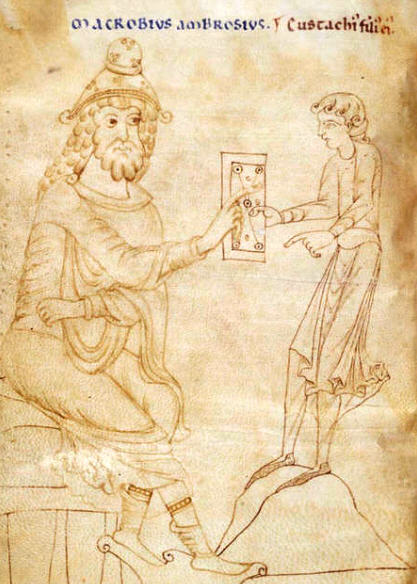
Macrobius presents the Commentary to his Son |
|
|
Macrobius presents the Commentary to his Son |
Macrobii Ambrosii Theodosii Viri Clarissimi et Illvstris in Somnivm Scipionis. Engl.Transl. partly based on Stahl, 1952
|
ON THE DREAM of SCIPIO |
Macrobii Ambrosii
Theodosii Viri Clarissimi et Illvstris |
|
BOOK ONE |
LIBER PRIMVS |
|
(Book 1) CHAPTER 1 |
1.1. |
|
[1] IN our reading of Plato’s Republic and Cicero’s Republic, my son Eustachius, my joy and boast in life, we noted this difference at a glance: the former drafted plans for the organization of a state, the latter described one already in existence; the one discussed an ideal state, the other the government established by his forefathers. |
1 Inter Platonis et Ciceronis libros quos de re publica uterque constituit, Eustathi fili, uitae mihi dulcedo pariter et gloria, hoc interesse prima fronte perspeximus quod ille rem publicam ordinauit, hic rettulit; alter qualis esse deberet, alter qualis esset a maioribus instituta disseruit. |
|
[2] In one respect, however, imitation has produced a striking similarity, namely, that whereas Plato, at the conclusion of his work, has a man who apparently had died and was restored to life reveal the conditions of souls liberated from their bodies, introducing as well an interesting description of the spheres and constellations, the Scipio of Cicero’s work treats of the same subjects, but as revelations which came to him in a dream. |
2 In hoc tamen uel maxime operis similitudinem seruauit imitatio quod, cum Plato in uoluminis conclusione a quodam uitae reddito, quam reliquisse uidebatur, indicari faciat qui sit exutarum corporibus status animarum, adiecta quadam sphaerarum uel siderum non otiosa descriptione, rerum facies non dissimilia significans a Tulliano Scipione per quietem sibi ingesta narratur. |
|
[3] The reason for including such a fiction and dream in books dealing with governmental problems, and the justification for introducing a description of celestial circles, orbits, and spheres, the movements’ of planets, and the revolutions of the heavens into a discussion of the regulations governing commonwealths seemed to me to be worth investigating; and the reader, too, will perhaps be curious. Otherwise we may be led to believe that men of surpassing wisdom, whose habit it was to regard the search for truth as nothing if not divine, have padded their treatises, nowhere else prolix, with something superfluous. A brief explanation of this point must be made, therefore, so that the reader may clearly comprehend what follows. |
3 Sed quid uel illi commento tali uel huic tali somnio in his potissimum libris opus fuerit in quibus de rerum publicarum statu loquebantur, quoue adtinuerit inter gubernandarum urbium constituta circulos, orbes globosque describere, de stellarum modo, de caeli conuersione tractare, quaesitu dignum et mihi uisum est et aliis fortasse uideatur, ne uiros sapientia praecellentes nihilque in inuestigatione ueri nisi diuinum sentire solitos aliquid castigato operi adiecisse superfluum suspicemur. De hoc ergo prius pauca dicenda sunt, ut liquido mens operis de quo loquimur innotescat. |
|
[4] With a deep understanding of all human affairs Plato advises throughout his discussion of the establishment of a republic that a love of justice must be instilled in men’s minds, without which it is impossible to maintain not only a state, but human fellowship and family life as well. [5] He realized that in order to implant this fondness for justice in an individual nothing was quite so effective as the assurance that one’s enjoyments did not terminate with death. But how could Plato show thατ these continued after death except by demonstrating the immortality of souls? After he had created a belief in the immortality of souls he drew the obvious conclusion that the souls, upon being released from their bodies, had definite places allotted them according to their deserts. [6] For example, in the Phaedο,’ when he has proved by brilliant and ineontrovertible arguments thατ the soul is immortal, there follows a comparison of the abodes that are destined for those departing from this life, as each one has merited by his mode of living. Likewise in the Georgias,’ after a defense of justice, the reader is admonished in that characteristically grave but charming Socratic manner about the condition of souls after death. [7] This subject is also painstakingly treated in those books thατ deal with the establishment of a republic. After Plato has given the chief place to justice and has taught that the soul does not perish at death, be points out by means of that closing fable’ —for that is what many call it—whither the soul goes on leaving the body and whence it comes to the body. This he does in order to show that rewards for the pursuit of justice and penalties for its neglect await the souls of men, for these are indeed immortal and must submit to judgment. |
4 Rerum omnium Plato et actuum naturam penitus inspiciens aduertit in omni sermone de rei publicae institutione proposito infundendum animis iustitiae amorem, sine qua non solum res publica, sed nec exiguus hominum coetus, ne domus quidem parua constabit. 5 Ad hunc porro iustitiae adfectum pectoribus inoculandum nihil aeque patrocinaturum uidit quam si fructus eius non uideretur cum uita hominis terminare. Hunc uero superstitem durare post hominem qui poterat ostendi, nisi prius de animae immortalitate constaret? Fide autem facta perpetuitatis animarum, consequens esse animaduertit ut certa illis loca nexu corporis absolutis pro contemplatu probi improbiue meriti deputata sint. 6 Sic in Phaedone inexpugnabilium luce rationum anima in ueram dignitatem propriae immortalitatis adserta, sequitur distinctio locorum quae hanc uitam relinquentibus ea lege debentur quam sibi quisque uiuendo sanxerunt. Sic in Gorgia, post peractam pro iustitia disputationem, de habitu post corpus animarum morali grauitate Socraticae dulcedinis admonemur. 7 Idem igitur obseruanter secutus est in illis ρraecipue uoluminibus quibus statum rei publicae formandum recepit. Nam postquam principatum iustitiae dedit docuitque animam post animal non perire, per illam demum fabulam — sic enim quidam uocant — quo anima post corpus euadat uel unde ad corpus ueniat in fine operis adseruit, ut iustitiae uel cultae praemium uel spretae poenam animis quippe immortalibus subiturisque iudicium seruari doceret. |
|
[8] Cicero proved to be equally judicious and clever in following this method of treatment: after giving the palm to justice in all matters concerning the welfare of the state, be revealed, at the very end of his work,e the sacred abodes of immortal souls and the secrets of the heavens and pointed out the place to which the souls of those who had served the republic prudently, justly, courageously, and temperately7 must proceed, or rather, must return. |
8 Hunc ordinem Tullius non minore iudicio reseruans quam ingenio repertus est: postquam in omni rei publicae otio ac negotio palmam iustitiae disputando dedit, sacras immortalium animarum sedes et caelestium arcana regionum in ipso consummati operis fastigio locauit, indicans quo his perueniendum uel potius reuertendum sit qui rem publicam cum prudentia, iustitia, fortitudine ac moderatione tractauerint. |
|
[9] In Plato’s work these secrets had been disclosed by a man named Er, a Pamphylian by birth, a soldier by calling, who was supposed to be dead from wounds received in battle. But twelve days later, when he was about to be burned on a pyre together with those who perished with him, he suddenly recovered the breath of life (or perhaps it had never left him) and made what one might call an of ciαl proclamation to the human race of all that he had seen and done in the days that elapsed between his two lives. Cicero, as if assured of the truth of this tale, deplored the ridicule it received at the hands of ignorant critics and yet, fearful of the unwarranted censure that was heaped upon Plato, preferred to have his account given by a man aroused from sleep rather than by one returned from the dead |
9 Sed ille Platonicus secretorum relator Er quidam nomine fuit, natione Pamphylus, miles officio, qui, cum uulneribus in proelio acceptis uitam effudisse uisus duodecimo demum die inter ceteros una peremptos ultimo esset honorandus igne, subito seu recepta anima seu retenta, quicquid emensis inter utramque uitam diebus egerat uideratue, tamquam publicum professus indicium humano generi enuntiauit. Hanc fabulam Cicero licet ab indoctis quasi ipse ueri conscius doleat irrisam, exemplum tamen stolidae reprehensionis uitans excitari narraturum quam reuiuiscere maluit. |
|
(Book 1) CHAPTER 2 |
1.2. |
|
[1] BEFORE CONSIDERING the words of Scipio’s Dream, we must ascertain what sort of men Cicero says either ridiculed Plato’s story or at least had no fear that the same thing might happen to them. He does not mean to leave the impression that they were an unlearned lot, but rather that they were men who concealed their fundamental ignorance by a display of apparent wisdom—the type of men, indeed, who were moved only to adverse criticism by reading such words as these. [2] Therefore we shall declare which group it was that, according to Cicero, indulged in superficial criticism, which of them went so far as to put his charges in writing, and finally what reply it is fitting to make to their objections, as far as they concern the present work. When these critics have been answered (a really simple matter) then any malicious attack, past or future, uροn Scipio’s Dream—’ surely Cicero never expected there would be any—will fall to the ground. |
1 Ac priusquam somnii uerba consulimus, enodandum nobis est a quo genere hominum Tullius memoret uel irrisam Platonis fabulam uel ne sibi idem eueniat non uereri. Nec enim his uerbis uult imperitum uulgus intellegi, sed genus hominum ueri ignarum sub peritiae ostentatione, quippe quos et legisse talia et ad reprehendendum constaret animatos. 2 Dicemus igitur et quos in tantum philosophum referat quandam censurae exercuisse leuitatem, quisue eorum etiam scriptam reliquerit accusationem, et postremo quid pro ea dumtaxat parte quae huic operi necessaria est responderi conueniat obiectis. Quibus, quod factu facile est, eneruatis, iam quicquid uel contra Ciceronis opinionem etiam in Scipionis somnium seu iaculatus est umquam morsus liuoris seu forte iaculabitur, dissolutum erit. |
|
[3] The whole sect of Epicureans, consistently mísaρρrchending the truth and continually branding as ridiculous things which are beyond their understanding, made sport of Plato’s sacred scroll aσd majestic discourse on nature. In fact Colotes,’ well known among the disciples of Epicurus because of his ready tongue, even wrote a book to vent his caustic criticisms. Those of his arguments, false though they be, which do not apply to Scipio’s Dream, the subject of this treatise, must be disregarded for the present; but we must follow up that cavil which, unless removed, will always discredit Cicero as well as Plato.’ [4] He insists that philosophers should refrain from using fiction since no kind of fiction has a place with those who profess to tell the truth.’ “If you wished to impart to us a conception of the heavenly realms and reveal the conditions of souls, why,” he asks, “did you not do so in a simple and straightforward manner, instead of defiling the very portals of truth with imaginary character, event, and setting, in a vile imitation of a playwright?” [5] Since this censure, though directed against Plato’s Er, nevertheless applies to our dreaming Scipio as well—in either case the author justified his choice of character as suited to the expression of his doctrines—we must resist this adversary and refute his pointless argument, so that by one stroke each character may retain his rightful dignity. |
3 Epicureorum tota factio, aequo semper errore a uero deuia et illa aestimans ridenda quae nesciat, sacrum uolumen et augustissima irrisit naturae seria. Colotes uero, inter Epicuri auditores loquacitate notabilior, etiam in librum rettulit quae de hoc amarius cauillatus est. Sed cetera quae iniuria notauit — si quidem ad somnium de quo hic procedit sermo non attinent — hoc loco nobis omittenda sunt: illam calumniam persequemur quae, nisi supplodetur, manebit Ciceroni cum Platone communis. 4 Ait a philosopho fabulam non oportuisse confingi, quoniam nullum figmenti genus ueri professoribus conueniret. «Cur enim, inquit, si rerum caelestium notionem, si habitum nos animarum docere uoluisti, non simplici et absoluta hoc insinuatione curatum est, sed quaesita persona casusque excogitata nouitas et composita aduocati scaena figmenti ipsam quaerendi ueri ianuam mendacio polluerunt?» 5 Haec quoniam, dum de Platonico Ere iactantur, etiam quietem Africani nostri somniantis accusant — utraque enim sub apposito argumento electa persona est quae accommoda enuntiandis haberetur —, resistamus urgenti et frustra arguens refellatur, ut una calumnia dissoluta utriusque factum incolumem, ut fas est, retineat dignitatem. |
|
[6] Philosophy does not discountenance all stories nor does it accept all, and in order to distinguish between what it rejects as unfit to enter its sacred precincts and what it frequently and gladly admits, the points of division must needs be clarified. |
6 Nec omnibus fabulis philosophia repugnat, nec omnibus adquiescit; et ut facile secerni possit quae ex his a se abdicet ac uelut profana ab ipso uestibulo sacrae disputationis excludat, quae uero etiam saepe ac libenter admittat, diuisionum gradibus explicandum est. |
|
[7] Fables—the very word acknowledges their falsity’—serve two purposes: either merely to gratify the ear or to encourage the reader to good works. [8] They delight the ear as do the comedies of Menander and his imitators, or the narratives replete with imaginary doings of lovers in which Petronius Arbiter so freely indulged and with which Apuleius, aston-ishingly, sometimes amused himself. This whole category of fables that promise only to gratify the ear a philosophical treatise avoids and relegates to children’s nurseries. [g] The other group, those that draw the reader’s attention to certain kinds of virtue, are divided into two types. In the first both the setting and plot are fictitious, as in the fables of Aesop, famous for his exquisite imagination. The second rests on a solid foundation of truth, which is treated in a fictitious style. This is called the fabulous narrative (narratio to distinguish it from the ordinary fable; examples of it are the performances of sacred rites, the stories of Hesiod and Orpheus that treat of the ancestry and deeds of the gods, and the mystic conceptions of the Pythagoreans. |
7 Fabulae, quarum nomen indicat falsi professionem, aut tantum conciliandae auribus uoluptatis aut adhortationis quoque in bonam frugem gratia repertae sunt. 8 Auditum mulcent uel comoediae, quales Menander eiusue imitatores agendas dederunt, uel argumenta fictis casibus amatorum referta, quibus uel multum se Arbiter exercuit uel Apuleium non numquam lusisse miramur. Hoc totum fabularum genus, quod solas aurium delicias profitetur, e sacrario suo in nutricum cunas sapientiae tractatus eliminat. 9 Ex his autem quae ad quandam uirtutum speciem intellectum legentis hortantur fit secunda discretio. In quibusdam enim et argumentum ex ficto locatur et per mendacia ipse relationis ordo contexitur, ut sunt illae Aesopi fabulae elegantia fictionis illustres, at in aliis argumentum quidem fundatur ueri soliditate, sed haec ipsa ueritas per quaedam composita et ficta profertur, et hoc iam uocatur narratio fabulosa, non fabula, ut sunt caerimoniarum sacra, ut Hesiodi et Orphei quae de deorum progenie actuue narrantur, ut mystica Pythagoreorum sensa referuntur. |
|
[10] Of the second main group, which we have just mentioned, the first type, with both setting and plot fictitious, is also inappropriate to philosophical treatises. |
10 Ergo ex hac secunda diuisione quam diximus, a philosophiae libris prior species, quae concepta de falso per falsum narratur, aliena est. |
|
The second type is subdivided, for there is more than one way of telling the truth when the argument is real but is presented in the form of a fable. [ii] Either the presentation of the plot involves matters that are base and unworthy of divinities and are monstrosities of some (as, for example, gods caught in adultery, Saturn cutting off the privy parts of his father Caelus and himself thrown into chains by his son and successor), a type which philosophers prefer to disregard altogether;’ or else a decent and dignified conception of holy truths, with respectable events and characters, is presented beneath a modest veil of allegory. This the only type of fiction approved by the philosopher who is prudent in handling sacred matters. |
Sequens in aliam rursus discretionem scissa diuiditur: nam cum ueritas argumento subest solaque fit narratio fabulosa, non unus reperitur modus per figmentum uera referendi. 11 Aut enim contextio narrationis per turpia et indigna numinibus ac monstro similia componitur, ut di adulteri, Saturnus pudenda Caeli patris abscidens et ipse rursus a filio regni potito in uincla coniectus — quod genus totum philosophi nescire malunt; aut sacrarum rerum notio sub pio figmentorum uelamine honestis et tecta rebus et uestita nominibus enuntiatur. Et hoc est solum figmenti genus quod cautio de diuinis rebus philosophantis admittit. |
|
[12] Therefore, since the treatises of Plato and Cicero suffer no harm from Er’s testimony or Scipio’s dream, and the treatment of sacred subjects is accomplished without loss of dignity by using their names, let our critic at last hold his peace, taught to differentiate between the fable and the fabulous narrative. |
12 Cum igitur nullam disputationi pariat iniuriam uel Er index uel somnians Africanus, sed rerum sacrarum enuntiatio integra sui dignitate his sit tecta nominibus, accusator tandem edoctus a fabulis fabulosa secernere conquiescat. |
|
[13] We should not assume, however, that philosophers approve the use of fabulous narratives, even those of the proper sort, in all disputations. It is their custom to employ them when speaking about the Soul,’ or about spirits having dominion in the lower and upper air, or about gods in general.’ [54] But when the discussion aspires to treat of the Highest and Supreme of all gods, called by the Greeks the Good (tagathon) and the First Cause (proton anion), or to treat of Mind or Intellect, which the Greeks call nου,10 born from and originating in the Supreme God and embracing the original concepts of things, which are called Ideas (ideai),11 when, I repeat, philosophers speak about these, the Supreme God and Mind, they shun the use of fabulous narratives. When they wish to assign attributes to these divinities that not only pass the bounds of speech but those of human comprehension as well, they resort to similes and analogies. |
13 Sciendum est tamen non in omnem disputationem philosophos admittere fabulosa uel licita, sed his uti solent cum uel de anima uel de aeriis aetheriisue potestatibus uel de ceteris dis loquuntur. 14 Ceterum cum ad summum et principem omnium deum, qui apud Graecos , qui nuncupatur, tractatus se audet attollere, uel ad mentem, quam Graeci appellant, originales rerum species, quae dictae sunt, continentem, ex summo natam et profectam deo, cum de his, inquam, loquuntur, summo deo et mente, nihil fabulosum penitus attingunt; sed, si quid de his adsignare conantur quae non sermonem tantummodo, sed cogitationem quoque humanam superant, ad similitudines et exempla confugiunt. |
|
[15] That is why Plato, when he was moved to speak about the Good, did not dare to tell what it was, knowing only this about it, that it was impossible for the human mind to grasp what it was. In truth, of visible objects he found the sun most like it, and by using this as an illustrations’ opened a way for his discourse to approach what was otherwise incomprehensible.. |
15 Sic Plato, cum de loqui esset animatus, dicere quid sit non ausus est, hoc solum de eo sciens, quod sciri quale sit ab homine non possit, solum uero ei simillimum de uisibilibus solem repperit, et per eius similitudinem uiam sermoni suo adtollendi se ad non comprehendenda patefecit. |
|
[16] On this account men of old fashioned no likeness οf the Good when they were carving statues of other deities, for the Supreme God and Mind sprung from it are above the Soul and therefore beyond nature.l’ It is a sacrilege for fables to approach this sphere |
16 Ideo et nullum eius simulacrum, cum dis aliis constituerentur, finxit antiquitas, quia summus deus nataque ex eo mens, sicut ultra animam, ita supra naturam sunt, quo nihil fas est de fabulis peruenire. |
|
[17] But in treating of the other gods and the Soul, as I have said, phílosoρhers make use of fabulous narratives; not without a purpose, however, nor merely to entertain, but because they realize that a frank, open exposition of herself is distasteful to Nature,l’ who, just as she has withheld an understanding of herself from the uncouth senses of men by enveloping herself in variegated garments, has also desired to have her secrets handled by more prudent individuals through fabulous narratives. [18] Accordingly, her sacred rites are veiled in mysterious representations so that she may not have to show herself even to initiates. Only eminent men of superior intelligence gain a revelation of her truths; the others must satisfy their desire for worship with a ritual drama which prevents her secrets from becoming common.]’ Indeed, Numenius, a philosopher with a curiosity for occult things, had revealed to him in a dream the outrage he had committed against the gods by proclaiming his interpretation of the Eleusinian mysteήes.1e The Eleusinian goddesses themselves, dressed in the garments of courtesans, appeared to him standing before an open brothel, and when in his astonishment he asked the reason for this shocking conduct, they angrily replied that he had driven them from their sanctuary of modesty and had prostituted them to every passer-by. [2O] In truth, divinities have always preferred to be known and worshiped in the fashion assigned to them by ancient popular tradition, which made images of beings that had no physical form, represented them as of different ages, though they were subject neither to growth nor decay, and gave them clothes and ornaments, though they had no bodies. [21] In this way Pythagoras himself, and Empedocles, Parmenides, and Heraclitus spoke of the gods, and Timaeus, their disciple, continued the tradition that had come down to him. |
17 De dis autem, ut dixi, ceteris et de anima non frustra se nec ut oblectent ad fabulosa cunuertunt, sed quia sciunt inimicam esse naturae apertam nudamque expositionem sui, quae, sicut uulgaribus hominum sensibus intellectum sui uario rerum tegmine operimentoque subtraxit, ita a prudentibus arcana sua uoluit per fabulosa tractari. 18 Sic ipsa mysteria figurarum cuniculis operiuntur ne uel haec adeptis nudam rerum talium natura se praebeat, sed, summatibus tantum uiris sapientia interprete ueri arcani consciis, contenti sint reliqui ad uenerationem figuris defendentibus a uilitate secretum. 19 Numenio denique inter philosophos occultorum curiosiori offensam numinum, quod Eleusinia sacra interpretando uulgauerit, somnia prodiderunt, uiso sibi ipsas Eleusinias deas habitu meretricio ante apertum lupanar uidere prostantes, admirantique et causas non conuenientis numinibus turpitudinis consulenti respondisse iratas ab ipso se de adyto pudicitiae suae ui abstractas et passim adeuntibus prostitutas. 20 Adeo semper ita se et sciri et coli numina maluerunt qualiter in uulgus antiquitas fabulata est, quae et imagines et simulacra formarum talium prorsus alienis, et aetates tam incrementi quam diminutionis ignaris, et amictus ornatusque uarios corpus non habentibus adsignauit. 21 Secundum haec Pythagoras ipse atque Empedocles, Parmenides quoque et Heraclitus de dis fabulati sunt, nec secus Timaeus qui progenies eorum sicut traditum fuerat exsecutus est. |
| Different Kinds of Dreams | |
|
(Book 1) CHAPTER 3 |
1.3. |
|
[z] AFTER THESE prefatory remarks, there remains another matter to be considered before taking up the text of Scipio’s Dream. We must first describe the many varieties of dreams recorded by the ancients, who have classified and defined the various types that have appeared to men in their sleep, wherever they might be. Then we shall be able to decide to which type the dream we are discussing belongs. |
1 His praelibatis antequam ipsa somnii uerba tractemus, prius quot somniandi modos obseruatio deprehenderit, cum licentiam figurarum quae passim quiescentibus ingeruntur sub definitionem ac regulam uetustas mitteret, edisseramus, ut cui eorum generi somnium quo de agimus applicandum sit innotescat. |
|
[2] All dreams may be classified under five main types:’ there is the enigmatic dream, in Greek οneirοs, in Latin somnium; second, there is the prophetic vision, in Greek horama, in Latin visio; third, there is the oracular dream, in Greek chrcmasismos, in Latin oracu-lum; fourth, there is the nightmare, in Greek cnypnion, in Latin insomnium; and last, the apparition, in Greek phantasms, which Cicero, when he has occasion to use the word, calls vúum,a |
2 Omnium quae uidere sibi dormientes uidentur quinque sunt principales et diuersitates et nomina. Aut enim est secundum Graecos quod Latini somnium uocant, aut est quod uisio recte appellatur, aut est quod oraculum nuncupatur, aut est quod insomnium dicitur, aut est quod Cicero, quotiens opus hoc nomine fuit, uisum uocauit. |
|
[3] The last two, the nightmare and the apparition, are not worth interpreting since they have no prophetic significance. |
3 Vltima ex his duo cum uidentur, cura interpretationis indigna sunt, quia nihil diuinationis apportant, dico et . |
|
[4] Nightmares may be caused by mental or physical distress, or anxiety about the future: the patient experiences in dreams vexations similar to those that disturb him during the day. As examples of the mental variety, we might mention the lover who dreams of possessing his sweetheart or of losing her, or the man who fears the plots or might of an enemy and confronted with him in his dream or seems to be fleeing him. The physical variety might be illustrated by one who has overindulged in eating’ or drinking and dreams that he is either choking with food or unburdening himself, or by one who has been suffering from hunger or thirst and dreams that he craving and searching for food or drink or has found it. Anxiety about the future would cause a man to dream that he is gaining a prominent position or office as he hoped or that he is being deprived of it as he feared .5 |
4 Est enim quotiens cura oppressi animi corporisue siue fortunae, qualis uigilantem fatigauerat, talem se ingerit dormienti: animi, si amator deliciis suis aut fruentem se uideat aut carentem, si metuens quis imminentem sibi uel insidiis uel potestate personam aut incurrisse hanc ex imagine cogitationum suarum aut effugisse uideatur; corporis, si temeto ingurgitatus aut distentus cibo uel abundantia praefocari se aestimet uel grauantibus exonerari, aut contra si esuriens cibum aut potum sitiens desiderare, quaerere, uel etiam inuenisse uideatur; fortunae, cum se quis aestimat uel potentia uel magistratu aut augeri pro desiderio aut exui pro timore. |
|
[5] Since these dreams and others like them arise from some condition or circumstance that irritates a man during the day and consequently disturbs him when he falls asleep, they flee when he awakes and vanish into thin ay. Thus the name insomnium was given, not because such dreams mein “in sleep”—in this rasped nightmares arc like other types—but because they are noteworthy only during their course and afterwards have no importance or meaning. |
5 Haec et his similia, quoniam ex habitu mentis quietem sicut praeuenerant ita et turbauerant dormientis, una cum somno auolant et pariter euanescunt. Hinc et insomnio nomen est, non quia per somnium uidetur — hoc enim est huic generi commune cum ceteris —, sed quia in ipso somnio tantummodo esse creditur dum uidetur, post somnium nullam sui utilitatem uel significationem relinquit. |
|
Virgil, too, considers nightmares deceitful: |
6 Falsa esse insomnia nec Maro tacuit: |
|
“False are the dreams (insomnia) sent by departed spirits to their sky.” |
sed falsa ad caelum mittunt insomnia manes, |
|
He used the word “sky” with reference to our mortal realm because the earth bears the same relation to the regions of the dead as the heavens bear to the earth. Again, in describing the passion of love, whose concerns are always accompanied by nightmares, he says: |
caelum hic uiuorum regionem uocans quia, sicut di nobis, ita nos defunctis superi habemur. Amorem quoque describens, cuius curam semper sequuntur insomnia, ait: |
|
Oft to her heart rushes back the chief’s valour, oft his glorious stock; |
... haerent infixi pectore uultus |
|
his looks and words cling fast within her bosom, and the pang withholds calm rest from her limbs.” |
uerbaque, nec placidam membris dat cura quietem, |
|
And a moment later |
et post haec: |
|
: “Anna, my sister, what dreams (insomni’) thrill me with fears?” |
Anna soror, quae me suspensam insomnia terrent? |
|
The apparition (phantasms or visum) comes upon one in the moment between wakefulness and slumber, in the so-called “first cloud of sleep.” In this drowsy condition he thinks he is still fully awake and imagines he sees specters rushing at him or wandering vaguely about, differing from natural creatures in size and shape, and hosts of diverse things, either delightful or disturbing. To this class belongs the incubus, which, according to popular belief, rushes upon people in sleep and presses them with a weight which they can feel.o |
7 uero, hoc est uisum, cum inter uigiliam et adultam quietem in quadam, ut aiunt, prima somni nebula adhuc se uigilare aestimans qui dormire uix coepit aspicere uidetur irruentes in se uel passim uagantes formas a natura seu magnitudine seu specie discrepantes uariasque tempestates rerum uel laetas uel turbulentas. In hoc genere est et , quem publica persuasio quiescentes opinatur inuadere et pondere suo pressos ac sentientes grauare. |
|
The two types just described are of no assistance in foretelling the future; but by means of the other three we arc gifted with the powers of divination. |
8 His duobus modis ad nullam noscendi futuri opem receptis, tribus ceteris in ingenium diuinationis instruimur. |
|
We call a dream oracular in which a parent, or a pious or revered man, or a priest, or even a god clearly reveals what will or will not transpire, and what action to take or to avoid.” |
Et est oraculum quidem cum in somnis parens uel alia sancta grauisque persona seu sacerdos uel etiam deus aperte euenturum quid aut non euenturum, faciendum uitandumue denuntiat. |
|
[9] We call a dream a prophetic vision if it actually comes true. For example, a man dreams of the return of a friend who has been staying in a foreign land, thoughts of whom never enter his mind. He goes out and presently meets his friend and embraces him. Or in his dream he agrees to accept a deposit, and early the next day a man runs anxiously to him, charging him with the safekeeping of his money and committing secrets to his trust.” |
9 Visio est autem cum id quis uidet quod eodem modo quo apparuerat eueniet. Amicum peregre commorantem quem non cogitabat uisus sibi est reuersum uidere, et procedenti οbuius quem uiderat uenit in amplexus. Depositum in quiete suscepit et matutinus ei precator occurrit mandans pecuniae tutelam et fidae custodiae celanda committens. |
|
[το] By an enigmatic dream we mean one that conceals with strange shapes and veils with ambiguity the true meaning of the information being offered, and requires an interpretation for its understanding. We need not explain further the nature of this dream since everyone knows from experience what it is. There are five varieties of it: personal, alien, social, public, and universal. [ττ] It is called personal when one dreams that he himself is doing or experiencing something; alien, when he dreams this about someone else; social, when his dream involves others and himself; public, when he dreams that some misfortune or benefit has befallen the city, forum, theater, public walls, or other public enterprise; universal, when he dreams that some change has taken place in the sun, moon, planets, sky, or regions of the earth.” |
10 Somnium proprie uocatur quod tegit figuris et uelat ambagibus non nisi interpretatione intellegendam significationem rei quae demonstratur, quod quale sit non a nobis exponendum est, cum hoc unusquisque ex usu quid sit agnoscat. Huius quinque sunt species: aut enim proprium aut alienum aut commune aut publicum aut generale est. 11 Proprium est, cum se quis facientem patientemue aliquid somniat, alienum cum alium, commune cum se una cum alio; publicum est, cum ciuitati foroue uel theatro seu quibuslibet publicis moenibus actibusue triste uel laetum quid aestimat accidisse; generale est, cum circa solis orbem lunaremue globum seu alia sidera uel caelum omnesue terras aliquid somniat innouatum. |
|
[12] The dream which Scipio reports that he saw embraces the three reliable types mentioned above, and also has to do with all five varieties of the enigmatic dream. It is oracular since the two men who appeared before him and revealed his future, Aemilius Paulus and Scipio the Elder, were both bis father,” both were pious and revered men, and both were am,liated with the priesthood. It is a prophetic vision since Scipio saw the regions of his abode after death and his future condition. It is an enigmatic dream because the truths revealed to him were couched in words that hid their profound meaning and could not be comprehended without skillful interpretation. |
12 Hoc ergo quod Scipio uidisse se rettulit et tria illa quae sola probabilia sunt genera principalitatis amplectitur, et omnes ipsius somnii species adtingit. Est enim oraculum, quia Paulus et Africanus uterque parens, sancti grauesque ambo nec alieni a sacerdotio, quid illi euenturum esset denuntiauerunt. Est uisio, quia loca ipsa in quibus post corpus uel qualis futurus esset aspexit. Est somnium, quia rerum quae illi narratae sunt altitudo, tecta profunditate prudentiae, non potest nobis nisi scientia interpretationis aperiri. |
|
It also embraces the five varieties of the last type. [13] It is personal since Scipio himself was conducted to the regions above and learned of his future. It is alien since he observed the estates to which the souls of others were destined. It is social since he learned that for men with merits similar to his the same places were being prepared as for himself. It is public since he foresaw the victory of Rome and the destruction of Carthage, his triumph on the Capitoline, and the coming civil strife. And it is universal since by gazing up and down he was initiated into the wonders of the heavens, the great celestial circles, and the harmony of the revolving spheres, things strange and unknown to mortals before this; in addition he witnessed the movements of the stars and planets and was able to survey the whole earth. |
13 Ad ipsius quoque somnii species omnes refertur: est proprium, qu<od> ad supera ipse perductus est et de se futura cognouit; est alienum, quod quem statum aliorum animae sortitae sint deprehendit; commume, quod eadem loca tam sibi quam ceteris eiusdem meriti didicit praeparari; publicum, quod uictoriam patriae et Carthaginis interitum et Capitolinum triumphum ac sοllicitudinem futurae seditionis agnouit; generale, quod caelum caelique circulos conuersionisque concentum, uiuo adhuc homini noua et incognita, stellarum etiam ac luminum motus terraeque omnis situm suspiciendo uel despiciendo concepit. |
|
[14] It is incorrect to maintain that Scipio was not the proper person to have a dream that was both public and universal inasmuch as he had not yet attained the highest office but, as he himself admitted, was still ranked “not much higher than a private soldier.” The critics say that dreams concerning the welfare of the state are not to be considered significant unless military or civil officers dream them, or unless many plebeians have the same dream. [55] They cite the incident in Hοmer1° when, before the assembled Greeks, Agamemnon disclosed a dream that he had had about a forthcoming battle. Nestor, who helped the army quite as much with his prudence as all the youth with their might, by way of instilling confidence in the dream said that in matters of general welfare they had to confide in the dream of a king, whereas they would repudiate the dream of anyone else.17 [ ιό] However, the point in Scipio’s favor was that although he had not yet held the consulship or a military command, he—who himself was destined to lead that campaign—was dreaming about the coming destruction of Carthage, was witnessing the public triumph in his honor, and was even learning of the secrets of nature; for he excelled as much in philosophy as in deeds of courage. |
14 Nec dici potest non aptum fuisse Scipionis personae somnium quod et generale esset et publicum quia necdum illi contigisset amplissimus magistratus, immo cum adhuc, ut ipse dicit, paene miles haberetur. Aiunt enim non habenda pro ueris de statu ciuitatis somnia nisi quae rector eius magistratusue uidisset, aut quae de plebe non unus sed multi similia somniassent. 15 Ideo apud Homerum, cum in concilio Graecorum Agamemnon somnium quod de instruendo proelio uiderat publicaret, Nestor, qui non minus ipse prudentia quam omnis iuuenta uiribus iuuit exercitum, concilians fidem relatis: «De statu, inquit, publico credendum regio somnio, quod, si alter uidisset, repudiaremus ut futile.» 16 Sed non ab re erat ut Scipio, etsi necdum adeptus tunc fuerat consulatum nec erat rector exercitus, Carthaginis somniaret interitum cuius erat auctor futurus audiretque uictoriam beneficio suo publicam, uideret etiam secreta naturae, uir non minus philosophia quam uirtute praecellens. |
|
[17] Because, in citing Virgil above as an authority for the unreliability of nightmares, we excerpted a verse from his description of the twin portals of dreams, someone may take the occasion to inquire why false dreams arc allotted to the gate of ivory and trustworthy one to the gate of horn. He should avail himself of the help of Porphyry, who, in his Commentaries, makes the following remarks on a passage in Homer1° presenting the same distinction between gates: |
17 His adsertis, quia superius falsitatis insomniorum Vergilium testem citantes, uersus fecimus mentionem eruti de geminarum somnii descriptione portarum, si quis forte quaerere uelit cur porta ex ebore falsis et e cornu ueris sit deputata, instruetur auctore Porphyrio, qui in commentariis suis haec in eundem locum dicit ab Homero sub eadem diuisione descriptum: |
|
“All truth is concealed. |
18 «Latet, inquit, omne uerum. |
|
[18] Nevertheless, the soul, when it is partially disengaged from bodily functions during sleep, at times gazes and at times peers intently at the truth, but does not apprehend it; and when it gazes it dog not see with clear and direct vision, but rather with a dark οbstnυcώιg veil interροsed.” [19] Virgil attests that this is natural in the following lines: |
Hoc tamen anima cum ab officiis corporis sοmnο eius paululum libera est, interdum aspicit, nonnumquam tendit aciem nec tamen peruenit, et, cum aspicit, tamen non libero et directo lumine uidet, sed interiecto uelamine, quod nexus naturae caligantis obducit.» 19 Et hoc in natura esse idem Vergilius asserit, dicens: |
|
‘Behold—for all the cloud, which now, drawn over thy sight, |
aspice —namque omnem quae nunc obducta tuenti |
|
dulls thy mortal vision and with dank pall enshrouds thee |
mortales hebetat uisus tibi et umida circum |
|
I will tear away.” |
caligat nubem eripiam. ... |
|
2° [oJ If, during sleep, this veil permits the vision of the attentive soul to perceive the truth, it is thought to be made of horn, the nature of which is such that, when thinned, it becomes transparent. When the veil dulls the vision and prevents its reaching the truth, it is thought to be made of ivory, the composition of which is so dense that no matter how thin a layer of it may be, it remains ορaque.21 |
20 Hoc uelamen cum in quiete ad uerum usque aciem animae introspicientis admittit, de cornu creditur, cuius ista natura est ut tenuatum uisui peruium sit; cum autem a uero hebetat ac repellit obtutum, ebur putatur, cuius corpus ita natura densetum est ut ad quamuis extremitatem tenuitatis erasum nullo uisu ad ulteriora tendente penetretur. |
|
CHAPTER IV |
1.4. |
|
[1] NOW THAT we have discussed the types to which Scipiós Dream belongs, and before we examine the words of the dream itself, let us try to reveal its design and purpose, its skοpos, as the Greeks call it.1 Once again we must arm, as we did at the opening of this discourse, that the pwρase of the dream is to teach us that the souls of those who serve the state well are returned to the heavens after death and there enjoy everlasting blessedness. |
1 Tractatis generibus et modis ad quos somnium Scipionis refertur, nunc ipsam eiusdem somnii mentem ipsumque propositum, quem Graeci uocant, antequam uerba inspiciantur, temptemus aperire et eo pertinere propositum praesentis operis adseramus, sicut etiam in principio huius sermonis adstruximus, ut animas bene de re publica meritorum post corpora caelo reddi et illic frui beatitatis perpetuitate nos doceat. |
|
[2] It was the following occasion, indeed, that impelled Scipio to relate his dream, which, he says, he had kept secret for a long time. When Laelius was deploring the fact that no statues of Nasica had been set up in public in recognition of his slaying a tyrant,’ Scipio replied among other things: “Though for wise men the fullest reward for virtue is consciousness of the merit of their deeds, still that Divine Virtue does not long for statues held together with lead nor for triumphs with their withering laurels, but for rewards of a more substantial and enduring character.” “What are they ?” Laelius inquired. [3] Scipio then answered, “Grant me your indulgence since this is the third day of our holiday festival,” a together with other introductory words. Then he began to narrate his dream,’ showing by words like the following that the rewards which he saw in the sky reserved for the outstanding men of public affairs were more substantial and lasting: [4] That you may be more ΖealΟus in saf eguard-ing the commonwealth, Scipio, be persuaded of this: all those who have saved, aided, or enlarged the commonwealth have a definite place marked of in the heavens where they may enjoy a blessed existence forever.° |
2 Nam Scipionem ipsum haec occasio ad narrandum somnium prouocauit, quod longo tempore se testatus est silentio condidisse. Cum enim Laelius quereretur nullas Nasicae statuas in publico in interfecti tyranni remunerationem locatas, respondit Scipio post alia in haec uerba: «Sed quamquam sapientibus conscientia ipsa factorum egregiorum amplissimum uirtutis est praemium, tamen illa diuina uirtus non statuas plumbo inhaerentes nec triumphos arescentibus laureis, sed stabiliora quaedam et uiridiora praemiorum genera desiderat.» — «Quae tamen ista sunt?» inquit Laelius. 3 Tum Scipio: «Patimini me, quoniam tertium diem iam feriati sumus,» et cetera quibus ad narrationem somnii uenit, docens illa esse stabiliora et uiridiora praemiorum genera quae ipse uidisset in caelo bonis rerum publicarum seruata rectoribus, sicut his uerbis eius ostenditur: 4 «Sed quo sis, Africane, alacrior ad tutandam rem publicam, sic habeto: omnibus qui patriam conseruarint, adiuuerint, auxerint, certum esse in caelo definitum locum ubi beati aeuo sempiterno fruantur.» |
|
A little later, in describing the sort of place it was, Paulus said: But, Scipio, cherish justice and your obligations to duty, as yo’r grandfather here and 1, your father, have done; this is important where parents and relatives are concerned, but is of utmost importance in matters concerning the commonwealth. This sort of life is your pass-por: into the sky, lo a union with those who have finished their lives on earth and who, upon being released from iheir bodies, inhabit that place at which you are now looking, meaning the Milky Way. |
Et paulo post hunc certum locum qui sit designans ait: «Sed sic, Scipio, ut auus hic tuus, ut ego qui te genui, iustitiam cole et pietatem quae, cum magna in parentibus et propinquis, tum in patria maxima est. Ea uita uia est in caelum et in hunc coetum eorum qui iam uixere et corpore laxati illum incolunt locum quem uides», significans . |
|
[g] You must know that the place where Scipio thought he was in his dream is the Milky Way, called by the Greeks galaxias. We may be assured of this because in the first part of the dream Scipio uses these words: From our lofty perch, dazzling and glorious, set among the radiant stars, he pointed out Carthage. And a little later he spoke more clearly: Furthermore, it was a circle of surpassing brilliance gleaming out amidst the blazing stars, which takes its name, the Milky Way, from the Greek word. As 1 looked out from this spot everything appeared splendid and wonderful. About this Milky Way we shall have more to say later when we come to a discussion of the celestial circles.” |
5 Sciendum est enim quod locus in quo sibi uidetur esse Scipio per quietem, lacteus circulus est, qui uocatur, siquidem his uerbis in principio utitur: «Ostendebat autem Carthaginem de excelso et pleno stellarum illustri et claro quodam loco.» Et paulo post apertius dicit : «Erat autem is splendidissimo candore inter flammas circus elucens, quem uos, ut a Grais accepistis, orbem lacteum nuncupatis. Ex quo omnia mihi cοntemplanti praeclara et mirabilia uidebantur.» Et de hoc a quidem , cum de circulis loquemur, plenius disseremus. |
|
[Book 1] CHAPTER V |
1.5. |
|
[1] THUS FAR our treatise has explained the following: what points of difference and similarity there arc between Plato’s Republic and Cicero’s Republic; why Plato added to his work the testimony of Er, and Cicero, the dream of Scipio; what objections the Epicureans made to Plato’s work and how this feeble cavil is refuted; in which treatises philosophers consider the use of fabulous narratives appropriate; and from which treatises they wholly exclude them. Then, of course, we included a classification of dreams and indicated which arc significant and which are not; next we enumerated the various types of enigmatic dreams, to all of which that of Scipio was clearly related; and we also indicated whether Scipio was the proper person to have such a dream and what earlier opinions were expressed concerning the twin portals of dreams. In addition to all these matters we have shown what the design and purpose of the dream was and have clearly designated the region of the sky in which Scipio seemed to see and hear in his dream the things that he reported. Now we must discuss the words of Scipio’s Dream, not all of them, but those that seem worth investigating .1 |
1 Sed iam quoniam, inter libros quos de re publica Cicero quosque prius Plato scripserat, quae differentia, quae similitudo habeatur expressimus, et cur operi suo uel Plato Eris indicium uel Cicero somnium Scipionis adsciuerit, quidue sit ab Epicureis obiectum Platoni uel quemadmodum debilis calumnia refellatur, et quibus tractatibus philosophi admisceant uel a quibus penitus excludant fabulosa rettulimus, adiecimusque post haec necessario genera omnium imaginum quae falso quaeque uero uidentur in somnis, ipsasque distinximus species somniorum ad quas Africani somnium constaret referri, et si Scipioni conuenerit talia somniare, et de geminis somnii portis quae fuerit a ueteribus expressa sententia, super his οmnibus ipsius somnii de quo loquimur mentem propositumque signauimus, et partem caeli euidenter expressimus in qua sibi Scipio per quietem haec uel uidisse uisus est uel audisse quae rettulit, nunc iam discutienda sunt nobis ipsius somnii uerba, non omnia, sed ut quaeque uidebuntur digna quaesitu. |
|
[***] |
|
|
[Book 1] CHAPTER 8 |
1.8. |
|
[1] WE have considered only a part of the grandfather’s statement; let us now take up the remainder. That you may be more zealous in safeguarding the commonwealth, Scipio, be persuaded of this: all those who have saved, aided, or enlarged the commonwealth have a definite place marked οff in the heavens where they may enjoy a blessed existence forever. Nothing that occurs on earth, indeed, is more gratifying to that supreme God who rules the whole universe than the establishment of associations and federations of men bound together by principles of justice, which are called commonwealths. The governors and protectors of these proceed from here and return hither after death. |
1 His aliqua ex parte tractatis progrediamur ad reliqua: «Sed quo sis, Africane, alacrior ad tutandam rem publicam, sic habeto: omnibus qui patriam conseruarint, adiuuerint, auxerint, certum esse in caelo definitum locum ubi beati aeuo sempiterno fruantur. Nihil est enim illi principi deo qui omnem mundum regit, quod quidem in terris fiat, acceptius quam concilia coetusque hominum iure sociati, quae ciuitates appellantur. Earum rectores et seruatores hinc profecti huc reuertuntur.» |
|
[2] After revealing to Scipio the time and manner of his Bath, it was fitting for the grandfather to introduce next the subject of the rewards that good men should expect after death. In contemplation 0f such rewards men’s thoughts have been so far removed from fear of imminent death as even to be incited to a yearning for it because of the splendor of the prospect of blessedness and a celestial abode. But first it will be necessary to explain a few matters about the blessedncs which is reserved for the protectors of commonwealths, so that we may afterwards clear up the whole passage which we have just excerpted for discussion. |
2 Bene et opportune, postquam de morte praedixit, mox praemia bonis post obitum speranda subiecit. Quibus adeo a metu praedicti interitus cogitatio uiuentis erepta est ut ad moriendi desiderium ultro animaretur maiestate promissae beatitudinis et caelestis habitaculi. Sed de beatitate quae debetur conseruatoribus patriae pausa dicenda sunt, ut postea locum omnem, quem hic tractandum recepimus, resoluamus. |
|
[3] Virtues alone make one blessed and only through them is one able to attain the name.’ Hence thοse who maintain that virtues arc found only in men who philosophize openly affirm that none are blessed except philosophers. Ρroρerly assuming wisdom to be an understanding of divine things, they say that only those men are wise who search for heavenly truths with acuteness of mind and lay hold of them by sagacious and painstaking inquiry and pattern after them as far as they are able. In their opinion it is here alone that the virtues are exercised, and they attribute foul functions to the virtues:’ [4] prudence, that is, to despise the world and all that is in the world in contemplation of what is divine, and to direct all the attention of the soul to divine things alone; temperance, to abstain from everything that the habits of the body seek, as far as nature will permit;° courage, for the soul not to be terrified as it ,.withdraws from the body, so to speak, under the guidance of philosophy, and to have no dread of the dizzy heights of the complete ascension to the celestial realms; justice, to accept the only way to this mode of life, namely, obedience to each virtue.4 Now according to the limitations of so stringent a classification the rulers of commonwealths would be unable to attain blessedness |
3 Solae faciunt uirtutes beatum, nullaque alia quisquam uia hoc nomen adipiscitur: unde qui aestimant nullis nisi philosophantibus inesse uirtutes, nullos praeter philosophos beatos esse pronuntiant. Agnitionem enim rerum diuinarum sapientiam proprie uocantes, eos tantummodo dicunt esse sapientes qui superna et acie mentis requirunt et quaerendi sagaci diligentia comprehendunt et, quantum uiuendi perspicuitas praestat, imitantur; et in hoc solo esse aiunt exercitia uirtutum, quarum sic officia dispensant. 4 Prudentiae esse mundum istum et omnia quae mundo insunt diuinorum contemplatione despicere omnemque animae cogitationem in sola diuina dirigere; temperantiae, omnia relinquere, in quantum natura patitur, quae corporis usus requirit; fortitudinis, non terreri animam a corpore quodam modo ductu philosophiae recedentem, nec altitudinem perfectae ad superna ascensionis horrere; iustitiae, ad unam sibi huius propositi consentire uiam uniuscuiusque uirtutis obsequium. Atque ita fit ut, secundum hoc tam rigidae definitionis abruptum, rerum publicarum rectores beati esse non possint. |
|
[5] But Plotínus, chief with Plato among the professors of philosophy, in a treatise On the Virtues,° arranges the grades of the virtues according to a proper and natural classification. In his scheme each of the above four virtues embraces four types: the first, political virtues; the second, cleansing virtues; the third, virtues of the purified mind; and the fourth, the exemplary virtues. [6] Man has political virtues because he is a social animal. By these virtues upright men devote themselves to their commonwealths, protect cities, revere ραreηts, love their children, and cherish relatives;by these they direct the welfare of the citizens, and by these they safeguard their allies with anxious forethought and bind them with the liberality of their justice; by these |
5 Sed Plotinus, inter philosophiae professores cum Platone princeps, libro De uirtutibus gradus earum uera et naturali diuisionis ratione compositos per ordinem digerit. Quattuor sunt, inquit, quaternarum genera uirtutum. Ex his primae politicae uocantur, secundae purgatoriae, tertiae animi iam purgati, quartae exemplares. 6 Et sunt politicae hominis, qua sociale animal est. His boni uiri rei publicae consulunt, urbes tuentur; his parentes uenerantur, liberos amant, proximos diligunt; his ciuium salutem gubernant; his socios circumspecta prouidentia protegunt, iusta liberalitate deuinciunt: hisque |
|
“They have won remembrance among men.” |
... sui memores alios fecere merendo. |
|
[7] To have political prudence’ one must direct all his thoughts and actions by the standard of reason, and wish for or do nothing but what is right, and have regard for human affairs as he would for divine authority. In prudence we find reason, understanding, circumspection, foresight, willingness to learn, and caution. To have political courage, one must exalt his mind above all dread of danger, fear nothing except disgrace, and bear manfully both adversity and prosperity. Courage endows one with magnanimity, confidence, composure, nobleness, constancy, endurance, and steadfastness. To have political temperance, one must strive after nothing that is base, in no instance overstepping the bounds of moderation but subduing all immodest desires beneath the yoke of reason. Temperance is accompanied by modesty, humility, self-restraint, chastity, integrity, moderation, frugality, sobriety, and purity. To have political justice, one must safeguard for each man that which belongs to him.’ From justice comes uprightness, friendship, harmony, sense of duty, piety, love, and human sympathy. [8] By these virtues the good man is first made lord of himself and then ruler of the state, and is just and prudent in his regard for human welfare, never forgetting his obligations. |
7 Et est politici prudentia<e> ad rationis normam quae cogitat quaeque agit uniuersa dirigere ac nihil praeter rectum uelle uel facere, humanisque actibus tamquam diuinis arbitris prouidere; prudentiae insunt ratio, intellectus, circumspectio, prouidentia, docilitas, cautio; fortitudinis, animum supra periculi metum agere nihilque nisi turpia timere, tolerare fortiter uel aduersa uel prospera; fortitudo praestat magnanimitatem, fiduciam, securitatem, magnificentiam, constantiam, tolerantiam, firmitatem; temperantiae, nihil appetere paenitendum, in nullo legem moderationis excedere, sub iugum rationis cupiditatem domare; temperantiam sequuntur modestia, uerecundia, abstinentia, castitas, honestas, moderatio, parcitas, sobrietas, pudicitia; iustitiae, seruare unicuique quod suum est; de iustitia ueniunt innocentia, amicitia, concordia, pietas, religio, affectus, humanitas. 8 His uirtutibus uir bonus primum sui atque inde rei publicae rector efficitur, iuste ac prouide gubernans, humana non deserens. |
|
The virtues of the second type, known as the cleansing virtues, are found in the man who is capable of attaining the divine. They release the minds only of those who have resolved to cleanse themselves from any contamination° with the body, and by an escape from mortal things, as it were, to mingle solely with the divine.10 These are the virtues of men of leisure, who have withdrawn from active service in the state. We mentioned above the nature of each of these virtues when we were speaking of the virtues of philosophers, those which they, indeed, regard as the only virtues. |
Secundae, quas purgatorias uocant, hominis sunt qua diuini capax est, solumque animum eius expediunt qui decreuit se a corporis contagione purgare et quadam humanorum fuga solis se inserere diuinis. Hae sunt otiosorum qui a rerum publicarum actibus se sequestrant. Harum quid singulae uelint, superius expressimus cum de uirtutibus philosophantium diceremus, quas solas quidam aestimauerunt esse uirtutes. |
|
[q] The third type includes the virtues of the purified and serene mind, completely and thoroughly cleansed from all taint of this world. In that estate it is the part of prudence not to prefer the divine as though there were any choice, but to know it alone, and to fix one’s attention upon it as if there were nothing else; it is the part of temperance not to restrain earthly longings but to forget them completely; it is the part of courage to ignore the passions, not to suρρrc s them, so that one |
9 Tertiae sunt purgati iam defaecatique animi et ab omni mundi huius aspergine presse pureque detersi. Illic prudentiae est diuina non quasi in electione praeferre, sed sola nosse, et haec tamquam nihil sit aliud intueri; temperantiae, terrenas cupiditates non reprimere, sed penitus obliuisci; fortitudinis, passiones ignorare, non uincere, ut |
|
“knows not how to be angry, has longing for nothing” |
nesciat irasci, cupiat nihil...; |
|
it is the part of justice to be so attached to the divine heavenly Mind as to keep an everlasting covenant with it by imitating ít. |
iustitiae, ita cum supera et diuina mente sociari ut seruet perpetuum cum ea foedus imitando. |
|
10 The fourth type comprises the virtues that are present in the divine Mind itself, the notes, from the pattern of which all thc other virtues are derived. For if we believe that there are ideas of other things in the Mind, then with much greater assurance must we believe that there are ideas of the virtues. There the divine Mind itself is prudence; it is temperance because it always looks back upon itself with unremitting attention; it is courage because it is always the same and is never changed; it is justice because, by eternal law, it never turns from constant application to its wοrk |
10 Quartae sunt quae in ipsa diuina mente consistunt quam diximus uocari, a quarum exemplo reliquae omnes per ordinem defluunt. Nam si rerum aliarum, multo magis uirtutum ideas esse in mente credendum est. Illic prudentia est mens ipsa diuina; temperantia, quod in se perpetua intentione conuersa est; fortitudo, quod semper idem est nec aliquando mutatur; iustitia, quod perenni lege a sempiterna operis sui continuatione non flectitur. |
|
.[11] These are the four types of the four virtues, which above all else are most clearly distinguished from one another in regard to the passions. |
11 Haec sunt quaternarum quattuor genera uirtutum, quae praeter cetera maximam in passionibus habent differentiam sui. Passiones autem, ut scimus, uocantur quod homines |
|
These, as we know, are: “Fears and desires, griefs and joys.” 14 |
… metuunt cupiuntque, dolent gaudentque... |
|
The first type of virtues mitigates thc passions, the second puts them away, the third has forgotten them, and to the fourth they are anathema |
Has primae molliunt, secundae auferunt, tertiae obliuiscuntur, in quartis nefas est nominari. |
|
[12] Now if the function and office of the virtues is to bless, and, moreover, if it is agreed that political virtues do exist, then political virtues do make men blessed. And so Cicero is right in claiming for the rulers of commonwealths a place where they may enjoy a blessed existence forever. In order to show that some men become blessed by the exercise of virtues at leisure and others by virtucs cχercised in active careers, he did not say with finality that nothing is more gratifying to that supreme God than commonwcalths, but added a qualiication, nothing that occurs on earth is more gratifying. His purpose was to distiuguísh those who are primarily concerned with divine matters from the rulers of commonwealths, whose earthly achievcments prepare their way to the sky |
12 Si ergo hoc est officium et effectus uirtutum, beare, constat autem et politicas esse uirtutes, igitur et politicis efficiuntur beati. Iure ergo Tullius de rerum publicarum rectoribus dixit: «ubi beati aeuo sempiterno fruantur»; qui, ut ostenderet alios otiosis, alios negotiosis uirtutibus fieri beatos, non dixit absolute nihil esse illi principi deo acceptius quam ciuitates, sed adiecit: «quod quidem in terris fiat», ut eos qui ab ipsis caelestibus incipiunt discerneret a rectoribus ciuitatum, quibus per terrenos actus iter paratur ad caelum. |
|
[13] What could be more accurate, what more guarded than his definítíon of the term commonwealths as the associations and f edera-tions of men bound together by principles of justice? Indeed there have been bands of slaves and of gladiators that might be called associations and federations, but they were not bound together by principles of right. The name “just” can be applied only to that group of men which in its entirety consents in obedience to the laws. |
13 Illa autem definitione quid pressius potest esse, quid cautius de nomine ciuitatum? «Quam concilia, inquit, coetusque hominum iure sociati, quae ciuitates appellantur». Nam et seruilis quondam et gladiatoria manus «concilia hominum et coetus» fuerunt, sed non «iure sociati». Illa autem sola iusta est multitudo, cuius uniuersitas in legum consentit obsequium. |
|
[Book 1] CHAPTER IX |
1.9. |
|
HIS WORDS, The governors and protectors of these commonwealths proceed from here and return hither, must be interpreted in the following manner. Philosophers whose views are correct do not hesitate to agree that souls originate in the sky; moreover, this is the perfect wisdom of the soul, while it occupies a body, that it recognizes from what source it came. [2] Hcnce, in a diatribe bοth witty and pungent a famous quotation was used seriously: |
1 Quod uero ait: «harum rectοres et seruatores hinc profecti huc reuertuntur», hoc modo accipiendum est. Animarum originem manare de caelo inter recte philosophantes indubitatae constat esse sententiae; et animae, dum corpore utitur, haec est perfecta sapientia ut unde orta sit, de quo fonte uenerit, recognoscat. 2 Hinc illud a quodam inter alia seu festiua, siue mordacia, serio tamen usurpatum est: |
|
“From the sky has come to us the saying, ‘Know thyself.” |
... de caelo descendit |
|
Indeed, this is said to have been the advice of the Delphic oracle.2 Tο one desiring to know by what path blesscdncss is rcachcd the reply is, “Know thyself.” ° The maxim was inscribed on the front of the temple at Delphi.’ |
Nam et Delphici uox haec fertur oraculi. Consulenti ad beatitatem quo itinere perueniret: «si te, inquit, agnoueris.» Sed et ipsius fronti templi haec inscripta sententia est. 3 |
|
[3] A man has but one way of knowing himself, as we have just remarked: if he will look back to his first beginning and origin and “not search for himself clsewhere.” |
Homini autem, ut diximus, una est agnitio sui: si originis natalisque principii exordia prima respexerit nec se quaesiuerit extra. |
|
In this manncr the soul, in the vcry cognizance of its high estate, assumes those virtues by which it is raised aloft after leaving the body and returns to the place of its origin; in fact, a soul that is permeated with the pure and subtle stuff of the virtues does not become defiled or burdened with the impurities of the body, nor does it seem to have ever left the sky which it has always kept in sight and thought. |
Sic enim anima uirtutes ipsas conscientia nobilitatis induitur, quibus post corpus euecta eo unde descenderat reportatur, quia nec corporea sordescit uel oneratur eluuie, quae puro ac leui fomite uirtutum rigatur, nec deseruisse umquam caelum uidetur, quod respectu et cogitationibus possidebat. |
|
[4] But when a soul allows the habits of its body to enslave it and to change the man somehow to a beast, it dreads leaving the body, and at the very last moment “with a moan it passes indignant to the Shades below.” |
4 Hinc anima, quam in se pronam corporis usus effecit atque in pecudem quodam modo reformauit ex homine, et absolutionem corporis perhorrescit et, cum necesse est, non nisi cum gemitu fugit indignata sub umbras |
|
Such a soul does not readily leave the body at death, since “not all the plagues of the body quit it utterly,” but it either hovers about its corpse or it goes to seek lodging in a new body, in beast as well as man, απd chooses the beast best suited to the sort of conduct it willfully adopted in the mane It prefers to endure anything in order to avoid the sky which it forsook through negligence, deceit, or rather betrayal. |
5 Sed nec post mortem facile corpus relinquit, quia non funditus <omnes> cοrpοreae excedunt pestes,sed aut suum oberrat cadauer aut noui corporis ambit habitaculum, non humani tantummodo, sed ferini quoque, electo genere moribus congruo quos in homine libenter exercuit, mauultque omnia perpeti ut caelum, quod uel ignorando uel dissimulando uel potius prodendo deseruit, euadat. |
|
[6] But the rulers of commonwealths and other wise men, by keeping in mind their origin, really live in the sky though they still cling to mortal bodies, απd consequently have no difficulty, after leaving their bodies, in laying claim to the celestial seats which, one might say, they never left. With good reason and not in vain flattery did the men of antiquity enroll certain founders of cities and men distinguished in public service in the number of the gods. Ηesiod, affirming his belief in the divine lineage of heroes, numbers the early kings among the gods and, in witness of the power they once exercised, assigns to them the task of ruling human affairs in the sky as well. [7] For fear that it might annoy someone if we should quote the original words° of the Greek poet, we shall offer them in translation: |
6 Ciuitatum uero rectores ceterique sapientes caelum respectu, uel cum adhuc corpore tenentur, habitantes, facile post corpus caelestem, quam paene non reliquerant, sedem reposcunt. Nec enim de nihilo aut de uana adulatione ueniebat, quod quosdam urbium conditores aut clariores in re publica uiros in numerum deorum consecrauit antiquitas; sed Hesiodus quoque, diuinae subolis adsertor, priscos reges cum dis aliis enumerat, hisque exemplo ueteris potestatis etiam in caelo regendi res humanas adsignat οfficium. 7 Et ne cui fastidiosum sit si uersus ipsos ut poeta Graecus protulit inseramus, referemus eos ut ex uerbis suis in Latina uerba conuersi sunt: |
|
These are the hero-gods by the will of supreme Jupiter, |
Indigetes diui fato summi Iouis hi sunt: |
|
formerly men, now with the heavenly deities watching over human affairs, |
quondam homines, modo cum superis humana tuentes, |
|
generous and munificent, having now also gained the authority of kings.” |
largi ac munifici, ius regum nunc quoque nacti. |
|
[8] Virgil is in agreement with this, too, for although he consigns his heroes to the underworld in accordance with his plan, he does not deprive them of the sky, but grants them an “ampler ether” and states20 that “they know their own sun and stars of their own,” thus giving evidence of his twofold training, the poet’s imagination and the philosopher’s accuracy. |
8 Hoc et Vergilius non ignorat, qui, licet argumento suo seruiens heroas in inferos relegauerit, non tamen eos abducit a caelo, sed aethera his deputat largiorem, et nosse eos solem suum ac sua sidera profitetur, ut geminae doctrinae obseruatione praestiterit et poeticae figmentum et philosophiae ueritatem. |
|
[9] If, as Virgil declares, even the more trivial things in which men indulged during life occupy them after death—” |
9 Et si secundum illum res quoque leuiores quas uiui exercuerant, etiam post corpus exercent, |
|
The selfsame pride in chariot |
… quae gratia currum |
|
and arms that was theirs in life, |
armorumque fuit uiuis, quae cura nitentis |
|
the selfsame care in keeping sleek steeds, attends them when hidden beneath the earth” |
pascere equos, eadem sequitur tellure repostos, |
|
“—then much more surely do the former rulers of cities retain in the sky their interest in ruling men.” |
multo magis rectores quondam urbium recepti in caelum curam regendorum hominum non relinquunt. |
|
[10] These souls are believed to be received into the outermost sphere of the universe, the so-called fixed sphere, a name that is appropriate if, indeed, they started out from there. The starry portion of the universe affords habitation for those souls not yet overtaken by a longing for a body; and leaving here they slip down into bodies.’“ The deserving souls are allowed to return here.” Therefore, what was told to Scipio in his dream while standing in the Milky Way, a part of the fixed sphere, was quite correct: The governors and protectors of these corn monwcalths proceed from here and return hither. |
10 Hae autem animae in ultimam sphaeram recipi creduntur quae uocatur, nec frustra hoc usurpatum est siquidem inde profectae sunt. Animis enim necdum desiderio corporis inretitis siderea pars mundi praestat habitaculum et inde labuntur in corpora. Ideo his illo est reditio qui merentur. Rectissime ergo dictum est, cum in galaxia, quem continet, sermo iste procedat: «hinc profecti huc reuertuntur.» |
|
[Book 1] CHAPTER X |
1.10. |
|
LET US PASS on to what follows. At this point, though 1 was greatly dismayed, not at the fear of dying but rather at the thought of being betrayed by relatives, 1 nevertheless asked whether he and my father Aemilius Paulus and the others whom we think of as dead were really still living |
1 Ad sequentia transeamus: «Hic ego etsi eram perterritus, non tam mortis metu quam insidiarum a meis, quaesiui tamen uiueretne ipse et Paulus pater et alii quos nos extinctos esse arbitraremur.» |
|
[2] Even in chance happenings and in fictitious narratives the seeds of the virtues implanted in us become manifest; these you may now see shining forth from Scipio’s heart, though he is only dreaming. In a single incident he exercises equally well all his political virtues.1 |
2 Vel fortuitis et inter fabulas elucent semina infìxa uirtutum: quae nunc uideas licet ut e pectore Scipionis uel somniantis emineant. In re enim una politicarum uirtutum omnium pariter exercet offìcium. |
|
[3] In that he does not falter when his death is predicted, he displays courage. In that he is dismayed at the thought of betrayal at the hands of relatives and shudders more at the prophecy of someone else’s crime than at that of his own doom, he gives evidence of piety and extreme love for his kin. His conduct also reflects his sense of justice, which safeguards for each man what belongs to him. Because he does not regard his own judgments as the criterion of truth and spurns opinion, which in less cautious minds is mistaken for knowledge, and because he seeks more accurate information, he undoubtedly shows prudence. [ç] When complete blessedness and a place in the sky are promised to those in whose class Scipio knows he belongs, and when he nevertheless suppresses his yearning to hear about such things so that he may ask whether his grandfather and father are still living, what is this but temperance? By this time it was clear that Scipio had been transported in his dream to those regions which were destined for him. |
3 Quod non labitur animo praedicta morte perterritus, fortitudo est. Quod suorum terretur insidiis magisque alienum facinus quam suum horrescit exitium, de pietate et nimio in suos amore procedit; haec autem diximus ad iustitiam referri, quae seruat unicuique quod suum est. Quod ea quae arbitratur non pro compertis habet, sed, spreta opinione quae minus cautis animis pro uero inolescit, quaerit discere certiora, indubitata prudentia est. 4 Quod cum perfecta beatitas et caelestis habitatio humanae naturae, in qua se nouerat esse, promittitur, audiendi tamen talia desiderium frenat, temperat et sequestrat ut de uita aui et patris interroget, quid nisi temperantia est? Vt iam tum liqueret Africanum per quietem ad ea loca quae sibi deberentur adductum. |
|
5] Furthermore, Scipio’s question brings up the subject of the immortality of the soul. This is the purport of his interrogation. We are of the opinion that the soul perishes with a man’s last breath and has no further existence—did he not say, whom we think of as dead? —surely that which is dead has ceased to exist any longer. Consequently Scipio wanted to learn from his grandfather whether he and his father Aemilius Paulus and the others were really living. |
5 In hac autem interrogatione de animae immortalitate tractatur. Ipsius enim consultationis hic sensus est: nos, inquit, arbitramur animam cum fine morientis extingui nec ulterius esse post hominem. Ait enim: «quos extinctos esse arbitraremur». Quod autem extinguitur, esse iam desinit. Ergo uelim dicas, inquit, si et pater Paulus tecum et alii supersunt. |
|
[6] This question, as it concerned his grandfather and father, came from a solicitous son, and as it concerned the others, came from a wise man bursting into nature’s secrets. Let us look into the grandfather’s reply. |
6 Ad hanc interrogationem, quae et de parentibus ut a pio filio, et de ceteris ut a sapiente ac naturam ipsam discutiente processit, quid ille respondit |
|
“Of course these men arc alive,” he said, “who have flown from the bonds of their bodies as from a prison; indeed, that life of yours, as it is called, is really death.” |
? «Immo uero, inquit, hi uiuunt, qui e corporum uinclis tamquam e carcere euolauerunt; uestra uero quae dicitur esse uita mors est.» |
|
[7] If it is death to pass into the lower regions and life to be in the heavens, you will easily discern what must be considered the soul’s death and what its life by determining what place is meant by the lower regions, so that the soul, while it is shunted off here, should be believed to be dead, and while it is far removed from here should be thought of as enjoying life and truly flourishing. |
7 Si ad inferos meare mors est et uita est esse cum superis, facile discernis quae mors animae, quae uita credenda sit, si constiterit qui locus habendus sit inferorum, ut anima, dum ad hunc truditur, mori, cum ab hoc procul est, uita frui et uere superesse credatur. |
|
[8] Inasmuch as the whole discussion which the ancients provoked in trying to solve this question is obscured by their refusal to be explicit, we, because of our love of brevity, have excerpted out of the mass 0f material those points which will serve to extricate us. |
8 Et quia totum tractatum quem ueterum sapientia de inuestigatione huius quaestionis agitauit, in hac latentem uerborum paucitate reperies, ex omnibus aliqua, quibus nos de rei quam quaerimus absolutione sufficiet admoneri, amore breuitatis excerpsimus. |
|
[9] Before the zeal of philosophers for the study of natural science grew to such vigorous proportions, those who were responsible for establishing religious rites among different races insisted that the lower regions were nothing more than the mortal bodies themselves,’ shut up in which souls suffered a horrible imprisonment in vile darkness and blood. [ io] They called the body the tomb of the soul, the vaults of Pluto, and the infernal regions; everything that fable taught us to believe was in the lower regions they tried to assign to us ourselves and to our mortal bodies. The river Lethe was to them nothing more than the error committed by the soul in forgetting its former high estate before it was thrust into a body,° and in thinking that its sole existence was in a body. [11] Similarly, thεγ thought that Phlegethon was merely the fires of our wraths and passions,` that Acheron was the chagrin we experienced over having said or done something, even to the point of becoming melancholy, as is the way with human beings, that Cocytus was anything that moved us to lamentation or tears, and that Styx was anything that plunged human minds into the abyss of mutual hatred.° |
9 Antequam studium philosophiae circa naturae inquisitionem ad tantum uigoris adolesceret, qui per diuersas gentes auctores constituendis sacris caerimoniarum fuerunt, aliud esse inferos negauerunt quam ipsa corpora, quibus inclusae animae carcerem foedum tenebris, horrendum sordibus et cruore patiuntur. 10 Hoc animae sepulcrum, hoc Ditis concaua, hoc inferos uocauerunt, et omnia quae illic esse credidit fabulosa persuasio, in nobismet ipsis et in ipsis humanis corporibus adsignare conati sunt, obliuionis fluuium aliud non esse adserentes quam errorem animae obliuiscentis maiestatem uitae prioris qua, antequam in corpus truderetur, potita est, solamque esse in corpore uitam putantis. 11 Pari interpretatione <Ph>legethontem ardores irarum et cupiditatum putarunt, Acherontem quidquid fecisse dixisseue usque ad tristitiam humanae uarietatis more nos paenitet, Cocytum quidquid homines in luctum lacrimasque compellit, Stygem quidquid inter se humanos animos in gurgitem mergit odiorum. |
|
[12] The description of the punishments, they believe, originated in human experience;’ and the vulture “gnawing at the deathless liver,” 9 they would have us understand is nothing more than the pangs of a conscience prying into our insides as though they were guilty of offense, and incessantly tearing at our very vitals with the chastisement of a sense of guilt, and like the vulture clinging to the “liver that grows anew,” ° always stirring up cares that are ready to subside, never relenting with a feeling of pity. This is the rule, that “no guilty man is acquitted who has himself for judge”;10 one cannot escape his own decision in regard to himself. |
12 Ipsam quoque poenarum descriptionem de ipso usu conuersationis humanae sumptam crediderunt, uulturem iecur immortale tondentem nihil aliud intellegi uolentes quam tormenta conscientiae, obnoxia flagitio uiscera interiora rimantis, et ipsa uitalia indefessa admissi sceleris admonitione laniantis, semperque curas, si requiescere forte temptauerint, excitantis tamquam fibris renascentibus inhaerendo, nec ulla sibi miseratione parcentis lege hac qua... se iudice nemo nocens absoluitur, nec de se suam potest uitare sententiam. |
|
[13] Those who have food set before them and yet are tortured with hunger and wasting away from starvation are really, they say, the men whom a longing to acquire more and more compels to overlook their present wealth, men affiuent yet needy, suffering the evils of poverty amidst their plenty, not knowing how to take stock of their possessions because of a lust for possessing. [14] They “hang outstretched on spokes of wheels”“ who are reckless about the future, who never govern their actions by reason nor solve their problems by recourse to the virtues. They entrust themselves and all their business to fortune, and so are always whirled about by chance and accident.” [15] They “roll a huge stone up a hill,” consuming their lives in futile and tedious efforts, the dark stone ever wavering and seeming ready to fall back on their heads, who strive for the arduous places of power and the accursed sovereignty of an autocrat, destined never to reach their goal without fear,” and compelling their subjects to “hate, provided that they fear.” 16 These men always seem to obtain the end they merited; and the cosmogonists had good reason to expect this. |
13 Illos aiunt, epulis ante ora positis, excruciari fame et inedia tabescere quos magis magisque adquirendi desiderium cogit praesentem copiam non uidere; et, in affluentia inopes, egestatis mala in ubertate patiuntur, nescientes parta respicere dum egent habendis. 14 Illos radiis rotarum pendere districtos qui, nihil consilio praeuidentes, nihil ratione moderantes, nihil uirtutibus explicantes, seque et actus omnes suos fortunae permittentes, casibus et fortuitis semper rotantur. 15 Saxum ingens uoluere inefficacibus laboriosisque conatibus uitam terentes; atram silicem lapsuram semper et cadenti similem illorum capitibus imminere qui arduas potestates et infaustam ambiunt tyrannidem, numquam sine timore uicturi, et, cogentes subiectum uulgus odisse dum metuat, semper sibi uidentur exitium quod merentur excipere. |
|
[16] Take the case of Dionysius, that ruthless tyrant of Syracuse. Wishing to show a former servant of his, who thought that the tyrant’s life was the only truly blessed one, how really wretched it was and how constantly he was in fear of threatening danger, he arranged a banquet and had a sword unsheathed and let down by a slender hοrschaιr attached to the hilt, with the point poised over the servant’s head. Costly viands lay before him and all the splendor of the Sicilian court, but when in the face of death he begged to be released, Dionysius said, “Such is the life that you suppose is blessed. This is the sort of death we always see before us. Consider when a man can be happy who never ceases to fear.” |
16 Nec frustra hoc theologi suspicati sunt. Nam et Dionysius, aulae Siculae inclementissimus incubator, familiari quondam suo solam beatam existimanti uitam tyranni uolens quam perpetuo metu misera quamque impendentium semper periculorum plena esset ostendere, gladium uagina raptum et a capulo de filo tenui pendentem mucrone demisso iussit familiaris illius capiti inter epulas imminere; cumque ille et Siculas et tyrannicas copias praesentis mortis periculo grauaretur, «talis est,» inquit Dionysius, «uita quam beatam putabas: sic semper mortem nobis imminentem uidemus. Aestima quando esse felix poterit qui timere non desinit.» |
|
If what the cosmogonists maintain is correct, and “each of us suffers his own punishment,” “ and if we believe that the infernal regions are in our very bodies, what other attitude must we adopt than that the “death” of the soul occurs when it is plunged into the lower regions of the body, but that it “lives” when it c caρes to the upper world after leaving the body? |
17 Secundum haec igitur quae a theologis adseruntur, si uere quisque suos patimur manes et inferos in his corporibus esse credimus, quid aliud intellegendum est quam mori animam cum ad corporis inferna demergitur, uiuere autem cum ad supera post corpus euadit? |
|
[Book 1] CHAPTER XI |
1.11. |
|
[1] WE MUST also mention the additions that have been made to these beliefs by the philosophers, a more exacting group in the search for truth. Both the followers of Pythagoras and later those of Plato declared that there are two deaths, one of the soul, the other of the creature, affirming that the creature dies when the soul leaves the body, but that the soul itself dies when it leaves the single and individual source of its origin and is allotted to a mortal body. [2] The first assertion is obvious and is recognized by all; the second is apprehended only by the wise, all others believing this to be the soul’s life. Consequently most people fail to understand why we sometimes call the god of death magnificent° and sometimes ruthless: the complimentary name refers to the first death, that of the creature, and is witness that the soul is released and restored to the real riches of its origin and to its natural freedom; concerning the second death, which is commonly thought of as life, we testify by our use of a dread word that the soul is being thrust from the radiance of its immortal state into the shades of death, as it were. |
1 Dicendum est quid his postea ueri sollicitior inquisitor philosophiae cultus adiecerit. Nam et qui primum Pythagoram et qui postea Platonem secuti sunt, duas esse mortes, unam animae, animalis alteram prodiderunt, mori animal cum anima discedit e corpore, ipsam uero animam mori adserentes cum a simplici et indiuiduo fonte naturae in membra corporea dissipatur. 2 Et quia una ex his manifesta et omnibus nota est, altera non nisi a sapientibus deprehensa, ceteris eam uitam esse credentibus, ideo hoc ignoratur a plurimis cur eundem mortis deum modo Ditem, modo immitem uocemus, cum per alteram, id est animalis mortem, absolui animam et ad ueras naturae diuitias atque ad propriam libertatem remitti faustum nomen indicio sit; per alteram uero, quae uulgo uita existimatur, animam de immortalitatis suae luce ad quasdam tenebras mortis impelli uocabuli testemur horrore. |
|
[3] For a creature to have existence, it is necessary that a soul be confined in the body;’ for this reason the Greek words for body are demos, that is a “bond,” and soma, a as it were, being a “tomb” of the soul.° Thus you see that Cicero, by the words those who have flown from the bonds of their bodies, as if from a prison, means both that the body serves as fetters and that it is a tomb, being the prison of the entombed. |
3 Nam ut constet animal, necesse est in corpore anima uinciatur. Ideo corpus , hoc est uinculum, nuncupatur, et , quasi quoddam , id est animae sepulcrum. Vnde Cicero, pariter utrumque significans, corpus esse uinculum, corpus sepulcrum, quod carcer est sepultorum, ait: «qui e corporum uinclis tamquam e carcere euolauerunt.» |
|
[4] The Platonists, however, did not believe that the lower regions referred to mortal bodies, but that they were more extensive; they called a definite part of the universe the “abode of Dis,” meaning the lower regions. As to what constituted its boundaries they had rather different views, cmbracing three sets of opinions. |
4 Inferos autem Platonici non in corporibus esse, id est non a corporibus incipere, dixerunt, sed certam mundi istius partem Ditis sedem, id est inferos, uocauerunt; de loci uero ipsius finibus inter se dissona publicauerunt et in tres sectas diuisa sententia est. |
|
Some of them divided the universe into two parts, active and passive a They said that that part was active which, since it was immutable, imposed causes and laws of change upon the rest. The part which suffered the changes was passive. [6] They declared that the immutable part of the universe extended from the outer sphere, which is called the aplanes, the fixed sphere, down to the beginning of the moon’s sphere, and that the changeable part extended from the moon to the earth;1 that souls were living while they were in the immutable part but died when they fell into the region subject to change, and that accordingly the area between the moon and the earth was known as the infernal regions of the dead. The opinion that the moon is the demarcation of life and death and that souls falling from there towards the earth die and that those rising from there to the heavens are returning to life has some merit. The realm of the perishable begins with the moon and goes downwards. Souls coming into this region begin to be subject to the numbering of days and to time. [7] Natural philosophers called the moon the ethereal earth8 and its inhabitants lunar people, but their reasons for doing so are too numerous for us to take up here. There is no doubt that the moon is the builder and affords the increase of mortal bodies, so that some bodies, at the renewal of her light, experience an increase and diminish again when she wanes. A lengthy statement about this obvious phenomenon would be tediοus,10 so let us proceed to the other opinions about the boundaries of the infernal regions. |
5 Alii enim mundum in duo diuiserunt, quorum alterum facit, alterum patitur; et illud facere dixerunt quod, cum sit immutabile, alteri causas et necessitatem permutationis imponit, hoc pati quod permutatione uariatur. 6 Et immutabilem quidem mundi partem a sphaera, quae dicitur, usque ad globi lunaris exordium, mutabilem uero a luna ad terras usque dixerunt; et uiuere animas dum in immutabili parte consistunt, mori autem cum ad partem ceciderint permutationis capacem; atque ideo inter lunam terrasque locum mortis et inferorum uocari; ipsamque lunam uitae esse mortisque confinium; et animas inde in terram fluentes mori, inde ad supera meantes in uitam reuerti nec immerito aestimatum est. A luna enim deorsum natura incipit caducorum: ab hac animae sub numerum dierum cadere et sub tempus incipiunt. 7 Denique illam aetheriam terram physici uocauerunt, et habitatores eius lunares populos nuncuparunt. Quod ita esse plurimis argumentis, quae nunc longum est enumerare, docuerunt. Nec dubium est quin ipsa sit mortalium corporum et auctor et conditrix, adeo ut nonnulla corpora sub luminis eius accessu patiantur augmenta et hoc decrescente minuantur. Sed ne de re manifesta fastidium prolixa adsertione generetur, ad ea quae de inferorum loco alii definiunt transeamus. |
|
[8] A second group” preferred to divide the universe into three successions of the four elements: in the first rank were arranged earth, water, air, and fire, the last being a purer form of air touching upon the moon. In the rank above this the four elements were again found, but of a more refined nature, so that the moon now stood in the place of earth—we just remarked that natural philosophers called the moon the “ethereal earth”—water was in the sphere of Mercury, air in the sphere of Venus, and fire in the sun itself. The elements of the third rank were thought of as reversed in order, so that earth now held last position and with the other elements drawn inwards the lowest and highest extremities ended in earth; thus the sphere of Mars was considered fire, the sphere of Jupiter air, the sphere of Saturn water, and the the fixed sphere, earth.” The men of old handed down the tradition that the Elysian fields were in this sphere, destined for the pure souls. [9] The soul, when it was dispatched to a body, descended from these fields through the three ranks of the elements to the body by a threefold death. This is the second opinion among Platonists about the death of the soul when it is thrust downwards into a body. |
8 Maluerunt enim mundum alli in elementa ter quaterna diuidere, ut in primo numerentur ordine terra, aqua, aer, ignis, qui est pars liquidior aeris uicina lunae; supra haec rursum totidem numero, sed naturae purioris elementa, ut sit luna pro terra, quam aetheriam terram a physicis diximus nominatam, aqua sit sphaera Mercurii, aer Veneris, ignis in sole, tertius uero elementorum ordo ita ad nos conuersus habeatur ut terram ultimam faciat, et, ceteris in medium redactis, in terras desinat tam ima quam summa postremitas, igitur sphaera Martia ignis habeatur, aer Iouis, Saturni aqua, terra uero , in qua Elysios esse campos puris animis deputatos antiquitas nobis intellegendum reliquit. 9 De his campis anima, cum in corpus emittitur, per tres elementorum ordines trina morte ad corpus usque descendit. Haec est inter Platonicos de morte animae, cum in corpus truditur, secunda sententia. |
|
[10] The third group of Platοnists13—γou remember we said there were three divisions of opinion here—like the first group divide the universe into two parts, but not in the same way. These would have the sky, which is called the fixed sphere, as one part, and the seven so-called errant spheres and what is between them and the earth, and the earth itself, as the second part. [11] According to this sect, which is more devoted to reason, the blessed souls, free from all bodily contamination, possess the sky;’ but the soul that from its lofty pinnacle of perpetual radiance disdains to grasp after a body and this thing that we on earth call life, but yet allows a secret yearning for it to creep into its thoughts,’ gradually slips down to the lower realms because of the very weight of its earthy thοughts. [12] It does not suddenly assume a defiled body out of a state of complete incorporeality, but, gradually sustaining imperceptible lasses and departing farther from its simple and absolutely pure state, it swells out with certain increases of a planetary body: in each of the spheres that lie below the sky it puts on another ethereal envelopment,” so that by these steps it is gradually prepared for assuming this earthy dress. Thus by as many deaths as it passes through spheres, it reaches the stage which on earth is called life.” |
10 Alii uero — nam tres esse inter eos sententiarum diuersitates ante signauimus — in duas quidem et ipsi partes, sicut primi faciunt, sed non isdem terminis diuidunt mundum. Hi enim caelum, quod sphaera uocitatur, partem unam, septem uero sphaeras quae uagae uocantur et quod inter illas ac terram est terramque ipsam, alteram partem esse uoluerunt. 11 Secundum hos ergo, quorum sectae amicior est ratio, animae beatae, ab omni cuiuscumque contagione corporis liberae, caelum possident. Quae uero appetentiam corporis et huius quam in terris uitam uocamus, ab illa specula altissima et perpetua luce despiciens, desiderio latenti cogitauerit, pondere ipso terrenae cogitationis, paulatim in inferiora delabitur. 12 Nec subito a perfecta incorporalitate luteum corpus induitur, sed sensim, per tacita detrimenta et longiorem simplicis et absolutissimae puritatis recessum, in quaedam siderei corporis incrementa turgescit. In singulis enim sphaeris quae caelo subiectae sunt aetheria obuolutione uestitur, ut per eas gradatim societati huius indumenti testei concilietur, et ideo, totidem mortibus quot sphaeras transit, ad hanc peruenit quae in terris uita uocitatur. |
|
[Book 1] CHAPTER XII |
1.12. |
|
1] AT THIS POINT we shall discuss the order of the steps by which the soul descends from the sky to the infernal regions of this life. |
1 Descensus uero ipsius, quo anima de caelo in huius uitae inferna delabitur, sic ordo digeritur. |
|
[The Milky Way girdles the zodiac, its great circle meeting it obliquely so that it crosses it at the two tropical signs, Capricorn and Cancer.1 Natural philosophers named these the “portals of the sun”‘ because the solstices lie athwart the sun’s path on either side, checking farther progress and causing it to retrace its course across the belt beyond whose limits it never trespasses. [2] Souls are believed to pass through these portals when going from the sky to the earth and returning from the earth to the sky. For this reason one is called the portal of men and the other the portal of gods: Cancer, the portal of men, because through it descent is made to the infernal regions; Capricorn, the portal of gods, because through it souls return to their rightful abode of immortality, to be reckoned among the gods.’ [3] This is what Homer with his divine intelligence signifies in his description of the cave at Ithaca. Pythagoras also thinks that the infernal regions of Dis begin with the Milky Way,` and extend downwards, because souls falling away from it seem to have withdrawn from the heavens. He says that the reason why milk is the first nourishment offered to the newborn infant is that the first movement of souls slipping into earthly bodies is from the Milky Way.° Now you see, too, why Scipio, when the Milky Way had been shown to him, was told that the souls of the blessed proceed from here and return hither. |
Zodiacum ita lacteus circulus obliquae circumflexionis occursu ambiendo complectitur ut eum qua duo tropica signa, Capricornus et Cancer, feruntur, intersecet. Has solis portas physici uocauerunt, quia in utraque obuiante solstitio ulterius solis inhibetur accessio, et fit ei regressus ad zonae uiam cuius terminos numquam relinquit. 2 Per has portas animae de caelo in terras meare et de terris in caelum remeare creduntur. Ideo hominum una, altera deorum uocatur: hominum, Cancer, quia per hunc in inferiora descensus est; Capricornus, deorum, quia per illum animae in propriae immortalitatis sedem et in deorum numerum reuertuntur. 3 Et hoc est quod Homeri diuina prudentia in antri Ithacensis descriptione significat. Hinc et Pythagoras putat a lacteo circulo deorsum incipere Ditis imperium, quia animae inde lapsae uidentur iam a superis recessisse. Ideo primam nascentibus offerri ait lactis alimoniam, quia primus eis motus a lacteo incipit in corpora terrena labentibus. Vnde et Scipioni de animis beatorum ostenso lacteo dictum est: «hinc profecti huc reuertuntur.» |
|
[4] So long as the souls heading downwards still remain in Cancer they are considered in the company of the gods, since in that position they have not yet left the Milky Way. But when in their descent they have reached Leo, they enter upon the first stage of their future condition. Since the first steps of birth and certain primary traces of human nature are found in Leo, and, moreover, since Aquarius is in opposition to Leo, setting just as it is rising, the festival in honor of the dead’ is celebrated when the sun is in Aquarius, that is, in a sign contrary and hostile to human life. |
4 Ergo descensurae cum adhuc in Cancro sunt, quoniam illic positae necdum lacteum reliquerunt, adhuc in numero sunt deorum. Cum uero ad Leonem labendo peruenerint, illic condicionis futurae auspicantur exordium. Et quia in Leone sunt rudimenta nascendi et quaedam humanae naturae tirocinia, Aquarius autem aduersus Leoni est et illo oriente mox occidit, ideo, cum sol Aquarium tenet, Manibus parentatur, utpote in signo quod humanae uitae contrarium uel aduersum feratur. |
|
[5] The soul, descending from the place where the zodiac and the Milky Way intersect, is protracted in its downward course from a sphere, which is the only divine form, into a cone,’ just as a line is sprung from a point and passes from this indivisible state into length; from its point, which is a monad, it here comes into a dyad, which is its first protraction.’ |
5 Illinc ergo, id est a confinio quo se zodiacus lacteusque contingunt, anima descendens a tereti, quae sola forma diuina est, in conum defluendo producitur, sicut a puncto nascitur linea et in longum ex indiuiduo procedit, ibique a puncto suo, quod est monas, uenit in dyadem, quae est prima protractio. |
|
[6] This is the condition that Plato called “at once indivisible and divisible” when he was speaking in the Τimaeus about the construction of the World-Soul. Souls, whether of the world or of the individual, will be found to be now unacquainted with division if they are reflecting on the singleness of their divine state, and again susceptible to it when that singleness is being dispersed through the parts of the world or of man.11 |
6 Et haec est essentia quam indiuiduam eandemque diuiduam Plato inTimaeo, cum de mundanae animae fabrica loqueretur, expressit. Animae enim, sicut mundi, ita et hominis unius, modo diuisionis reperientur ignarae, si diuinae naturae simplicitas cogitetur, modo capaces, cum illa per mundi, haec per hominis membra diffunditur. |
|
[7] When the soul is being drawn towards a body in this first protraction of itself it begins to experience a tumultuous influx of matter rushing upon it. This is what Plato alludes to when he speaks in the Ρhaedοlt of a soul suddenly staggering as if drunk as it is being drawn into the body; he wishes to imply the recent draught of on-rushing matter by which the soul, defiled and weighted down, is pressed carthwards.15 [8] Another clue to this secret is the location of the constellation of the Bowl of Βacchust` in the region between Cancer and Leo, indicating that there for the first time intoxication overtakes descending souls with the influx of matter;1δ whence the companion of intoxication, forgetfulness, also begins to steal quietly upon souls at that point. [9] Now if souls were to bring with them to their bodies a memory of the divine order of which they were conscious in the sky, there would be no disagreement among men in regard to divinity; but, indeed, all of them in their descent drink of forgetfulness, some more, some less. Consequently, although the truth is not evident to all on earth, all nevertheless have an opinion, since opinion is born of failure of the memory.1ß [so] Truth is more accessible to those who drank less of forgetfulness because they more easily recall what they previously knew above.17 That is why in Greek the word for reading18 means “knowledge regained”: when we are learning the truth we are relearning those things that we naturally knew before the influx of matter intoxicated our souls as they approached their bodies. |
7 Anima ergo, cum trahitur ad corpus, in hac prima sui productione siluestrem tumultum, id est influentem sibi, incipit experiri, et hoc est quod Plato notauit in Phaedone, animam in corpus trahi noua ebrietate trepidantem, uolens nouum potum materialis alluuionis intellegi, quo delibuta et grauata deducitur. 8 Arcani huius indicium est et Crater Liberi patris ille sidereus, in regione quae inter Cancrum est et Leonem locatus, ebrietatem illic primum descensuris animis euenire silua influente significans, unde et comes ebrietatis, obliuio, illic animis incipit iam latenter obrepere. 9 Nam si animae memoriam rerum diuinarum, quarum in caelo erant consciae, ad corpora usque deferrent, nulla inter homines foret de diuinitate dissensio; sed obliuionem quidem omnes descendendo hauriunt, aliae uero magis, minus aliae. Et ideo in terris uerum cum non omnibus liqueat, tamen opinantur omnes, quia opinionis ortus est memoriae defectus. 10 Hi tamen hoc magis inueniunt qui minus obliuionis hauserunt, quia facile reminiscuntur quid illic ante cognouerint. Hinc est quod, quae apud Latinos lectio, apud Graecos uocatur repetita cognitio, quia, cum uera discimus, ea recognoscimus quae naturaliter noueramus, priusquam materialis influxio in corpus uenientes animas ebriaret. |
|
[11] Moreover, this is the matter which, imprinted with ideas, has fashioned the whole mass of the universe that we sec everywhere about us. The highest and purest part of it, upon which the heavenly realm depends for sustenance and existence, is called nectar and is believed to be the drink of the gods, whereas the lower and more turbid portion is believed to be the drink of souls; this is what the ancients meant by the river Lethe. |
11 Haec est autem hyle, quae omne corpus mundi quod ubicumque cernimus, ideis impressa, formauit. Sed altissima et purissima pars eius, qua uel sustentantur diuina uel constant, nectar uocatur et creditur esse potus deorum, inferior uero atque turbidior potus animarum, et hoc est quod ueteres Lethaeum fluuium uocauerunt. |
|
[12] Members of the Orphic sect believe that material mind is represented by Bacchus himself, who, born of a single parent, is divided into separate parts. In their sacred rites they portray him as being torn to pieces at the hands of angry Titans and arising again from his buried limbs alive21 and sound, their reason being that or Mind, by offering its undivided substance ‘to be divided, and again, by returning from its divided state to the indivisible, both fulfills its worldly functions and does not forsake its secret nature. |
12 Ipsum autem Liberum Patrem Orphaici suspicantur intellegi, qui ab illo indiuiduo natus in singulos ipse diuiditur. Ideo in illorum sacris traditur Titanio furore in membra discerptus et frustis sepultis, rursus unus et integer emersisse, quia , quem diximus mentem uocari, ex indiuiduo praebendo se diuidendum, et rursus ex diuiso ad indiuiduum reuertendo et mundi implet officia et naturae suae arcana non deserit. |
|
[13] By the impulse of the first weight the soul, having started on its downward course from the intersection of the zodiac and the Milky Way to the successive spheres lying beneath, as it passes through these spheres, not only takes on the aforementioned envelopment in each sphere by approaching a luminous body,22 but also acquires each of the attributes which it will exercise later. [14] In the sphere of Saturn it obtains reason and understanding, called lοgi tikοn and theοretikοn; in Jupiter’s sphere, the power to act, called praktikοn; in Mars’ sphere, a bold spirit or thymikοn; in the sun’s sphere, sense-perception and imagination, aisthetikοn and phantastikon; in Venus’ sphere, the impulse of passion, epithymetikοn; in Mercury’s sphere, the ability to speak and interpret, hermeneutikοn; and in the lunar sphere, the function of molding and increasing bodies, phytikon.” [15] This last function, being the farthest removed from the gods, is the first in us and all the earthly creation; inasmuch as our body represents the dregs of what is divine, it is therefore the first substance of the creature. |
13 Hoc ergo primo pondere de zodiaco et lacteo ad subiectas usque sphaeras anima delapsa, dum et per illas labitur, in singulis non solum, ut iam diximus, luminosi corporis amicitur accessu, sed et singulos motus, quos in exercitio est habitura, producit: 14 in Saturni, ratiocinationem et intellegentiam, quod et uocant; in Iouis, uim agendi, quod dicitur; in Martis, animositatis ardorem, quod nuncupatur; in Solis, sentiendi opinandique naturam, quod et appellant; desiderii uero motum, quod uocatur, in Veneris; pronuntiandi et interpretandi quae sentiat, quod dicitur, in orbe Mercurii; uero, id est naturam plantandi et augendi corpora, in ingressu globi lunaris exercet. 15 Et est haec, sicut a diuinis ultima, ita in nostris terrenisque omnibus prima. Corpus enim hoc, sicut faex rerum diuinarum est, ita animalis est prima substantia. |
|
[16] The difference between terrestrial and supernal bodies (I am speaking of the sky and stars and the other components) lies in this, that the latter have been summoned upwards to the abode of the soul and have gained immortality by the very nature of that region and by copying the perfection of their high estate; but to our terrestrial bodies the soul is drawn downwards, and here it is believed to be dead while it is shut up in a perishable region and the abode of mortality. |
16 Et haec est differentia inter terrena corpora et supera, caeli dico et siderum aliorumque elementorum, quod illa quidem sursum arcessita sunt ad animae sedem, et immortalitatem ex ipsa natura regionis et sublimitatis imitatione meruerunt. Ad haec uero terrena corpora anima ipsa deducitur et ideo mori creditur, cum in caducam regionem et in sedem mortalitatis includitur. |
|
[17] Be not disturbed that in reference to the soul, which we say is immortal, we so often use the term “death.” In truth, the soul is not destroyed by its death but is overwhelmed for a time; nor does it surrender the privilege of immortality because of its lowly sojourn, for when it has rid itself completely of all taint of evil and has deserved to be sublimated, it again leaves the body and, fully recovering its former state, returns to the splendor of everlasting life. |
17 Nec te moueat quod de anima, quam esse immortalem dicimus, mortem totiens nominamus. Et enim sua morte anima non extinguitur, sed ad tempus obruitur, nec temporali demersione beneficium perpetuitatis eximitur, cum rursus e corpore, ubi meruerit contagione uitiorum penitus elimata purgari, ad perennis uitae lucem restituta in integrum reuertatur. |
|
[18] The distinction between the soul in life and in death, which the learning and wisdom of Cicero drew forth from the sanctuaries of philosophy, is now, I believe, perfectly clear.’` |
18 Plene, ut arbitror, de uita et morte animae definitio liquet, quam de adytis philosophiae doctrina et sapientia Ciceronis elicuit. |
|
[Book 11] CHAPTER XIII |
1.13. |
|
[1] SCIPIO, encouraged in his dream both by the prospect of the sky which is allotted as a reward to the blessed and by the promise of immortality, had his glorious and splendid expectations corroborated upon seeing his father; he had asked whether he was still living, apparently being yet in doubt. [z] Hereupon he began to wish for death that he might really live. Not content with having wept at the sight of his parent whom he had believed dead, as soon as he was able to speak out he desired first of all to convince him that nothing was closer to his heart than to remain henceforth with him. He did not, however, determine by himself to carry out his desires without consulting his father. One action betokens his prudence, the other his piety. |
1 Sed Scipio per quietem, et caelo quod in praemium cedit beatis, et promissione immortalitatis animatus, tam gloriosam spem tamque inclitam magis magisque firmauit uiso parente, de quo utrum uiueret, cum adhuc uideretur dubitare, quaesiuerat. 2 Mortem igitur malle coepit, ut uiueret, nec flesse contentus uiso parente quem crediderat extinctum, ubi loqui posse coepit, hoc primum probare uoluit, nihil se magis desiderare quam ut cum eo iam moraretur. Nec tamen apud se quae desiderabat facienda constituit quam ante consuleret: quorum unum prudentiae, alterum pietatis adsertio est. |
|
Now let us consider the words of his question and his father’s advice.’ [3] “1 pray you, most revered and best of fathers, since this is truly life, as 1 hear Africanus tell, why do 1 linger on earth? Why do 1 not hasten hither to you?” “You are mistaken,” he replied, “for until that God who rules all the region of the sky at which you are now looking has freed you from the fetters of your body, you cannot gain admission here. [ç] Men were created with the understanding that they were to look after that sphere called Earth, which you see in the middle of the temple.º Minds have been given to them out of the eternal fires you call fixed stars and planets, those spherical solids which, quickened with divine minds, journey through their circuits and orbits with amazing speed. Wherefore, Scipio, you and all other dutiful men must keep your souls in the custody of your bodies and must not leave this life of men except at the command of that One who gave it to you, that you may not appear to have deserted the office assigned you.” |
Nunc ipsa uel consulentis uel praecipientis uerba tractemus. 3 «Quaeso, inquam, pater sanctissime atque optime, quoniam haec est uita, ut Africanum audio dicere, quid moror in terris? Quin huc ad uos uenire propero?» — «Non est ita,» inquit ille. «Nisi enim cum deus is, cuius hoc templum est omne quod conspicis, istis te corporis custodiis liberauerit, huc tibi aditus patere non potest. 4 Homines enim sunt hac lege generati qui tuerentur illum globum quem in templo hoc medium uides, quae terra dicitur, hisque animus datus est ex illis sempiternis ignibus quae sidera et stellas uocatis, quae, globosae et rotundae, diuinis animatae mentibus, circos suos orbesque conficiunt celeritate mirabili. Quare et tibi, Publi, et piis omnibus retinendus animus est in custodia corporis nec iniussu eius, a quo ille est uobis datus, ex hominum uita migrandum est, ne munus adsignatum a deo diffugisse uideamini.» |
|
[5] This doctrine and precept are Plato’s, who in his Phaedoe lays down the rule that a man must not die of his own volition. And yet in the same dialogue he also says that philosophers ought to seek after death, and that philosophy is itself a meditation upon dying.’ These statements seem to be contradictory but are really not, for Plato acknowledged two deaths in a man. Now I am not here repeating what was said above, than there are two deaths, one of the soul, the other of the creature; rather he is maintaining that there are, as well, two deaths of the creature, that is, of man, one afforded by nature and the other by the virtues. [6] The man dies when the soul leaves the body in accordance with the laws of nature; he is also said to die when the soul, still residing in his body, spurns all bodily allure-mens under the guidance of philosophy, and frees itself from the tempting devices of the lusts and all the other passions.° This is the death which, as we pointed out above,° proceeds from the second type of those virtues which befit only philosophers. [7] This is the death which Plato is saying wise men ought to seek; but the other death, which nature ordains for all, he forbids us to force, or to cause, or to hasten,y teaching us to wait upon nature and showing us why this is imperaYvc by borrowing terms from everyday use. [8] He says that those who are committed to prison by the authority in power should not run away before that authority which shut them up permits them to leave; that we do not escape the penalty by stealing away but rather aggravate it. He also adds thαt the gods are our masters, who govern us with care and forethought, and that it is wrong, moreover, to remove, against their wilt, any of their possessions from the place in which they have set them.° Just as the man who takes the life of another man’s slave will be liable to punishment, so he who seeks to end his own life without the consent of his master will gain not freedom but condemnation .9 |
5 Haec secta et praeceptio Platonis est, qui in Ph<a>edone defìnit homini non esse sua sponte moriendum. Sed in eodem tamen dialogo idem dicit mortem philosophantibus appetendam et ipsam philosophiam meditationem esse moriendi. Haec sibi ergo contraria uidentur, sed non ita est. Nam Plato duas mortes hominis nouit. Nec hoc nunc repeto quod superius dictum est, duas esse mortes, unam animae, animalis alteram. Sed ipsius quoque animalis, hoc est hominis, duas adserit mortes, quarum unam natura, uirtutes alteram praestant. 6 Homo enim moritur cum anima corpus relinquit solutum lege naturae. Mori etiam dicitur cum anima, adhuc in corpore constituta, corporeas illecebras philosophia docente contemnit, et cupiditatum dulces insidias reliquasque omnes exuitur passiones. Et hoc est quod superius ex secundo uirtutum ordine, quae solis philosophantibus aptae sunt, euenire signauimus. 7 Hanc ergo mortem dicit Plato sapientibus esse appetendam, illam uero quam omnibus natura constituit cogi uel inferri uel accersiri uetat, docens expectandam esse naturam, et has causas huius aperiens sanctionis quas ex usu rerum quae in cotidiana conuersatione sunt mutuatur. 8 Ait enim eos qui potestatis imperio truduntur in carcerem non oportere inde diffugere priusquam potestas ipsa quae clausit abire permiserit: non enim uitari poenam furtiua discessione, sed crescere. Hoc quoque addit, nos esse in dominio dei, cuius tutela et prouidentia gubernamur; nihil autem esse inuito domino de his quae possidet ex eo loco in quo suum constituerat auferendum; et sicut qui uitam mancipio extorquet alieno, crimine non carebit, ita eum qui finem sibi domino necdum iubente quaesiuerit, non absolutionem consequi sed reatum. |
|
[9] Plotinus develops more fully the principles of Plato’s doctrine.10 He says that the soul, after departing from the man, should be found to be free of all bodily passions, but that the man who violently expels it from his body does not permit it to be free. Anyone who, weary of indigence, or because of fear or hatred—all these are considered passions—takes his life into his own hands, defiles his soul by the very act 0f forcibly expelling it, even if it was free from these taints beforc. |
9 Haec Platonicae sectae semina altius Plotinus exsequitur. Oportet, inquit, animam post hominem liberam corporeis passionibus inueniri. Quam qui de corpore uiolenter extrudit, liberam esse non patitur. Qui enim sibi sua sponte necem comparat, aut pertaesus necessitatis aut metu cuiusquam ad hoc descendit aut odio, quae omnia inter passiones habentur. Ergo etsi ante fuit his sordibus pura, hoc ipso tamen, quo<d> exit extorta, sordescit. |
|
11 He adds that death ought to be the soul’s release from the body and not its bondage; that the soul that has been ex-pclled by force is bound more tightly about the body. [zo] Indeed, this accounts for the fact that ejected souls for a long time hovcr about their bodies,” or their place of burial, or the ground into which the hand la was thrown. But souls which in this life free themselves from the chains of the body by the philosopher’s death, even while the body remains intact, find their way to the sky and stars. Thus he shows that of the voluntary deaths only that one is commendable which is obtained, as we said, in the philosopher’s manner and not by the sword, by contemplation” and not by poison. |
Deinde mortem debere ait animae a corpore solutionem esse, non uinculum; exitu autem coacto animam circa corpus magis magisque uinciri. 10 Et re uera ideo sic extortae animae diu circa corpus eiusue sepulturam uel locum in quo iniecta manus est peruagantur, cum contra illae animae, quae se in hac uita a uinculis corporis philosophiae morte dissoluunt, adhuc extante corpore caelo et sideribus inserantur. Et ideo illam solam de uoluntariis mortibus significat esse laudabilem quae comparatur, ut diximus, philosophiae ratione, non ferro; prudentia, non ueneno. |
|
[11] He also says that death occurs naturally only when the body leaves the soul and not when the soul leaves the body. |
11 Addit etiam illam solam esse naturalem mortem ubi corpus animam, non anima corpus relinquit. |
|
Now it is a well-known fact that a definite and fixed reckoning of numbers associatcs souls with bodics.1° As long as these numbers hold our, the body continues to be animated, but when they run out, that secret power by which the assοdatiοn was maintained slips away; and this is what is known as fate or the allotted span of years. [12] The soul itself does not fail—for, to be sure, it is immortal and everlasting—but the body collapses, its course of numbers having run out; the soul does not become weary with its service, but merely lcavcs its office, the body, when it can no longer be animated. Hence the words of that most learned bard: |
Constat enim numerorum certam constitutamque rationem animas sociare corporibus. Hi numeri dum supersunt, perseuerat corpus animari; cum uero deficiunt, mox arcana illa uis soluitur qua societas ipsa constabat, et hoc est quod fatum et fatalia uitae tempora uocamus. 12 Anima ergo ipsa non deficit quippe quae immortalis atque perpetua est, sed impletis numeris corpus fatiscit; nec anima lassatur animando, sed officium suum deserit corpus cum iam non possit animari. Hinc illud est doctissimi uatis: |
|
“I shall fulfill the number and rejoin the shades.” |
… explebo numerum reddarque tenebris. |
|
[13] This is therefore the truly natural death, when the span of numbers runs out and brings on the end for the body, and not when life is wrested from a body still capable of carrying on.15 + The difference between death by nature and by volition is an important one. [14] When the soul is deserted by the body it can retain nothing corporeal in itself if it has conducted itself chastely while it was in this life; but when it is violently thrust from the body, since in departing its bonds are broken and not released, the very compulsion becomes the occasion of passion, and it is tainted with evil even while it is breaking the bonds.” |
13 Haec est igitur naturalis uere mors, cum finem corporis solus numerorum suorum defectus apportat, non cum extorquetur uita corpori adhuc idoneo ad continuationem ferendi. Nec leuis est differentia uitam uel natura uel sponte soluendi. 14 Anima enim, cum a corpore deseritur, potest in se nihil retinere corporeum, si se pure, cum in hac uita esset, instituit. Cum uero ipsa de corpore uiolenter extruditur, quia exit rupto uinculo, non soluto, fit ei ipsa necessitas occasio passionis, et malis uinculi, dum rumpit, inficitur. |
|
[15] Another reason for not ending one’s own life Plotinus adds to thosc above: inasmuch as it is agreed, he says, that the rewards above are bestowed upon souls in proportion to the degree of perfection attained by each in this life, it behooves us not to hasten the end of life since improvement upon our attainments is still possible.” [161 This is quite true, indeed, for in the esoteric discourses about the return of the soul the remark is made that delinquents in this life are like those who stumble on level ground and are able to rise again without difficulty, whereas the souls that depart from this life with the pollution of sin upon them must be likened to those who have fallen into a deep abyss from which they cannot be recovered. We must therefore use the span of life allotted us in order to get a greater opportunity of purification. |
15 Hanc quoque superioribus adicit rationem non sponte pereundi: cum constet, inquit, remunerationem animis illic esse tribuendam pro modo perfectionis ad quam in hac uita unaquaeque peruenit, non est praecipitandus uitae finis cum adhuc proficiendi esse possit accessio. 16 Nec frustra hoc dictum est. Nam in arcanis de animae reditu disputationibus fertur in hac uita delinquentes similes esse super aequale solum cadentibus, quibus denuo sine difficultate praesto sit surgere; animas uero ex hac uita cum delictorum sordibus recedentes aequandas his qui in abruptum ex alto praecipitique delapsi sint, unde numquam facultas sit resurgendi. Ideo ergo utendum concessis uitae spatiis ut sit perfectae purgationis maior facultas. |
|
[17] But you will say that one who is already completely purified should take his life into his hands since there is no reason for him to linger, for further improvement is not required of one who has already attained his goal. On the contrary, the very act of summoning death ahead of time in the hope of enjoying blessedness ensnares a man in a net of passion, since hope is a passion as well as fear;20 this man also incurs the other penalties discussed above. [ 18] This explains why Aemilius Paulus forbade his son, hoping for a truer life, to hasten to him; he did not want Scipio’s rash yearning for freedom and resurrection to bind him and hold him back the more because of his passion. |
17 Ergo, inquies, qui iam perfecte purgatus est, manum sibi debet inferre, cum non sit ei causa remanendi, quia profectum ulterius non requirit qui ad supera peruenit. Sed hoc ipso quo sibi celerem finem spe fruendae beatitatis arcessit, inretitur laqueo passionis, quia spes, sicut timor, passio est, sed et cetera quae superior ratio disseruit incurrit. 18 Et hoc est quod Paulus filium spe uitae uerioris ad se uenire properantem prohibet ac repellit, ne festinatum absolutionis ascensionisque desiderium magis eum hac ipsa passione uinciat ac retardet, nec dicit quod nisi mors naturalis aduenerit «emori non poteris», sed «huc uenire non poteris». |
|
Furthermore, he did not tell him that he could not die unless a natural death overtook him, but that he could not gain admission there: [19] for until God ... has freed you from the fetters of your body, you cannot gain admission here. He who had already been received into heaven kncw that admission to a habitation in the sky was open only to the completely pure. It is equally true that death which does not come naturally must be feared, and that we must not anticipate the time decreed by nature. |
19 «Nisi enim cum deus» inquit, «istis te corporis custodiis liberauerit, huc tibi aditus patere non potest», quia scit, iam receptus in caelum, nisi perfectae puritati caelestis habitaculi aditum non patere. Pari autem constantia mors nec ueniens per naturam timenda est, nec contra ordinem cogenda naturae. |
|
[20] These statements by Plato and Plotinus about suicide, which we have just reported here, will clear up any difficulty in the words with which Cicero prohibits it. |
20 Ex his quae Platonem quaeque Plotinum de uoluntaria morte pronuntiasse rettulimus, nihil in uerbis Ciceronis quibus hanc prohibet remanebit obscurum. |
|
[Book 1] CHAPTER XIV |
1.14. |
|
NOW LET US take up the passage immediately following the one just discussed. Men were created with the understanding that they were to look after that sphere called Earth, which you see in the middle of the temple. Minds have been given to them out of the eternal fires you call fixed stars and plants, those spherical solids which, quickened with divine minds, journey through their orbits and circuits with amazing speed |
1 Sed illa uerba quae praeter hoc sunt inserta repetamus. «Homines enim sunt hac lege generati qui tuerentur illum globum quem in templo hoc medium uides, quae terra dicitur, hisque animus datus est ex illis sempiternis ignibus quae sidera et stellas uocatis; quae globosae et rotundae, diuinis animatae mentibus, circos suos orbesque conficiunt celeritate mirabili.» |
|
.[2] Why, in referring to the earth, he calls it a sphere set in the middle of the universe, we shall discuss rather fully when we come to the nine spheres.’ His designation of the universe as the temple of God was appropriate, too, and was for the edification of thosc who think that there is no other god except the sky itself and the celestial bodies we are able to see. In order to show, therefore, that the omnipotcnce of the Supreme God can hardly ever be comprehended and never witnessed, he called whatever is visible to our eyes the templeº of that God who is apprehended only in the mind, so that those who worship these visible objects as temples might still owe the greatest reverence to the Creator, and that whoever is inducted into the privileges of this temple might know that he has to live in the manner of a ρτiest.n |
2 De terra cur globus dicatur in medio mundo positus, plenius disseremus cum de nouem sphaeris loquemur. Bene autem uniuersus mundus dei templum uocatur, propter illos qui aestimant nihil esse aliud deum nisi caelum ipsum et caelestia ista quae cernimus. Ideo ut summi omnipotentiam dei ostenderet posse uix intellegi, numquam uideri, quidquid humano subicitur aspectui templum eius uocauit qui sola mente concipitur, ut qui haec ueneratur ut templa, cultum tamen maximum debeat conditori, sciatque quisquis in usum templi huius inducitur ritu sibi uiuendum sacerdotis; |
|
In the above passage we are also informed in words that cannot lx mistaken that such divinity is present in the human race that we are all of us ennobled by our kinship with the heavenly Mind. |
unde et quasi quodam publico praeconio, tantam humano generi diuinitatem inesse testatur ut uniuersos siderei animi cognatione nobilitet. |
|
[3] Attention must be drawn to the fact that Paulus is using the word animus in both its proper and improper senses. The proper meaning of animus is of course “mind,” which no one denies is more divine than soul, but sometimes we also assume for the word the meaning “soul.” [4] Accordingly, when he says, Animi have been given to them out of those eternal fires, he wants us to understand “mind,” which is the essence that we alone have in common with the sky and stars. But when he says, Your animus must be kept in the custody of your body, he is then referring to the soul, imprisoned in the confines of the body, to which the divine Mind is not subject. |
3 Notandum est quod hoc loco animum et ut proprie et ut abusiue dicitur posuit. Animus enim proprie mens est, quam diuiniorem anima nemo dubitauit; sed nonnunquam sic et animam usurpantes uocamus. 4 Cum ergo dicit: «hisque animus datus est ex illis sempiternis ignibus», mentem praestat intellegi, quae nobis proprie cum caelo sideribusque communis est. Cum uero ait: «retinendus animus est in custodia corporis», ipsam tunc animam nominat quae uincitur custodia corporali, cui mens diuina non subditur. |
|
[5] Now let us explain, in accordance with the teachings of cos-mogonists, how animas, meaning “mind,” is common to us and the stars.` [6] God, who both is and is called the First Cause, is alone the beginning and source of all things which are and which seem to be° He, in a bounteous outpouring of his greatness, created from himself Mind. This Mind, called as long as it fixes its gaze upon the Father, retains a complete likeness of its Creator, but when it looks away at things below creates from itself Soul .6 [7) Soul, in turn, as long as it contemplates the Father, assumes his part, but by diverting its attention more and more, though itself incorporeal, degenerates into the fabric of bodies. Thus it has purest reason, logikοn, from Mind from which it springs; moreover, out of its own nature it takes on the first beginnings of sense-perception and growth, aisthetikοn and phytikοn. But of these the first, logikon, which is received at birth from Mind, inasmuch as it is truly divine, is suitable only for the divine; the other two, aisthetikon and phytikon, are apart from the divine and hence conform with the mortal.’ |
5 Nunc qualiter nobis animus, id est mens, cum sideribus communis sit secundum theologos disseramus. 6 Deus, qui prima causa et est et uocatur, unus omnium quaeque sunt quaeque uidentur esse princeps et origo est. Hic superabundanti maiestatis fecunditate de se mentem creauit. Haec mens, quae uocatur, qua patrem inspicit, plenam similitudinem seruat auctoris, animam uero de se creat posteriora respiciens. 7 Rursum anima patrem qua intuetur, induitur, ac paulatim regrediente respectu in fabricam corporum incorporea ipsa degenerat. Habet ergo et purissimam ex mente, de qua est nata, rationem, quod uocatur, et ex sua natura accipit praebendi sensus praebendique incrementi seminarium, quorum unum , alterum nuncupatur. Sed ex his primum, id est , quod innatum sibi ex mente sumpsit, sicut uere diuinum est, ita solis diuinis aptum; reliqua duo, et , ut a diuinis recedunt, ita conuenientia sunt caducis. |
|
[8] Soul, creating and fashioning bodies for itself—on that account the creation, which men who really know about God and Mind call has its beginning in Soul—out of that pure and clearest fount of Mind from whose abundance it had drunk deep at birth, endowed those divine or ethereal bodies, meaning the celestial sphere and the stars which it was first creating, with mind; divine minds were infused into all bodies which had smooth spherical shapes,8 and that is the reason why he said, when he was speaking about the stars, which are quickened with divine minds. |
8 Anima ergo, creans sibi condensque corpora — nam ideo ab anima natura incipit quam sapientes de deo et mente nominant — ex illo mero ac purissimo fonte mentis, quem nascendo de originis suae hauserat copia, corpora illa diuina uel supera — caeli dico et siderum — quae prima condebat, animauit, diuinaeque mentes omnibus corporibus quae in formam teretem, id est in sphaerae modum, formabantur, infusae sunt; et hoc est quod, cum de stellis loqueretur, ait: «quae diuinis animatae mentibus.» |
|
[9] Soul, degenerating as it came into the lower regions and to the earth, discovered that the frailty of the mortal realm made it incapable of sustaining the pure divinity of Mind. Human bodies, on the other hand, were found to be capable of sustaining, with difficulty, a small part of it, and only they, since they alone seemed to be erect—reaching towards heaven and shunning earth, as it were—and since only the erect can always gaze with ease at the heavens;° furthermore, they alone have in their heads a likeness of a sphere,10 the shape which we said was the only one capable of containing mind. |
9 In inferiora uero ac terrena degenerans, fragilitatem corporum caducorum deprehendit meram diuinitatem mentis sustinere non posse, immo partem eius uix solis humanis corporibus conuenire, quia et sola uidentur erecta, tamquam ad supera ab imis recedant, et sola caelum facile, tamquam semper erecta, suspiciunt, solisque inest uel in capite sphaerae similitudo, quam formam diximus solam mentis capacem. |
|
[10] Man alone was endowed with reason, the power of mind, the seat 0f which is in the head; but he was also given the other two faculties of sense-perception and growth, since his body is mortal. |
10 Soli ergo homini rationem, id est uim mentis, infudit, cui sedes in capite est, sed et geminam illam sentiendi crescendique naturam, quia caducum est corpus, inseruit. |
|
[ττ] Accordingly, man possesses reasoning power and perceives and grows, and solely by his reasoning power has deserved precedence over the other animals, which, because they are always bent forward and have difficulty in looking upwards, have drifted away from the heavens,ll and which, because they have not received in any part of their bodies a likeness of divine shapes, have been allotted no share of mind and consequently lack reasoning power; only two faculties belong to them, sense-perception and growth. [1z] If there is any suggestion of reasoning power in them it is really not reasoning power but memory, and not memory mingled with reason but merely attendant upon the dull perceptions of the five senses. We shall not discuss this point further since it has nothing to do with the present work. |
11 Et hinc est quod homo et rationis compos est et sentit et crescit, solaque ratione meruit praestare ceteris animalibus, quae, quia semper prona sunt et ex ipsa quoque suspiciendi difficultate a superis recesserunt nec ullam diuinorum corporum similitudinem aliqua sui parte meruerunt, nihil ex mente sortita sunt et ideo ratione caruerunt, duoque tantum adepta sunt, sentire uel crescere. 12 Nam si quid in illis similitudinem rationis imitatur, non ratio sed memoria est, et memoria non illa ratione mixta, sed quae hebetudinem sensuum quinque comitatur; de qua plura nunc dicere, quoniam ad praesens opus non adtinet, omittemus. |
|
[13] A third class of terrestrial bodies is that of the trees and vegetation, which lack both reasoning power and sense-perception; because the faculty of growth alone remains in these, they are said to be alive in this respect alone. |
13 Terrenorum corporum tertius ordo in arboribus et herbis est, quae carent tam ratione quam sensu, et quia crescendi tantummodo usus in his uiget, hac sola uiuere parte dicuntur. |
|
[14] This classification was also used by Virgil. He assigned Soul to the world, and in order to bear witness to its purity he also called it Mind. He says that the sky, the lands, the seas, and the stars “are sustained by an inward breath,” |
14 Hunc rerum ordinem et Vergilius expressit. Nam et mundo animam dedit et, ut puritati eius adtestaretur, mentem uocauit. Caelum enim, ait, et terras et maria et sidera spiritus intus alit... |
|
|
|
|
13 referring here to Soul just as in another passage he uses the word soul to mean “breath”: |
id est anima, sicut alibi pro spiramento animam dicit: |
|
“... insofar as fire and breath avail.” |
quantum ignes animaeque ualent... |
|
In order to affirm the excellence of the World-Soul he declared that it was Mind, saying that “Mind motivates the universe”; |
Et ut illius mundanae animae adsereret dignitatem, mentem esse testatus est: mens agitat molem... |
|
to show that all life in the universe is derived from and is animated by Soul he adds, “Thence comes the race of men and of beasts,” |
Nec non ut ostenderet ex ipsa anima constare et animari uniuersa quae uiuunt, addidit: inde hominum pecudumque genus... |
|
and all the rest of the creation; to affirm that Soul always retains the same vigor but is restricted in the exercise of its powers in living creatures because of the grossness of their bodies, he adds, “... insofar as it is not hindered by an injurious bodily frame,” and by other mortal frailties.15 |
et cetera; utque adsereret eundem esse in anima semper uigorem, sed usum eius hebescere in animalibus corporis densitate, adiecit: ...quantum non noxia corpora tardant et reliqua. |
|
[15] Accordingly, since Mind emanates from the Supreme God and Soul from Mind, and Mind, indeed, forms and suffuses all below with life, and since this is the one splendor lighting up everything and visible in all, like a countenance reflected in many mirrors arranged in a rOw,1ß and since all follow on in continuous succession, degenerating step by step in their downward course, the close observer will find that from the Supreme God even to the bottommost dregs of the universe” there is one tie, binding at every link and never broken. This is the golden chain of Homer which, he tells us, God ordered to hang down from the sky to the earth.3δ |
15 Secundum haec ergo, cum ex summo deo mens, ex mente anima sit, anima uero et condat et uita compleat omnia quae sequuntur, cunctaque hic unus fulgor illuminet et in uniuersis appareat, ut in multis speculis per ordinem positis uultus unus, cumque omnia continuis successionibus se sequantur degenerantia per ordinem ad imum meandi, inuenietur pressius intuenti a summo deo usque ad ultimam rerum faecem una mutuis se uinculis religans et nusquam interrupta conexio; et haec est Homeri catena aurea, quam pendere de caelo in terras deum iussisse commemorat. |
|
[16] By the words of Paulus it becomes clear that of all the creatures on earth man alone has a common share in Mind, that is animus, with the sky and the stars. And that is why he said, Minds have been given to them out of the eternal fires you call fixed stars απd planets. [17] He did not infer, however, that we were animated by those celestial and eternal fires—indeed, fire, even if it is divine, is nevertheless corporeal, απd we could not be animated by a body, even if it were divine—but rather by that which animates those very bodies which are and seem to be divine, that is, by that part of the World-Soul which we said consists of pure Mind. [18] And so after saying, Minds have been given to them out of the eternal fires you call fired stars and planets, he presently added, which are quickened with divine minds, so as clearly to distinguish between the corporeal portion of the stars, the eternal fires, and the Soul-portion, the divine minds; he also shows that from the stars the power of mind comes into our souls. |
16 His ergo dictis, solum hominem constat ex terrenis omnibus mentis, id est animi, societatem cum caelo et sideribus habere communem. Et hoc est quod ait: «hisque animus datus est ex illis sempiternis ignibus, quae sidera et stellas uocatis.» 17 Nec tamen ex ipsis caelestibus et sempiternis ignibus nos dicit animatos — ignis enim ille, licet diuinum, tamen corpus est, nec ex corpore quamuis diuino possemus animari — sed unde ipsa illa corpora, quae diuina et sunt et uidentur, animata sunt, id est ex ea mundanae animae parte quam diximus de pura mente constare. 18 Et ideo postquam dixit: «hisque animus datus est ex illis sempiternis ignibus, quae sidera et stellas uocatis», mox adiecit: «quae diuinis animatae mentibus», ut per sempiternos ignes corpus stellarum, per diuinas uero mentes earum animas manifesta discretione significet, et ex illis in nostras uenire animas uim mentis ostendat. |
|
[19] It is interesting to note that this discussion of Soul embraces the opinions of all who are known to have made pronouncements about the soul. Plato said that the soul was an essence moving itself; e Xcnocratcs, a number moving itself;10 Aristotle called it entelechy;a1 Pythagoras and Philolaus, harmony;” Posidonius, idea; Asclepia-des, a harmonious functioning of the five senses;” Hippocrates, a subtle spirit diffused through every part of the body;1δ Heraclides Ponticus, light;9e Heraclitus the ρhilosoρher, a spark of starry essence;” Zeno, a spirit grown into the body;3e Democritus, a spirit implanted in the atoms having such freedom of movement that it permeated the bοdy.7Θ [20] Critolaus the Peripatetic stated that it was composed of a fifth esseηce;ΘO Hipparchus called it fire,81 Anaxi-mencs, air;e8 Empedοcles” and Critias,e4 blood; Parmenides, a mixture of earth and fire;”s Xenophanes, one of earth and water;”“ Boethos, of air and fire;94 and Epicurus, a mixture of heat, air, and breath.’ The acceptance of the soul’s incorporeality has been as general as the acceptance of its immortality. |
19 Non ab re est ut haec de anima disputatio in fine sententias omnium qui de anima uidentur pronuntiasse contineat. Platon dixit animam essentiam se mouentem, Xenocrates numerum se mouentem, Aristoteles , Pythagoras et Philolaus , Posidonius ideam, Asclepiades quinque sensuum exercitium sibi consonum, Hippocrates spiritum tenuem per corpus omne dispersum, Heracli<de>s Ponticus lucem, Heraclitus physicus scintillam stellaris essentiae, Zenon concretum corpori spiritum, Democritus spiritum insertum atomis hac facilitate motus ut corpus illi omne sit peruium; 20 Critolaus Peripateticus constare eam de quinta essentia, Hipparchus ignem, Anaximenes aera, Empedocles et Critias sanguinem, Parmenides ex terra et igne, Xenophanes ex terra et aqua, Boethos ex aere et igne, Epicurus speciem ex igne et aere et spiritu mixtam. Obtinuit tamen non minus de incorporalitate eius quam de immortalitate sententia. |
|
[2I] Now let us see what is meant by the two terms mentioned together in the phrase which you call fixed stars and planets. These two words [sides and stellae] are not synonymous as are the words e»sis and gladius;öθ stellae refers to the solitary planets, the five errant ones and the others which, belonging to no constellation, are borne along by themselves,10 whereas sidera refers to the stars which, with many others, make up their respective constellations, as for instance Aries, Taurus, Andromeda, Perseus, and Corona, and the various other figures that are supposed to be visible in the heavens. Likewise, among the Greeks aster and astron do not have the same meaning, aster signifying a lone star and astron a group of stars, which form a constellation or sidus.11 |
21 Nunc uideamus quae sint haec duo nomina quorum pariter meminit cum dicit: «quae sidera et stellas uocatis». Neque enim hic res una gemina appellatione monstratur, ut ensis et gladius, sed sunt stellae quidem singulares, ut erraticae quinque, et ceterae quae non admixtae aliis solae feruntur: sidera uero, quae in aliquod signum stellarum plurium compositione formantur, ut Aries, Taurus, ut Andromeda, Perseus uel Corona, et quaecumque uariarum genera formarum in caelum recepta creduntur. Sic et apud Graecos et diuersa significant, et stella una est, signum stellis coactum, quod nos sidus uocamus. |
|
[2.2] In speaking of the stars as spherical solids, he is not merely describing the lone stars but the stars in constellations as well. All stars, even if they differ somewhat in magnitude, are identical in shape. Both words are needed to describe a solid sphere: the word solid would not suffice unless roundness were inferred, nor the word spherical unless a solid ball were inferred, since the one word overlooks the shape and the other the solidity of a starry body. |
22 Cum uero stellas globosas et rotundas dicat, non singularium tantum exprimit speciem, sed et earum quae in signa formanda conueniunt. Omnes enim stellae inter se, etsi in magnitudine aliquam, nullam tamen habent in specie differentiam. Per haec autem duo nomina solida sphaera describitur, quae nec ex globo, si rotunditas desideretur, nec ex rotunditate, si globus desit, efficitur, cum alterum forma, alterum soliditate corporis deseratur. |
|
[23] We use the word sphere in this instance with reference to the bodies of the stars, which are all of this shape.’’ In addition, the word sphere has another application, referring to the the greatest sphere, and the seven underlying spheres in which the five errant planets and the two brilliant planets” run their courses. |
23 Sphaeras autem hic dicimus ipsarum stellarum corpora, quae omnia hac specie formata sunt. Dicuntur praeterea sphaerae et illa, quae maxima est, et subiectae septem, per quas duo lumina et uagae quinque discurrunt. |
|
[24] The words circus and orbis have their own distinct meanings, and indeed they vary on different occasions. Cicero used the word orbis to mean “circle” when he spoke of the orbis lactmus, the “Milky Circle,” and later used orbis in reference to the spheres when he spoke 0f the nine spheres or globes.” The word circus refers to the great circles that girdle the outermost sphere, as we shall se in the following chapter; one of these the Milky Circle, about which he used the expression a circle ... gleaming οut amidst the blazing stars.” [25] But none of the above meanings of circus and orbis apply to the words at the opening of this chapter. Rather by the word orbis he means one complete revolution of a star, or the distance covered by the star in the sphere in which it is traveling until it returns to its starting point; the word circus here refers to the boundary lines encircling the spheres and marking the limits within which the sun and moon veer in their courses, and within which the lawful dcviation of the errant planets is confined. |
24 Circi uero et orbes duarum sunt rerum duo nomina; et his nominibus quidem alibi aliter est usus. Nam et orbem pro circulo posuit, ut «orbem lacteum», et orbem pro sphaera, ut «nouem tibi orbibus uel potius globis». Sed et circi uocantur qui sphaeram maximam cingunt, ut eos sequens tractatus inueniet; quorum unus est lacteus, de quo ait: «inter flammas circus elucens». 25 Sed hic horum nihil neque circi neque orbis nomine uoluit intellegi, sed est orbis in hoc loco stellae una integra et peracta conuersio, id est ab eodem loco post emensum sphaerae per quam mouetur ambitum in eundem locum regressus. Circus est autem hic linea ambiens sphaeram ac ueluti semitam faciens per quam lumen utrumque discurrit, et intra quam uagantium stellarum error legitimus coercetur. |
|
[26] The errant planets were thus named by the ancients because they are borne along in their own course, moving from west to east in a contrary direction to that of the greatest or celestial sphere;” moreover, they all have similar movements and travel at the same rare of speed, and yet they do not all complete their orbits in the same amount of time. [27] He described their speed as amazing, for although it is the same for all and none can accelerate or retard its speed, the time required for their revolutions varies. The cxplanation, the differences in the distances traversed, will be given shortly.” |
26 Quas ideo ueteres errare dixerunt quia et cursu suo feruntur et contra sphaerae maximae, id est ipsius caeli, impetum contrario motu ad orientem ab occidente uoluuntur. Et omnium quidem par celeritas, motus similis, et idem est modus meandi, sed non omnes eodem tempore circos suos orbesque conficiunt. 27 Et ideo est celeritas ipsa mirabilis quia, cum sit eadem omnium nec ulla ex illis aut concitatior esse possit aut segnior, non eodem tamen temporis spatio omnes ambitum suum peragunt. Causam uero sub eadem celeritate disparis spatii aptius nos sequentia docebunt. |
|
|
|
|
|
|
|
BOOK 2, CHAPTER 17 |
2.17. |
|
[1] AFTER HE HAD revealed and verified the soul’s motion, the elder Scipio charged his grandson as to the proper use of it in the following words. [2] Exercise it in the best achievements. The noblest efforts are in behalf of your native country; a soul thus stimulated and engaged will speed hither to its destination and abode without delay; and this flight will be even swifter if the soul, while it is still shut up in the body, will rise above it, and in contemplation of what is beyond, detach itself as much as possible from the body. [3] Indeed, the souls of those who have surrendered themselves to bodily pleasures, becoming their slaves, and who in response to sensual passions have flouted the laws of gods and of men, slip out of their bodies at death and hover close to the earth, and return to this region only after long ages of torment. |
1 Edocto igitur atque adserto animae motu, Africanus qualiter exercitio eius utendum sit in haec uerba mandat et praecipit: 2 «Hanc tu exerce optimis in rebus; sunt autem optimae curae de salute patriae, quibus agitatus et exercitatus animus uelocius in hanc sedem et domum suam peruolabit; idque ocius faciet, si iam tum cum erit inclusus in corpore, eminebit foras, et ea quae extra erunt contemplans quam maxime se a corpore abstrahet. 3 Namque eorum animi qui se corporis uoluptatibus dediderunt, earumque se quasi ministros praebuerunt, impulsuque lubidinum uoluptatibus oboedientium deorum et hominum iura uiolauerunt, corporibus elapsi circum terram ipsam uolutantur, nec hunc in locum nisi multis exagitati saeculis reuertuntur.» |
|
[4] In an early part of this work we noted that men of leisure possessed some virtues and men of affairs others, that the former virtues befitted philosophers and the latter the leaders in public welfare, and that the exercise of both made one blessed.’ These virtues are sometimes separated, but they arc occasionally combined if a man by disposition and training is found to have a capacity for both. [g] If a man is looked upon as possessing no learning but is nevertheless prudent, temperate, courageous, and just in public office, though enjoying no leisure he may nevertheless be recognized for his exercise of the virtues of men of action and receive his reward in the sky as well as the others.’ [6] And if a man, because of a quiet disposition, is unfit for a life of activity but by virtue of rich gifts for introspection is elevated to the realms above and devotes the benefits of his training solely to divine matters, searching for heavenly truths and shunning the material world, he, too, is taken up into the sky in consideration of his virtues of leisure. [7] It often happens, too, that the same individual is distinguished for excellence both in public life and in private reflections, and he also is assured of a place in the sky.* [8] Romulus would be placed in the first group, a man who never failed to exercise courage; Pythagoras belongs in the second, a man who had no experience in public office but who was skillful in reasoning and was concerned only with the virtues of learning and deep thinking; in the third, or mixed, group among the Greeks there would be Lycurgus and Solon, and among the Romans luma, both Catos, and a host of others, who drank deeply of philosophy and laid a firm basis for the state; Greece, it is true, produced many men whose lives were dedicated solely to the philosopher’s retirement, but such men arc not found among the Romans. |
4 In superiore huius operis parte diximus alias otiosas, alias negotiosas esse uirtutes, et illas philosophis, has rerum publicarum rectoribus conuenire, utrasque tamen exercentem facere beatum. Hae uirtutes interdum diuiduntur, nonnumquam uero miscentur, cum utrarumque capax et natura et institutione animus inuenitur. 5 Nam si quis ab omni quidem doctrina habeatur alienus, in re publica tamen et prudens et temperatus et fortis et iustus sit, hic, a feriatis remotus, eminet tamen actualium uigore uirtutum, quibus nihilo minus caelum cedit in praemium. 6 Si quis uero insita quiete naturae non sit aptus ad agendum, sed solum optima conscientiae dote erectus ad supera, doctrinae supellectilem ad exercitium diuinae disputationis expendat, sectator caelestium, deuius caducorum, is quoque ad caeli uerticem otiosis uirtutibus subuehetur. 7 Saepe tamen euenit ut idem pectus et agendi et disputandi perfectione sublime sit, et caelum utroque adipiscatur exercitio uirtutum. 8 Romulus nobis in primo genere ponatur, cuius uita uirtutes numquam deseruit, semper exercuit; in secundo Pythagoras, qui, agendi nescius, fuit artifex disserendi et solas doctrinae et conscientiae uirtutes secutus est; sit in tertio ac mixto genere apud Graecos Lycurgus et Solon, inter Romanos Numa, Catones ambo, multique alii qui et philosophiam hauserunt altius et firmamentum rei publicae praestiterunt: soli enim sapientiae otio deditos, ut abunde Graecia tulit, ita Roma nesciuit. |
|
[g] Since our younger Scipio Africanus, who has just been receiving instructions from his grandfather, belongs tο that group of men who both mold their lives according to the precepts of philosophy and support their commonwealths with deeds of valor, he is charged with upholding the highest standards of both modes of life. |
9 Quoniam igitur Africanus noster, quem modo auus praeceptor instituit, ex illo genere est quod et de doctrina uiuendi regulam mutuatur et statum publicum uirtutibus fulcit, ideo ei perfectionis geminae praecepta mandantur. |
|
[10] Of course the virtues of a public career were called to his attention first, for he was at that time stationed in a military camp, enduring the hardships of a campaign: The noblest ejorts are in behalf of your native country; a soul thus stimulated and engaged will speed hither to its destination and abode without delay. |
10 Sed ut in castris locato ac sudanti sub armis primum uirtutes politicae suggeruntur his uerbis: «Sunt autem optimae curae de salute patriae, quibus agitatus et exercitatus animus uelocius in hanc sedem et domum suam peruolabit.» |
|
[11] Then, being a man of no less learning than courage, he is informed of the philosopher’s virtucs: This flight will be even swifter if that sou], while it is still shut up in the body, will rise above it, and in contemplation of what is beyond, detach itself as much as possible from the body. [12] These are the rules of that discipline which directs philosophers to seek after that sort of death in which, while still living, they despise the body as an extraneous burden to the fullest extent that nature’s laws will permit. |
11 Deinde quasi non minus docto quam forti uiro philosophis apta subduntur, cum dicitur: «Idque ocius faciet, si iam tunc cum erit inclusus in corpore, eminebit foras, et ea quae extra erunt contemplans quam maxime se a corpore abstrahet.» 12 Haec enim illius sunt praecepta doctrinae quae illam dicit mortem philosophantibus appetendam; ex qua fit ut, adhuc in corpore positi, corpus ut alienam sarcinam, in quantum patitur natura, despiciant. |
|
The grandfather found it cast’ to persuade him at this opportune time, after he had pointed out the magnificent heavenly rewards for virtuous conduct. |
Et facile nunc atque opportune uirtutes suadet, postquam quanta et quam diuina praemia uirtutibus debeantur edixit. 13 |
|
But because a law that has no stated penalty for its infraction is incomplete, the elder Scipio at the close of Cicero’s work revealed the punishment awaiting all who disregard these precepts. In Plato’s work this task is well cared for by Er, who points to the countless ages that must elapse before the souls of the guilty can quit their round of torment and at last rise from the lowcr regions to their natural origin, the sky, after undergoing ρuriftcatiοn.° |
Sed quia inter leges quoque illa imperfecta dicitur in qua nulla deuiantibus poena sancitur, ideo in conclusione operis poenam sancit extra haec praecepta uiuentibus; quem locum Er ille Platonicus copiosius exsecutus est, saecula infinita dinumerans quibus nocentum animae, in easdem poenas saepe reuolutae, sero de Tartaris permittuntur emergere et ad naturae suae principia, quod est caelum, tandem impetrata purgatione remeare. |
|
[14] Of course every soul must return to its original abode; but those that sojourn in mortal bodies as strangers are recalled home soon after leaving their bodies, while those that are allured by their bodies as if they belonged to them return to the heavens as much later as the effοττ required to separate them from their bodies determines. |
14 Necesse est enim omnem animam ad originis suae sedem reuerti; sed quae corpus tamquam peregrinae incolunt, cito post corpus uelut ad patriam reuertuntur, quae uero corporum illecebris ut suis sedibus inhaerent, quanto ab illis uiolentius separantur, tanto ad supera serius reuertuntur. |
|
[15] Let us now check our discussion and bring an end to this Commentary with one additional remark, which will afford a fitting conclusion: there are three branches of the whole field of philosophy —moral, physical, and rational. ° Moral philosophy is a guide to the highest perfection in moral conduct, physical philosophy is concerned with the physical part of the divine order, and rational philosophy discusses incorporealitíes, matters apprehended only by the mind. Accordingly, Cicero included all three in Scipio’s Dream. |
15 Sed iam finem somnio cohibita disputatione faciamus, hoc adiecto quod conclusionem decebit, quia, cum sint totius philosophiae tres partes, moralis, naturalis et rationalis, et sit moralis quae docet morum elimatam perfectionem, naturalis quae de diuinis corporibus disputat, rationalis cum de incorporeis sermo est quae mens sola complectitur, nullam de tribus Tullius in hoc somnio praetermisit. |
|
[16] What is his exhortation to do virtuous deeds, to love one’s country, and to despise glory, if not instruction in moral philosophy? When he discusses the spheres, the unknown stars, the magnitude of heavenly bodies, the sun’s dominant position, the celestial circles and terrestrial zones, and the location of Ocean, and when he discloses the secret of the harmony of the spheres, he is dealing with matters of physical philosophy. When he argues the motion and immortality of the soul, about which there is of course nothing corporeal and the nature of which is ascertained not by the senses but by the mind alone, he is ascending to the heights of rational philosophy. |
16 Nam illa ad uirtutes amoremque patriae et ad contemptum gloriae adhortatio quid aliud continet nisi ethicae philosophiae instituta moralia? Cum uero uel de sphaerarum modo uel de nouitate siue magnitudine siderum deque principatu solis et circis caelestibus cingulisque terrestribus et Oceani situ loquitur et harmoniae superum pandit arcanum, physicae secreta commemorat. At cum de motu et immortalitate animae disputat, cui nihil constat inesse corporeum cuiusque essentiam nullus sensus sed sola ratio deprehendit, illic ad altitudinem philosophiae rationalis ascendit. |
|
[17] Consequently we must declare that there is nothing more complete than this work, which embraces the entire body of philosophy. |
17 Vere igitur pronuntiandum est nihil hoc opere perfectius, quo uniuersa philosophiae continetur integritas. |
| Different Kinds of Dreams | |
|
(Book 1) CHAPTER 3 |
1.3. |
This Webpage was created for a workshop held at Saint Andrew's Abbey, Valyermo, California in 1998