|
|
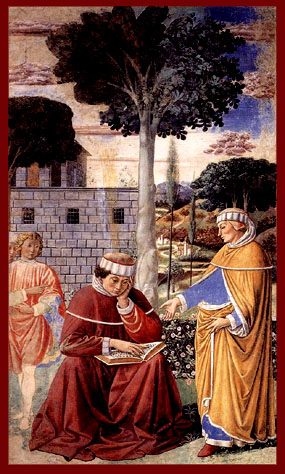
Benozzo Gozzoli, Augustine Reading in the Garden - Tolle lege, Augustine Cycle San Gimignano, 1465. |
|
|
Benozzo Gozzoli, Augustine Reading in the Garden - Tolle lege, Augustine Cycle San Gimignano, 1465. |
THUS the true sacrifice is offered in every act which is designed to unite us to God in a holy fellowship, every act, that is, which is directed to that Final Good which makes possible our true blessedness [...] This is the sacrifice of Christians: we, the many, are one body in Christ (Ro 12.5). And this is the sacrifice which the Church continually celebrates in the sacrament of the altar, known to the faithful, in which she teaches that she herself is offered in the offering she makes [to God]. (The City of God, 10.6).
Proinde verum sacrificium est omne opus, quo agitur, ut sancta societate inhaereamus Deo, relatum scilicet ad ilium finem boni, quo veraciter beati esse possimus' (CCL XLVII, 278) [...] Hoc est sacrificium Christianorum: multi unum corpus in Christo. Quod etiam Sacramento altaris fidelibus noto frequentat ecclesia, ubi ei demonstratur, quod in ea re, quam offert, ipsa offeratur' (CCL XLVII, 279).
Adapted from: The Oxf. Dict. of the Christian Church, ed. Cross, Livingstone; (OUP, 1983) 108-110.
BISHOP of HIPPO REGIUS, Doctor of the Church
[1] BORN at Tagaste in N. Africa, of a pagan father and a Christian mother (Monica), he received a Christian education. He was sent to the University of Carthage, where he studied rhetoric with a view to becoming a lawyer, but he soon decided to devote himself exclusively to literary pursuits. Here he gradually abandoned what little Christianity he possessed, and also took a mistress, whose name he never mentions, but to whom he remained faithful for fifteen years.
[2] A new stage was reached in 373, (age 19) when a reading of Cicero’s (lost) ‘Hortensius’ aroused in him a passionate interest in problems of philosophy. Shortly afterwards he became a Manichaean, and to this religion he remained attached for nine years.
[3] In 383 (age 29) the failure of Faustus, a celebrated Manichaean, to solve many problems which had been puzzling him eventually disillusioned him, and when shortly afterwards Augustine migrated to Rome and opened a school of rhetoric, he had ceased to be openly a member of the sect though he was still held captive by some of their doctrines.
Disgusted by the behaviour of his pupils at Rome, he left the capital for a professorship at Milan, where he soon came under the influence of the bishop, Ambrose. By the time he arrived at Milan, his philosophy was probably already that of the ‘Academics’, which denied the possibility of attaining absolute truth; but a little later
he became a Neoplatonist and gradually drew nearer to Christianity. The sermons of St Ambrose attracted him both by their literary quality and the answers they afforded to many of his objections to the Bible. Simplicianus, Ambrose’s tutor, recounted the conversion of the Neoplatonist, Victorinus, and it soon became apparent that the only thing that held Augustine back was his inability to live in continence.
[4] In the summer of 386 (age 32) he heard from Pontitian the story of the two civil servants who had become monks after reading the Life of St. Antony, and very soon afterwards a glance at Rom. 13:13 f. (in response to a Divine oracle, ‘Tolle lege’), gave him the final victory. After some months spent in seclusion at Cassiciacum, Augustine was baptized on Easter Eve, 387 (age 33) .
[5] In 388 (age 34) he returned to Africa and established with some friends a kind of monastery at Tagaste. While visiting the town of Hippo Regius he was suddenly seized by the people and presented to the aged bishop, Valerius, for ordination.
[6] He became a priest in 391 (age 37) , and although he continued to live a monastic life he soon acquired considerable influence in the affairs of the African Church. In 395 (age 41) he was consecrated coadjutor bishop to Valerius, Bishop of Hippo, and from c. 396 (age 42) until his death (age 76) presided as sole bishop over the see. He died on 28 Aug. 430, when the Vandals were besieging Hippo.
Augustine’s abiding importance rests on his penetrating understanding of Christian truth. During his episcopate he was called upon to deal with three heresies, all of which were confronting the Church with problems of the greatest moment; and it was mainly through his struggle with these three systems that his own theology was formulated. The least dangerous was Manichaeism, for its doctrines were too obviously remote from historic Christianity to have any real hope of success at that period. But in his attack on it, Augustine laid the basis of the metaphysic which moulded the thought of the Schoolmen. He defended, against the Manichaean attempt to solve the problem of evil by positing the existence of an evil agency eternally opposed to the good God, the essential goodness of all creation. He maintained that God was the sole creator of all things and alone sustained them in being, and that evil is, properly speaking, the privation of some good which ought to be had. In the case of physical evil this results from the imperfect character of creatures; in the case of moral evil it springs from free-will.
More urgent on the practical side was the Donatist controversy on account of the deep divisions into which it rent the African Church. It forced Augustine to carry the doctrines of the Church, the Sacraments, and Sacramental grace to a stage beyond that reached by any of his predecessors, and thereby to influence all subsequent Western theology. The Church, he maintained, was ‘one’ through the mutual charity of its members, and ‘holy’, not because her members, but because her purposes, are holy. She contains within her fold both good and evil men, and not till the last day will the latter be rooted out; and while he acknowledged that there were good men outside the Church, he seems to have thought that all who were to be saved would become members of the Church before they died. His teaching also greatly furthered the development of the distinction between ‘validity’ and ‘regularity’ in the administration of the Sacraments. In another department of theology, the same controversy forced him to consider the relation of the coercive authority of the state to the Church. He accepted the civil power as part of God’s Providence, but held that it was good only in so far as it was founded on justice, which included the worship of the true God. As a corollary, he came to accept the aid of the state to punish and suppress heresy and schism, but deprecated the use of the death-penalty.
His later years were taken up largely with the Pelagian controversy. It was c. 410 that Augustine received news that Pelagius had been attacking a sentence of his (Da quod iubes et iube quod vis) in the ‘Confessions’ (x. 29 [40]). A fierce controversy ensued which evoked his teaching upon the Fall, Original Sin, and Predestination. Augustine maintained that man was created with certain supernatural gifts which were lost by the Fall of Adam. As a result, man suffers from a hereditary moral disease, and is also subject to the inherited legal liability for Adam’s sin; and from these evils we can be saved solely by the grace of God. At times Augustine shows himself to be frankly Predestinarian. The whole human race is one mass of sin (massa peccati), out of which God has elected some souls to receive His unmerited mercy. There is no other explanation of the elect and non-elect than the inscrutable wisdom of God, and babies who die unbaptized go into everlasting perdition. This side of Augustine’s teaching was strongly affected by his personal experience of the overpowering grace of God. It found its most extreme formulation in the writings which he issued at the end of his life, and exercised a great influence upon J. Calvin and some of the other Reformers, though its details have won only limited approval from some of the most illustrious theologians both before and since the 16th century.
In consequence of these controversies, a large proportion of Augustine’s writings take a polemical form. Of his other works, the two most celebrated are the ‘Confessions’ and the ‘City of God’. The former, the greater part of which is autobiographical and carries the story of his life down to his conversion, was written shortly before 400. The marked differences in temper between the ‘Confessions’ and his philosophical writings roughly contemporary with his conversion seem to compel the conclusion that in the ‘Confessions’ he has imposed on the facts, probably unintentionally, a considerable element of interpretation. In its power of analysing the emotional side of Christian experience in the face of sin it is unsurpassed. The impulse to the writing of the 22 books of the ‘City of God’, which was spread over several years (413–26), arose out of the fall of Rome to Alaric in 410. The event had caused consternation throughout the civilized world, and Augustine, who himself was profoundly moved, conceived the book as a reply to pagans who maintained that the fall of the city was due to the abolition of the heathen worship. It led him to deal with the fundamental contrast between Christianity and the world, and has made it the supreme exposition of a Christian philosophy of history. Among his other writings are a philosophical treatise ‘De Trinitate’ in 15 books, a large collection of epistles (including an interesting correspondence with St. Jerome), many sermons, and, from his earlier Christian years, a collection of philosophical dialogues. Shortly before his death he published his ‘Retractations’, in which he reviewed his literary work.
Augustine’s influence on the course of subsequent theology has been immense. He moulded the whole of that of the Middle Ages down to the 13th cent., and even the reaction against Augustinianism with the rediscovery of Aristotle in the 13th cent., e.g. in St. Thomas Aquinas, was less complete than has widely been supposed. The Reformers also appealed to elements of Augustine’s teaching in their attack on the Schoolmen; and later the Jansenists invoked his authority. Without St. Augustine’s massive intellect and deep spiritual perception Western theology would never have taken the shape in which it is familiar to us. Feast day, 28 Aug.
Adapted from Cross and Livingstone, The Oxford Dictionary of the Christian Church, 2nd. ed, (Oxford,1983). pp. 108-110
from The Life of St.
Augustine, by Possidius,
Tr..Herbert T. Weiskotten. (1919 Latin
text:, Migne, PL vol. 50
Possidius, friend and colleague of Augustine of Hippo, wrote a biography and an indiculus or list of Augustine's works. He was a member of Augustine's monastery and later became bishop of Calama in the Roman province of Numidia.
|
CHAPTER 31. Death and burial |
|
| Now the holy man in his long life given of God for the benefit and happiness of the holy Church (for he lived seventy-six years, almost forty of which he spent as a priest or bishop), in private conversations frequently told us that even after baptism had been received exemplary Christians and priests ought not depart from this life without fitting and appropriate repentance. | 31. 1. Sane ille sanctus in vita sua prolixa pro utilitate ac felicitate sanctae Ecclesiae divinitus condonata - nam vixit annis septuaginta sex, in clericatu autem vel episcopatu annis ferme quadraginta) - dicere autem nobis inter familiaria colloquia consueverat, post perceptum Baptismum, etiam laudatos Christianos et sacerdotes absque digna et competenti poenitentia exire de corpore non debere. |
| And this he himself did in his last illness of which he died. For he commanded that the shortest penitential Psalms of David should be copied for him, and during the days of his sickness as he lay in bed he would look at these sheets as they hung upon the wall and read them; and he wept freely and constantly. | 31. 2. Quod et ipse fecit, ultima qua defunctus est aegritudine: nam sibi iusserat Psalmos Davidicos, qui sunt paucissimi de poenitentia, scribi, ipsosque quaterniones iacens in lecto contra parietem positos diebus suae infirmitatis intuebatur, et legebat, et iugiter ac ubertim flebat. |
| And that his attention might not be interrupted by anyone, about ten days before he departed from the body he asked of us who were present that no one should come in to him, except only at the hours in which the physicians came to examine him or when nourishment was brought to him. This, accordingly, was observed and done, and he had all that time free for prayer. | 31. 3. Et ne intentio eius a quoquam impediretur, ante dies ferme decem quam exiret de corpore, a nobis postulavit praesentibus, ne quis ad eum ingrederetur, nisi iis tantum horis, quibus medici ad inspiciendum intrarent, vel cum ei refectio inferretur. Et ita observatum et factum est: et omni illo tempore orationi vacabat. |
| Up to the very moment of his last illness he preached the Word of God in the church incessantly, vigorously and powerfully, with a clear mind and sound judgment. | 31. 4. Verbum Dei usque ad ipsam suam extremam aegritudinem impraetermisse, alacriter et fortiter, sana mente, sanoque consilio in ecclesia praedicavit. |
| With all the members of his body intact, p.143 with sight and hearing unimpaired, while we stood by and watched and prayed, “he slept with his fathers,” as it is written, “well-nourished in a good old age.” And in our presence, after a service was offered to God for the peaceful repose of his body, he was buried. | 31. 5. Membris omnibus sui corporis incolumis, integro aspectu atque auditu, et, ut scriptum est, nobis astantibus, et videntibus, et orantibus obdormivit cum patribus suis (3 Reg 2, 10; 1 Par 29, 28, enutritus in bona senectute; et nobis coram pro eius commendanda corporis depositione sacrificium Deo oblatum est, et sepultus est. |
| He made no will, because as a poor man of God he had nothing from which to make it. He repeatedly ordered that the library of the church and all the books should be carefully preserved for future generations. Whatever the church had in the way of possessions or ornaments he left in charge of his presbyter, who had the care of the church building under his direction. | 31. 6. Testamentum nullum fecit, quia unde faceret pauper Dei non habuit. Ecclesiae bibliothecam, omnesque codices diligenter posteris custodiendos semper iubebat. Si quid vero Ecclesia, vel in sumptibus, vel in ornamentis habuit, fidei presbyteri, qui sub eodem domus Ecclesiae curam gerebat, dimisit. |
| Neither in life nor death did he treat his relatives according to the general custom, whether they observed his manner of life or not. But while he was still living, whenever there was need he gave to them the same as he gave others, not that they should have riches, but that they might not be in want, or at least might be less in want. | 31. 7. Nec suos consanguineos, vel in proposito vel extra constitutos, in sua vita et morte vulgi more tractavit: quibus, dum adhuc superesset, id si opus fuit, quod et ceteris, erogavit, non ut divitias haberent, sed ut aut non, aut minus egerent. |
xxxx» cont
xcxxcxxc
AUGUSTINE:
With Regard to Unbaptized Infants . . .
Contra Iulianum.(Book V, XI, 44, PL 44, 809)
This line of thinking was explored thoroughly by St. Thomas Aquinas. The Angelic Doctor consigned infants who died without baptism to the outermost borders of hell, which he called the “limbo of children.” They died without the grace of God, and would spend eternity without it, but they were not worthy of punishment. St. Thomas insisted that these little ones would know no pain or remorse. He explained this opinion in various ways. In his commentary on Peter Lombard’s Sentences, he stated that no one regrets the lack of something which he is totally unequipped to have (II Sent. , d.33, q.2, a.2). Ten years later (in De Malo, q.5, a.3) he suggested that infants would not be distraught over their loss because they simply would have no knowledge of what they were missing.
| (43) You boastfully and vainly say I put parents on a par with those who murder their own children, declaring that they cause their offspring to be born under condemnation. While you are elevating yourself on the exultation of your own eloquence, in the furor you create for yourself you forget God. Why not make these complaints to the very Creator of men, instead of those who beget them, since He is certainly the Author and Creator of all goods; yet He does not cease to create those He has foreknown will burn in eternal fires, nor is aught but goodness imputed to Him because He creates them. Certain infants, even those baptized, He does not take from this life as adopted into the eternal kingdom, and does not confer on them the great benefit given him of whom we read: ‘He was taken away lest wickedness alter his understanding.’(Wisd. 4.114) Yet, nothing is attributed to God except justice and goodness, by which from goods and evils He makes all things well and rightly. You see how much more understandable it is that nothing be imputed to parents, undeniably ignorant of their children’s future, except that they choose to have children. |
Non est parentibus tribuendum ut filii
cum peccato nascantur. 11. 43. Quod autem te iactas, et inaniter spumeum diffundis eloquium, "parentes comparans parricidis, in eis asserens esse causam ut filii cum damnatione nascantur": fereris omnino linguae tuae velut exsultantibus et plaudentibus pennis, nec in isto strepitu quem tibi ipse facis, respicis Deum. Cur enim non istavel tale aliquid, ipsi potius hominum Creatori quam genitoribus dicitur, qui certe omnium bonorum est auctor et conditor? Et tamen quos ignibus aeternis praescivit arsuros, creare non desinit: nec ei, quia eos creat, nisi bonitas imputatur. Et quosdam infantes etiam baptizatos quos futuros praescivit apostatas, non aufert ex hac vita in aeternum regnum adoptatos, nec eis confert magnum beneficium, quod ei de quo legitur: Raptus est, ne malitia mutaret intellectum eius 105. Nec tamen Deo tribuitur, nisi bonitas atque iustitia, qua de bonis et malis omnia bene ac recte facit. Quanto facilius intellegitur, parentibus non esse tribuendum, nisi quod filios volunt, qui procul dubio quae illis futura sunt nesciunt? |
| Damnatio levissima infantium sine baptismo decedentium. | |
| (44) You quote from the Gospel: ‘It were better for that man if he had not been born.’{Matt. 26.24} But was his birth not due more to the work of God than his parents? Why did not God, foreknowing the evil that lay before him and which parents cannot know, give the better portion to His own image? Those who understand rightly know that nothing is attributed to God except what is proper to the goodness of the Creator. In like manner, without any difficult investigation, we must attribute to parents their wish to have children, although they know nothing of their future. | 11. 44. Quod autem commemorasti ex Evangelio: Melius erat homini illi non nasci 106; nonne ut nasceretur plus opere Dei actum est, quam parentum? Cur non ipse imagini suae praestitit quod melius erat, qui malum quod ei futurum fuerat praesciebat, quod parentes nosse non possunt? Et tamen ab eis qui recte intellegunt, non tribuitur Deo, nisi quod benignitati tribuendum est Creatoris. Sic et parentibus sine nodo difficilis quaestionis hoc tribuitur, quod filios voluerunt, quorum futura nesciverunt. |
| But I do not say that children who die without the baptism of Christ will undergo such grievous punishment that it were better for them never to have been born, since our Lord did not say these words of any sinner you please, but only of the most base and ungodly. If we consider what He said about the Sodomites, which certainly He did not mean of them only that it will be more tolerable for one than for another in the day of judgment’ | Ego autem non dico parvulos sine Christi Baptismate morientes tanta poena esse plectendos, ut eis non nasci potius expediret; cum hoc Dominus non de quibuslibet peccatoribus, sed de scelestissimis et impiissimis dixerit. Si enim quod de Sodomis ait, et utique non de solis intellegi voluit, alius alio tolerabilius in die iudicii punietur 107; |
| who can doubt that non-baptized infants, having only original sin and no burden of personal sins, will suffer the lightest condemnation of all? I cannot define the amount and kind of their punishment, but I dare not say it were better for them never to have existed than to exist there. But you, also, who contend they are, as it were, free of any condemnation, do not wish to think about the condemnation by which you punish them by estranging from the life of God and from the kingdom of God so many images of God, and by separating them from the pious parents you so eloquently urge to procreate them. They suffer these separations unjustly, if they have no sin at all; or if justly, then they have original sin. | quis dubitaverit parvulos non baptizatos, qui solum habent originale peccatum, nec ullis propriis aggravantur, in damnatione omnium levissima futuros? Quae qualis et quanta erit, quamvis definire non possim, non tamen audeo dicere quod eis ut nulli essent quam ut ibi essent, potius expediret. Verum vos quoque, qui eos velut liberos ab omni damnatione esse contenditis, cogitare non vultis qua illos damnatione puniatis, alienando a vita Dei et a regno Dei tot imagines Dei, postremo separando a parentibus piis, quos ad eos procreandos tam disertus hortaris. Haec autem iniuste patiuntur, si nullum habent omnino peccatum: aut si iuste, ergo habent originale peccatum. |
T