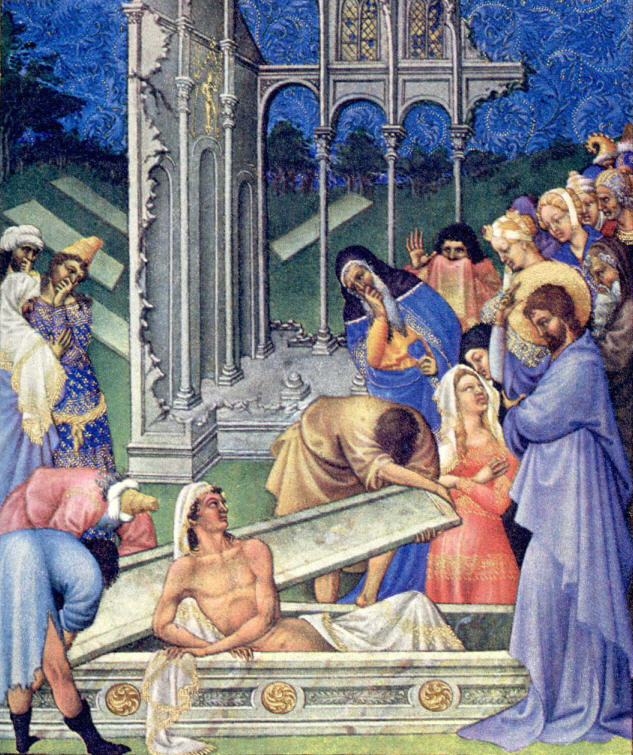
|
|
Christ Raises Lazarus |
|
|
Christ Raises Lazarus |
|
|
|
|
|
|
|
from |
PL 46 937-938 |
|
|
|
|
|
|
|
|
|
|
ON THE GOSPEL of MARY and MARTHA, Bk.I,1-11 |
|
|
|
|
|
|
|
|
|
|
|
|
|
|
|
|
|
|
|
|
|
|
|
|
|
|
A reading from a sermon by St. Augustine (Sermo 103, 1-2, 6: PL 38, 613, 615) for the Feast of Saint Martha sister of Mary and Lazarus on July 29. |
|
|
On the words of the Gospel, Luke x. 38, “And a certain woman named Martha received him into her house,” etc. |
SERMO CIII . De verbis Evangelii Lucae, Et mulier quaedam Martha nomine excepit illum in domum suam. etc. Cap. X, V\. 38-42 . |
|
|
CAPUT PRIMUM. |
|
|
|
|
|
|
|
1. The words of our Lord Jesus Christ which have just been read out of the Gospel, give us to understand, that there is some one thing for which we must be making, when we toil amid the manifold engagements of this life. Now we make for this as being yet in pilgrimage, and not in our abiding place; as yet in the way, not yet in our country; as yet in longing, not yet in enjoyment. Yet let us make for it, and that without sloth and without intermission, that we may some time be able to reach it. |
1. Unitas commendatur. Verba Domini nostri Jesu Christi, quae modo ex Evangelio recitata sunt, admonent nos, esse unum aliquid quo tendamus, quando in hujus saeculi multitudine laboramus. Tendimus autem adhuc peregrinantes, nondum manentes; adhuc in via, nondum in patria; adhuc desiderando, nondum fruendo. Tamen tendamus, et sine pigritia et sine intermissione tendamus, ut aliquando pervenire valeamus. |
|
|
|
|
|
|
|
2. Martha and Mary were two sisters, true kinswomen both, not only in blood, but in religion also; both clave to the Lord, both with one heart served the Lord when He was present in the flesh. Martha received Him, as strangers are usually received. Yet it was the handmaid received her Lord, the sick her Saviour, the creature her Creator. And she received Him to be fed in the body, herself to be fed in spirit. For the Lord was pleased to “take on Him the form of a servant,” and “having taken the form of a servant” in it to be fed by servants, by reason of His condescension, not His condition. For this truly was condescension, to allow Himself to be fed by others. He had a body, wherein He might hunger indeed and thirst; but do ye not know that when He hungered in the wilderness Angels ministered to Him? So then, in that He was pleased to be fed, He showed favour to them that fed Him. And what marvel is this, seeing He showed this same favour to the widow as touching the Holy Elias, whom He had before fed by the ministry of a raven? Did He fail in His power of feeding him, when He sent him to the widow? By no means. He did not fail in His power of feeding him, when He sent him to the widow; but He designed to bless the religious widow, by means of her pious office paid to His servant. Thus then was the Lord received as a guest, “who came unto His own, and His own received Him not: but as many as received Him, to them gave He power to become the sons of God:” adopting servants, and making them brethren; redeeming captives, and making them co-heirs. Yet let none of you, as perhaps may be the case, say, “O blessed they who obtained the grace to receive Christ into their own house!” Do not grieve, do not murmur, that thou wert born in times when thou seest the Lord no more in the flesh; He has not taken this blessedness from thee. “Forasmuch,” says He, “as ye have done it unto the least of Mine, ye have done unto Me.” |
2. Christus pascendum se praebere dignatur. Martha et Maria duae sorores erant, ambae non solum carne, sed etiam religione germanae; ambae Domino cohaeserunt, ambae Domino in carne praesenti concorditer servierunt. Suscepit eum Martha, sicut solent suscipi peregrini. Sed tamen suscepit famula Dominum, aegra Salvatorem, creatura Creatorem. Suscepit autem Spiritu pascenda, in carne pascendum. Voluit enim Dominus formam servi accipere, et accepta forma servi in illa pasci a servis, dignatione, non conditione. Nam et ista dignatio fuit, se praebere pascendum. Habebat carnem, in qua esuriret quidem, et sitiret: sed nescitis quia in eremo esurienti Angeli ministrabant (Matth. IV, 11)? Ergo quod pasci voluit, pascenti praestitit. Quid autem mirum, si et de sancto Elia praestitit viduae, quem prius corvo ministrante pascebat (III Reg. XVII, 6)? Numquid pascendo defecerat, quando ad viduam mittebat? Nequaquam. Non pascendo defecerat, quando ad viduam mittebat : sed religiosam viduam, per obsequium exhibitum servo suo, benedicere disponebat. Sic ergo susceptus est Dominus, tanquam hospes, qui in sua propria venit, et sui eum non receperunt: sed quotquot receperunt eum, dedit eis potestatem filios Dei fieri (Joan. I, 11); adoptans servos, et fratres faciens; redimens captivos, et faciens cohaeredes. Ne quis tamen vestrum forsitan dicat: O beati qui Christum suscipere in domum propriam meruerunt! Noli dolere, noli murmurare quia temporibus natus es, quando jam Dominum non vides in carne: non tibi abstulit istam dignationem. Cum uni, inquit, ex minimis meis fecistis, mihi fecistis (Matth. XXV, 40). |
|
|
CAPUT II. [Col.0614] |
|
|
|
|
|
|
|
3. These few words, as the shortness of the time allowed me, would I speak concerning the Lord who was pleased to be fed in the flesh, while He feedeth in the spirit: let us now come to the subject which I have proposed concerning unity. Martha, who was arranging and preparing to feed the Lord, was occupied about much serving. Mary her sister chose rather to be fed by the Lord. She in a manner deserted her sister who was toiling about much serving, and she sat herself at the Lord’s feet, and in stillness heard His word. Her most faithful ear had heard already; “Be still, and see that I am the Lord.” Martha was troubled, Mary was feasting; the one was arranging many things, the other had her eyes upon the One. Both occupations were good; but yet as to which was the better, what shall we say? We have One whom we may ask, let us give ear together. Which was the better, we heard now when the lesson was read, and let us hear again as I repeat it. Martha appeals to her Guest, lays the request of her pious complaints before the Judge, that her sister had deserted her, and neglected to assist her when she was so busied in her serving. Without any answer from Mary, yet in her presence, the Lord gives judgment. Mary preferred as in repose to commit her cause to the Judge, and had no mind to busy herself in making answer. For if she were to be getting ready words to answer, she must remit her earnest attention to hear. Therefore the Lord answered, who was in no difficulty for words, in that He was the Word. What then did He say? “Martha, Martha.” The repetition of the name is a token of love, or perhaps of exciting attention; she is named twice, that she might give the more attentive heed. “Martha, Martha,” hear: “Thou art occupied about many things: but one thing is needful;” for so meaneth unum opus est, not “one work,” that is, one single work, but one is needful, is expedient, is necessary, which one thing Mary had chosen. |
3. Marthae et Mariae officium utrumque bonum: melius tamen Mariae. Haec de Domino pascendo in carne, sed pascente in spiritu, pauca pro tempore dixerimus: veniamus ad causam, quam de unitate proposui. Martha Dominum pascere disponens et praeparans, circa multum ministerium occupabatur: Maria soror ejus pasci a Domino magis elegit. Deseruit quodam modo sororem suam circa multum ministerium laborantem, et sedit ipsa ad pedes Domini, et vacans audiebat verbum ejus. Auris fidelissima audierat: Vacate, et videte, quoniam ego sum Dominus (Psal. XLV, 11). Illa turbabatur, ista epulabatur: illa multa disponebat, ista unum aspiciebat. Utrumque officium bonum: sed tamen quod sit melius, quid nos dicamus? Habemus quem interrogemus, patienter audiamus. Quid sit melius, jam cum legeretur audivimus, et me commemorante iterum audiamus. Interpellat Martha hospitem, ad judicem deponit postulationem piarum querelarum, quod eam soror deseruerit, et sic laborantem in ministerio adjuvare neglexerit. Non respondente illa, sed tamen praesente, judicat Dominus. Maria causam suam tanquam otiosa judici maluit committere, nec in respondendo voluit laborare. Si enim pararet respondenti sermonem, remitteret audiendi intentionem. Respondit ergo Dominus, qui in verbo non laborabat, quia Verbum erat. Quid ergo dixit? Martha, Martha, Repetitio nominis indicium est dilectionis, aut forte movendae intentionis: ut audiret attentius , bis vocata est, Martha, Martha, audi: Tu circa multa es occupata, unum autem opus est: id est, unum necessarium est. Non unum opus quasi singulare opus: sed opus est, expedit, necessarium est; quod unum hoc elegerat Maria . |
|
|
CAPUT III. |
|
|
|
|
|
|
|
4. Consider, Brethren, this “one thing,” and see if even in multitude itself anything pleases, but “this oneness.” See how great a number, through God’s mercy, ye are: who could bear you, if ye did not mind “one thing”? Whence in this many is this quiet? Give oneness, and it is a people; take oneness away, and it is a crowd. For what is a crowd, but a disordered multitude? But give ear to the Apostle: “Now I beseech you, brethren.” He was speaking to a multitude; but he wished to make them all “one.” “Now I beseech you, brethren, that ye all speak the same thing, and that there be no schisms among you; but that ye be perfected in the same mind, and in the same knowledge.” And in another place, “That ye be of one mind, thinking one thing, doing nothing through strife or vainglory.” And the Lord prays to the Father touching them that are His: “that they may be one even as We are One.” And in the Acts of the Apostles; “And the multitude of them that believed were of one soul, and of one heart.” Therefore, “Magnify the Lord with me, and let us exalt His Name in one together.” For one thing is necessary, that celestial Oneness, the Oneness in which the Father, and the Son, and Holy Spirit are One. See how the praise of Unity is commended to us. Undoubtedly our God is Trinity. The Father is not the Son the Son is not the Father, the Holy Spirit is neither the Father, nor the Son, but the Spirit of both; and yet these Three are not Three Gods, nor Three Almighties; but One God, Almighty, the whole Trinity is one God; because One thing is necessary. To this one thing nothing brings us, except being many we have one heart. |
4. Unum necessarium. Unum cogitate, fratres mei, et videte in ipsa multitudine si delectat, nisi unum. Ecce Deo propitio quam multi estis: quis vos ferret, nisi unum saperetis? Unde in multis quies ista? Da unum, et populus est: tolle unum, et turba est. Quid est enim turba, nisi multitudo turbata? Sed audite Apostolum: Obsecro autem vos, fratres. Multitudini dicebat: sed omnes unum facere volebat. Obsecro autem vos, fratres, ut idipsum dicatis omnes, et non sint in vobis schismata; sitis autem perfecti in eodem sensu, et in eadem scientia (I Cor. I, 10). Et alio loco: Unanimes, unum sentientes, nihil per contentionem, neque per inanem gloriam (Philipp. II, 2, 3). Et Dominus ad Patrem de suis: Ut sint unum, sicut et nos unum sumus (Joan. XVII, 22). Et in Actibus Apostolorum: Multitudinis autem credentium erat anima una et cor unum (Act. IV, 32). Ergo magnificate Dominum mecum, et exaltemus nomen ejus in unum (Psal. XXXIII, 4). Quia unum est necessarium, unum illud supernum, unum ubi Pater et Filius et Spiritus sanctus sunt unum. Videte nobis commendari unitatem. [Col.0615] Certe Trinitas est Deus noster. Pater non est Filius, Filius non est Pater, Spiritus sanctus nec Pater est, nec Filius, sed amborum Spiritus: et tamen ista tria non tres dii, non tres omnipotentes, sed unus Deus omnipotens, ipsa Trinitas unus Deus: quia unum necessarium est. Ad hoc unum non nos perducit, nisi multi habeamus cor unum. |
|
|
CAPUT IV. |
|
|
|
|
|
|
|
5. Good are ministrations done to the poor, and especially the due services and the religious offices done to the saints of God. For they are a payment, not a gift, as the Apostle says, “If we have sown unto you spiritual things, is it a great thing if we shall reap your carnal things?” Good are they, we exhort you to them, yea by the word of the Lord we build you up, “be not slow to entertain” the saints. Sometimes, they who were not aware of it, by entertaining those whom they knew not, have entertained angels. These things are good; yet better is that thing which Mary hath chosen. For the one thing hath manifold trouble from necessity; the other hath sweetness from charity. A man wishes when he is serving, to meet with something; and sometimes he is not able: that which is lacking is sought for, that which is at hand is got ready; and the mind is distracted. For if Martha had been sufficient for these things, she would not have demanded her sister’s help. These things are manifold, are diverse, because they are carnal, because they are temporal; good though they be, they are transitory. But what said theLord to Martha? “Mary hath chosen that better part.” Not thou a bad, but she a better. Hear, how better; “which shall not be taken away from her.” Some time or other, the burden of these necessary duties shall be taken from thee: the sweetness of truth is everlasting. “That which she hath chosen shall not be taken away from her.” It is not taken away, but yet it is increased. In this life, that is, is it increased, in the other life it will be perfected, never shall it be “taken away.” |
5. Bonum Marthae, ministerium: melior pars Mariae. Bona sunt ministeria circa pauperes, et maxime circa sanctos Dei servitia debita, obsequia religiosa. Redduntur enim, non dantur, dicente Apostolo, Si nos vobis spiritualia seminavimus, magnum est si carnalia vestra metamus (I Cor. IX, 11)? Bona sunt, exhortamur ad haec, et in verbo Domini aedificamus vos, nolite pigri esse ad suscipiendos sanctos. Aliquando nescientes, suscipiendo quos nesciebant, Angelos susceperunt (Hebr. XIII, 2). Bona sunt haec: melius est tamen quod elegit Maria. Illud enim habet ex necessitate occupationem: istud autem ex charitate suavitatem. Vult homo occurrere quando ministrat; et aliquando non potest: quaeritur quod deest, paratur quod adest; distenditur animus. Nam si Martha ad illa sufficeret, adjutorium sororis non posceret. Multa sunt, diversa sunt, quia carnalia sunt, quia temporalia sunt: etsi bona sunt, transitoria sunt. Marthae autem quid ait Dominus? Maria meliorem partem elegit. Non tu malam, sed illa meliorem. Audi unde meliorem: Quae non auferetur ab ea. A te auferetur aliquando onus necessitatis: aeterna est dulcedo veritatis. Non auferetur ab ea quod elegit. Non aufertur, sed tamen augetur. In hac autem vita augetur, in alia vita perficietur, nunquam auferetur. |
|
|
CAPUT V. |
|
|
|
|
|
|
|
6. Yea, Martha, blessed in thy good serving, even thou (with thy leave would I say it) seekest this reward for all thy labour—quiet. Now thou art occupied about much serving, thou hast pleasure in feeding bodies which are mortal, though they be the bodies of Saints; but when thou shalt have got to that country, wilt thou find there any stranger whom thou mayest receive into thine house? wilt thou find the hungry, to whom thou mayest break thy bread? or the thirsty, to whom thou mayest hold out thy cup? the sick whom thou mayest visit? the litigious, whom thou mayest set at one? the dead, whom thou mayest bury? None of all these will be there, but what will be there? What Mary hath chosen; there shall we be fed, and shall not feed others. Therefore there will that be in fulness and perfection which Mary hath chosen here; from that rich table, from the word of the Lord did she gather up some crumbs. For would ye know what will be there? The Lord Himself saith of His servants: “Verily I say unto you, that He will make them to sit down to meat, and will pass by and serve them.” What is “to sit down to meat,” but to “be still”? What is, “to sit down to meat,” but to rest? What is, “He will pass by and serve them”? First, He passeth by, and so serveth. And where? In that heavenly Banquet, of which he saith, “Verily I say unto you, Many shall come from the East and West, and shall sit down with Abraham, and Isaac, and Jacob, in the kingdom of heaven.” There will the Lord feed us, but first He passeth on from hence. For (as ye should know) the Pasch is by interpretation Passing-over. The Lord came, He did divine things, He suffered human things. Is He still spit upon? Is He still struck with the palm of the hand? Is He still crowned with thorns? Is He still scourged? Is He still crucified? Is He still wounded with a spear? “He hath passed by.” And so too the Gospel tells us, when He kept the Paschal feast with His disciples. What says the Gospel? “But when the hour was come that Jesus should pass out of this world unto the Father.” Therefore did He pass, that He might feed us; let us follow, that we may be fed. |
6. Marthae ministerium ad Mariae quietem tendit. Caeterum tu Martha, pace tua dixerim, in bono ministerio benedicta, pro isto labore tuo mercedem quaeris, quietem. Modo occupata es circa multum ministerium, pascere vis mortalia corpora, licet sanctorum: numquid cum veneris ad illam patriam, invenies peregrinum, quem suscipias hospitio? invenies esurientem, cui panem frangas? sitientem, cui potum porrigas? aegrum, quem visites? litigantem, quem concordes? mortuum, quem sepelias? Omnia ista ibi non erunt: sed quid ibi erit? Quod Maria elegit: ibi pascemur, non pascemus. Ideo hoc ibi erit plenum atque perfectum, quod hic elegit Maria: de illa mensa opulenta, de verbo Domini micas colligebat. Nam vultis nosse quid ibi erit? Dominus ipse dicit de servis suis: Amen dico vobis, quia faciet eos recumbere, et transibit, et ministrabit illis (Luc. XII, 37). Recumbere quid est, nisi vacare? Recumbere quid est, nisi requiescere? Quid est, Transibit, et ministrabit illis? Prius transit, et sic ministrat. Sed ubi? In illo convivio superno, de quo dicit: Amen dico vobis, multi ab oriente et occidente venient, et recumbent cum Abraham, et Isaac, et Jacob in regno coelorum (Matth. VIII, 11). Ibi Dominus pascit, sed prius hinc transit. Nam ut noveritis, Pascha Transitus interpretatur. Venit Dominus, fecit divina, passus est humana. [Col.0616] Numquid adhuc conspuitur? numquid adhuc expalmatur? numquid adhuc spinis coronatur? numquid adhuc flagellatur? numquid adhuc crucifigitur? numquid adhuc lancea vulneratur? Transivit. Denique et Evangelium sic loquitur, quando Pascha fecit cum discipulis suis. Quid dicit Evangelium? Cum autem venisset hora, ut Jesus transiret de hoc mundo ad Patrem (Joan. XIII, 1). Ergo ille transivit, ut pascat: nos sequamur, ut pascamur. |
|
|
|
|
|
|
|
[CIV. Ben.] |
|
|
Again, on the words of the Gospel, Luke x. 38, etc., about Martha and Mary. |
SERMO CIV . Rursus in illud Evangelii Lucae, ubi de Martha et Maria. Cap. X, V\. 38-42. |
|
|
CAPUT PRIMUM. |
|
|
|
|
|
|
|
1. When the holy Gospel was being read, we heard that the Lord was received by a religious woman into her house, and her name was Martha. And while she was occupied in the care of serving, her sister Mary was sitting at the Lord’s Feet, and hearing His Word. The one was busy, the other was still; one was giving out, the other was being filled. Yet Martha, all busy as she was in that occupation and toil of serving, appealed to the Lord, and complained of her sister, that she did not help her in her labour. But the Lord answered Martha for Mary; and He became her Advocate, who had been appealed to as Judge. “Martha,” He saith, “thou art occupied about many things, when one thing is necessary. Mary hath chosen the better part, which shall not be taken from her.” (Luke 10. 41, 42) For we have heard both the appeal of the appellant, and the sentence of the Judge. Which sentence answered the appellant, defended the other’s cause. For Mary was intent on the sweetness of the Lord’s word. Martha was intent, how she might feed the Lord; Mary intent how she might be fed by the Lord. By Martha a feast was being prepared for the Lord, in whose feast Mary was even now delighting herself. As Mary then was listening with sweet pleasure to His most sweet word, and was feeding with the most earnest affection, when the Lord was appealed to by her sister, how, think we, did she fear, lest the Lord should say to her, “Rise and help thy sister”? For by a wondrous sweetness was she held; a sweetness of the mind which is doubtless greater than that of the senses. She was excused, she sat in greater confidence. And how excused? Let us consider, examine, investigate it thoroughly as we can, that we may be fed also. |
1. Marthae et Mariae officia compararantur. Sanctum Evangelium cum legeretur, audivimus a femina religiosa susceptum esse Dominum hospitio, eaque Martha vocabatur. Et cum esset ipsa occupata in cura ministrandi, soror ejus Maria sedebat ad pedes Domini, et audiebat verbum ejus. Laborabat illa, vacabat ista: illa erogabat, haec implebatur. Verumtamen Martha laborans multum in illa occupatione et negotio ministrandi, interpellavit Dominum, et de sorore sua conquesta est, quod eam laborantem non adjuvaret. Dominus autem pro Maria respondit Marthae; et ipse ejus factus est advocatus, qui judex fuerat interpellatus. Martha, inquit, circa multa es occupata, quando unum est necessarium. Maria meliorem partem elegit, quae non auferetur ab ea. Audivimus enim et interpellationem interpellantis, et sententiam judicis. Quae sententia interpellanti respondit, susceptam defendit. Erat enim Maria intenta dulcedini verbi Domini. Intenta erat Martha quomodo pasceret Dominum: intenta Maria quomodo pasceretur a Domino. A Martha convivium Domino parabatur, in cujus convivio Maria jam jucundabatur. Cum ergo Maria suaviter audiret verbum dulcissimum, et corde intentissimo pasceretur, interpellato Domino a sorore sua, quomodo putamus eam timuisse, ne diceret ei Dominus, Surge, et adjuva sororem tuam? Mira enim suavitate tenebatur: quae profecto major est mentis quem ventris. Excusata est, sedit securior. Quomodo autem excusata? Attendamus, inspiciamus, perscrutemur quod possumus; ut pascamur et nos. |
|
|
|
|
|
|
|
2. For what, do we imagine that Martha’s serving was blamed, whom the cares of hospitality had engaged, who had received the Lord Himself into her house? How could she be rightly blamed, who was gladdened by so great a guest? If this be true, let men give over their ministrations to the needy; let them choose for themselves “the better part, which shall not be taken from” them; let them give themselves wholly to the word, let them long after the sweetness of doctrine; be occupied about the saving knowledge; let it be no care to them, what stranger is in the street, who there is that wants bread, or clothing, or to be visited, to be redeemed, to be buried; let works of mercy cease, earnest heed be given to knowledge only. If this be “the better part,” why do not all do this, when we have the Lord Himself for our defender in this behalf? For we do not fear in this matter, lest we should offend His justice, when we have the support of His judgment. |
2. Ministerium Marthae non reprehensum a Christo. Quid enim? putamus reprehensum esse ministerium Marthae, quam cura hospitalitatis occupaverat, quae ipsum Dominum hospitio receperat? Quomodo recte reprehendebatur, quae tanto hospite laetabatur? Hoc si verum est, dimittant homines quod ministrant egentibus; eligant sibi partem meliorem, quae non auferetur ab eis; vacent verbo, inhient doctrinae dulcedini; occupentur circa scientiam salutarem; nihil eis curae sit, quis peregrinus in vico sit, quis egeat pane, quis indumento, quis visitandus, quis redimendus, quis sepeliendus: vacent opera misericordiae, uni instetur scientiae. Si melior pars est, cur non omnes hoc [Col.0617] faciunt, quando ipsum Dominum in hac causa patronum habemus? Non enim timemus in hac re, ne offendamus ejus justitiam, cum patronam teneamus ejus sententiam. |
|
|
CAPUT II. |
|
|
|
|
|
|
|
3. And yet it is not so; but as the Lord spake so it is. It is not as thou understandest; but it is as thou oughtest to understand it. So mark; “Thou art occupied about many things, when one thing is needful. Mary hath chosen the better part.” Thou hast not chosen a bad part; but she a better. And how better? Because thou art “about many things,” she about “one thing.” One is preferred to many. For one does not come from many, but many from one. |
3. Melior pars Mariae. Et tamen ita non est: sed sicut dixit Dominus, ita est. Quomodo intelligis, non est: est autem quomodo intelligere debes. Ecce adverte: Circa multa es occupata, quando unum est necessarium. Maria meliorem partem elegit. Non tu malam: sed illa meliorem. Sed unde meliorem? Quia tu circa multa, illa circa unum. |
|
The things which were made, are many, He who made them is One. The heaven, the earth, the sea, and all things that in them are, how many are they! Who could enumerate them? who conceive their vast number? Who made all these? God made them all. Behold, “they are very good.” (Gen. 1. 31) Very good are the things He made; how much better is He who made them! Let us consider then our “occupations about many things.” Much serving is necessary for the refreshment of our bodies. Wherefore is this? Because we hunger, and thirst. Mercy is necessary for the miserable. Thou breakest bread to the hungry; because thou hast found an hungry man; take hunger away; to whom dost thou break bread? Take houseless wandering away; to whom dost thou show hospitality? Take nakedness away; to whom dost thou furnish clothes? Let there be no sickness; whom dost thou visit? No captivity; whom dost thou redeem? No quarrelling; whom dost thou reconcile? No death; whom dost thou bury? In that world to come, these evils will not be; therefore these services will not be either. Well then did Martha, as touching the bodily—what shall I call it, want, or will, of the Lord?—minister to His mortal flesh. But who was He in that mortal flesh? “In the beginning was the Word, and the Word was with God, and the Word was God:” (John 1.1) see what Mary was listening to! “The Word was made flesh, and dwelt among us:” (John 1.14) see to whom Martha was ministering! Therefore “hath Mary chosen the better part, which shall not be taken from her.” For she chose that which shall abide for ever; “it shall not be taken from her.” She wished to be occupied about “one thing.” She understood already, “But it is good for me to cleave to the Lord.” (Ps. 73. 28) She sat at the feet of our Head. The more lowlily she sat, the more amply did she receive. For the water flows together to the low hollows of the valley, runs down from the risings of the hill. The Lord then did not blame Martha’s work, but distinguished between their services. “Thou art occupied about many things; yet one thing is needful.” Already hath Mary chosen this for herself. The labour of manifoldness passeth away, and the love of unity abideth. Therefore what she hath chosen, “shall not be taken from her.” But from thee, that which thou hast chosen (of course this follows, of course this is understood) from thee, that which thou hast chosen shall be taken away. But to thy blessedness shall it be taken away, that that which is better may be given. For labour shall be taken away from thee, that rest may be given. Thou art still on the sea, she is already in port. |
Praeponitur unum multis. Non enim a multis unum, sed multa ab uno. Multa sunt quae facta sunt, unus est qui fecit. Coelum, terra, mare, et omnia quae in eis sunt, quam multa sunt! Quis ista enumeret? quis horum multitudinem cogitet? Quis haec fecit? Deus omnia. Ecce bona valde (Gen. I, 31). Bona valde quae fecit: quanto melior ille qui fecit? Attendamus igitur occupationes nostras circa multa. Necessarium est ministerium corpora refecturis. Quare hoc? Quia esuritur, quia sititur. Misericordia miseris necessaria est. Frangis panem esurienti; quia invenisti esurientem: tolle famem; cui frangis panem? Tolle peregrinationem; cui exhibes hospitalitatem? Tolle nuditatem; cui praeparas vestem? Non sit aegritudo; quem visitas? Non sit captivitas; quem redimis? Non sit rixa; quem concordas? Non sit mors; quem sepelis? In illo saeculo futuro non erunt ista mala: ergo nec ista ministeria. Bene ergo Martha circa corporalem Domini, quid dicam, necessitatem an voluntatem? ministrabat carni mortali. Sed quis erat in carne mortali? In principio erat Verbum, et Verbum erat apud Deum, et Deus erat Verbum: ecce quod Maria audiebat. Verbum caro factum est, et habitavit in nobis (Joan. I, 1-14). Ecce Martha cui ministrabat. Ergo, Maria meliorem partem elegit, quae non auferetur ab ea. Hoc enim elegit, quod semper manebit: non auferetur ab ea. Circa unum se voluit occupari. Jam tenebat: Mihi autem adhaerere Deo, bonum est (Psal. LXXII, 28). Sedebat ad pedes capitis nostri. Quanto humilius sedebat, tanto amplius capiebat. Confluit enim aqua ad humilitatem convallis, denatat de tumoribus collis. Non ergo Dominus opus reprehendit, sed munus distinxit. Circa multa es occupata: porro unum est necessarium. Jam hoc sibi Maria elegit. Transit labor multitudinis, et remanet charitas unitatis. Ergo quod elegit, non auferetur ab ea. A te autem quod elegisti: utique hoc sequitur, utique hoc subintelligitur: a te quod elegisti auferetur. Sed bono tuo auferetur, ut quod melius est detur. Auferetur enim a te labor, ut requies detur. Tu navigas, illa jam in portu est. |
|
|
CAPUT III. |
|
|
|
|
|
|
|
4. Ye see then, dearly Beloved, and, as I suppose, ye understand already, that in these two women, who were both well pleasing to the Lord, both objects of His love, both disciples; ye see, I say (and an important thing it is which whosoever understand, understand hereby, a thing which, even those of you who do not understand ought to give ear to, and to know), that in these two women the two lives are figured, the life present, and the life to come, the life of labour, and the life of quiet, the life of sorrow, and the life of blessedness, the life temporal, and the life eternal. These are the two lives: do ye think of them more fully. What this life contains, I speak not of a life of evil, or iniquity, or wickedness, or luxuriousness, or ungodliness; but of labour, and full of sorrows, by fears subdued, by temptations disquieted: even this harmless life I mean, such as was suitable for Martha: this life I say, examine as best ye can; and as I have said, think of it more fully than I speak. But a wicked life was far from that house, and was neither with Martha nor with Mary; and if it ever had been, it fled at the Lord’s entrance. There remained then in that house, which had received the Lord, in the two women the two lives, both harmless, both praiseworthy; the one of labour, the other of ease; neither vicious, neither slothful. Both harmless, both, I say, praiseworthy: but one of labour, the other of ease: neither vicious, which the life of labour must beware of; neither slothful, which the life of ease must beware of. There were then in that house these two lives, and Himself, the Fountain of life. In Martha was the image of things present, in Mary of things to come. What Martha was doing, that we are now; what Mary was doing, that we hope for. Let us do the first well, that we may have the second fully. For what of it have we now? How far have we it? As long as we are here, how much of it is there that we have? For in some measure are we employed in it now, and ye too when removed from business, and laying aside domestic cares, ye meet together, stand, listen. In so far as ye do this, ye are like Mary. And with greater facility do ye do that which Mary doeth, than I who have to distribute. Yet if I say ought, it is Christ’s; therefore doth it feed you, because it is Christ’s. For the Bread is common to us all, of which I too live as well as you. “But now we live, if ye, Brethren, stand fast in the Lord.” (1 Thess. 3. 8) I would not that ye should stand fast in us, but in the Lord. “For neither is he that planteth anything, neither he that watereth; but God that giveth the increase.”(1 Cor. 3. 7) |
4. Duae vitae in Martha et Maria figuratae. Videtis ergo, charissimi, et quantum arbitror, jam intelligitis, in his duabus mulieribus, quae ambae fuerant Domino gratae, ambae amabiles, ambae discipulae: videtis ergo, et magnum aliquid intelligitis, quicumque intelligitis, quod audire et scire debetis, etiam qui non intelligitis; in his duabus mulieribus, duas vitas esse figuratas, praesentem et futuram, laboriosam et quietam, aerumnosam et beatam, temporalem et aeternam. Duae sunt vitae: de illis vos [Col.0618] copiosius cogitate. Quid habeat haec vita, non dico mala, non iniqua, non nefaria, non luxuriosa, non impia; sed laboriosa et aerumnis plena, timoribus castigata, tentationibus sollicita: hanc ipsam innocentem vitam dico, qualem decebat habere Martham: hanc ergo, quantum potestis, inspicite; et de hac, ut dixi, copiosius quam loquimur cogitate. Vita vero iniqua aberat ab illa domo, nec cum Martha erat, nec cum Maria: et si aliquando fuit, Domino intrante fugit. Remanserunt ergo in illa domo, quae susceperat Dominum, in duabus feminis duae vitae, ambae innocentes, ambae laudabiles: una laboriosa, altera otiosa; nulla facinorosa, nulla desidiosa. Ambae innocentes, ambae, inquam, laudabiles, sed una laboriosa, altera otiosa: nulla facinorosa, quam cavere debet laboriosa; nulla desidiosa, quam cavere debet otiosa. Erant ergo in illa domo istae duae vitae, et ipse fons vitae. In Martha erat imago praesentium, in Maria futurorum. Quod agebat Martha, ibi sumus: quod agebat Maria, hoc speramus. Hoc agamus bene, ut illud habeamus plene. Nam quid inde habemus? In quantum habemus? Quamdiu hic sumus, quantum est quod inde habemus? Nam et modo inde aliquid agimus, remoti a negotiis, sepositis familiaribus curis, convenistis, statis, auditis. In quantum hoc agitis, Mariae similes estis. Et facilius vos quod agit Maria, quam ego qui praerogo. Si quid tamen dico, Christi est: ideo vos pascit, quia Christi . Quia panis communis est, unde et ego vobiscum vivo. Nunc autem vivimus, si vos, fratres, statis in Domino (I Thess. III, 8). Nolo in nobis, sed in Domino. Quia neque qui plantat est aliquid, neque qui rigat; sed qui incrementum dat Deus (I Cor. III, 7). |
|
|
|
|
|
|
This Webpage was created for a workshop held at Saint Andrew's Abbey, Valyermo, California in 1990