|
|
|
|
|
|
transl. based on that of Luke Eberle, modified. and adapted for this webpage by L. Dysinger
|
Question of
the disciples: |
Interrogatio discipulorum: XLVII. De disciplina psallendi.* Respondit Dominus per magistrum: |
|
1So great must be the reverential seriousness and the manner of chanting the psalms that the Lord listens more lovingly than we say them; 2as Scripture declares: ‘You take delight in the coming of the morning, and in the evening’, 3*and again: ‘Sing the psalms to him joyfully and skillfully, for direct is the word of the Lord’, 4*and again: ‘Exult in him with fear’, 5*and again, ‘Sing to the Lord wisely’. 6Therefore if it commands the singing of psalms to be done wisely and with fear, the person singing them should stand with body motionless and head bowed, and should sing praises to the Lord with composure, 7since he is indeed performing his service before the Godhead, 8*as the prophet teaches when he says: ‘In the presence of the angels I will sing your praise’. |
1* Tanta debet esse reuerentiae grauitas uel disciplina psallendi, ut amabilius a Domino quam a nobis dicitur audiatur, 2*† sicut ait scribtura: Exitus matutini et uespere delectaberis, 3*† et item: Bene psallite ei in iubilatione, quia rectus est sermo Domini, 4*† et item: Exullate ei cum tremore, 5*† et item: Psallite Domino sapienter. 6* Ergo si sapienter et cum timore iubet psalli, oportet psallentem inmobili corpore, inclinato capite stare et laudes Domino moderate canere, 7* quippe qui ministerium suum ante diuinitatem inplet, 8*† docente propheta, cum dicit: In conspectu angelorum psallam tibi. |
|
9So the singer of psalms must always be careful not to let his attention wander elsewhere, 10*lest God say to us when our mind has strayed to some other thought: ‘This people honors me only with lip-service, while their hearts are far from me’, 11*and lest it likewise be said of us: ‘With their mouth they blessed and in their heart they cursed’, 12and lest when we praise God with the tongue alone, we admit God only to the doorway of our mouth while we bring in and lodge the devil in the dwelling of our heart. 13For he who goes inside is held in higher esteem by the one who brought him in than is he who is left waiting outside. 14Therefore for a duty so great and so important the heart should be in consonance with the tongue, in order to render with fear what is due to the Lord every day. 15And in his heart let the singer of psalms pay attention to each and every verse he says, because if each verse is noted the soul derives profit for salvation 16*and therein finds all it seeks, for ‘the psalm says everything for edification”; 17*as the prophet declares: ‘I shall sing and understand in the way of integrity, when you come to me’. 18Let him who resounds in the voice also be in the mind of the singer. 19*Let us therefore sing with voice and mind in unison; as the apostle says: ‘I will sing with the spirit, but I will sing with the understanding also’. 20We must cry out to God not only with our voices, but with our heart as well. |
9* Nam considerare debet qui psallet semper, ne alibi sensus eius demigret, 10*† ne cum in alia cogitatione sensus noster migrauerit, de nobis dicat Deus: Populus iste labiis me honorat, cor autem eorum longe est a me, 11*† et item de nobis dicatur: Ore suo benedicebant et corde suo maledicebant, 12* et ne cum in sola lingua Deum laudamus, in sola regia oris nostri Deum admittamus et intus in domum cordis nostri introductum diabolum collocemus. 13* Fortior enim ab introducente iudicatur quiintus ingreditur quam qui foris expectat. 14* Ergo ad tantum et talem officium cor pariter cum lingua conueniat cum timore Domino cottidianum debitum redibere. 15* Et notet sibi in corde qui psallet ad singula omnia testimonia, quae dicit, quia singuli uersus si notentur, proficiunt animae ad salutem 16*† et in eis totum inuenitur, quod quaeritur, quia omnia ad aedificationem loquitur psalmus, 17*† dicente propheta: Psallam et intellegam in uia inmaculata, quando uenies ad me. 18* Qui sonat in uoce, ipse sit et in mente psallentis. 19*† Psallamus ergo uoce et mente communiter, dicente apostolo: Psallam spiritu, psallam et mente. 20* Non solum uocibus, sed et corde ad Deum clamare. |
|
21Furthermore, care must be taken while singing that there is not a lot of frequent coughing or prolonged gasping or constant spitting out of saliva; 22nor should the singer dispose In front of him of filth extracted from the nose, but the brother should get rid of it behind his back, 23*for the angels are instructed to stand before the singers of psalms, as the prophet says: ‘In the presence of the angels I will sing your praise’. 24Therefore when these distractions are presented to the singers by the devil, let him who is singing immediately trace the sign of the cross on his mouth. |
21* Cauendum namque est, cum psallitur, ne frequens tussis aut anelus prolixus abundet aut saliuarum excreatus adsiduus, 22* aut narium spurcitiae detractae a psallente inante iactentur, sed debere fratrem post se proicere, 23† quia angeli ante psallentes docentur stare, cum dicit propheta: In conspectu angelorum psallam tibi. 24*† Ergo cum haec omnia inpedimenta psallentibus a diabolo fuerint ministrata, mox sibi qui psallet signet os crucis sigillo. |
|
Question of
the disciples: |
Interrogatio discipulorum: XLVIII. De reverentia orationis.* Respondit Dominus per magistrum: |
|
1If to men in the flesh a petition is made with humility only when we ask them for some temporal favor, 2how much more should we plead with Christ about our sins and crimes by praying as much as we can. 3Therefore there must be no duplicity in prayer. 4Let one person not be found in the mouth, yet another in the heart. 5*Prayer must not be protracted by an abundance of words; as the holy gospel says, those who do this become hypocrites. |
1* Si hominibus carnalibus nisi cum humilitate non fit praecatio, cum beneficia eos aliqua temporalia postulamus, 2* quanto magis conuenit, ut pro peccatis nostris uel facinoribus omni, qua possumus, Christum praece rogemus. 3*† Nulla ergo debet esse in oratione duplicitas. 4* Non unus in ore, alter in corde inueniatur. 5*† Non multiloquio protrahi orationem debere, sicut ait sanctum euangelium hypocritas eos fieri tales. |
|
6There should not be a great deal of frequent coughing or constant spitting or gasping, because the devil uses all these as a hindrance to prayers and psalms. 7For what we have said above should be avoided also during the prayers, namely, if the one praying wishes to spit or dispose of filth from his nose, he should get rid of it not in front of him but behind him, because of the angels standing in front, 8*as the prophet indicates when he says: ‘In the presence of the angels I will sing your praise; I will worship at your holy temple’. 9So you see how evident it is that we pray and sing psalms in the presence of the angels. |
6*† Non frequens tussis, non excreatus adsiduus, non anelus abundet, quia haec omnia orationibus et psalmis ad inpedimentum a diabolo ministrantur. 7* Nam illud, quod superius diximus, et in orationibus caueatur, ut qui orat, si uoluerit expuere aut narium spurcitias iactare, non inante sed post se retro proiciat propter angelos inante stantes, 8*† demonstrante propheta ac dicente: In conspectu angelorum psallam tibi et adorabo ad templum sanctum tuum. 9* Ergo uides quia ante angelos ostendimur et orare et psallere. |
|
10Now, the reason we have said that the prayer should be short is to avoid falling asleep because the prayer is drawn out, 11*or the devil might set various images before the eyes of those lying prostrate for a long time or insinuate something else into their heart. 12*So it is right and proper to pray suppliantly with fear, in such a way that he who is praying seems to be embracing the feet of Christ who is present. 13And we must pray with a fear so great that we are conscious of speaking with God. 14*Therefore we must pray with full attention, as the apostle says: ‘I will pray with both the mind and the spirit’.
|
10*† Nam ideo diximus breuem fieri orationem, ne per occasionem prolixae orationis obdormiat. 11*† aut forte diu iacentibus diabolus eis ante oculos diuersa ingerat uel in corde aliud subministret. 12*† Ergo oportet orare cum timore suppliciter, ut qui orat praesentis Christi uideatur pedes tenere. 13 Et cum tanto debemus orare timore, ut cognoscamus quia cum Deo loquimur. 14*† Orare ergo debemus cum omni mente, sicut apostolus ait: Orabo simul et mente et spiritu. |
This Webpage was created for a workshop held at Saint Andrew's Abbey, Valyermo, California in 2011
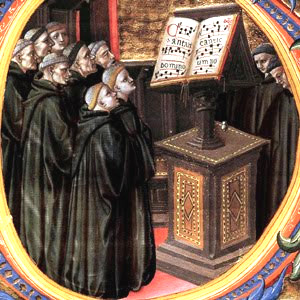
XLVII. THE MANNER of CHANTING THE PSALMS.
The Lord has replied through the master:
1So great must be the reverential seriousness and the manner of chanting the psalms that the Lord listens more lovingly than we say them; 2as Scripture declares: ‘You take delight in the coming of the morning, and in the evening’, 3*and again: ‘Sing the psalms to him joyfully and skillfully, for direct is the word of the Lord’, 4*and again: ‘Exult in him with fear’, 5*and again, ‘Sing to the Lord wisely’. 6Therefore if it commands the singing of psalms to be done wisely and with fear, the person singing them should stand with body motionless and head bowed, and should sing praises to the Lord with composure, 7since he is indeed performing his service before the Godhead, 8*as the prophet teaches when he says: ‘In the presence of the angels I will sing your praise’.
9So the singer of psalms must always be careful not to let his attention wander elsewhere, 10*lest God say to us when our mind has strayed to some other thought: ‘This people honors me only with lip-service, while their hearts are far from me’, 11*and lest it likewise be said of us: ‘With their mouth they blessed and in their heart they cursed’, 12and lest when we praise God with the tongue alone, we admit God only to the doorway of our mouth while we bring in and lodge the devil in the dwelling of our heart. 13For he who goes inside is held in higher esteem by the one who brought him in than is he who is left waiting outside. 14Therefore for a duty so great and so important the heart should be in consonance with the tongue, in order to render with fear what is due to the Lord every day. 15And in his heart let the singer of psalms pay attention to each and every verse he says, because if each verse is noted the soul derives profit for salvation 16*and therein finds all it seeks, for ‘the psalm says everything for edification”; 17*as the prophet declares: ‘I shall sing and understand in the way of integrity, when you come to me’. 18Let him who resounds in the voice also be in the mind of the singer. 19*Let us therefore sing with voice and mind in unison; as the apostle says: ‘I will sing with the spirit, but I will sing with the understanding also’. 20We must cry out to God not only with our voices, but with our heart as well.
21Furthermore, care must be taken while singing that there is not a lot of frequent coughing or prolonged gasping or constant spitting out of saliva; 22nor should the singer dispose In front of him of filth extracted from the nose, but the brother should get rid of it behind his back, 23*for the angels are instructed to stand before the singers of psalms, as the prophet says: ‘In the presence of the angels I will sing your praise’. 24Therefore when these distractions are presented to the singers by the devil, let him who is singing immediately trace the sign of the cross on his mouth.
Question of the disciples:
XLVIII. REVERENCE in PRAYER.
The Lord has replied through the master:
1If to men in the flesh a petition is made with humility only when we ask them for some temporal favor, 2how much more should we plead with Christ about our sins and crimes by praying as much as we can. 3Therefore there must be no duplicity in prayer. 4Let one person not be found in the mouth, yet another in the heart. 5*Prayer must not be protracted by an abundance of words; as the holy gospel says, those who do this become hypocrites.
6There should not be a great deal of frequent coughing or constant spitting or gasping, because the devil uses all these as a hindrance to prayers and psalms. 7For what we have said above should be avoided also during the prayers, namely, if the one praying wishes to spit or dispose of filth from his nose, he should get rid of it not in front of him but behind him, because of the angels standing in front, 8*as the prophet indicates when he says: ‘In the presence of the angels I will sing your praise; I will worship at your holy temple’. 9So you see how evident it is that we pray and sing psalms in the presence of the angels.
10Now, the reason we have said that the prayer should be short is to avoid falling asleep because the prayer is drawn out, 11*or the devil might set various images before the eyes of those lying prostrate for a long time or insinuate something else into their heart. 12*So it is right and proper to pray suppliantly with fear, in such a way that he who is praying seems to be embracing the feet of Christ who is present. 13And we must pray with a fear so great that we are conscious of speaking with God. 14*Therefore we must pray with full attention, as the apostle says: ‘I will pray with both the mind and the spirit’.
Interrogatio discipulorum:
XLVII. De disciplina psallendi.*
Respondit Dominus per magistrum:
1* Tanta debet esse reuerentiae grauitas uel disciplina psallendi, ut amabilius a Domino quam a nobis dicitur audiatur, 2*† sicut ait scribtura: Exitus matutini et uespere delectaberis, 3*† et item: Bene psallite ei in iubilatione, quia rectus est sermo Domini, 4*† et item: Exullate ei cum tremore, 5*† et item: Psallite Domino sapienter. 6* Ergo si sapienter et cum timore iubet psalli, oportet psallentem inmobili corpore, inclinato capite stare et laudes Domino moderate canere, 7* quippe qui ministerium suum ante diuinitatem inplet, 8*† docente propheta, cum dicit: In conspectu angelorum psallam tibi.
9* Nam considerare debet qui psallet semper, ne alibi sensus eius demigret, 10*† ne cum in alia cogitatione sensus noster migrauerit, de nobis dicat Deus: Populus iste labiis me honorat, cor autem eorum longe est a me, 11*† et item de nobis dicatur: Ore suo benedicebant et corde suo maledicebant, 12* et ne cum in sola lingua Deum laudamus, in sola regia oris nostri Deum admittamus et intus in domum cordis nostri introductum diabolum collocemus. 13* Fortior enim ab introducente iudicatur quiintus ingreditur quam qui foris expectat. 14* Ergo ad tantum et talem officium cor pariter cum lingua conueniat cum timore Domino cottidianum debitum redibere. 15* Et notet sibi in corde qui psallet ad singula omnia testimonia, quae dicit, quia singuli uersus si notentur, proficiunt animae ad salutem 16*† et in eis totum inuenitur, quod quaeritur, quia omnia ad aedificationem loquitur psalmus, 17*† dicente propheta: Psallam et intellegam in uia inmaculata, quando uenies ad me. 18* Qui sonat in uoce, ipse sit et in mente psallentis. 19*† Psallamus ergo uoce et mente communiter, dicente apostolo: Psallam spiritu, psallam et mente. 20* Non solum uocibus, sed et corde ad Deum clamare.
21* Cauendum namque est, cum psallitur, ne frequens tussis aut anelus prolixus abundet aut saliuarum excreatus adsiduus, 22* aut narium spurcitiae detractae a psallente inante iactentur, sed debere fratrem post se proicere, 23† quia angeli ante psallentes docentur stare, cum dicit propheta: In conspectu angelorum psallam tibi. 24*† Ergo cum haec omnia inpedimenta psallentibus a diabolo fuerint ministrata, mox sibi qui psallet signet os crucis sigillo.
Interrogatio discipuli:
XLVIII. De reverentia orationis.*
Respondit Dominus per magistrum:
1* Si hominibus carnalibus nisi cum humilitate non fit praecatio, cum beneficia eos aliqua temporalia postulamus, 2* quanto magis conuenit, ut pro peccatis nostris uel facinoribus omni, qua possumus, Christum praece rogemus. 3*† Nulla ergo debet esse in oratione duplicitas. 4* Non unus in ore, alter in corde inueniatur. 5*† Non multiloquio protrahi orationem debere, sicut ait sanctum euangelium hypocritas eos fieri tales.
6*† Non frequens tussis, non excreatus adsiduus, non anelus abundet, quia haec omnia orationibus et psalmis ad inpedimentum a diabolo ministrantur. 7* Nam illud, quod superius diximus, et in orationibus caueatur, ut qui orat, si uoluerit expuere aut narium spurcitias iactare, non inante sed post se retro proiciat propter angelos inante stantes, 8*† demonstrante propheta ac dicente: In conspectu angelorum psallam tibi et adorabo ad templum sanctum tuum. 9* Ergo uides quia ante angelos ostendimur et orare et psallere.
10*† Nam ideo diximus breuem fieri orationem, ne per occasionem prolixae orationis obdormiat. 11*† aut forte diu iacentibus diabolus eis ante oculos diuersa ingerat uel in corde aliud subministret. 12*† Ergo oportet orare cum timore suppliciter, ut qui orat praesentis Christi uideatur pedes tenere. 13 Et cum tanto debemus orare timore, ut cognoscamus quia cum Deo loquimur. 14*† Orare ergo debemus cum omni mente, sicut apostolus ait: Orabo simul et mente et spiritu.
* 47, T-24 PAESW 47, T Interrogatio discipulorum XLVII om. ESW || discipuli A || De disciplina psallendi: cum quale disciplina debeat psalli (debiat salli S1) S1W1 de reuerentia orationis S2W2 || Respondit om. SW || Dominus per mag. om. ESW
* 1 reuerentiae: reuerentia et E || uel: ac SW
* 2 scriptura PASW || exitus usque delectaberis om. E || delectaueris P dilectabiris S1
† 47, 2 Ps. 64, 9
* 3 et item om. E || ei om. E || Domini: di E
† 3 Ps. 32, 3–4
* 4–5 item: iterum E
† 4 Ps. 2, 11
* 5 Domino om. S1
† 5 Ps. 46, 8
* 6 ergo si sapienter om. E || immobili W1 immobile S1 || stare et: in SW moderatae E
* 7 diuinatatem E || implet SW
* 8 docente: hoc add. PA
† 8 Ps. 137, 1
* 9 psallit AS2W2 sallit siue sallet S1 || aliubi S2W2 || emigret E
* 10 nec AE || in om. S1 || aliam A || gogitatione Pac cogitationem A || dicit W1 dicatur S2W2
† 10 Mt. 15, 8; cf. Is. 29, 13
* 11 item: ne add. S2W2 || dicatur: dicitur Pac correctione haud perfecta dicetur • Et dilexerunt eum in ore suo Et in lingua sua mentiti sunt ei • Cor autem eorum non erat rectum cum eo (Ps. 77, 36–37) Et iterum de nobis dicatur E
† 11 Ps. 61, 5
* 12 laudamus: et add. SW || admittamur W1 || in3 om. SW || nostri introductum: introductum PA nostroductum E || contocemus PAS1pcS2W2 conlecemus S1ac conlocemur W1
* 13 introducentem P || quintus: qui intus E || exspectat A
* 14 et: ad add. SW || tale A || cor pariter: corporaliter Aac ut uid. SW || cum1 om. SW || domini SW || cotidianum AS1W1 || redibere: reddere S1W1 redebere S2 sedebere W2
* 15 notet: notetur SW || psallit A sallet S1 psallat W1 || que S1W1 || uersos S2W2 || notentur: notetur S2 || animae om. S2
* 16 quaeritur: queritur S1W1S2 om. W3 ex deperditione
† 16 I Cor. 14, 3 et 26
* 17 intellam W2 || ueniens P uenes S1
† 17 Ps. 100, 1–2
* 18 Qui … ipse: quod … ipsud A || psallentis om. W2
* 19 psallamus ergo uoce et mente om. W2 || et1: in add. W1ac || conmuniter PW1 cummuniter S1
† 19 I Cor. 14, 15
* 20 corde: debemus add. SW
* 21 namquod W1 || est om. W2 || cum psallitur: qui salletur S1 || freques S1 || tusis S2W2 || anhelitus A anhelus S2W2 || habundet SW || salibarum PW1 saluarum Aac || assiduus ASW
* 22 expurcicie S1 expurtitiae W1 expurcitiae S2W2 || detractentur E detracte S1W1S2 || a psallente usque 24 cum om. E || ab W1 || fratre W1 || pro iecere W1
† 23 Ps. 137, 1
* 24 omnia om. SW || a: cum E || diabulo SW || psallit AS2W2 sallet S1 || sigillo: siggillo S1 explicit add. S1W1.
† 24 Cf. Evagrivs Ponticvs, Practicos 66.
* 48, T-14 PASW 48, T Interrogatio usque magistrum: Incipit de oracione S1 de oratione W1 tot. om. S2W2
* 1 humitate W2 || precacio S1 || eis … postulantur SW
* 2 conuenit ut: conuenitur SW || omne S1 || praece Christum SW
* 3 dupplicitas S1
† 48, 3–4 Cf. CYPR., De orat. 31
* 4 ure P || aliter PA
* 5 protrahi: protrai PS1S2 om. W2 ex deperditione || hypocritas: ypocrita P ypocritas S1 om. W2 ex deperditione
† 5 Mt. 6, 5–7; Mt. 23, 14
* 6 excreati A || assiduus SW || anelus PW1 anhelitus A hanelus S1 || diabulo SW || ministrentur Aac
† 6–11 Cf. Cass., Inst. 2, 10
* 7 illum Pac correctione haud perfecta || diximus superius A || et om. S1 || oracionibus S1 || ut om. SW || expere P exspuere A || expurcitias S2W2 expurcicias S1 expurtitias W1 || post se: pust se S1 ipse W2 || retro usque stantes om. SW
* 8 demonstrante usque dicente: dicente propheta S1
† 8 Ps. 137, 1–2
* 9 angelus S1
* 10 nam: et SW || brebem P || occasione S1 || prolixe PS1W1 || obdormiatur S2W2
† 10 Cf. Cass., Inst. 2, 7, 2–3
* 11 aut: ne SW || iacentes diabulus A || uel: aut SW || aliut A
† 11 Cf. Historia monach. 29
* 12 timore: dei add. S1 || presentis A praesentes SW || uideat S1 || tenire S1
† 12 Mt. 28, 9; cf. Hieron., Ep. 39, 5–6
* 14 ergo om. W2 || orabo: orare W1 || spiritu: explicit add. W1 explicit de oracione add. S1.
† 14 I Cor. 14, 15.