|
|
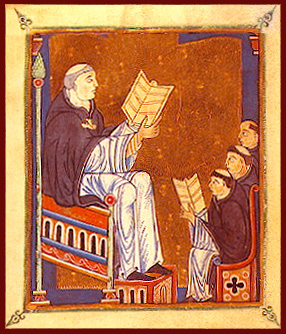
Hugh, teaching. Engl. 13 th. c. Illum. MS., image modif. |
|
|
Hugh, teaching. Engl. 13 th. c. Illum. MS., image modif. |
Based on an article in The Oxford Concise Dictionary of the Christian Church. ed. E.A. Livingstone, (Oxford, 1996).
THEOLOGIAN. Little is known of his life except that c. 1115 he entered St. Victor, an Augustinian house of canons in Paris . He wrote on grammar, geometry, and philosophy; the Didascalion, which is a guide to the study of the artes and of theology; Biblical commentaries; a commentary on Pseudo-Dionysius’ Celestial Hierarchy; a treatise on the Sacraments; and works on spirituality. In all these fields he made a distinctive contribution, with no parade of learning or claims to originality.
This Webpage was created for a workshop held at Saint Andrew's Abbey, Valyermo, California in 1990
Hugh of St-Victor (d. 1142), Victorine theologian. Little is known about his life. About 1115 he entered St-Victor, the house of Augustinian Canons recently founded in Paris by William of Champeaux. According to one account he was born in the region of Ypres, according to another he came from Saxony. His uncle is said to have been archdeacon of the church of Halberstadt, and Hugh dedicated his De arrha animae (‘The Soul’s Betrothal-gift’) to the Augustinian Canons of Hamersleben near Halberstadt. The tradition that makes him a member of the family of the Counts of Blankenberg in Saxony is post-medieval. From the time of his arrival in Paris he does not seem to have left it except for a visit to the court of Pope Innocent II.
Hugh’s works cover a very wide field. He wrote on grammar and geometry, an Epitome in philosophiam, a chronicle, the Didascalion, which is a guide to the study of the artes and of theology, commentaries on the Octateuch and Lamentations, homilies on Ecclesiastes, a commentary on Dionysius the Pseudo-Areopagite’s Celestial Hierarchy, a large-scale De sacramentis Christianae fidei, and works of spirituality such as De archa Noe (morali and mystica), De vanitate mundi, De laude caritatis, and a number of shorter pieces. In all these fields Hugh made a distinctive contribution with no parade of learning or claims to originality. In his biblical commentaries he gave new emphasis to the historical study of Scripture and to the importance of studying the literal sense. The De sacramentis is one of the first medieval summae of theology, beginning with the work of Creation and tracing the historical unfolding of the work of Restoration. History was the foundation for all. Theology and the liberal arts prepared the student for literal and allegorical Biblical interpretation. Virtue and knowledge were paired in the restoration of the goodness of human nature lost in the Fall. Hugh is notable for including the mechanical arts along with the liberal arts in his scheme of the divisions of knowledge. Overarching all was the pursuit of the transforming contemplative experience of the Divine, attained through loving and knowing. Hugh was Augustinian in inspiration, but his works show engagement with the discussions and controversies of his day, esp. with the views of Peter Abelard, William of Conches, and St Bernard.
Collected edn. of his works first pub. at Paris, 1518; also ed. by the Canons of St-Victor, 3 vols., Rouen, 1648, virtually repr. in J. P. Migne, PL 175–7. Crit. edn. by P. Sicard and D. Poirel (CCCM 176, 176 A, 177, etc.; 2001 ff.). Works not incl. in these edns. are ‘De Tribus Maximis Circumstantiis Gestorum’ first pub. by W. M. Green in Speculum, 18 (1943), pp. 484–93, Opera Propaedeutica [‘Practica geometriae’, ‘De Grammatica’, and ‘Epitome in philosophiam’] ed. R. Baron (University of Notre Dame Publications in Mediaeval Studies, 20; 1966), and ‘Descriptio Mappe Mundi’, ed. P. Gautier Dalché (Études Augustiniennes, 1988). There are also modern edns. of ‘De Arrha Animae’ and ‘De Vanitate Mundi’, Books 1–2, by K. Müller (Kleine Texte für Vorlesungen und Übungen, 123; 1913); of ‘Didascalion’ by C. H. Buttimer (Catholic University of America Studies in Medieval and Renaissance Latin, 10; 1939), and of Six Opuscules spirituels, with Fr.tr., by R. Baron (SC 155; 1969). Lat. text of the works, with Fr. tr. by H. Feiss and others (‘Sous la Règle de Saint Augustin’, 3, 7, etc.; Turnhout, 1997 ff.). Further details of his works in D. Poirel, see below. The ‘De Contemplatione’ pub. by [J.] B. Hauréau, Hugues de Saint-Victor: Nouvel examen de l’édition de ses œuvres (1859), pp. 177–210, is not genuine. Eng. trs. of ‘De Arrha Animae’ by F. S. Taylor (London, 1945); of ‘De Sacramentis’ by R. J. Deferrari (Mediaeval Academy of America Publication, 58; 1951); of ‘Didascalion’ by J. Taylor (Records of Civilization. Sources and Studies, 64; 1961), with important introd. and comm.; of Selected Spiritual Writings [incl. ‘De archa Noe morali’ and ‘De vanitate mundi’, Books 1–2] by Sr. [Penelope], CSMV (Classics of the Contemplative Life, 1962), with introd. by A. Squire, OP, pp. 13–42; and of ‘De Tribus Maximis Circumstantiis Gestorum’ and ‘De Archa Noe Mystica’, in M. Carruthers and J. M. Ziolkowski (eds.), The Medieval Craft of Memory (Philadelphia [2002]), pp. 32–70. The Explanation of the Rule of St Augustine usually attributed to Hugh of St-Victor, but prob. the work of Lietbert of St-Ruf, tr. into Eng. by A. Smith, OSB (London, 1911). H. Ostler, Die Psychologie des Hugo von St Viktor (BGPM 6, Heft 1; 1906). H. Weisweiler, SJ, Die Wirksamkeit der Sakramente nach Hugo von St-Viktor (1932). R. Baron, Science et sagesse chez Hugues de Saint-Victor (1957). D. van den Eynde, OFM, Essai sur la succession et la date des écrits de Hugues de Saint-Victor (Spicilegium Pontificii Athenaei Antoniani, 13; 1960). J. Ehlers, Hugo von St Viktor (Frankfurter Historische Abhandlungen, 7; Wiesbaden, 1973). R. Goy, Die Überlieferung der Werke Hugos von St Viktor (Monographien zur Geschichte des Mittelalters, 14; Stuttgart, 1976). S. Ernst, Gewissheit des Glaubens: Der Glaubenstraktat Hugos von St Viktor als Zugang zu seiner theologischen Systematik (BGPM, NF 30; 1987). L. Karfíková, ‘De esse ad pulchrum esse’: Schönheit in der Theologie Hugos von St. Viktor (Bibliotheca Victorina, 8; Turnhout, 1998). D. Poirel, Livre de la nature et débat Trinitaire au XIIe siècle: Le De tribus diebus de Hughes de Saint-Victor (ibid., 14; 2002), with list of edns. of his works, pp. 465–9. J. B. Schneyer, Repertorium der lateinischen Sermones des Mittelalters für die Zeit von 1150–1350, 2 (BGPM, NF 43, Heft 2, 1970) pp. 786–813. R. Baron in Dict. Sp. 7 (pt. 1; 1969), cols. 901–39, s.v. ‘Hugues de Saint-Victor’; J. Châtillon in TRE 15 (1986), pp. 629–35, s.v. ‘Hugo von St. Viktor’; G. A. Zinn and D. van den Eynde in NCE (2nd edn.), 7 (2003), pp. 156–9,CCCM Corpus Christianorum, Continuatio Mediaevalis (Turnhout, 1967 ff.).
ff. and following.
SC Sources Chrétiennes (Paris, 1942 ff.).
BGPM Beiträge zur Geschichte der Philosophic des Mittelalters. Texte and Untersuchungen, begründet von C. Baeumker (Münster i.W., 1891 ff.; from 1938 Beiträge zur Geschichte der Philosophie und Theologie des Mittelalters; NF, 1970 ff.; Supplementbände, 1913 ff.).
NF Neue Folge.
Dict. Dictionnaire de Spiritualité, ed. M. Viller, SJ, and others (16 vols. + index, 1937–95).
NCE New Catholic Encyclopedia (14 vols. + index, New York, etc., 1967, + 3 supplementary vols., 16–18; 1974–89).