|
|
|
|
|
|
The following is adapted from a variety of sources including Hanegraff, Dict. of Gnosis and Esotericism
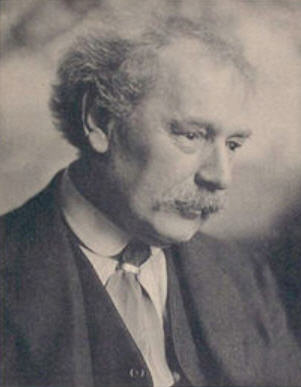
WAITE, Arthur Edward. (c.1857-1842), born on October 2, 1857, in Brooklyn, New York, and brought to London, England, by his family when he was an infant. Raised a Roman Catholic and educated in Catholic schools, he drifted away from his faith after the death of his sister in 1874 gravitating towards spiritualism and Theosophy, both of which he eventually rejected, creating instead an idiosyncratic mixture of sacramental Christianity with the elements of esotericism he found most appealing, particularly Jewish Kabbalah.
Waite was familiar with many of the personalities associated with the late-nineteenth and early twentieth-century revival of occultism. His personal friends included Arthur Machen and Ralph Shirley. He also met William Butler Yeats, Helena Petrovna Blavatsky, Annie Besant, Rudolf Steiner, Wynn Westcott, Algernon Blackwood, and Aleister Crowley.
Throughout his lifetime he remained fascinated with Roman Catholic ritual and mysticism and was initiated into a wide variety of esoteric orders, including the Masons, the Rosicrucians, alleged Knights Templar, and most significantly, the Hermetic Order of the Golden Dawn, which he joined in 1891 and which he transformed in 1915 into the Fellowship of the Rosy Cross.
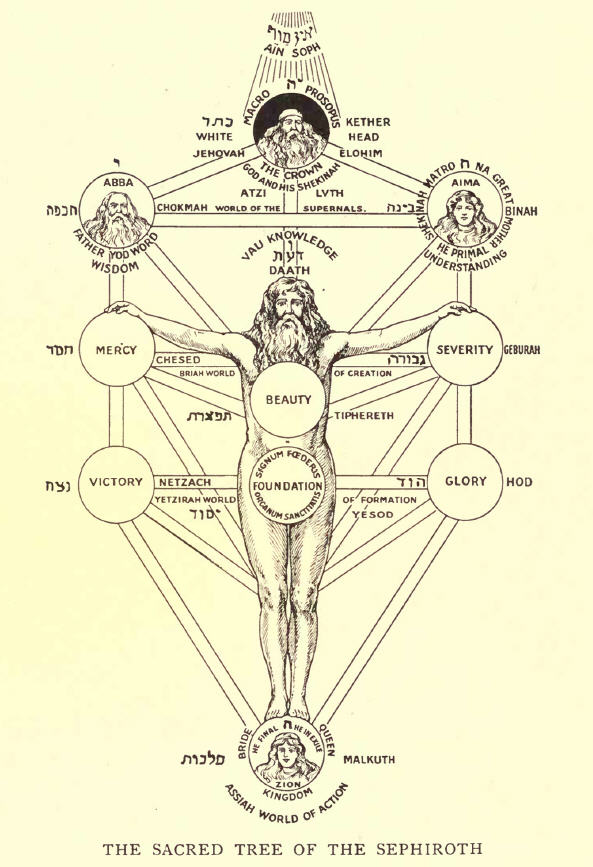
The Golden Dawn was a Rosicrucian offshoot founded in 1888 by Theosophist W.W. Westcott, S.L. Mathers, and W.R. Woodman, the latter a competent hebraist and kabbalist. Westcott created a false pedigree for the Golden Dawn, claiming authorization from Anna Sprengel a non-existent Bavarian Rosicrucian. The rituals for the society were partly based on mysterious cypher documents created around 1880 by K. MacKenzie, encoded according to the Polygraphiae of Abbot Johannes Trithemius, OSB, and decoded after MacKenzie's death in 1886. The rituals of the Golden Dawn combined Rosicrucian grades of initiation with Jewish Kabbalah, associating progressive initiation in the society with the ten Sephiroth of the mystical Tree of Life described in the kabbalistic text Zohar.
Waite was a successful and popular author of books on esoteric spirituality and the occult, writing on mysterious matters with an acerbic claim to objectivity . Fascinated with the writings of the apostate Catholic deacon and self-styled magician, Eliphas Levi, Waite published an anthology of Lévi’s writings, The Mysteries of Magic in 1886, as well as his own studies, The Real History of the Rosicrucians, (1887), and The Occult Sciences, (1891). Having Joined the Golden Dawn in 1891 he became a Mason in 1901 and sought and received initiation into as many masonic and quasi-masonic/rosicrucian rites and orders as were available to him. Unsatisfied with the teachings of the Golden Dawn,
He was drawn increasingly towards the idea of the “Secret” or “Interior Church”; not an instituted body but ‘the withdrawn spirit of the outward Holy assembly’, made up of ‘the integration of believers in the higher consciousness’. Coupled with this notion was Waite’s concept of “The Secret Tradition”, which he developed from his interpretation of the doctrine of the Fall, defining it as ‘the immemorial knowledge concerning man’s way of return whence he came by a method of the inward life’. This tradition, Waite argued, has been maintained down the ages in secret by means of ‘Instituted Mysteries and cryptic literature’.
Hannegraff, Dictionary of Gnosis and Esotericism, 1164-65
Waite publically disputed the legitimacy of the Golden Dawn’s cypher documents (and the existence of Anna Sprengel); and with the disintegration of the Golden Dawn in 1903 he took control of its Isis-Urania Temple in London. He re-named the order the “Independent and Rectified Rite”, and shifted this new branch of the Golden Dawn away from magic and the occult, inserting into its rituals and teachings his own version of Christian mysticism. With the collapse of this rite in 1915 he closed the former Golden Dawn Temple and established his own “Fellowship of the Rosy Cross”, retaining both his emphasis on Christian mysticism and the ceremonies derived from the Zohar Tree of Life. His considered his adapted rituals as intentionally dramatic and devotional rather than magical and manipulative. Their goal was ascent to the “Secret Tradition”, understood as spiritual/psychological union with the Divine or “The Higher Self”.
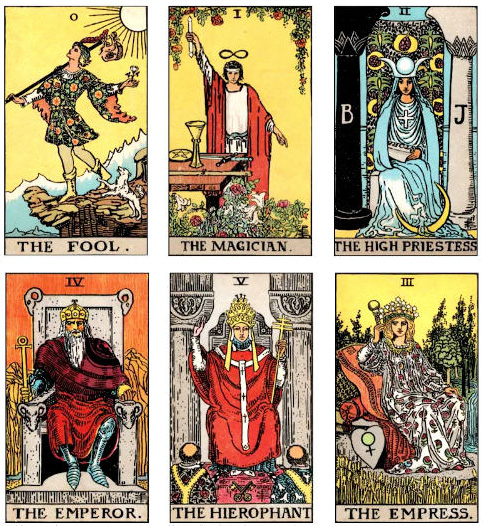
A position with Horlicks, a British manufacturer of malted chocolate, enabled him to both financially support his growing family and continue writing and publishing. He wrote popular and supposedly-historical texts on esoteric subjects, including the Holy Grail, Freemasonry, Kabbalah, Rosicrucianism, alchemy, and the Tarot. He is particularly remembered by occultists today for his collaboration with the British artist Pamela Coleman-Smith in producing the so-called Waite deck of Tarot cards, as well as for his 1910 commentary, The Pictorial Key to the Tarot. Both the deck and the book remain popular in the Wiccan and New Age movements; however, Waite denied the remote origins of Tarot cards and he considered their use their use in fortune-telling and divination less significant than as pictorial-symbolic images for use in Christian meditation:
there is no particle of evidence for the Egyptian origin of Tarot cards. […] The Tarot embodies symbolical presentations of universal ideas, behind which lie all the implicits of the human mind, and it is in this sense that they contain secret doctrine, which is the realization by the few of truths imbedded in the consciousness of all, though they have not passed into express recognition by ordinary men.
[...] I do not suggest that the Tarot set the example of expressing Secret Doctrine in pictures and that it was followed by Hermetic writers; but it is noticeable that it is perhaps the earliest example of this art. It is also the most catholic, because it is not, by attribution or otherwise, a derivative of any one school or literature of occultism; it is not of Alchemy or Kabalism or Astrology or Ceremonial Magic; but, as I have said, it is the presentation of universal ideas by means of universal types, and it is in the combination of these types--if anywhere--that it presents Secret Doctrine.
Waite, The Tarot, (ch 1.4 and 2.1)
|
|
|
|
ZOHAR/KABBALAH SEPHIROTH |
SIX CARDS of THE WAITE--SMITH TAROT (Major Arcana) |
This Webpage was created for a workshop held at Saint Andrew's Abbey, Valyermo, California in 1990