|
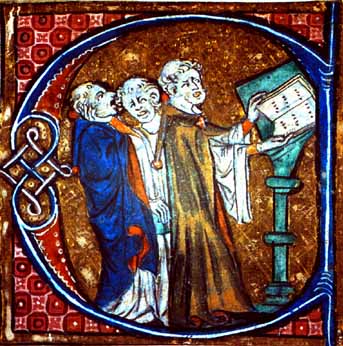
Singing
clerics, medieval illum. MS, Bodleian lib., Oxford |
RESPONSORIES
and SEQUENCES
IN
THE
tenth chapter of his book L’Amour des letters et
le desire de Dieu (The Love of Learning and the Desire for God) Dom
Jean Leclercq, O.S.B.
describes what he calls “the
poem
of the liturgy”. |
HE
emphasizes that one
of the outstanding features of monastic
spirituality was “a
sense of the
Lord’s majesty”,
which can be most clearly appreciated in monastic liturgical compositions:
antiphons, responsories, hymns, tropes, and sequences. “It
was,”
he states “in
and through the liturgy that the monks came into contact with the Scripture and
the Fathers; and [through the liturgy] they were permeated by the great
traditional religious themes.”
(Paris, Les Éditions du Cerf, 1957).
WHILE
the liturgy was thus a principal source of monastic spiritual insight, it also
came to reflect the
results of monastic contemplative prayer. Monks and nuns who experienced God in the
liturgy wrote prayers and poems describing their spiritual perceptions: these poems, in turn, became antiphons, responsories, and
sequences in the monastic antiphonal (the book of music used at the Liturgy of the Hours)
and gradual (containing the music used at mass). In this way, over many
centuries experiences of contemplative
prayer were set to music and incorporated into the liturgies that had originally
inspired them.
LITURGICAL
prayer therefore affords an encounter God at many different levels. Two of
these are reflected in the literary genres that compose the liturgy:
[1]
God is present both in the historical narrative and “beneath
the letter”
of the inspired biblical texts which make up the majority of the liturgy; and
[2] the non-biblical poetry (hymns, antiphons,
responsories, sequences) and prayers of the liturgy invite us to make our own
the interpretations and experiences of our Christian forebears.
CONCERNING
the mystical significance of the sequences and responsories Leclercq
writes:
The
traditional bases were primarily the Bible and the Fathers. If all these compositions are essentially poetic
in character, they owe
it to minds which had been fashioned by Holy Scripture. Their modes of expression are concrete and rich
in images. The value
of their words lies more in what they mean than in what they actually say: their evocative power is
greater than their precision;
each of them is like a note which awakens harmonics.
All the delicacy of liturgical poetry comes from
the free and harmonious
use it makes of the sacred words: the groups of versicles, each of which, because of its origin and own particular meaning, has
special significance and whose combination produces a more complex,
and a newer whole; they are daring in juxtaposing two texts, one
of which throws light upon the other, thereby forming, because it is so different, a contrast with it which makes each one’s
individual light more intense; their
way of lending a wide range of different
colors to the same unchanging texts by, for example, incorporating
verses of the Psalms within the antiphons; the continual passage from fact to allegory, from event to idea; the
alternation of formulas, each of which evokes a different reality, which
complete each other within a whole that is richer still, as the facets of a diamond permit us to see all its fires
asparkle.
(The Love of Learning and the Desire
for God, A Study of Monastic Culture,
Jean Jeclercq, O.S.B. , tr, C. Misrahi,
(Fordham Univ. Press, NY, 1961, 1974). p. 295.)
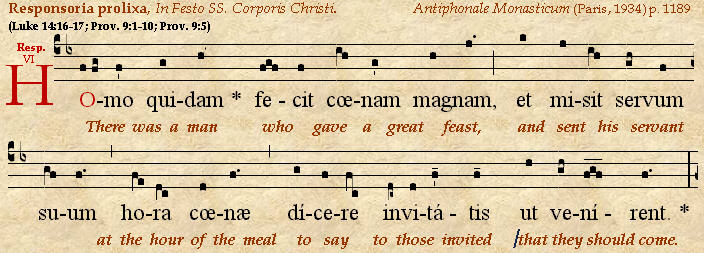
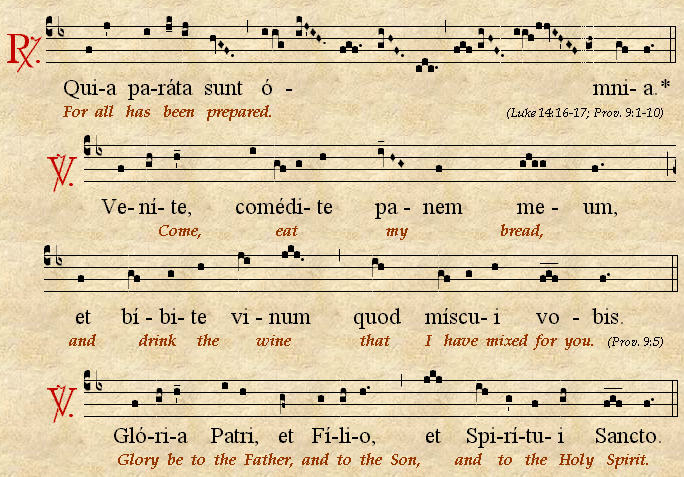
HOMO QUIDAM
THE
following prolix responsory illustrates many of
these features. It represents the musical and poetic application of the practice
of lectio divina to the liturgy. Meditation on the meaning of Corpus Christi,
the Feast of the Body and Blood of Christ, has interwoven the Lord’s parable
of the great feast (which does not have a happy ending) with the much more
joyful cry of Wisdom in Proverbs to “come eat the bread and drink the wine”
she has mixed. This responsory is also the focus of both readings in the Office
of Readings for Wednesday of the Sixth Week in Ordinary Time (v.
3, pp. 209-213: Prov. 9:1-18; Commentary on Proverbs by Procopius of
Gaza).
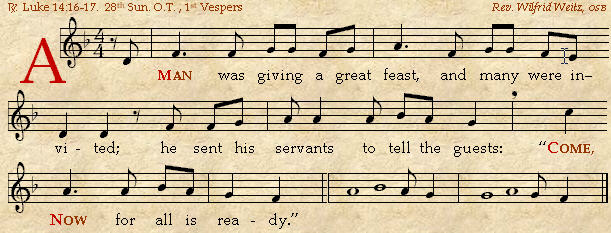
THIS
English antiphon for the Twenty-Eighth Sunday in Ordinary Time is based on the
prolix responsory above:
VENI SANCTE
SPIRITUS
VENI CREATOR SPIRITUS
VENI
CREATOR
SPIRITUS
/
COME,
CREATOR
SPIRIT
HYMN
to the HOLY
SPIRIT
|
Come Holy Spirit, creator,
from your bright heavenly throne,
come take possession of our souls
and make them all your own |
Veni Creator Spiritus,
Mentes tuorum visita,
Imple superna gratia,
Quae Tu creasti pectora. |
|
You Who are called Paraclete
blest gift of God above,
the living spring, the living fire,
sweet unction and true love. |
Qui diceris Paraclitus,
Altissimi donum Dei,
Fons Vivus, Ignis, Caritas,
Et spiritalis unctio. |
|
You Who are sevenfold in your grace,
finger of God's right hand;
his promise, teaching little ones
to speak and understand. |
Tu septiformis munere,
Digitus paternae dexterae,
Tu rite promissum Patris
Sermone ditans guttura. |
|
O guide our minds with your blest light,
inflame our hearts with love;
and with strength, which never decays,
confirm our mortal frame. |
Accende lumen sensibus,
Infunde amorem cordibus;
Infirma nostri corporis,
Virtute firmans perpeti.
|
|
Drive far from us our deadly foe;
true peace unto us bring;
and through all perils, lead us safe
beneath your sacred wing. |
Hostem repellas longius,
Pacemque dones protinus;
Ductore sic te previo,
Vitemus omne noxium. |
|
Through You may we know the Father;
through You the eternal Son,
and You the Spirit of them both,
thrice-blessed Three in One. |
Per te sciamus da Patrem,
Noscamus atque Filium
Teque utriusque Spiritum,
Credamus omni tempore. |
|
All glory to the Father be,
with his co-equal Son:
the same to You great Paraclete,
While endless ages run. |
Deo Patri sit gloria,
Et Filio, qui a mortuis
Surrexit, ac Paraclito,
In saeculorum saecula. |
|
Amen |
Amen. |
Antiphonale Synopticum: Neumes, square-note, and Latin text:
http://gregorianik.uni-regensburg.de/cdb/3095
This Webpage
was created for a workshop held at Saint Andrew's Abbey, Valyermo, California in
1990....x.... ’ “”.
SEE FULL TRANSLATION
Second reading
From a commentary on the Book of Proverbs by Procopius of Gaza, bishop
The Wisdom of God has mingled wine and spread a table for us
Wisdom has built herself a house. God the Father’s Power, himself a person, has
fashioned as his dwelling-place the whole world in which he lives by his
activity, and also man who, created to resemble God’s own image and likeness,
has a nature which is partly seen and partly hidden from our eyes.
And she has set up seven pillars. To man who was made in the image of Christ
when the rest of creation was completed, Wisdom gave the seven gifts of the
Spirit to enable him to believe in Christ and to keep his commandments. By means
of these gifts the spiritual man grows and develops until, through firm faith
and the supernatural graces he receives, he finally reaches maturity. Knowledge
stimulates virtue and virtue reflects knowledge. The fear of the Lord,
understanding and knowledge give the true orientation to his natural wisdom.
Power makes him eager to seek understanding of the will of God as revealed in
the laws by which the entire creation is governed. Counsel distinguishes these
most sacred and eternal laws of God from anything opposed to them; for these
laws are meant for man to ponder, to proclaim, and to fulfill. Insight disposes
man to embrace these expressions of God’s will and to reject whatever
contravenes them.
She has mingled her wine in a bowl and spread her table. Because the Word of God
has mingled in man, as in a bowl, a spiritual and a physical nature, and has
given him a knowledge both of creation and of himself as the Creator, it is
natural for the things of God to have on man’s mind the inebriating effect of
wine. Christ himself, the bread from heaven, is his nourishment enabling him to
grow in virtue, and it is Christ who quenches his thirst and gladdens him with
his teaching. For all who desire to share in it, he has prepared this rich
banquet, this spiritual feast.
She has sent forth her servants with the sublime message that all are to come to
the bowl and drink. Christ has sent forth his apostles, the servants of his
divine will, to proclaim the message of the Gospel which, since it is spiritual,
transcends both the natural and the written law. By this he calls us to himself
in whom as in a bowl there was brought about by the mystery of the incarnation a
marvelous mingling of the divine and human natures, although each still remains
distinct. And through the apostles he cries out: Is anyone foolish? Let him turn
to me. If anyone is so foolish as to think in his heart that there is no God,
let him renounce his disbelief and turn to me by faith. Let him know that I am
the maker of all things and their Lord.
And to those who lack wisdom he says: Come, eat my bread and drink the wine that
I have prepared for you. To those who still lack the works of faith and the
higher knowledge which inspires them he says: “Come, eat my body, the bread that
is the nourishment of virtue, and drink my blood, the wine that cheers you with
the joy of true knowledge and makes you divine. For in a wonderful way I have
mingled my divinity with my blood for your salvation.”