 |
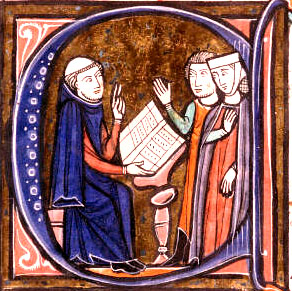
“Teaching Monk,” The Articella, 13th c. |
|
|
“Teaching Monk,” The Articella, 13th c. |
|
|
|
INTRODUCTION to DISCUSSIONS |
|
|
January 13, 2006
THE Discussion link on the navigation panel (that you presumably just clicked) opens this “portal” page, permitting you a choice of the different forums that will be opened successively throughout the course.
The first “Introductory Forum” (the link is given below) is for the purpose of self-introductions. I would be grateful if everyone would introduce themselves, saying a few words about themselves and their religious tradition, and perhaps sharing something of their hopes for this course. We share a great richness of different religious traditions and communities among one another, and it will be helpful to attune ourselves to this from the start.
FEEL free to interact with one another by responding to each another's postings and starting new “threads”. Don't worry if you don't know what that means: you'll soon discover it through practice. Use this introductory forum as an opportunity to play with the technology and see how it works. This is also an opportunity to ask each other questions about using the technology
ONE point to bear in mind is that you can't remove or edit comments after you have submitted them; so if you wish to write a longish note, it may be helpful to create it first in another program, then cut-and-paste it into the forum.
[I should warn you that the following comment may not make much sense until after you have played with the discussion forum a bit:] In regard to seeing one another's "threads" and responses, please note that you can adjust [by clicking, holding, and moving] the size of the frames in any discussion. Widely expanding the size of the left-hand frame will make it easier to see the "flow" of the threads.
Once you are in the forum you can always return to this course site by clicking the link in the upper left panel ("Monast.Spir.Theol").
OKAY, here we go. Click on this link to go to the Introductory Forum and introduce yourself: INTRODUCTORY FORUM
|
DISCUSSION FORUMS |
|
|
January 16, 2006
For those who have not yet introduced themselves (see the explanation below, dated January 13, 2006): INTRODUCTORY FORUM
[Please note that the questions below the link to the forum (they will be repeated within the forum itself) are intended only to BEGIN our conversation; feel free to share your own observations and insights]
|
PART ONE: Celestial Visions, Heavenly Voyages |
1) FORUM ONE Plato, The Parable of the Caves, The Myth of Er
a) Which elements in Plato's parables would be most appealing for Christian seeking to understand and practice "contemplation"?
b) What in Plato's thought could be problematic or misleading?
January 23, 2006
2) FORUM TWO Cicero, Enoch, The authentic meaning of "contemplation" and "action"
a) Is Enoch a more attractive (or more confusing) model of the contemplative than Plato's Er?
b) What elements of contemplation did you notice in Cicero that were less obvious in Plato?
c) Do you find the notion of a dynamic interrelationship between contemplation and the ascetical quest for virtue helpful? Have you had much experience with the tradition of stages in - or a stepwise movement of - spiritual progress?
January 30, 2006
|
PART TWO: Biblical and Early Christian Models of Spiritual Ascent |
3) FORUM THREE The Apophatic and Kataphatic Ways; Ascent to Vision in the Bible, the Martyrs, and the Monastic Founders
a) Although the notion of God present in “a deep but dazzling darkness” is perplexing to some Christians, apophatic prayer techniques based on the via negativa (e.g. centering prayer, the Jesus Prayer) have become increasingly popular in recent years. Is this a mixed blessing?
b) What is your personal reaction to the visions of the martyrs and early monastic founders? What role (if any) do such visions play in your own Christian tradition?
c) Does the notion of spiritual vision in the martyrs and monastic founders differ significantly from what we have seen in Er, Scipio, and Enoch?
February 6, 2006
|
PART 3 - SOLITUDE and COMMUNITY in EARLY MONASTICISM (introd.) |
4) FORUM FOUR Early Egyptian Monasticism; the Life of Antony.
a) One of the first terms used in reference to the monks and nuns of antiquity is anchorite, from the Greek anachoreo, which means to withdraw or to flee. Based on your reading and study, what were the early monastics running from, and what were they running towards?
b) What are your thoughts about the formation Antony received from his local Christian community (i.e. before he withdrew into the solitude of the abandoned fort)?
February 13, 2006
5) FORUM FIVE Hermits, Hermitesses, and Cenobites - Ancient and Modern.
a) How different is our contemporary experience of solitude and community from that of the monks and nuns of earlier ages? How did they - and how do we - envision the respective asceticisms of the two states?
b) Are you perchance an anchorite, or have you any friends who are? Would you care to share something of your experience of the hermitage in the modern world?
February 20, 2006
|
PART 4: LECTIO DIVINA: Praying the Scriptures in the Embrace of God |
6) FORUM SIX Lectio Divina, Praying the Scriptures.
a) In the practice of lectio divina the terms meditation and contemplation describe two aspects or movements within a process, rather than ends in themselves or “states” to be maintained. How does this correspond to your own understanding of these terms, or your experience with them as spiritual practices?
b) The text we studied from the Constitution on Divine Revelation suggests that lectio divina is one of the means by which sacred tradition makes progress over the centuries. Is this an exaggeration? What could it mean in practical terms?
February 27, 2006
7) FORUM SEVEN Lectio Divina, Praying the Scriptures - conclusion.
a) Philo, Guigo, and Hugh each highlight different aspects and applications of lectio divina. How do their insights compare with your own experience of this practice?
b) Leclercq suggests that lectio divina is the basis of a monastic approach to exegesis and of a whole “monastic culture”. Of what value is that approach today? Can it (should it) be reconciled with modern, scientific exegesis of the Scriptures?
c) We practiced together a "group experience" of lectio divina, a practice which is attracting renewed iterest since the 2008 Synod of Bishops on Sacred Scripture . What are your reactions to this exercise? How might you modify or employ it the parish?
March 6, 2006
|
PART 5 - PSALMODY and PRAYER: A Rhythm of Prayer that Heals the Soul |
8) FORUM EIGHT Psalmody and Prayer, A Rhythm that heals the Soul (introd.)
The central place of psalmody in Christian prayer has been attacked from many quarters in recent years. A famous monastic musician once quipped that the Psalter is "a quaint and vivid testimony to the spirituality of the late Bronze Age". Related complaints abound in the periodicals of most Christian denominations, generally in regard to the violent imagery and intolerant world view expressed in psalmody.
a) How would the sources we are studying respond to these criticisms?
b) Do you find their approaches helpful?
March 13, 2006
9) FORUM NINE Psalmody and Prayer, A Rhythm that heals the Soul (concl.)
The sources we have studied suggest an ancient approach to psalmody that is significantly different from what is generally experienced in worshipping Christian communities today. Intervals of silence allowed for an intertwining of psalmody with personal prayer. A symbolic or allegorical experience of the text expected the psalter to open out both as a mirror of the soul and a window into God and creation.
a) Is it realistic to hope that some aspects of this approach might be revived in our own day?
b) If you have any experience of communities or parishes that have attempted this, would you care to share them?
March 20, 2006
|
PART 6 - THE LITURGY, A PLACE OF MEETING WITH GOD |
10) FORUM TEN Liturgical Prayer - the Heart of Monastic Spiritual Theology (introd.)
We have seen that during the first centuries of Christian monasticism there existed an approach to liturgical prayer that was profoundly mystical, even “contemplative”.
a) In our own day it cannot be claimed that the mystical significance of liturgy is overemphasized. Has the notion of “contemplative liturgical prayer” any relevance (or any hope) in an era such as ours, where the liturgy is made to serve so many other purposes?
b) We have studied texts in which the liturgy is described as “divinizing”; and, indeed, this notion retains an important place in the mystical theology of the Christian East. In the West this teaching first cooled, and then simmered well below the surface for several centuries; but it is undergoing a revival in our own day. Is this a good thing?
March 27, 2006
11) FORUM ELEVEN Liturgical Prayer - the Heart of Monastic Spiritual Theology (concl.)
We now consider the spiritual pole of “kataphatic contemplation”: that is, of beholding the glory of God in complex images and in light, rather than the simplicity and “dazzling darkness”of Dionysius’ Mystical Theology.
a) What are your reactions to our glimpse at the music and visual arts of medieval monasticism? Are they primarily “period pieces” or do they have something to say to us today?
b) Our selections from St. Gertrude and Vatican II suggest that liturgical prayer can be both profoundly contemplative and a real exercise of our common priesthood. How does this comport with a modern approach which tends to emphasize the differences between (and sometimes the incompatibility of) liturgical prayer and contemplative prayer?
April 3, 2006
|
PART SEVEN: Contemplative Exegesis (introd.) |
12) FORUM TWELVE The Scriptures as a Source of Spiritual Transformation (introd.).
Our first three readings and lectures in this section provide the background and some of the medieval "working out" of Evagrius Ponticus' much more difficult text. Of all the early monastic authors, it is he who most strongly emphasizes the interrelationship between, prayer, contemplative reading of the bible, and the ability to offer spiritual direction. I am aware that the Gnostikos is a difficult text, but I am eager to hear your responses to it:
Do you believe Evagrius (and his predecessors) had a valid point about the way we "read" scripture and the way we "read" personal stories and human souls?
April 17, 2006
|
PART SEVEN: Contemplative Exegesis (concl.) |
13) FORUM THIRTEEN
The Scriptures as a Source of Spiritual Transformation (introd.).Cassian offers a method or model of contemplative exegesis. What do you think of the different ways his method is applied by Eucherius, Chrysologus, and Bede?
What are your reactions to the allegory of Christ's Passion in the anonymous reading for Holy Saturday?
April 24, 2006
|
PART EIGHT: Monologistic Prayer (introd.) |
13) FORUM FOURTEEN
Origins and Types of Early Christian Monologistic PrayerHow would you respond to a Christian who confides to you their discomfort with monologistic prayer because it seems to contradict the Lord's warning to avoid “vain repetition” in prayer? (And if you have not yet encountered this concern, I guarantee that you one day will!)
Did you find and surprises in the texts from Cassian or on the Rosary? Many modern advocates of monologistic prayer quote Conferences 9 and 10 in a very truncated and selective way. Do you have any experiences in this regard?
May 1, 2006
|
PART EIGHT: Monologistic Prayer (concl.) |
15) FORUM FIFTEEN
The Jesus Prayer and Modern Monologistic MethodsOur rather detailed study of the development of Eastern Hesychasm (the Jesus Prayer) suggests a more intricate interrelationship between liturgical prayer and private monologistic prayer than is generally appreciated. What our your thoughts on implications of this for the way we teach and recommend different forms of prayer today?
For those who read the article on Symeon, any thoughts on his sense of the interrelationship between an experience of divine indwelling and the authority to absolve from sin?
May 8, 2006
|
PART NINE: Monastic Reform and Renewal |
16) FORUM SIXTEEN Benedict as Reformer; Monastic Liturgical Renewal
I am very interested in your responses to the material we have reviewed on: (1) Epochs of Monastic Reform; (2) Benedict as monastic reformer/renewer; and (3) monastic reform of the Liturgy of the Hours.
But perhaps even more interesting and important is the question (for which there is obviously no right or wrong answer): what portions or aspects of the different sources and subjects we have studied together this semester do you believe could contribute to modern spiritual reform or renewal?
May 8, 2006
|
OPTIONAL FORUM: Final Thoughts and Suggestions |
17) FORUM SEVENTEEN Your Recommendations and Reflections
As was mentioned on the Announcements page, this is the first year that the sections on Monologistic Prayer and Monastic Reform have been offered: and I would be grateful to hear which portions of these (or any other sections) you think ought to be expanded or reduced. And please feel free to share your thoughts on the pace of the course. If anything else is to be added, or if any sections are to be expanded, that would mean increasing the number of lectures and texts per week. Any suggestions?