|
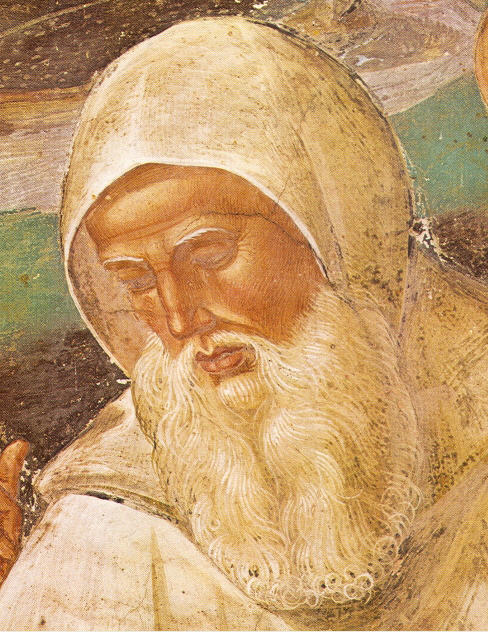
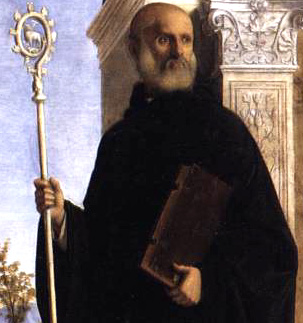
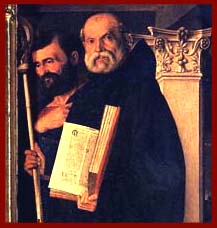
Saint Benedict Sodoma, Monte Oliveto, c.1500. |
|
|
Saint Benedict Sodoma, Monte Oliveto, c.1500. |
|
THEOSIS
/
DIVINIZATION
|
|
|
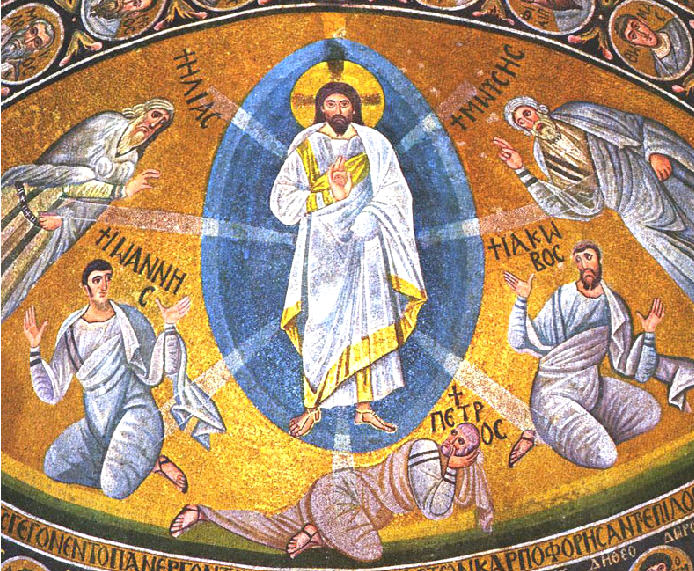
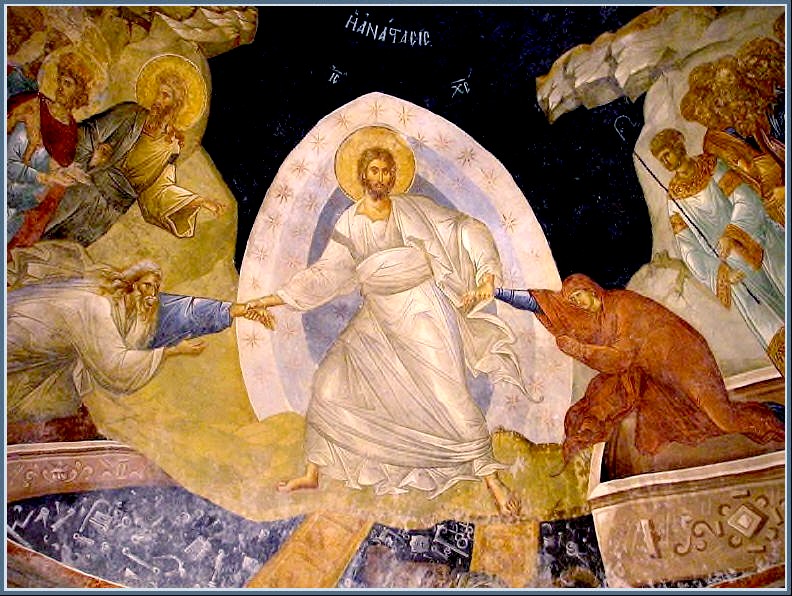
| Transfiguration, Apse mosiac, St. Catherine's Monastery, Sinai, 6th cent. | Anastasis, Constantinople, Chora monastery, 14th cent. |
Handout (MS-Word doc) † Timelines [addt'l-nav.] † Bibliography / Suggested Reading / Study Links [pdf]
THE following images and texts are intended to encourage meditation and reflection on three theological themes:
1. Theosis (θέωσις) “Divinization” often called “sanctifying grace” in the West.
2. Anastasis (ἀνάστασις) “Resurrection”.
3. Apokatastasis (ἀποκατάστασις) the doctrine of universal salvation, literally “restoration”.
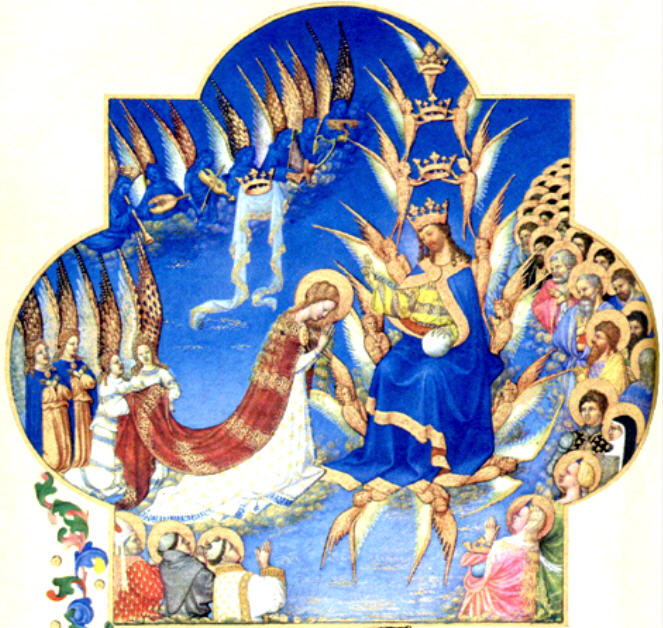
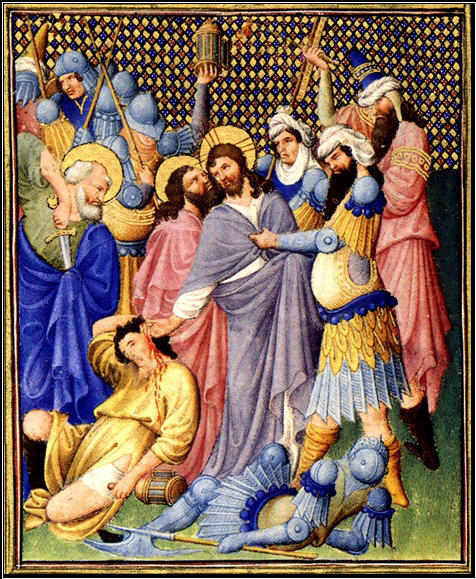
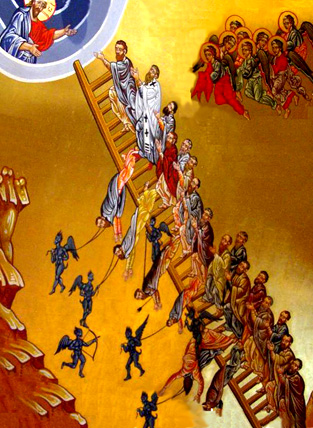
THE images are: first An early icon of the transfiguration (6th cent.); second, an illumination from the medieval West depicting the coronation of the Blessed Virgin Mary in heaven; third, the Anastasis/Resurrection icon employed in the Christian East to depict what the Western Church calls “The decent into Hell”; and fourth, a medieval western illumination of the betrayal of Jesus in the garden.
SUGGESTED texts include:
1. “Eucharistic divinization” in the Confessions and a Christmas homily of Saint Augustine
2. Saint Athanasius and the Catechism of the Catholic Church on divinization
3. Vatican II on the Blessed Virgin Mary as icon of the whole People of God
4. The Second Reading from the Office of Readings (“Vigils”) for Holy Saturday, from the Roman Catholic Liturgy of the Hours.
5. Gregory of Nyssa on the Apokatastasis
6. Joseph Ratzinger (Pope Benedict XVI) on Hell, Purgatory and Heaven, from his book on eschatology
|
|
| Transfiguration, Apse mosiac, St. Catherine's Monastery, Sinai, 6th cent.. |
|
|
|
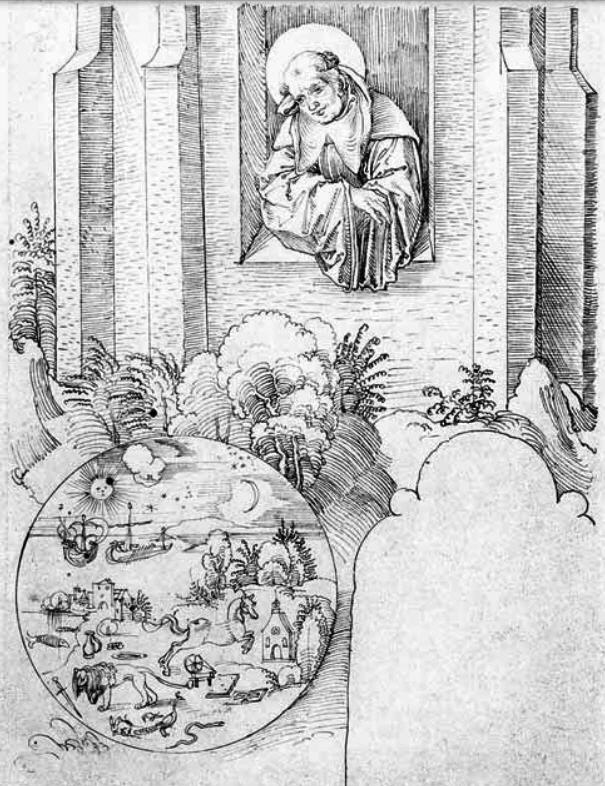
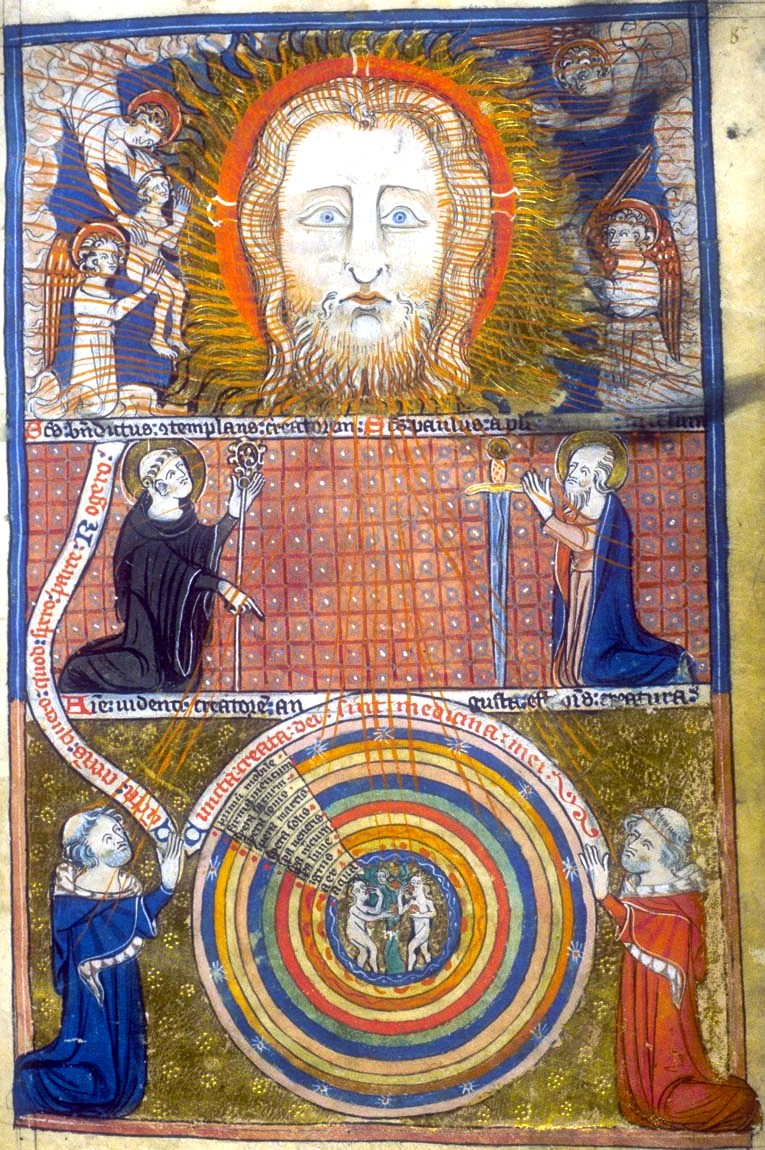
The Vision of Benedict, Schaüfelein/?Dürer c.1501 |
|
|
|
The Vision of Benedict, Glasgow Sp Coll MS Hunter 231 (U.3.4) c. 1330 |
|
|
|
“Benedict contemplates creation:
St. Paul . . . Here he [Benedict beholds the narrowness of all
created things” |
|
|
| The Coronation of the Blessed Virgin Mary, Tres Riches Heures of Jean, Duke of Berry, 15th cent. |
|
|
| Anastasis, Constantinople, Chora monastery, 14th cent. |
|
|
| Belles Heures of Jean, Duke of Berry, 15th cent. |
THESE two medieval images illustrate two complimentary theological perspectives of the question of the Apokatastasis – the restoration of all things in Christ: first, the soteriological and eschatological perspective; and second, the daily, psychological/moral perspective. On the one hand, the Orthodox icon of the Anastasis, the resurrection, illustrates Christ’s descent into hell to rescue Adam, Eve, and the ancient Just. The second image is of the betrayal in the Garden: here, too, Christ extends his healing hand in a miniature world swirling in a frenzy of violence. But this second image also hints at the possibility of redemption from the daily hell of chosen violence and self-imposed isolation. How deep are the hells into which Christ descends, and how do we clasp the hand that leads us out?
APOKATASTASIS:
ἀποκατάστασις,
εως , η
[Liddell & Scott Greek-English Lexicon]
restoration, re-establishment, τοῦ ἐνδεοῦς Arist.MM1205a4; εἰς φύσιν ib. 1204b36, 1205b11;
return to a position, Epicur.Ep.1p.8U.; esp. of military formations, reversal of a movement, Ascl.Tact.10.6, etc.; generally, πάντων Act.Ap.3.21 ; of the soul, Procl.Inst.199 (pl.); τῆς φύσιος ἐς τὸ ἀρχαῖον Aret. CD1.5 ; [to its primordial state]
recovery from sickness, Id.SA1.10; τῶν ὁμήρων εἰς τὰς πατρίδας Plb.3.99.6 ; εἰς ἀ. ἐλθεῖν, of the affairs of a city, Id.4.23.1;
return to original position, Ascl.Tact. 10.1;
ἄστρων return of the stars to the same place in the heavens as in the former year, Plu.2.937f, D.S.12.36, etc.; periodic return of the cosmic cycle, Stoic.2.184,190; of a planet, return to a place in the heavens occupied at a former epoch, Antioch.Astr. ap. Cat.Cod.Astr. 7.120,121;
but, zodiacal revolution, Paul.Al.T.1; opp. ἀνταπ.(q. v.), Doroth. ap. Cat.Cod.Astr.2.196.9;
restoration of sun and moon after eclipse, Pl.Ax.370b.
APOKATASTASIS
From
the 1914 Catholic Encyclopedia.
(Gr.,
apokatastasis; Lat. restitutio in pristinum statum, restoration to
the original condition).
A
name given in the history of theology to the doctrine which teaches that a time
will come when all free creatures will share in the grace of salvation; in a
special way, the devils and lost souls.
[1A] ORIGEN on the APOKATASTASIS
The doctrine of the apokatastasis is [not, indeed, peculiar to St. Gregory of Nyssa, but is] taken from Origen, who seems at times reluctant to decide concerning the question of the eternity of punishment. Tixeront has well said that in his “De principiis” (I, vi, 3) Origen does not venture to assert that all the evil angels shall sooner or later return to God (P.G., XI, col. 168, 169); while in his “Comment. in Rom.”, VIII, 9 (P.G., XIV, col. 1185), he states that Lucifer, unlike the Jews, will not be converted, even at the end of time. Elsewhere, on the other hand, and as a rule, Origen teaches the apokatastasis, the final restoration of all intelligent creatures to friendship with God.Tixeront writes thus concerning the matter:
“Not all shall enjoy the same happiness, for in the Father’s house there are many mansions, but all shall attain to it. If Scripture sometimes seems to speak of the punishment of the wicked as eternal, this is in order to terrify sinners, to lead them back into the right way, and it is always possible, with attention, to discover the true meaning of these texts. It must, however, always be accepted as a principle that God does not chasten except to amend, and that the sole end of His greatest anger is the amelioration of the guilty. As the doctor uses fire and steel in certain deep-seated diseases, so God does but use the fire of hell to heal the impenitent sinner. All souls, all impenitent beings that have gone astray, shall, therefore, be restored sooner or later to God’s friendship. The evolution will be long, incalculably long in some cases, but a time will come when God shall be all in all. Death, the last enemy, shall be destroyed, the body shall be made spiritual, the world of matter shall be transformed, and there shall be, in the universe, only peace and unity” [Tixeront, Histoire des dogmes, (Paris, 1905), I, 304, 305].
The primary text of Origen should be
referred to “De principiis”, III, 6, 6;
(P.G. XI, col. 338- 340). For
Origen’s teaching and the passages wherein it is expressed consult Huet, “Origeniana”,
II, qu. 11, n. 16
(republished in P.G., XVII, col. 1023-26); and Petavius,
“Theol. dogmat., De Angelis”, 107-109; also Harnack
[“Dogmengeschichte”
(Freiburg, 1894), I, 645, 646], who connects the teaching of Origen on this
point with that of Clement of Alexandria. Tixeront also writes very aptly
concerning this matter: “Clement allows that sinful souls shall be sanctified
after death by a spiritual fire, and that the wicked shall, likewise, be
punished by fire. Will their chastisement be eternal? It would not seem so. In
the Stromata, VII, 2
(P.G., IX, col. 416), the punishment of which Clement
speaks, and which succeeds the final judgment, constrains the wicked to repent.
In chapter xvi
(col. 541)
the author lays down the principle that God does not
punish, but corrects; that is to say that all chastisement on His part is
remedial. If Origen be supposed to have started from this principle in order to
arrive at the apokatastasis--and Gregory of Nyssa as well--it is
extremely probable that Clement of Alexandria understood it in the same sense”
(Histoire des dogmes, I,
277). Origen, however, does not seem to have regarded
the doctrine of the apokatastasis as one meant to be preached to all, it
being enough for the generality of the faithful to know that sinners will be
punished.
(Contra Celsum, VI, 26 in P.G., XI, col. 1332.)
The
doctrine, then, was first taught by Origen, and by Clement of Alexandria, and
was an influence in their Christianity due to Platonism, as Petavius has plainly
shown
(Theol. dogmat. De Angelis,
106), following St. Augustine “De Civitate
Dei”, XXI, 13. Compare Janet, “La philosophie de Platon”
(Paris,
1869), I,
603. It is evident, moreover, that the doctrine involves a purely natural scheme
of divine justice and of redemption.
(Plato, Republic, X, 614b.)
[1B] St.GREGORY of NYSSA on the APOKATASTASIS
This doctrine was explicitly taught by St. Gregory of Nyssa, and in more than one passage. It first occurs in his “De animâ et resurrectione” (P.G., XLVI, cols. 100, 101) where, in speaking of the punishment by fire assigned to souls after death, he compares it to the process whereby gold is refined in a furnace, through being separated from the dross with which it is alloyed. The punishment by fire is not, therefore, an end in itself, but is ameliorative; the very reason of its infliction is to separate the good from the evil in the soul. The process, moreover, is a painful one; the sharpness and duration of the pain are in proportion to the evil of which each soul is guilty; the flame lasts so long as there is any evil left to destroy. A time, then, will come, when all evil shall cease to be since it has no existence of its own apart from the free will, in which it inheres; when every free will shall be turned to God, shall be in God, and evil shall have no more wherein to exist. Thus, St. Gregory of Nyssa continues, shall the word of St. Paul be fulfilled: Deus erit omnia in omnibus (I Cor., xv, 28), which means that evil shall, ultimately, have an end, since, if God be all in all, there is no longer any place for evil (cols. 104, 105; cf. col. 152).
St. Gregory recurs to the same thought of the final annihilation of evil, in his “Oratio catechetica”, ch. xxvi; the same comparison of fire which purges gold of its impurities is to be found there; so also shall the power of God purge nature of that which is preternatural, namely, of evil. Such purification will be painful, as is a surgical operation, but the restoration will ultimately be complete. And, when this restoration shall have been accomplished (he eis to archaion apokatastasis ton nyn en kakia keimenon), all creation shall give thanks to God, both the souls which have had no need of purification, and those that shall have needed it. Not only man, however, shall be set free from evil, but the devil, also, by whom evil entered into the world (ton te anthropon tes kakias eleutheron kai auton ton tes kakias eyreten iomenos). The same teaching is to be found in the “De mortuis” (ibid., col. 536).
Bardenhewer justly observes (“Patrologie”, Freiburg, 1901, p. 266) that St. Gregory says elsewhere no less concerning the eternity of the fire, and of the punishment of the lost, but that the Saint himself understood this eternity as a period of very long duration, yet one which has a limit. Compare with this “Contra Usurarios” (XLVI, col. 436), where the suffering of the lost is spoken of as eternal, aionia, and “Orat. Catechet.”, XXVI (XLV, col. 69), where evil is annihilated after a long period of time, makrais periodois.
These verbal contradictions explain why the defenders of orthodoxy should have thought that St. Gregory of Nyssa’s writings had been tampered with by heretics. St. Germanus of Constantinople, writing in the eighth century, went so far as to say that those who held that the devils and lost souls would one day be set free had dared “to instil into the pure and most healthful spring of his [Gregory’s] writings the black and dangerous poison of the error of Origen, and to cunningly attribute this foolish heresy to a man famous alike for his virtue and his learning” (quoted by Photius, Bibl. Cod., 223; P.G. CIII, col. 1105). Tillemont, “Mémoires pour l’histoire ecclésiastique” (Paris, 1703), IX, p. 602, inclines to the opinion that St. Germanus had good grounds for what he said. We must, however, admit, with Bardenhewer (loc. cit.) that the explanation given by St. Germanus of Constantinople cannot hold. This was, also, the opinion of Petavius, “Theolog. dogmat.” (Antwerp, 1700), III, “De Angelis”, 109-111.
[1C] St.GREGORY of NAZIANZEN on the APOKATASTASIS
We note, further, that the doctrine of the apokatastasis was held in the East, not only by St. Gregory of Nyssa, but also by St. Gregory of Nazianzus as well; “De seipso”, 566 (P.G., XXXVII, col. 1010), but the latter, though he asks the question, finally decides neither for nor against it, but rather leaves the answer to God. Köstlin, in the “Realencyklopädie für protestantische Theologie” (Leipzig, 1896), I, 617, art. “Apokatastasis”, names Diodorus of Tarsus and Theodore of Mopsuestia as having also held the doctrine of apokatastasis, but cites no passage in support of his statement.
[2] St. JEROME and the APOKATASTASIS of the BAPTIZED
IT was through Origen that the Platonist doctrine of the apokatastasis passed to St. Gregory of Nyssa, and simultaneously to St. Jerome, at least during the time that St. Jerome was an Origenist. It is certain, however, that St. Jerome understands it only of the baptized: “In restitutione omnium, quando corpus totius ecclesiæ nunc dispersum atque laceratum, verus medicus Christus Jesus sanaturus advenerit, unusquisque secundum mensuram fidei et cognitionis Filii Dei . . . suum recipiet locum et incipiet id esse quod fuerat” (Comment. in Eph., iv, 16; P.G., XXVI, col. 503). Everywhere else St. Jerome teaches that the punishment of the devils and of the impious, that is of those who have not come to the Faith, shall be eternal.
(See
Petavius, Theol. dogmat. De Angelis, 111, 112.) The “Ambrosiaster” on the
other hand seems to have extended the benefits of redemption to the devils, (In
Eph., iii, 10; P.L., XVII, col. 382), yet the interpretation of the
“Ambrosiaster” on this point is not devoid of difficulty. [See Petavius, p.
111; also, Turmel, Histoire de la théologie positive, depuis l’origine, etc.
(Paris, 1904) 187.]
[3] St. AUGUSTINE and ETERNAL PUNISHMENT
FROM the moment, however, that anti-Origenism prevailed, the doctrine of the apokatastasis was definitely abandoned. St. Augustine protests more strongly than any other writer against an error so contrary to the doctrine of the necessity of grace. See, especially, his “De gestis Pelagii”, I: “In Origene dignissime detestatur Ecclesia, quod et iam illi quos Dominus dicit æterno supplicio puniendos, et ipse diabolus et angeli eius, post tempus licet prolixum purgati liberabuntur a poenis, et sanctis cum Deo regnantibus societate beatitudinis adhærebunt.” Augustine here alludes to the sentence pronounced against Pelagius by the Council of Diospolis, in 415 (P.L., XLIV, col. 325). He moreover recurs to the subject in many passages of his writings, and in Book XXI “De Civitate Dei” sets himself earnestly to prove the eternity of punishment as against the Platonist and Origenist error concerning its intrinsically purgatorial character.
[4] CONDEMNATION of the APOKATASTASIS
In any case, the doctrine was formally condemned in the first of the
famous anathemas pronounced at the Council of Constantinople in 543: Ei tis
ten teratode apokatastasis presbeuei anathema esto
[See, also, Justinian,
Liber adversus Originem, anathemas 7 and 9.]
The doctrine was thenceforth looked
on as heterodox by the Church.
It
was destined, nevertheless, to be revived in the works of ecclesiastical
writers, and it would be interesting to verify Köstlin’s and Bardenhewer’s
statement that it is to be traced in Bar Sudaili, Dionysius the Areopagite,
Maximus the Confessor, Scotus Erigena, and Amalric of Bena. It reappears at the
Reformation in the writings of Denk
(d.
1527), and Harnack has not hesitated to
assert that nearly all the Reformers were apocatastasists at heart, and that it
accounts for their aversion to the traditional teaching concerning the
sacraments
(Dogmengeschichte, III,
661). The doctrine of apokatastasis
viewed as a belief in a universal salvation is found among the Anabaptists, the
Moravian Brethren, the Christadelphians, among rationalistic Protestants, and
finally among the professed Universalists. It has been held, also, by such
philosophic Protestants as Schleiermacher, and by a few theologians, Farrar, for
instance, in England, Eckstein and Pfister in Germany, Matter in France. Consult
Köstlin, art. cit., and Grétillut, “Exposé de théologie systématique”
(Paris, 1890), IV, 603.
|
|
|
The Vision of Benedict, Schaüfelein/?Dürer c.1501 |
|
|
|
The Vision of Benedict, Glasgow Sp Coll MS Hunter 231 (U.3.4) c. 1330 |
|
|
|
“Benedict contemplates creation:
St. Paul . . . Here he [Benedict beholds the narrowness of all
created things” |
|
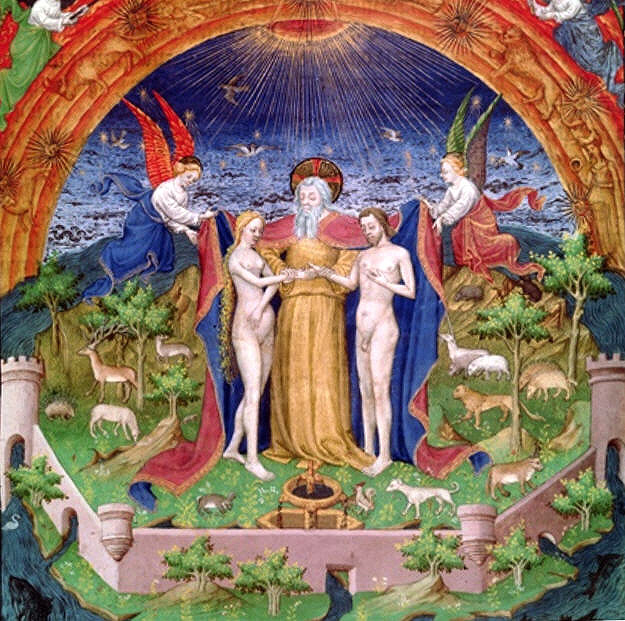
THE LADDER (stairway/path) of ascent to God and THE HEAVENLY GARDEN of delight in the divine presence. IN the monastic tradition these two themes intertwine in an alternating rhythm of spiritual ascent always energized by mystical vision (or at least the virtue of hope). One never graduate from the ascetical path; and heaven itself is a dynamic progress into God,
ALTHOUGH the notion of ascent to God is also frequently depicted as climbing a mountain (Sinai, Carmel, Tabor), the image of JACOB'S LADDER is a powerful image of heavenly ascent and descent; and it recurs in patristic depictions of martyrdom and very often in the monastic tradition THE GARDEN is a very ancient metaphor for gentle rest in the Divine Presence. The ancient word for garden is Paradise. In the garden of Eden humanity is at peace with God and all of creation. In the prophets and psalms hope for human struggle and pain is found in the prediction that the desert will blossom and become a garden. The garden of the Song of Songs was interpreted by both Jewish Rabbis and Christian mystics as an icon of the union between the Divine Lover and His beloved spouse - His people. And in the Book of Revelation the final destiny of saved humanity is described as a lush garden with trees and flowing rivers.
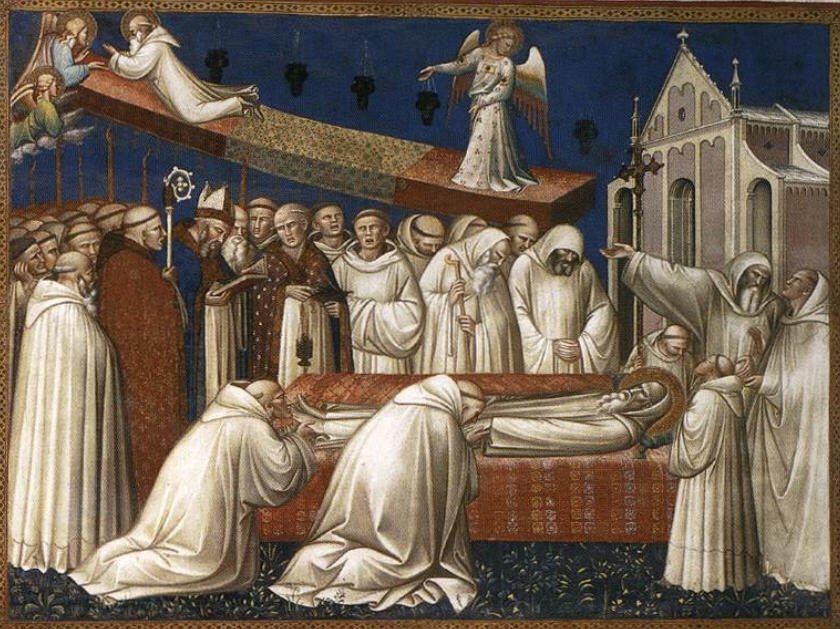
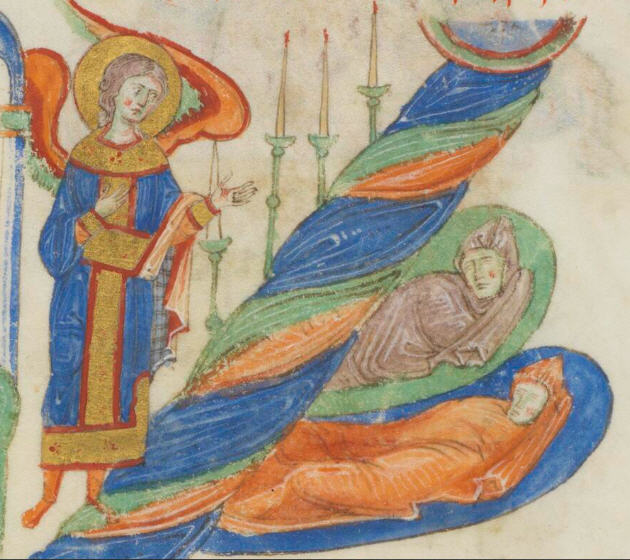
BENEDICT associates Jacob’s Ladder with the ladder of humility that leads to Heaven (RB 7.5); however his description of heaven here (love) and at the end of the Instruments of Good Works (Eye has not seen...; RB 4.62) is extremely restrained in comparison with the Master. IN the Rule of the Master both the Holy Art (RM 3) and the Ladder of Humility (RM 10) lead respectively to the garden-city of heaven (RM 3.83) and the heavenly rose-garden of the Passio Sebastiani (RM 10.92 ). Indeed, every step is explicitly called a “rung of the heavenly ladder.” AT the conclusion of the Life of Benedict two of his disciples see in a vision the path by which Benedict ascended to heaven (Dial.Bk.2.37) - a clear allusion to Benedict’s Rule.
THE disciples, interpreters, and commentators on the life and Rule of Saint Benedict are too numerous to enumerate here. They include: 1. An examples of the image of an ascent back to - and even beyond - the primordial garden of Eden is found in the famous reading for Holy Saturday that is clearly influenced by the ascetical/monastic tradition of the early Church. 2. Romuald and (3) Bernard offer examples of the monastic cell as a return to paradise and the Song of Songs as a vision of the monastic goal. 4. And, finally, Dante depicts both Benedict and his disciples, Peter Damien and Bernard as guides up the ladder that leads to God and to the heavenly garden where the saints rejoice.
THREATS to the interconnectedness and harmony of the path of spiritual practice and the contemplative vision of heaven have been enumerated by Lassus. They include: [1] The zeal for the extreme nature of a life that invites total commitment to God can be misused by superiors, thwarting the virtues that can arise from [moderate] oppression. [2] Sectarian Drift: that is, deterioration of a community into a sect or cult. Appropriate discretion/discernment can be difficult.
|
|||||||
|
|
|
Aretino, 1388, The Death of Benedict and the Disciples Vision of the Heavenly Path |
|
|
|
The Garden of Eden, Fouquet, 1477 |
|
“Truly as we advance in this way of life and faith (conversationis et fidei), our hearts open wide,” RB Prol. 49 “[Hermits], no longer in the first fervor of their way of life . . .” (conversationis fervore), RB 1.3. “Concerning all of these [Sarabites, Gyrovagues], and their most miserable way of life . . . ” (miserrima conversatione), RB 1.13. “. . . brothers of good reputation and a holy way of life (sanctae conversationis) [are] to be appointed deans,” RB 21.1. “One newly arriving to this way of life (ad conversationem) is not to be granted an easy entrance,” RB 58.1 “. . . the beginnings of this way of life (initium conversationis). But for those hastening to the perfection of this way of life (ad perfectionem conversationis) . . .” RB 73.1-2 As Benedict uses the term it implies both perseverance and stability. RELATED is the verb convertere,“to convert,” that describes a fundamental transformation or change in one’s state of life. (e.g. RB 7.30; Prol. 38; THE classical notion of virtue as a mean or balance is echoed in Benedict's Rule in the measure/mensura of correction in the disciplinary code (RB 30; RB 24), determining the proper amount of food (RB 39) and drink (RB 40) and especially in the admonition that everything is to be done with proper measure (RB 48.9) ESSENTIAL in employing and adapting spiritual practices, as noted by Lassus, are discretion and balance, as well as formation for freedom in God, freedom as “human act,” and freedom in opening the heart.
|
RB; RM 87-92
THE process of entry entails progress from entrance to guesthouse, then to novitiate. Then responsibility for formation lies with a senior skilled in winning souls, who watches for the four signs of a vocation. The novitiate is of three periods, testing stability, patience, and obedience. Implicitly linked to the eucharistic celebration, the vows are made at the altar: obedientia, stabilitas, conversatio morum suorum. The emphases on stability and obedience make it clear that the conversatio to which the monks commits himself is the way of life of a particular monastery RECENT authors such as Lassus have stressed the importance of formation in freedom [c.6; c.9!], and freedom in opening the heart, as well as avoiding prophetic assurance by the formator that a candidate has a vocation. THESE portions of the Rule of Benedict correspond to and contrasts with Chapters 87-91 of the Rule of the Master which is stricter and even encourages suspicion of those who wish to enter.
|
NAVIGATION BAR LINK
First, the monks learn to “see” Christ in the Abbot, “who is believed to hold the place of Christ in the monastery.” RB 2.2: Christi enim agere vices in monasterio creditor But Christ must also be contemplated aurally and perhaps paradoxically in the voice of the youngest newcomers to the monastery, through whose counsel God often (saepe) indicates what is best for the community to do. RB 3.3: (quia saepe iuniori Dominus revelat quod melius est)
Guests, too, are to be contemplated as Christ-bearers: on arrival and departure
they “are to be received as Christ” and venerated with a bow or prostration,
“because Christ is to be adored in them just as he is received in them”.
Similarly, monks visiting from another monastery may be the unexpected bearers
of a prophetic message from Christ.
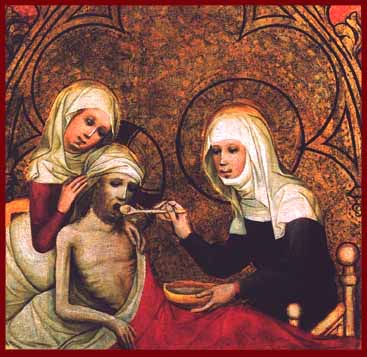
The sick are “truly to be served as Christ Himself […] out of honor for
God”
Thus the monks are to “outdo one another in
showing honor” that is, to
honor others in community as the Christ-Bearers they are. |
|
IN Chapter 72 the contemplative embrace of God is an destiny towards which we are drawn pariter - together into eternal life (RB 72.12). The good zeal that enables the brethren to contemplate Christ in one another is very different from the competitive zeal described in Chapter 92 of the Rule of the Master.
|
|
|
NAVIGATION BAR LINK
THIS book portrays St. Benedict's spiritual progress from solitary hermit to abbot of a community, and the last chapters depict his gradual transformation from zealous, miracle-working ascetic to receptive contemplative. At the very end his disciples receive a vision of the path (via) of Benedict's heavenly ascent (2.37) that is also his Rule (2.36).
|
|
|
|
|
|
|
RB; RM
|
ALL human experience can be conceived as a kind of alternating rhythm, a life-giving, energizing movement back and forth, between the the two poles of “activity” and “receptivity”:
|
|
SAINT Benedict describes the daily practice of lectio divina in Chapters 4, 8, 38, 48, and 49 (sel.) of his Rule. The medieval monks Peter Damien and Guigo II depict lectio divina as ascent to the heavenly banquet and the divine embrace. THE result of lectio divina is the practice of contemplative exegesis, again, a method of prayerful contemplation inherited from both Judaism and classical antiquity. Also called allegorical exegesis, this refers to the practice of contemplating the presence and purposes (logoi) of God in Sacred Scripture, in the unfolding of one’s own life, and in the movements of history. A medieval poem describes the interrelationship between the literal and mystical/allegorical senses:
|
THUS four levels or aspects of biblical and historical contemplation are identified:
|
LITERAL |
God in the Sacred Text |
SACRED SCRIPTURE |
|
MORAL |
God guiding us in our choices |
OUR LIVES |
|
ALLEGORICAL |
God unseen in the events of our lives |
HUMAN HISTORY |
|
ANAGOGICAL |
God united to us for all eternity in Heaven |
HEAVEN (beyond time) |
A CLASSICAL depiction of this practice/charism is the medieval Benedictine historian Bede’s story of the cowherd (and later monk), Caedmon.
NAVIGATION BAR LINK
|
|
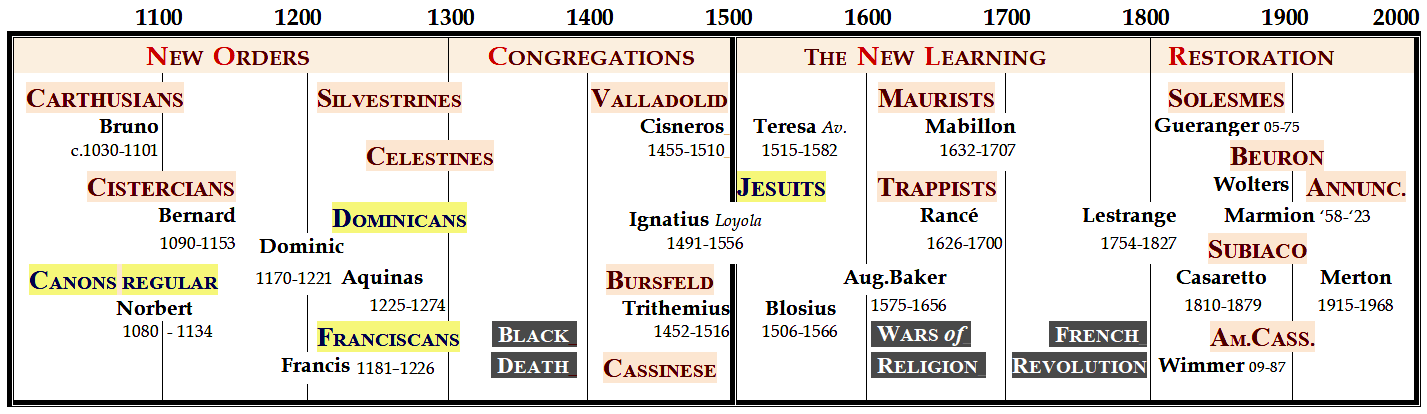
NEW monasteries continue to be founded, and the identification and manifestation of new monastic charisms is an ongoing task, and sometimes a source of concern. The shape and content of the different monastic congregations undergoes constant change.
|
|
THE
most recent and comprehensive movement of monastic renewal and reform occurred
in the wake of the French Revolution, and has powerfully affected all
Benedictine monasteries in the world today
|
|
|
|
|
|
IN both the Rule of Benedict and in Benedict's principal source, the Rule of the Master, the image of the ladder, with explicit reference to the dream of Jacob, is central as a way of conceptualizing spiritual progress. Their ladder of humility adapts a similar concept found in John Cassian.
THE Master describes the pleasure-garden of heaven in detail, while Benedict prefers a more succinct allusion to What eye has not seen, nor ear heard. For Benedict the garden of eternal life (ch.72) is attained by running together with others in the sweetness of love (Prol.) along the path that enables the community to be seen - and served - as Christ.
CHRISTIAN SPIRITUAL PRACTICES
|
|
|||||
This Webpage was created for a workshop held at Saint Andrew's Abbey, Valyermo, California in 2003