|
|
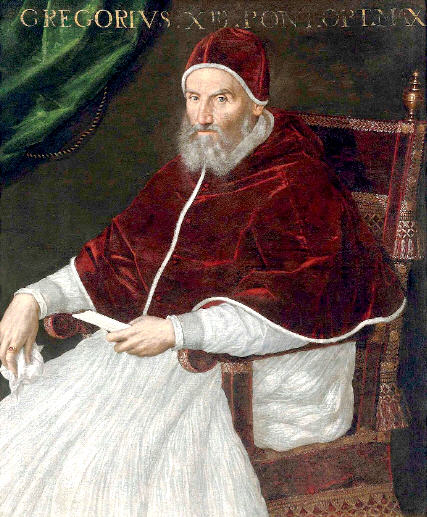
Pope Gregory XIII |
|
|
|
Pope Gregory XIII |
|
The Following is adapted from an Amon Duffy,
http://what-when-how.com/medieval-ireland/cogitosus-fl-c-650-medieval-ireland/
GREGORY XIII (572-85) was a former law professor with a bastard son, whom he proceeded to make governor of the Castel Sant’ Angelo. The Jesuits Robert Persons and Edmund Campion obtained a papal audience prior to embarking for England in 1580. They recorded and transmitted the responses they received to a series of questions submitted to the pope. These responses somewhat mitigated the application of Regnans in Excelsis, the papal bull of his predecessor, Pius V, that excommunicated and claimed to depose Queen Elizabeth I, and forbidding her Catholic subjects from obeying her orders, mandates, and laws.
The excommunication and deposition were reimposed and augmented in 1588 by his successor, Sextus V in A declaration of the sentence and deposition of Elizabeth, the vsurper and pretensed quene of Englande (Antwerp, 1588).
|
Ad
CONSOLATIONEM
et INSTRUCTIONEM |
|
|
Some Questions for the Consolation and Instruction |
§16 Ad consolationem et instructionem quorundam Catholicorum angustiis constitutorum quaestiones aliquot |
|
Some questions concerning the bull of Pius VII |
[f. 179*] Quaestiones aliquot circa bullam Pii Vti contra Reginam Angliae. |
|
|
|
|
First Question: Whether the bull of Pius V issued against Elizabeth, pretended queen of England, had and has force and power. This causes difficulty to some because the bull was not publicly promulgated here as it was in Campo di Fiori and other places. |
Quaestio prima. An bulla Pii V” emissa contra Elisabetham praetensam Angliae Reginam habuerit et habeat suum vigorem et robur; quibus movet difficultatem, quod non fuerit hic more aliarum in Campo Florae et alibi promulgata. |
|
Second Question: Whether Catholics in England can with safe conscience speak against this bull either because it was not sent to England and executed by Pius V but was carried here by some private person, or because throughout England there is some uncertainty about the pope’s intention because the bull was nailed to a door by a private nobleman; and whether it should not be sufficient that some Catholics have already suffered cruel deaths on behalf of the bull. |
Q[uaestio] 2nda. An Catholici in Anglia non possint tuta conscientia praedictae bullas contradicere, vel quod revera, non fuerit a Pio V” eo transmissa et in execu-tione posita, sed per privatum aliquem eo transportata, vel quod Catholicis in Anglia non constet de mente Pontificis, quoniam per privatum nobilem fuerit valvis affixa. Et utrum Catholicis non debeat sufficere quod pro haec bulla quidam Catholici mortem passi sint crudelissimam. |
|
Third Question: Whether on the strength of this bull, subjects have not only been freed from their oath and obedience to the queen, but also in conscience are to consider her illegitimate, deprived of all right to rule, and a tyrant so that one, who in conscience does not hold her such cannot be absolved if sufficiently instructed about the bull. |
Q[uaestio] 3ia. An huius bullae vigore subditi non modo sint a iuramento et obe- dientia illi debita liberati; verum etiam in conscientia teneantur illam habere illegit- imam omne iure Regni privatam et tyrannam, ut qui earn talem in conscientia non habeat de bulla sufficienter instructus non possit absolvi. |
|
Fourth Question: Whether while the bull stands in force, Catholics can obey Elizabeth in civil matters and cooperate in the administration of the realm in those matters which are just. |
Qluaestio] 4a. An stante bulla in vigore Catholici possint Elisabethae obedire in civilibus et cooperari in Regni administratione in eis quae fusta sunt. |
|
Fifth Question: Whether to give this obedience they can take the oath to Elizabeth. |
Qluaestio] 5a. Ad hanc obedientiam praestandam possint praestare Elisabethae iuramentum [p.91] |
|
(Sixth Question:I Whether they can call Elizabeth Queen of England and in their [legal] documents may give the same titles of royal power as they did before the issuance of the bull. |
Qluaestio] 6a. An possint Elisabetham vocare Angliae reginam et in suis instru-mentis eosdem dare titulos regno quos ante bullas emissionem dederunt. |
|
Seventh Question: Since Elizabeth adds “et cetera” at the end of the form of her title, whereby she understands to be supreme head of the church because that is the only title not expressly mentioned, whether Catholics understanding this, may also add the phrase Met cetera” while preserving safely their profession of faith. |
Q[uaestio] 7ma. Cum Elisabetha in forma titulorum adiungat in fine et caetera, quo intelligatur esse ecclesiae supremum caput, quoniam eo excepto omnes almm tituli expresse nominantur; an Catholici hoc intelligentes possunt salva fidei professione etiam illam particulam et caetera adiungere. [f. 184*] |
|
Eighth Question: Whether Catholics, while the bull remains in force, may take up arms in the defense of Elizabeth against her opponents who claim to be freeing the realm from her tyranny and be restoring the Catholic religion. |
Q[uaestio] 8va. An Catholici stante bulla in vigore, possunt arma pro eins defen-sione sumere contra eins adversarios, qui praetendunt et regnum ab eins tyrannide liberare et Catholicorum religionem restituere. |
|
Ninth Question: Whether Catholics are not held in conscience by virtue of the bull to take up arms against her, to ddisturb her from ruling; given the opportunity and likelihood of achieving victory, to kill her. |
Q[uaestio] 9a. An Catholici non teneantur in conscientia virtute bullae contra eam arma sumere, Regno deturbare, vel occidere data opportunitate et victoriae conse- quendae probabilitate. |
|
Tenth Question: Whether a private person, while the bull remains in force, cannot kill her because she is a tyrant and has no just title to the realm and whether the Pope is not able to give a dispensation so that this may be done if it is probable that her death will result in the restoration of Catholicism. |
Q[uaestio] 10a. An privatus, stante bulla in vigore, non possit eam occidere ratio sit quod sit tyranna nec habeat iustum Regni titulum. Et an Pontifex non possit dispensare ut hoc fiat, si probabile fuerit eins morte religionem Catholicam restituen-dam. |
|
Eleventh Question: Whether Catholics cannot take the oath that Elizabeth is the true and lawful queen of England not only so far as possession but also so far as the title to the realm is concerned. The Catholics reason for this could be that Pius V issued the bull in favour of Catholics wherefore they see now that it has had quite a contrary outcome, they can presume that the pope would not wish to bind them by this bull to their most grave loss. |
Qluaestio] 11a. An catholici non possint iuramentum praestare quod Elisabetha sit vera Angliae Regina et legitima, non modo quantum ad possessionem sed quantum ad titulos Regni. Ratio Catholicorum esse potest quod Pius bullam emiserit in favorem Catholicorum quare nunc videant quod contrarium plane habeat exitum, praesumere possunt quod Pontifex nollet eos hac bulla obligare ad eorum gravissi-mum damnum. |
|
Twelfth Question: Whether Catholics, after taking the prior oath, can take up arms against Elizabeth, given the opportunity, in virtue of this bull notwithstanding their prior oath. |
Q[uaestio] 12a. An Catholici praestitio priore iuramento non possint, eo non obstante arma contra eam vigore humus bullae sumere data opportunitate. |
|
Thirteenth Question: Whether anticipating the bull of Pius V, it was not lawful for Catholics to take up arms against Elizabeth, to depose her from her position as queen, to imprison her or to put her to death because if it was lawful at that time, they can still carry out these things even should the bull not be in force. What gives rise to this difficulty is the fact that the Council of Basle session 20, chapter “To avoid scandals’. renewed the decree of Pope Martin V to the effect that no excommunicated person is to be avoided unless he has been denounced or if it is evident that someone has so notoriously incurred excommunication it can not be concealed by any tergiversation or excused by any suffrage of law.! It is evident that Elizabeth was such before the denunciation of Pius V: the same can be seen from the bull of Pius, who even before his denunciation, calls her “the pretended queen.” |
Q[uaestio] 13a. An praeveniendo bullam Pmm V*’ non fuerit Catholicis licitum arma contra Elisabetham sumere, regno deturbare, incarcerare vel occidere, quia si tum fuerat licitum, etiam modo possunt, si bulla non habeat robur. Difficultatem facit quod Basiliense Concilium sessc zo, cap. [f. 585v] “Ad vitandum scandala,” reno-vavit Martini V*1 decretum quod nullus excommunicatus sit vitandus nisi fuerit denuntiatus, aut si aliquem ita notorie in excommunicationis sententiam constiterit incidisse, quod nulla possit tergiversatione celan aut aliquo nodo iuris suffragio excusari.Talem fuisse constat Elisabetham ante Pii denuntiationem: id ipsum ex Pii bulla potermt videri qui etiam ante denuntiationem eam vocat praetensam. |
|
Fourteenth Question: Whether a prince or king excommunicated or denounced because of heresy, is by that very fact deprived also of just right and title of royal powei; and his people are set free from their obedience and oath, or is it necessary for him to be deposed in plain and express words. |
Q[uaestio] 14a. An Princeps aut Rex propter haeresim excommunicatus aut denun-tiatus sit eo ipso etiam iure et titulo iusto Regni privatus et populus ab obedientia et iuramento liberatus, an opus etiam sit quod apertis verbis deponatur. [p.92] |
|
Fifteenth Question: Whether a Catholic noblewoman, who has been reconciled to the Church, can, with her husband’s consent, be numbered among the women of Elizabeth’s household in order thus to avoid the persecution of an heretical pseudo-bishop and of others who have wished to disturb her because of her religion; whether this noblewoman can accompany Elizabeth into the more secret chamber from which Elizabeth hears the divine service of heretics, through an open window, whilst this woman makes clear by no gesture that the service either pleases or displeases her because she does not wish to betray herself. |
Q[uaestio] 15a. An nobilis mulier Catholica et reconciliata cum mariti consensu curans se inter domesticas Elisabethae enumerara, ut sic vitet persecutionem haeretici pseudo episcopi et aliorum qui ob religionem earn perturbare voluerunt, ad haec possit Elisabetham comitari in cubiculum secretius unde Elisabetha audit per fenestram apertam officium haereticum, ea interim nullo gestu declarante sibi id officium placere vel displicere quia se ipsam non vult prodere. |
|
Sixteenth Question: Whether the pope cannot dispense Catholics in order that with just cause, they are living among heretics, they may eat meat on days normally forbidden by the Church. |
Q[uaestio] 16a. An Pointifex non poterit dispensare cum Catholicis ut ex iusta causa dum inter haereticos versantur carnes comedant diebus ab ecclesia prohibitis. |
|
Seventeenth Question: Whether the pope cannot dispense Catholics in order that with just cause being present in churches sometimes at the time of heretical divine office, provided they do not take part in their diabolical supper but read Catholic prayers privately so as not to betray themselves. The reason seems to be the same in both cases, viz. in eating meat and in attending services because in both cases scandal is taken only as long as heretics conclude that they are not Catholics because they eat meat on days forbidden by the Church, and because they are present at their services; and whether the same judgement is made of their listening to their sermons when probably there is no risk of their seduction into heresy. |
Q[uaestio] 17a. An Pontifex non poterit dispensare cum Catholicis ut ex iusta causa aliquando tempore haeretici officii praesentes sint in ecclesiis, modo cum haereticis [f. 185*] in sua caena diabolica non communicent, sed legant privatas Catholicas preces, ut non se prodant. Ratio videtur et in esu carnium, et in hoc facto pai; eo quod in iuroque sit scandalum tantum acceptum dum haeretici iudicant eos non esse Catholicos tum quia comedunt carnes diebus ab ecclesia prohibitis, quam quia praesentes sunt in eorum officio; et an non sit idem iudicium de eorum concionibus audiendis, quando probabiliter non est periculum seductionis. |
|
Eighteenth Question: Whether a Catholic going to a church while the religious service of heretics is being held, and remaining, not with the purpose of seeming by this very presence to comply with the laws of the prince or to show approval of that religious service, but rather wishing to make plain that it displeases him because, while others display reverence by their outward behaviour; he purposely sits with head covered; whether such is to be said either to be a schismatic or to sin mortally. What gives rise to the difficulty is the fact that heretics do not approve of such presence but wish rather for its absence. |
Q[uaestio]18a. An Catholicus accedens ecclesiam dum haereticorum agitur offi* cium, et manens non eo fine ut sua praesentia legibus Principis satisfacere aut illud officium probare videatur; quin potius aperte vult declarare sibi displicere quia dum alii externius exhibent reverentiam is studio operto sedet capite; an talis vel schis* maticus dicendus sit vel mortaliter peccare. Difficultatem facit quod haeretici talem praesentiam non probant, sed potins eius optant absentiam. |
|
Nineteenth Question: Whether outside the times of religious services, e.g. after lunch, a Catholic visiting a church now controlled by heretics, all scandal being removed, and praying there in the Catholic fashion, commits a sin. The reason for that he does not sin is that he acts out of devotion because he knows that the church was consecrated and that it belongs by right not to the heretics but to Catholics. |
Q[uaestio]19a. An extra officium haereticum, ut post prandium Catholicus accedens ecclesiam ab haereticis occupatam omni scandalo sublato et ibi Catholice oret, peccet. Ratio quod non peccat est quia id facit ex devotione eo quod scit ecclesiam esse consecratam et iure non ad haereticos sed ad Catholicos pertinere, [f. I86v] |
|
|
|
|
|
|
|
|
[RESPONSES TO THE ABOVE QUESTIONS] |
|
At the outset, it would seem expedient, in order to remove many difficulties which have arisen from the bull, to make clear that by the pope’s authority that the Catholics of England are not bound under pain of sin or of excommunication by virtue of the bull published by Pius V. However we have believed meanwhile, whatever may be argued concerning the sufficiency of the bull’s promulgation, and concerning the bull’s comments about the so-called queen, that Catholics are excused from the obligations laid down, and from excommunication, nor do they suffer any detriments by virtue of the bull. |
Principio videtur expedire declarara authoritate Pontificis Catholicos Regni Angliae non obligara ad peccatum aut excommunicationem ex vi bullas editae a Pio V10 ad tollendas multas difficultates quae ex praedicta bulla exortae sunt. Nos tamen interim credimus, quicquid sit de promulgatione sufficienti bullae et de lis quae in praedicta bulla contra praetensam Reginam Angliae contentae sunt, Catholicos modo excusara ab obligatione praecepti et excommunicationis neque ullum detrimentum ex vi eius bullae accipere. |
|
First, since the bull was published in favour of Catholics and of religion, and since it is clear that great harm befalls Catholics and religion from observance of the bull—a result which was not intended by the legislator. This must always be considered because what was done out of charity ought not to militate against charity. |
Primo, quia bulla edita est in favorem Catholicorum et religionis, atque constat magnum damnum Catholicis et religioni ex ipsius bullae observatione accidere, [p.93] quod non fuit ex mente legislatoris, ad quam oportet semper respicere; nam quod pro charitate institutum est non debet contra charitatem militari. |
|
Second, the aim and reason of a law cease universally and generally. But with the cessation of the aim of a law, observance of the law also ceases. |
2°. Quia finis et ratio legis cessant in universali et in communi. At cessante fine legis cessat et ipsius legis observatio. |
|
Third, no one is held today to obey an excommunication and a precept to his own grievous loss and injury of life, especially when harm to religion is added; nor is it to be believed that the Church has wished so to bind Catholics. |
3°. Nullus tenetur obedire excommunicationi et praecepto cum gravi suo damno et incommodo vitae, accidente praesertim detrimento religionis, nec cre-dendum est ecclesiam voluisse Catholicos ita obligare. |
|
Fourth, because the precept and the obligation seem to have been laid down as time and place required - no more and no less - within which there was hope of recovery of that realm by that way and manner. Therefore, since such occasion has disappeared and the hope has been frustrated, and that avenue has been entirely blocked, it follows that the time of that precept has passed by and that obligation therefore ceases; it would seem to be contrary to reason to use a method and a most inconvenient way to something practically impossible. |
4°. Quia praeceptum et obligatio videntur posita pro loco et tempore dumtaxat quibus spes esset recuperationis illius Regni ea via et modo. Cum ergo talis occasio evanuerit, et spes sit frustrata, et ea via omnino interclusa, consequitur tempus illius praecepti praeterisse, et obligationem proinde cessare: praeter rationem enim videretur nunc uti modo et ratione incommodissima ad rem fere impossibilem. |
|
These considerations thus determined, answer might be made as follows to the single questions, and indeed to the first question. |
His ita constitutis sic responderetur ad singula proposita: et quidem ad primara: [f. 186v] |
|
First Question. It has been stated that the bull does not bind Catholics not indeed for lack of publication, about which there is nothing certain, but because the purpose and reason for the bull ceases altogether. |
Dictum est bullam non obligare Catholicos non quidem propter defectum publicationis, de qua nihil certi habetur; sed quia cessat omnino finis et ratio ipsius. |
|
Second Question. If anyone taught that the obligation of this kind of bull ceases, he would not be speaking against it since there is certainty about the mind and intention Of the legislator In a word, Catholics, so far as pertains to them, are bound only by the general law, and not by any new law. |
Ad 2am. Si quis doceret cessare Obligationem huiusmodi bullae, non con-tradiceret, cum certe constat de mente et intentione legislatoris, et ut uno verbo dicatur; Catholici quod ad ipsos attinet solo iure communi obstringuntur et non fine ullo novo. |
|
Third Question. Setting aside the bull, everyone ought to consider her an unlawful and excommunicated queen. This is even more true because of the declaration of the sovereign pontiff occurs. However if anyone from some possible ignorance, held the contrary, he would not necessarily be committing mortal sin, nor would he have to be kept from receiving the sacraments. |
Ad 3am. Seclusa bulla unusquisque eam habere debet pro illegitima regina et excommunicata, quanto magis accidente declaratione summi Pontificis. Si quis tarnen ignoratione aliqua probabili contrarium teneret non continuo peccaret mor-taliter; nec arcendus esset a sacramentorum perceptione. |
|
Fourth Question. Catholics can with safe conscience obey Elizabeth in civil matters and it is well known that it is licit to cooperate in everything which is lawful under the governance of other tyrants and it is well known that those of old did so also. |
Ad 4am. Catholici possunt obedire tuta conscientia in civilibus Isabellae; et cooperara in omnibus quae iusta sunt in regimine caeterorum tyrannorum lacere et veteres fecisse constat. |
|
Fifth Question. As it is licit to obey Elizabeth so it is licit to take the oath to her in matters licit and good when it would be related to the oath in number 6. |
Ad 5am. Sicut licitum est obedire Isabellae ita licitum illi in licitis et honestis iuramentum praestare cum contingent de iureiurando in 6°. |
|
Sixth Question. It is lawful to call her queen “etc.” because those titles are to be understood to be and to be meant such as they are. |
Ad 6am. Licet earn vocare Reginam etc. quia tituli illi intelligendi sunt esse et dici tales quales ipsi sunt. |
|
Seventh Question. Although the heretics understand by the expression “etc.” the head of the English Church, Catholics are not forced to understand it so for the expression “etc.” is indifferent to many other things; further it is an expression which is usually added to the titles of other kings. |
Ad 7am. Licet haeretici per illam vocem (et caetera) intelligant caput eccle-siae Anglicanae, non coguntur tarnen Catholici ita earn intelligere: ea enim vox indifferens est ad alia multa. Immo vox est quae ut plurimum apponi solet in titulis aliorum Regum, [f. 187’] |
|
Eighth Question. Catholics cannot with safe conscience defend and champion her against those who attack her in virtue of the bull or from zeal for religion; however if anyone wished to attack the queen by reason of her unjust title as queen, they can certainly champion her. |
Ad 8am. Non possunt tuta conscientia earn Catholici defendere et propugnare contra cos qui earn vi bullae aut studio religionis impugnat; si tarnen iniquo titulo Reginam aliquis invadere vellet, illam certe propugnare possunt. |
|
Ninth Question. We think that Catholics are not held by virtue of the bull to the actions proposed unless everything has been so arranged that hope of victory is certain and ready, in which case the bull binds those who would be able to take any action, by reason of the common good of the faith and religion. |
Ad 9am. Ex vi bullae putamus teneri ad ea quae proponuntur nisi omnia ita comparata essent ut certa parataque spes esset victorias; quo casum propter bonum commune fidei et religionis ii tenentur qui aliquid possent praestare. |
|
Tenth Question. It is not lawful for a private person to kill any tyrant whomsoever as has been defined in the Council of Constance, session 151 unless he were such as would get possession of the royal power after the example of Ehud, Judges 3:15-30.3 Pertinent to this is the case that if someone were able by the queen’s death certainly to free the realm from oppression, doubtless it would be lawful for him to kill her. But things being in the position in which they now are, it is much better not ever to talk at all about that matter. |
Ad 10am. Non lacet privato quemcunque tyrannum occidere, ut definitum est in Concil. Constan, sess. 15: nisi talis esset qui vi regnum invasisset, exemplo [p.94] Aoth. Jud. 3. Quod vero ad hanc attinet, si quis eius interitu Regnum posset certe ab oppressione liberare, procul dubio illi liceret earn interimere. Sed rebus ut nunc constitutis multo sanus ne loqui quidem ea de re. |
|
Eleventh Question. This question has now been sufficiently answered. However the word “true” increases the difficulty somewhat. Moreover it is never lawful to swear a false oath; it is, however, lawful to conceal and cloak the truth by some equivocation. For example, were someone to understand that “in the common opinion of her adherents” she is the true queen or in some other manner. |
Ad 11. Huic questioni lam satisfactum est. Auget tarnen nonnullum dif* ficultatem illa particula (vera). Nunquam auteur licet turare falsum; licet tarnen occultare et tegere veritatem quacunque aequivocatione, ut si quis intelligat veram esse reginam opinione communi vulgi vel el adhaerentium, aut quovis alio modo. |
|
Twelfth Question. As was stated a little while back, it is licit in virtue of the bull (which remains, so far as it looks to the favour of religion and Catholics, untouched and in force) to take up arms against the queen, given the opportunity; indeed, if the bull had not been published, it would be lawful by public authority to depose a tyrant who is most hurtful to government and to religion. |
Ad 12 am. Ut paulo ante dictum est, licet virtute bullae’(quae quod spectat ad favorem religionis et Catholicorum integra et efficax manet) arma sumere contra [f. 187*] reginam data opportunitate; immo vero si bulla non esset publicata liceret tyrannam Reipublicae et religioni maxime obnoxiam deturbare autoritate publica. |
|
Thirteenth Question. It was lawful to take up arms for the end and by the means which have been explained previously, i.e. prudently and not rashly, and in order that Catholics might be rescued from those harassments of body and mind which they were at that time afflicted. |
Ad 13am. Licuit arma sumere eo fine et mediis quae ante explicata sunt, id est, prudenter et non temere. Atque ut Catholici eriperentur iis vexationibus cor* poris et animi quibus tuno afficiebantur. |
|
Fourteenth Question. Although it is a probable opinion that heretics are ipso facto deprived of their dominion, yet the common opinion is that they ought to be deprived. But to explain more at length what has been said, it must be added that the queen of England, not only because she is an heretical tyrant, but because she governs with the greatest harm and disturbance to the whole Church, can be lawfully deposed from royal power even if no bull had been published. |
Ad 14am. Quamquam probalis sententia sit haereticos ipso facto privatos esse dominio; communior tarnen opinio est privandos esse. Verumtamen ad maiorem explicationem eorum quae dicta sunt addere oportet et Reginam Angliae non solum quia haeretica est Tyranna, sed quia summo cum detrimento et pertur* barione totius ecclesiae gubernat. Iure posse auctoritate publica a Regno deturbari, etiam si nulla bulla publicata esset. |
|
To the questions which follow about the communion of Catholics with heretics: |
Ad alias quaestiones quae sequiintur circa communionem Catholicorum corn haereticis, |
|
Fifteenth Question. That woman can behave towards Elizabeth as Naaman the Syrian,< although we confess that it is dangerous and should be shunned as far as possible; but if it should be done, care must be taken that Catholics be not offended by too great ease and lack of restraint on her part and [care must be taken] not to show that she does consent in any way to heresy. |
Ad 15am. Posset illa mulier nobilis ad modum Naaman Syri se gerere cum Isabella, quanquam fatemur esse periculosum et debere subterfugi quoad fieri potest: si tarnen fiat, cavendum est ne offendantur Catholici nimia facilitate ac licentia eius, et ne prae se ferat se consentire aliqua ex parte haeresi. |
|
Sixteenth Question. It is not appropriate for the pope to dispense generally; but by reason of necessity and for the sake of life it is lawful to eat meat unless this is done to profess heresy and in detestation of Catholic truth, and with the exclusion of all scandal. |
Ad 16am. Non expedit Pontificem dispensare in universum, sed ex causa necessitatis et vitae licet carnes comedere, nisi id fieret in professionem [foliation discontinuous 1791] haeresiae et in detestationem Catholicae veritatis. |
|
Seventeenth Question. The answer is as a little above. |
Ad 17am. Respondetur ut paulo ante. |
|
Eighteenth Question. When there is no underlying cause for one to go to meetings of heretics, he can hardly be excused of rashness and will have deservedly to be rebuked. |
Ad 18a”1. Cum nulla subest causa quamobrem aliquis se conferat ad coetus haereticorum, vix excusari poterit a temeritate et merito reprehendendis erit. |
|
Nineteenth Question. It is lawful if all scandals be avoided. |
Ad 19am. Sedoso omni scandalo lieet. |
This Webpage was created for a workshop held at Saint Andrew's Abbey, Valyermo, California in 1998