|
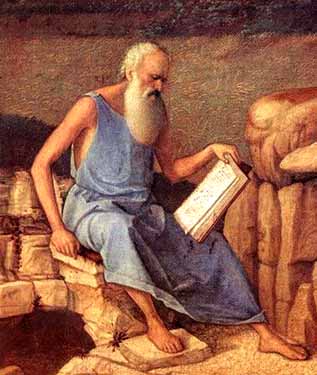
Based on: Desert Hermits, Byz. MS. illum., ca, 1081 Princ. U. Libr., image modif . |
MONASTIC SPIRITUALITY SELF-STUDY BELOW are links to materials from courses taught at : Saint John's Seminary, Camarillo; Loyola/Marymount University, Los Angeles; and Saint John's Abbey School of Theology, Collegeville, Minnesota. Anyone interested in academic credit for a a web-course that uses these materials should contact Dr. Susan Wood at Saint John's in Collegeville. PLEASE note that: (1) audio lectures (5-9 min. in length) will take several minutes to download on slow modem connections; and (2) they require a reasonably recent version of Windows Media Player (or another player capable of playing .wma files). To display the Greek text properly is is necessary to have loaded on your computer the SGreek font, available as shareware from SilverMountain Software: http://www.silvermnt.com/fonts.htm . |
(1)
VISIONS
of HEAVEN
and the
ASCENT to
GOD
Plato as mystical theologian; his Parable of the Cave and Myth
of Er. Spiritual Ascent in the intertestamental period: The
Book of Enoch. Cicero's retelling of Plato's Myth in the Dream of
Scipio.
(2)
BIBLICAL
and EARLY
CHRISTIAN
MODELS of SPIRITUAL
ASCENT:
Apophatic and Kataphatic Theology. Fundamental biblical texts in
the early Christian contemplative tradition. Saint Perpetua the
martyr as seer and intercessor. Three early examples of monastic
visionaries (Antony, Evagrius, Benedict)
(3)
SOLITUDE
and COMMUNITY
in
EARLY CHRISTIANITY:
Origins of Christian monasticism. Hermitage and cenobium in
northern Egypt (Nitria, Kellia, Scetis). Solitude and
community in: Athanasius' Life of Antony; the Apophthegmata;
The Ascetikon
(Rule) of Basil the Great; the Rule of Benedict.
(4)
LECTIO
DIVINA:
Introductory concepts (monologistic prayer, meditatio, parrhesia); Private
and Group lectio divina; Dei Verbum (Vatican II); Philo of
Alexandria; Cyprian of Carthage; Hugh of St. Victor; Guigo II.
(5)
THE
RHYTHM of
PSALMODY
and PRAYER:
Psalmody and hymnody in Judaism and early Christianity. Early
monastic descriptions of psalmody and prayer: Athanasius; Antony; John
Cassian; Evagrius Ponticus; and Basil. Gregory of Nyssa, On The
Inscriptions of the Psalms. Benedict on psalmody and prayer.
Gabriel Bunge, Geistgebet - Spiritual Prayer. Representative
psalms with antiphons, ancient and modern. Pope John Paul II, On
Psalm 117.
(6)
LITURGICAL
PRAYER
Cyril
of Jerusalem and Ambrose of Milan on baptism, chrismation, and the
Eucharist. Dionysius the Aereopagite on liturgy and mystical
theology; Maximos Confessor on Dionysius and liturgy. Suger of St. Denis
on the contemplation of beauty. Books of Hours; Gertude the Great on
liturgical prayer; Hildegard of Bingen. Vatican II (Lumen Gentium)
on the Royal Priesthood.
(7)
CONTEMPLATIVE
EXEGESIS
Biblical and early patristic recommendations of mystical (allegorical)
exegesis. Clement of Alexandria and Origen on fourfold and threefold
exegesis. Evagrius and Cassian (Conf. 14) on progressive levels of
biblical interpretation. Eucherius of Lyons’ allegorical glossary.
(8)
MONOLOGISTIC
PRAYER
Biblical and early patristic sources (Cyprian,
Tertullian, Clement of Alex.) on continuous prayer. Evagrius: sel, from on
Prayer; Cassian, Conf. 9-10. Early Byzantine witnesses (Diadochus and
Barsanuphius). The monks of Sinai:
Climacus, Hesychius, Gregory of Sinai. The
Jesus Prayer, Mount Athos, and Gregory Pallamas.
(9)
EVAGRIUS
PONTICUS
Introduction
to Evagrius' Life and teaching. Primary texts in Greek (where available) and
English, including: Praktikos; Gnostikos; Kephalaia Gnostica; Peri Logismon;
Skemmata; On Prayer; Scholia on Psalms, -on Proverbs, -on Ecclesiastes; select
Letters.
(10)
THE
APOKATASTASIS
Texts
and handouts from the patristic, medievel, and modern period on the early
Christian controversy concerning the apokatastasis (restoration).
This Webpage was created for a workshop held at Saint Andrew's Abbey, Valyermo, California in 1990