|
|
|
|
|
|
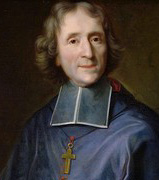
FÉNELON, François de Salignac de la Mothe (1651–1715), Abp. of Cambrai. He was born in Périgord, of an ancient and distinguished, but impoverished, family. He studied at St-Sulpice, was ordained c.1675, and served in the parish. In 1678 he became superior of the Nouvelles Catholiques, an institution for the education of girls and women recently converted from Protestantism. In 1685–6 he took part in a mission in the Saintonge to instruct those forcibly converted through the Dragonnades; he was strict on orthodoxy, but humane in his approach.
In 1687 he published his Traité de l’éducation des filles, written at the request of the Duchess of Beauvillier. Two years later he was appointed tutor to Louis XIV’s grandson, the Duke of Burgundy, for whom he wrote the educational novel Télémaque (pub. 1699, but not in its complete form until 1717). In this work, intended for a future king, he wrote in favor of a limited absolutism, rejected wars of aggression, and held that kings and their policies are subject to moral law in the true interest of the state. The implied criticism of Louis XIV hindered his career.
In the autumn of 1688 he met Mme Guyon; he was impressed by her account of her spiritual experiences (which he regarded as authentic), and esp. by her doctrine of pure love and ‘passive’ prayer: he sought from her some means of personally experiencing the God whose existence he had intellectually proved. There is some evidence, though, that he did not care for her voluminous writings in the Quietist vein. As one author has noted, “his search for spiritual peace was short-lived.” In 1693 he was elected a member of the French Academy. Bossuet and other influential figures at court attacked Madame Guyon’s teaching, but Fénelon continued to defend her integrity even after he censure in 1694.
In 1695 he became Archbishop of Cambrai and later in the same year signed the Thirty-Four Articles of Issy which condemned Quietism - and Mme Guyon, who also signed them. In 1697, however, he published his Explication des maximes des saints sur la vie intérieure (Eng. tr., 1698, Explanation of the Sayings of the Saints on the Interior Life), defending the concept of disinterested love and citing the works of recognized (esp. canonized) spiritual writers in support of his position. He effectively argued in forty-five points (Explication des maximes des saints sur la vie intérieure) that saints from all eras had held views similar to Guyon’s. The book was attacked by J. B. Bossuet and a long and bitter controversy ensued, sustained by intrigues in Rome. Bossuet’s views were later embodied in his Instruction sur les états d’oraison (1696) and Relation sur le quiétisme (1698). Defending Madame Guyon’s integrity, Fénelon not only lost Bossuet’s friendship but also exposed himself to Bossuet’s public denunciation. Having incurred the enmity not only of Bossuet but that of King Louis XIV, Fénelon was banished from court in the summer of 1679 and exiled to his diocese where he spent the rest of his life. During the years 1695-1699 he was stripped of his remaining livings (ecclesiastical sources of income).
Here his charitable giving mitigated suffering, esp., but not only, during the War of Spanish Succession. When, under pressure (and, some scholars maintain, bribes) from Louis XIV, a committee of cardinals pressured Pope Innocent XII to condemn 23 propositions from Fénelon’s Maximes des saints (Cum Alias, Brief of 12 Mar. 1699), Fénelon submitted unreservedly, and when the Jansenist controversy broke out again, he wrote in defence of the orthodox teaching on grace and other matters. He developed his spiritual teaching in his Traité sur l’existence de Dieu (part pub. in 1712; Eng. tr., 1713; the whole not until 1718; Eng. tr., 1720). He was much sought after as a spiritual director. He had considerable influence in the 18th cent., both inside and outside France, and among Protestants (esp. on J. Wesley), partly because of the Life written by Ramsay.
Œuvres complètes pub. in 35 vols., Versailles and Paris, 1820–30 (‘Édition de Versailles’), and 10 vols., Paris, 1848–52 (‘Édition de Saint-Sulpice’), repr. Geneva, 1971; modern edn. by J. Le Brun (Paris, 1983 ff.). Œuvres spirituelles, also ed. F. Varillon, SJ (Paris [1954]); Correspondance, ed. J. Orcibal and others (vols. 1–5, Paris, 1972–6; vols. 6–17, Geneva, 1987–99). Eng. tr. of selection of his letters by D. Sandford (London, 1957) and J. McEwen, with introd. by T. Merton (ibid. [1964]), and of his Traité de l’éducation des filles, with introd. and notes, by H. C. Barnard (Cambridge, 1966). A. M. Ramsay, Histoire de la vie de Messr. François de Salignac de la Motte-Fénelon (La Haye, 1723; Eng. trs., 1723 and 1897). Introductory studies by K. D. Little (New York [1951]), M. Raymond (Les écrivains devant Dieu, Bruges, 1967), and J. H. Davis (Boston [1979] ). H. Bremond, [ Histoire littéraire du sentiment religieux en France depuis la fin des guerres de religion jusqu’à nos jours (11 vols., 1916–33, + index, 1936).]Apologie pour Fénelon (1910); É. Carcassonne, Fénelon: L’Homme et l’œuvre [1946]; Dix-septième siècle, nos. 12–14 (1951–2), special issue devoted to Fénelon; J.-L. Goré, L’Itinéraire de Fénelon: Humanisme et spiritualité (1957); L. Cognet, Crépuscule des mystiques: Fénelon, Bossuet (Tournai [1958]); B. Dupriez, Fénelon et la Bible: Les origines du mysticisme Fénelonien (Travaux de l’Institut Catholique de Paris, 8 [1961]); R. Spaemann, Reflexion und Spontaneität: Studien über Fénelon (Stuttgart, 1963); H. Hillenaar, Fénelon et les Jésuites (Archives internationales d’histoire des idées, 21; The Hague, 1967); M. Haillant, Fénelon et la Prédication (Publications de la Faculté des Lettres et Sciences Humaines de Paris-Nanterre, Série A, vol. 6; 1969); id., Culture et imagination dans les œuvres de Fénelon (1982–3); H. Gouhier, Fénelon philosophe (Bibliothèque d’histoire de la philosophie, 1977); D. Leduc-Fayette, Fénelon et l’amour de Dieu [1996]. H. Hillenaar (ed.), Nouvel État Présent des Travaux sur Fénelon (Amsterdam and Atlanta, Ga., 2000), with bibl. 1940–2000, pp. 173–97. L. Ceyssens, ‘Autour de la bulle Unigenitus: Fénelon’, Antonianum, 59 (1984), pp 482–540, repr. in id. and J. A. G. Tans, Autour de l’Unigenitus (Bibliotheca Ephemeridum Theologicarum Lovaniensium, 76; 1987), pp. 521–79. Popular account by M. de la Bedoyere, The Archbishop and the Lady (1956). L. Cognet in Dict. Sp. 5 (1964), cols. 151–70; id. in DHGE 16 (1967), cols. 958–87, both s.v. Revue Fénelon (Paris, 1911 ff.).
xcxxcxxc F ” “ This Webpage was created for a workshop held at Saint Andrew's Abbey, Valyermo, California in 1990....x.... ’ “”.
MENTIONS Bro. Lawrence:
ŒUVRES CHOISIES DE FÉNELON (SELECTED WORKS of FENELON), Volume II, p.
320-321, 335, 342, 344, 346-348, 350, 477, 480 (4 times), 481 (5 times), 493,
535 (5 times), 536 (4 times), 550-551, 553, 599, 635, 641-643, 646, 651, 657,
673, 677 (mentions him as Frère (french for Brother) Laurent).
le grand Fénelon, autre admirateur de notre cuisinier mystique, l’a connu personnellement et témoigne : « les paroles propres des saints sont bien autres que les discours de ceux qui ont voulu les dépeindre. sainte Catherine de gênes est un prodige d’amour. le Frère laurent est grossier par nature, et délicat par grâce. Je l’ai vu et j’ai eu avec lui une excellente conversation sur la mort, pendant qu’il était fort malade et… fort gai. » et, en s’adressant à Bossuet au cours de leurs subtiles litiges sur la vraie mystique, il écrira : « on peut apprendre tous les jours en étudiant les voies de dieu sur les ignorants expérimentés. n’aurait-on pas pu apprendre pour la pratique en conversant par exemple avec le bon frère laurent ? ».
Cette
personne [Mme Guyon], il est vrai, me parut fort pieuse. Je l'estimai beaucoup ;
je la crus fort expérimentée et éclairée sur les voies intérieures. Quoiqu'elle
fût très ignorante, je crus apprendre plus sur la pratique de ses voies en
examinant avec elle ses expériences, que je n'eusse pu faire en consultant des
personnes fort savantes, mais sans expérience pour la pratique.
On peut apprendre tous les jours en étudiant les voies de Dieu sur les ignorants
expérimentés. N'aurait-on pas pu apprendre pour la pratique en conversant par
exemple avec le bon frère Laurent ?
RRQ, p. 1109. Les Maximes spirituelles du frère Laurent de la Résurrection,
carme déchaussé et spirituel (1614-1691) avaient été publiées en 1692.
Says somewhere - not in Maxims -
Le Frère Laurent est grossier par nature et délicat par grâce. Ce mé lange est aimable et montre Dieu en lui
HIDDEN TEXT:
FENELON, SELECTED WRITINGS
Edited, Translated, and Introduced by Chad Helms
Paulist Press New York • Mahwah
THE QUIETIST CONTROVERSY
AND THE “MAXIMS OF THE SAINTS”
Now it is time to turn our gaze back to the Fénelon’s early years at Versailles and his meeting with the woman who would exert such a powerful influence on his spirituality, Jeanne Guyon, in defense of whom he would be accused of Quietism and banished from court. Before entering into the detail of Fénelon’s own struggle, let us begin by briefly discussing the spiritual movement labeled Quietism.136
Exploding on the religious scene in the second half of the seventeenth century, Quietism’s adherents were found throughout Catholic Europe, from Italy to Spain. Even today, with the advantage of over three hundred years’ hindsight and reflection, it is difficult to say exactly what Quietism was and was not. In broad terms—and at the risk of over simplification—Quietism may be defined as the mystical theology that encourages its disciples to ignore virtues and practices traditionally taught by the church in favor of entering into a passive state of quietude (from the Latin quies, meaning “rest”) in which the soul communing with God is beyond the need for common “discursive” prayer or active acts of faith. In this passive, quiet state Christians were encouraged to suppress all mental images of Christ, all striving for perfection, all earthly considerations. Once Quietist disciples annihilated their 84 own will, having emptied themselves completely and having passively accepted God’s will in all things by means of a “single act” of abandonment, they were considered to have entered into a perfect union with God, a state of tranquility, of contemplation, of quietude. This state was deemed to be so perfect that acts, which would have been condemned in others, would not be considered sins if committed by Quietists. By the very nature of their newly acquired state of passivity and perfection, the disciples of Quietism were considered to be docile instruments of God’s will and therefore immune to the possibility of sin.
Ronald Knox, in his penetrating study of heterodox Christian movements, including Quietism, rightly points out, however, that Quietism is less a heresy or school of thought than a “tendency,” a “direction of the human mind” to exaggerate concepts that otherwise could be considered perfectly orthodox. He suggests that it is misleading to speak of a Quietist School, if by this we mean a well-thought-out set of beliefs that all members of a supposed Quietist heresy professed. Quietism, he maintains, is not a neat set of “conclusions.” Rather, he asserts, Quietism, as it manifested itself in seventeenth-century Europe, ran the spectrum from almost completely orthodox teaching to extremely heterodox beliefs. “You can,” he concludes, “be more or less of a Quietist.”137 The reader, therefore, should always bear in mind that many differences in style and emphasis (and in some cases even in rather essential beliefs) exist among the various mystics labeled Quietist. As Knox has shown, the teachings of Molinos are not necessarily synonymous with those of La Combe or Guyon, much less those of Fénelon. Keeping this caveat in mind, however, it is nevertheless incumbent upon us to indicate the major figures of Quietism (especially seen in relation to their influence on Fénelon) and attempt to delineate the broad outlines of Quietist belief as exemplified by their teaching. For our purposes three figures come to the fore as of preeminent importance: Miguel de Molinos, François La Combe, and Jeanne Guyon.
The leading figure of seventeenth-century Quietism (called the “Patriarch of Quietism” by Cardinal Bausset) was without a doubt Miguel de Molinos (1628-96).1” Having been sent from Spain to Rome in 1663 by his superiors on an administrative assignment, Molinos ended up spending the rest of his life in that city. He 85 became known as a spiritual director and published his Guia espiri-tual (Spiritual Guide) in 1675. Although Molinos gathered many disciples and was supported by several eminent churchmen, such as the Oratorian Pietro Matteo Petrucci (1636-1701), bishop of Jesi and later cardinal, he was vehemently attacked by others (especially the Jesuit Paolo Segneri) for both his teachings and his dissolute morals. Investigated by the Roman Inquisition, sixty-eight propositions taken from the Spiritual Guide, his correspondence, and his oral teaching as testified to by witnesses to the Inquisition were condemned by the Inquisition as heretical. Molinos was sentenced to life imprisonment and died imprisoned in Rome, repenting—it is said—of his errors. According to Cardinal Bausset there are three principal distinguishing characteristics of Quietism that can be derived fromMolinos’s writings:
1. Perfect contemplation—a permanent state of the soul in which there is no longer any reasoning or thought either about God or oneself. The soul passively receives the imprint of divine love and light without having the necessity of performing any act of love or adoration or indeed any act of discursive prayer or Christian piety as commonly understood.
2. Apatheia (lack of desire)—In this state of perfect contemplation the soul no longer desires anything for itself, not even its own salvation. There is a total absence of fear of damnation as the soul only seeks to abandon itself totally to God’s will. In the Spiritual Guide Molinos states: “The soul must not think either of its own reward, nor punishment; neither of heaven nor of hell.”139
3. Dispensation of Christian obligation—The Christian mystic who by the “single act” of abandonment to God’s will has attained to this state of perfect contemplation no longer has the need for the sacraments of the church or the practice of good deeds that bind ordinary Christians. These acts all become indifferent. And even. though the lower part of the soul may become tainted by sinful thoughts and desires, the higher part of the soul (in which intelligence and will reside) is not soiled by these sinful desires. As Molinos explains in the 86 Spiritual Guide: “Perfection consists in a continual act of love of God containing to a superior degree the acts of all other virtues that renders them useless.”14°
Knox, in Enthusiasm, goes further than Bausset, offering a slightly longer and more nuanced list of Quietism’s essential characteristics. According to him, Quietism may be defined not only by the concepts of
passive contemplation,
lack of concern for one’s salvation, and
disengagement from normative Christian morality, but also by
an instinctive rejection of “reflection” or intellectual considerations in prayer and
the tendency to de-emphasize devotion to Christ’s sacred humanity.
Since Quietists aimed for intimate, direct union with God, any mental images, even those of Christ’s infancy or passion, were considered distractions to the purest forms of contemplation. These sorts of antinomian doctrines of which the Quietists were accused had previously appeared under different names through the history of Christianity. For example, the Spanish Alumbrados of the early seventeenth century, seen by many as precursors of Quietism, were accused of holding similar beliefs.
The practical result of Molinos’s teaching was that many of his disciples neglected the time-honored devotional practices of the church. Many even abandoned the confessional as well, judging that since they were in a state of permanent union with God they no longer had need of absolution. Some of his more hedonistic disciples were accused by the Roman Inquisition of engaging in acts of sexual license and criminality, believing that their bodies (and the physical acts they performed) were no longer of any importance because their soul was intimately and permanently united with God.
In France two mystics, Père François La Combe (1640-1715) and Mme. Jeanne Guyon (1648-1717), were teaching and gathering disciples to their concept of disinterested love at roughly the same time as Molinos was active in Rome.’4’ Although neither La Combe nor Guyon ever admitted to having more than a passing acquaintance with Molinos’s doctrine, both were seen by their enemies as being tainted with the Spanish mystic’s errors. Guyon would be attacked repeatedly for intemperate language used especially in three of her writings: Moyen Court (Easy and Short Method of Prayer That Eveiyone Can Easily Practice), Torrents spirituels (Spiritual 87 Torrents), and her commentary on the Song of Songs. Whether rightly or wrongly, her critics saw her doctrine as reminiscent of and, they suspected, inspired by Molinos.’42
In fact, many examples could be given of similarities—whether deliberate or coincidental—between the Quietist teachings of Molinos and Guyon’s own teaching. From belief in “silent communications” to the “single act,” Guyon in her writings echoes Falconi, Malaval, Molinos, and other celebrated Quietists.’43 One teaching of Guyon’s that was to trouble Bossuet perhaps above all others, for example, was her willingness to accept damnation if it were God’s will—the so-called impossible demand that had been discussed previously by de Sales and other mystics. In common with Molinos, Guyon took this concept to its logical conclusion, maintaining that Christians seeking perfection and union with God should not only be willing to accept the sacrifice of personal salvation but also to glory in this acceptance as proof of their total love of God and indifference to their own fate. Knox points out that Guyon indeed seems to “harp on the matter of damnation,” as if it were a matter of “standing or falling to her petite église. “144 Guyon apparently felt that complete abandonment to God’s will necessarily entailed the willingness—indeed eagerness—to undergo this ultimate sacrifice of one’s personal salvation. In one passage of the Torrents spirituels she exclaims: “It matters not whether I am in the pit of Hell with the demons, provided that I’m not sinning. “145 In another celebrated passage, she asks God: “Damn me, so that I may stop sinning.”146
Up to the time when Mme. Guyon became known to the general public in France in the 1690s, her life had been a tumultuous one. After an unhappy marriage she was left a widow in 1676, at which time she decided to wander throughout France, Savoy, and Italy preaching her “short and easy” method of passive prayer that would allow her disciples to die to themselves (s’anéantir) and meld themselves into mystical union with God. During a sojourn in Savoy she met with Père La Combe, a Barnabite priest of similar mystical leanings, who became her confessor and spiritual director. It is difficult to qualify Guyon and La Combe’s association as anything other than unfortunate for both of them. Instead of being the steadying influence—the moderating force—that each needed to calm his or her exalted nature, they acted on each other in the 88 opposite sense. Père La Combe has been described by one biographer as “hyper-nervous and hyper-emotional: a man given to visions, celestial communications and imprudent exaltation.”14’ Another historian has called him simply “unbalanced.”148 These two nervous, exalted personalities seem to have encouraged one another in the expression of the most extravagant forms of mystical experience. They seem to have, moreover, fostered in each other the belief that they were both privileged beings, predestined by God for a special ministry: the apostolate of pure love experienced in silence and quietude.
If La Combe’s and Guyon’s apostolate were destined for greatness, it was still not free from difficulties and even suffering. Both Jeanne Guyon and her confessor would be calumnied wherever they sojourned. They would both spend years in prison; La Combe, in fact, died in prison, and Guyon spent her last years under a sort of house arrest. Being of delicate constitutions, both would suffer from chronic pain and illness. None of these trials, however, discouraged Guyon. In her Autobiography she describes the suffering she endured in achieving union with God as a divine gift. “I suffered gaily,” she says, “like a child,” learning all the while to communicate with God in “an ineffable silence, the language of the angels.”149
It was during her travels with La Combe, amid their alternating periods of suffering and exaltation, that Guyon deepened her knowledge of the mystical tradition. Although she never pretended to be a professional theologian, her reading of the mystical authors would eventually be voracious and wide, encompassing patristic and medieval authors such as the Pseudo-Areopagite and Tauler as well as more modern mystics such as Francis de Sales and Teresa of Avila. In her writings she consequently borrows from this rich tradition of mystical imagery, describing herself variously as “a little fish in the ocean” of divine union and as a “child” in the “state of childish simplicity.”1so
Whereas these sorts of metaphor were often found in approved mystical writings, Guyon would furnish ammunition for her later detractors when she went beyond such commonly accepted images and began to speak of her unique “apostolic motherhood.” It was given to her to understand, for example (in her “silent communications” with God) that she was to become a “shepherdess” to a “little 89 flock” of contemplatives seeking to worship God in spirit and truth. She saw herself, moreover, as the crowned Woman of the Apocalypse (an identification that incensed Bossuet no end). She told her disciples that they should think of her as their spiritual mother (and call her ma mère), because she had suffered pains of childbirth when they became her spiritual offspring. It would be her maternal mission to guide them in the way of pure, disinterested love, showering them with the overabundance of the gifts granted to her by God. She saw herself as a means of grace for her disciples, being so filled with grace that—at least in one instance—she had to have her corset unlaced to give her relief.151 “Oh! My Lord,” she exclaims in one passage, “Give me hearts on which to pour out my plenitude!”‘“ It would be Mme. Guyon’s greatest reward (as well as, eventually, her greatest trial) to have her prayer answered throughout the years following her travels with La Combe in the 1680s. From Gex and Geneva to Grenoble, Lyon, Turin, and finally Paris she would gather disciples to her bosom wherever she preached and taught her doctrine. The greatest and most brilliant of these fellow travelers to pure love would, of course, be Fénelon, whom she would meet upon her return to France.
Having embarked together on a spiritual odyssey throughout southeastern France, preaching and teaching her doctrine as best they could with the forbearance of ecclesiastical authorities,1S3 La Combe and Guyon finally ended up in Paris in 1686, where they endeavored to continue their ministry but found the climate uncongenial. Harlay de Champvallon, archbishop of Paris (a dissolute and vain prelate) was hostile to their teachings and had La Combe imprisoned in 1687 and Guyon in 1688. Benefiting from her family’s connections, Mme. Guyon was quickly released and returned to Paris, where she became friends with the Colbert clan, the two daughters of Louis XIV’s former finance minister, at this time both duchesses (one married to the Duc de Beauvillier and the other to the Duc de Chevreuse). All of these personages were of the highest aristocracy and wielded enormous influence at court. Indeed, the fascination with Quietism in seventeenth-century France among the literate public has as much to do with the celebrity and high social standing of those associated with the movement as it does with theology. Add to this fascination with celebrity the intellectual 90 brilliance of Fénelon; the renown of those vehemently opposing Quietism, such as Bossuet, Rancé, Nicole, and Noailles (all scholars with an international reputation); and the personal intervention of Louis XIV and Mme. de Maintenon—and all the elements are present for a confrontation of the most dramatic sort. In fact, no other theological dispute had so gripped the imagination of the French reading public since Pascal had so brilliantly sparred with the Jesuit Casuists more than fifty years previously in his Provincial Letters.
At the time that Mme. Guyon returned to Paris, the Beauvillier and Chevreuse families were already under the spiritual direction of Fénelon, who had recently been appointed chief tutor of Louis XIV’s grandsons, the little dukes of Bourgogne, Anjou, and Berry. Although Guyon had already met and charmed the Colbert clan and Mme. de Maintenon, in the beginning Fénelon’s relationship with. Mme. Guyon was reserved. He was careful to maintain his distance, being somewhat taken aback by the extravagance of her mystical effusions. Nor did he wish to do anything to compromise his position with Mme. de Maintenon, whose spiritual director he had become, or to endanger his growing reputation as a solidly orthodox theologian and protégé of France’s preeminent churchman Bossuet. In the summer and autumn of 1689, however, their friendship grew and Fénelon’s reticence waned. He came to appreciate the sincerity of Guyon’s spiritual ardor. Much more, perhaps, he came to admire the depth of her spiritual experiences and mystical union with God. He had always yearned to experience such spiritual ecstasy and closeness to God, experiences that had heretofore been denied him. He seems to have seen in Jeanne Guyon not only a friend and deeply committed Christian, but also a mentor to the inner paths of the spiritual life analogous to the role that Teresa of Avila had played as friend, confidante, and mentor to John of the Cross or Madame Acarie to Bérulle a century earlier. For nearly five years the little flock, as she called them, of the Beauvilliers, the Chevreuses, Fénelon, and Maintenon met together, prayed together, and discussed means of living out the gospel together. Fénelon acted as confessor to them all and undertook during these years a correspondence with each of them that would eventually produce hundreds of letters of spiritual direction. 91
This harmonious situation was not to last, however. By the spring of 1693 Mme. de Maintenon had begun to become anxious at the influence that Guyon was exerting on Fénelon and the two ducal families, the Beauvilliers and the Chevreuses. She was disturbed by the language Guyon used to describe herself and her apostolate. Not herself experienced in the vocabulary of mysticism, Maintenon was at a loss as to how to understand Guyon’s referring to herself as the “building stone” and the “shepherdess” and “mother.”154 On May 2, 1693, Maintenon ordered Guyon to not return to Saint-Cyr. A convert to Catholicism, and always fearful of having her personal orthodoxy called into question or being found guilty by association, Maintenon finally asked Bossuet to investigate Mme. Guyon’s doctrine and writings. After consultation with Beauvillier and Chevreuse, it was decided that Bossuet would be seconded in his deliberations by Noailles, bishop of Châlons, and M. Tronson, director of Fénelon’s former seminary of Saint Sulpice. The composition of this commission was, therefore, decidedly favorable to Fénelon.’” Mme. de Maintenon was doubtless hoping—as Cardinal Bausset would later relate—”that the opinion of the commissioners would contribute in disabusing Fénelon and M. de Beauvillier of the illusions they had concerning Mme. Guyon.”156
During this spring and summer of 1693, Fénelon, as intuitive as ever, had sensed the growing disquiet over Guyon’s teaching at Saint-Cyr and Versailles. He knew Maintenon well enough to divine her growing panic at association with a possible heretic. It was time to act. He therefore encouraged Mme. Guyon to allow herself and her writings to be judged by this panel of competent ecclesiastical judges. At this time he still trusted in Bossuet’s intellectual ability to discern heresy from the mere intemperate, extravagant language that Guyon had used. He doubtless also still trusted in the bonds of affection that had been forged between his mentor, Bossuet, and himself during the previous decade.
By March 1694 Bossuet had finished his initial examination of Guyon’s writings and addressed a long letter to her in which he made clear that he was very concerned about what he termed “false maxims concerning prayer.” He mentioned several examples of the “errors” and “illusions” into which he believed that Guyon had fallen. Guyon had used symbolism and metaphor in her writings 92 reminiscent of the imagery used by mystics before her, many of whom were approved by the Catholic Church. These images evoking mystical marriage and divine union, although part and parcel of the mystical tradition, were new and shocking to Bossuet, a commonsense, practical prelate descended from a family of middle-class lawyers, who had been trained in the precise terminology of Scholasticism. Fénelon would repeatedly claim that Bossuet had never even read the mystical authors before his participation in the Conferences of Issy and, while this is no doubt an exaggeration, it is true that Bossuet himself spoke of his incomprehension—antipathy even—for the mystical tradition. In one letter to a friend, written at the very time he was examining Mme. Guyon’s doctrine, he states: “I have never heard so much talk of [contemplative] prayer before and, in spite of myself, I can’t shake a certain disgust I feel for these mystics.”157 To Guyon herself he admitted in a letter that he did not understand all that she said about mystical unions and her role as mother and shepherdess to her sheep, of binding and loosing their sins, and so forth. “Here where you write,” he says in a letter to her, “that ‘whatever I bind, will be bound and whatever I loose shall be loosed’ is excessive and unbearable.” He goes on to say that he fears that she had conferred apostolic sanction upon herself in a way “of which there is no example in the whole church.” He ends his letter, however, with an irenic tone, saying that he approves of her docility by agreeing to submit to his judgment and he is prepared for her to “explain” herself “more fully” at a later date.158 This date would come that summer, beginning in June, when, along with M. de Noailles and M. Tronson, he would meet in the village of Issy, outside of Paris, to debate once again Guyon’s doctrine and issue a final opinion as to her orthodoxy.
Fénelon’s reactions to the conference were mixed: anxiety that the commissioners would condemn Guyon alternated with relief that the matter would be at least resolved. At this stage of the proceedings he seemed hopeful that the commissioners would either find in favor of Guyonian mysticism or at least not assail the basic tenets of the mystical tradition. In June 1694 Fénelon wrote that he would accept whatever decision the commissioners reached: “I declare before God [...] that I will subscribe without any equivocation or restriction to all that M. Tronson along with Messieurs de Meaux [Bossuet] and de Châlons [de Noailles] decide concerning questions of spirituality in order to anticipate any errors or illusions of Quietism and the like.”159
The Conference of Issy (often called conferences because the commissioners met at different intervals) lasted from mid July 1694 to March 10, 1695. According to Bossuet:
We read entire books...It was a question of absolute importance for the church since it was about nothing less than preventing the rebirth of Quietism that we saw beginning again in the kingdom in the writings of Madame Guyon. And we regarded as the greatest of all misfortunes that she had for advocate Monsieur the abbé de Fénelon. His intellect, his eloquence, his virtue, the position he occupied and those that were destined for him caused us to make every effort to bring him back to reason.’6°
Fénelon, for his part, saw Bossuet as the one who needed enlightenment. He would write later that “this prelate admitted at the beginning of the conferences that he had never read either Saint Francis de Sales or the Blessed John of the Cross or most of the mystical authors.”161 He saw not only Mme. Guyon and himself as being under attack, but also mystical doctrine itself. Under such circumstances it was almost inevitable that there would be misunderstanding among the various parties involved in the conferences.
In September 1694 the Duc de Beauvillier asked M. Tronson personally to interview Mme. Guyon and question her about her doctrine. It is not known whether the superior of Saint Sulpice was actually able to fulfill his request, being nearly bedridden during this time from the gout. However, in November 1694 Fénelon attempted once more to persuade Tronson to engage his authority on Guyon’s behalf by sending a copy of his letters to Mme. de Maintenon to Tronson, asking him to judge whether he finds any hint of Quietist heresy in them.
The commissioners turned directly to Mme. Guyon in October 1694, receiving a written apologia of her writings in which she tried to explain away confusion over her mystical terminology. Two months later, on December 6, 1694, Bossuet and Noailles 94 interviewed Mme. de Guyon for several hours, questioning her at length about her doctrine. Throughout these months Fénelon had been sending letters to Bossuet, trying to defend Guyon’s mysticism to him, mysticism that Fénelon believed to be in agreement with approved mystical doctrine of the church. He doubtless sincerely hoped to bring Bossuet around to his views on “pure love” and the “interior life” by deluging him with these written explanations and citations from mystical authors.
Bossuet remained unmoved. Indeed, he became increasingly suspicious of Fénelon’s role in defending mystical doctrine, a role he sees more and more as a defense of Guyon herself. “Without naming Mme. Guyon or her books, everything tended to support them or excuse them.”162 In January 1695 Fénelon, hoping to break the impasse and appeal directly to Bossuet, composed an apologia of his own life and views of mystical doctrine, which he sent to Bossuet.
An event now occurred to somewhat change the balance between Fénelon and the three commissioners. On February 4,1695, Fénelon was nominated to be archbishop of Cambrai by Louis XIV. Thus he was no longer simply a priest, inferior in degree to Bossuet and Noailles. Up to this point he had been treated courteously but somewhat condescendingly, especially by Bossuet. He would henceforth be anointed with the same sacred oil as the other bishops, a successor of the apostles as they are. From this date, therefore, the commissioners agreed that they should allow Fénelon to join their group as an equal and take part fully in their discussions.
No radical change of heart was observed in Fénelon, however. He still maintained an attitude of deference and respect toward his colleagues. In spite of his newfound position as an equal member of the commission on February 8, 1695, Fénelon agreed voluntarily to sign the “Act of Adhesion to Cardinal de Bérulle’s Doctrine,” in which he declared that he had never believed any other doctrine concerning “the interior paths” than that held by Bérulle “in the precise sense that he himself gave to his words.” And although he continued to defend Mme. Guyon, saying that he still believed her doctrine to be that of Saint John of the Cross and Saint Francis de Sales, he stated, “I am ready to condemn it if it is required of me.”163
At this point the commissioners had interviewed Mme. Guyon and poured over thousands of pages of documents relating to her 95 doctrine and the works of mystical authors stretching back to Clement of Alexandria in the second century. They had received manuscript after manuscript from Fénelon himself, defending his interpretation of pure love. As Bossuet would later write in the Relation, “He had explained himself in such detail that we perfectly understood all his thoughts.”164 They had drafted a list of propositions concerning mystical doctrine that they all agreed was a compromise allowing Fénelon honorably to hold to the doctrine of approved mystics such as de Sales and Saint Teresa while condemning what they saw as excesses in Mme. Guyon’s mystical works. There seemed to be no point in dragging out the discussions any longer. By February 1695, therefore, the discussions were clearly nearing an end. Bossuet wrote Tronson that he was ready to “put an end to this business between us.” It appears that right up to the close of the conference Bossuet held to the hope that he could separate Fénelon from Guyon and “lead him gently back” to Bossuet’s own views of Catholic orthodoxy.165
Ultimately, thirty-four propositions came out of these conferences at Issy. At first Fénelon was not satisfied with the final document. He apparently quibbled with his fellow commissioners over the exact wording of the propositions concerning pure love, points that we know were dear to his heart and would continue to be recurring themes in all his writings until his death. The crux of the problem seems to have been this: Fénelon firmly believed in the doctrine of a pure, disinterested love of God in the sense that a Christian could and should love God without any selfish thought of personal salvation. Bossuet, on the contrary, believed this opinion to be erroneous at best and heretical at worst. In spite of all the copies of works and quotations from a multitude of Christian mystics asserting this doctrine, he could never bring himself to believe that love of God could exclude a personal interest in salvation. He would go so far as admit that many approved Catholic saints seemed to speak of pure love as Fénelon understood it, but he could never wholeheartedly accept that this was anything other than an “extravagant” (his word) and dangerous doctrine.
Nevertheless, on March 10, 1695, after some tweaking of various propositions in an effort to satisfy Fénelon’s objections (what Bossuet called “the delicateness of his spirit”), the commissioners 96 met and signed the final document, the “Articles of the Conferences of Issy,” as they would be known. Thereupon (to quote Knox), each commissioner—fervently believing that he was in the right—”proceeded to interpret the articles in opposite senses.”‘“ On the completion of the conferences the commissioners returned to their respective dioceses, and both Bossuet and Noailles published ordinances in which they reproduced the articles agreed upon at Issy and also condemned various Quietist writings. Bossuet’s ordinance, for example, condemned not only Nme. de Guyon’s Short Method and her Explanation of the Song of Solomon, but also Molinos’s Spiritual Guide and Nalaval’s Easy Practice, both of which had previously been condemned by the Holy See for their Quietist doctrine.
Since the proceedings surrounding the conferences at Issy would in following years be the subject of so much acrimonious debate between the various signatories, we would do well at this point to consider some of the actual articles to which Fénelon set his signature. Let us particularly consider those articles that would later lend themselves to the most heated debate. These are the essential articles:
1. Each Christian, no matter what state he is in, although not necessarily in every moment, is obliged to conserve the exercise of faith, hope, and charity, and to produce acts thereof, as three distinct virtues.
5. Each Christian, in every state, although not at every moment, is obliged to want, desire, and ask explicitly for his eternal salvation, as a thing that God wants and that he desires that we should want as well, for his glory.
9. It is not permitted for a Christian to be indifferent concerning his salvation, nor for the things that have a relation to it. Holy Christian indifference concerns events in this life (excepting sin) and the dispensation of consolation during time of spiritual aridity.
19. Perpetual prayer does not consist in a perpetual and unique act that is presumed to be without interruption and that must never be repeated, but rather in a habitual preparation and disposition to do nothing that might displease God and to do everything to please him. The contrary proposition that would exclude in any conceivable state—even perfect—all plurality or succession of acts would be erroneous and opposed to the tradition of all the saints. 97
20. There are no apostolic traditions except those that are recognized by the entire church and whose authority was decided by the Council of Trent; the contrary proposition is erroneous and supposed secret apostolic traditions would be a trap for the faithful and a means of introducing all sorts of bad doctrines in the church.
25. It is not permitted for a Christian, under any pretext of passive prayer (oraison passive) or another extraordinary sort, to wait in the conduct of his life, either spiritual or temporal, for God to decide each action for him by a special means or inspiration; the contrary leads to testing of God, to illusion, and to lethargy.
28. The extraordinary paths (voies extraordinaires), with the signs that the approved mystics have given of them, according to the mystics themselves, are very rare and are subject to the oversight of bishops, ecclesiastical superiors, and doctors who must judge them, not so much according to the experiences themselves, but rather according to the immutable laws of scripture and of Tradition. To teach or practice the contrary is to attempt to cast off the yoke of obedience that we owe to the church.
After the signing of these articles, life seemed to calm down for Fénelon. He continued to be tutor to the king’s grandchildren. In what was seen as a sign of reconciliation, he was consecrated archbishop of Cambrai by Bossuet himself in July 1695 in the presence of Mme. de Maintenon at Saint-Cyr, the private school she had founded for impoverished girls of noble birth outside of Paris.
As for Mme. Guyon, since January 1695 she had been in self-imposed seclusion in the Convent of the Visitation in Bossuet’s diocese of Meaux. It was at this point that the waters of discord became agitated again, mostly because of the rash conduct of Guyon herself. After promising adhesion to the formularies of Issy and assuring Bossuet of her personal devotion to him and her “pure and simple submission,” she had requested a certificate attesting to her 98 submission to the Catholic faith and opposition to Quietism as articulated in the Articles of Issy. Bossuet granted this document, unsuspecting of the woman he would later term “the cause of the divisions of the church.”167 Guyon, thereupon, pretended to go to Bourbon to take the waters for her health. In actuality, however, she headed for Paris, where she hid under various assumed names and began spreading about the tale that the Issy commissioners, with Bossuet in the lead, had absolved her from any suspicion of heresy.
Bossuet was chagrined upon hearing this, accusing her of bad faith and hypocrisy. Mme. de Maintenon too was alarmed that Guyon seemed to be gathering around her once again the members of her “little flock.” She determined to put a stop to this and finish the matter once and for all, since the conferences at Issy apparently had not been able to do so. She persuaded the king to issue a warrant for Guyon’s arrest. The unfortunate mystic was subsequently imprisoned in the Château de Vincennes on December 24, 1695. In spite of requests by her friends for royal clemency, she would spend most of her remaining life either in prison or under house arrest.168
It was now Fénelon’s turn to suffer the consequences of his association with Mme. Guyon. Once Louis XIV learned, from Bossuet and Maintenon, the extent of Guyon’s influence over both the governor of his grandchildren’s education (Beauvillier) and their tutor, he began to take steps to remove his patronage from Fénelon. Not only did Maintenon whisper doubts about Fénelon’s trustworthiness in the king’s ear, but Bossuet in a melodramatic gesture literally threw himself to his knees in front of the king to denounce the viper that he had nourished in his bosom. Moreover, as Louis delved into Fénelon’s writings, he became more suspicious of this cleric who was being denounced as unorthodox and was perhaps seditious as well.
The two works that more than any others led both to Fénelon’s theological and literary reputation and to his political disgrace were the Maxims of the Saints and the Adventures of Telemachus. The pedagogical tale of Ulysses’ son, Telemachus, has already been discussed. Let us now consider the Maxims, the book that Fénelon began to write during the deliberations of the conferences at Issy and that he published in January 1697, a year and a half after he had 99 signed the Articles of Issy, pledging his conformity to the doctrine articulated therein.
What is this book, the Explanation of the Maxims of the Saints on the Interior Life, to give its full title, and why did it cause such a furor in both ecclesiastical and court circles of its time? Why did it lead to the breakup of a twenty-year friendship between its author and Bossuet, whom Fénelon had considered his mentor and protector? Why was it debated and criticized throughout theologically literate French circles and ultimately condemned by the pope? The answers to these questions lie both in the nature of the book itself and, perhaps more important, in the personality of its author.
After solemnly professing in a letter to Bossuet earlier that year, in 1696, to “obey” the man whom he described as not only a “very great theologian” but the image of God,169 Fénelon refused to approve Bossuet’s Instruction sur les états d’oraison, published the same year. This was scandalous in Bossuet’s eyes, being an act that now publicly distanced Fénelon from a man who had been associated in the public mind with him for so many years: his friend and his patron. Moreover, as Bossuet noted, Fénelon was now putting himself forth publicly as the defender of this misguided, heretical woman whom he and his fellow commissioners had just formally condemned in both the Articles of Issy and in their respective pastoral ordinances. The Eagle of Meaux prepared to unsheathe his talons against Fénelon; they would not be retracted again during his lifetime. Fénelon would not be moved, however, from his position. As he stated in a letter that year to Mme. de Maintenon, one of the last he would write her. “I can be mistaken about a person whom I believe to be a saint [...] but I have seen close up definite acts of hers that have infinitely edified me; why would people now want me to condemn her regarding other facts that I have not seen? “17°
Moreover, the book that he composed was not in reality an effort to defend the reputation of his friend, Jeanne Guyon. Fénelon was politically astute, and he realized by this time that Guyon was irremediably discredited and beyond his powers to help. Indeed, after her imprisonment they would never see each other again. No, what Fénelon had undertaken to accomplish in writing the Maxims of the Saints was not a defense of Jeanne Guyon but an apologia of the doctrine he held as his own, that of disinterested 100 pure love. The book would be nothing less than a defense of the mystical tradition of the Catholic Church, a tradition he felt to be in danger and under attack. This tradition he believed was at the heart of the purest and most perfect expression of Christianity and must be defended at all costs, whatever the repercussions to his reputation or political future at Versailles. Although he realized that Guyon had been guilty of flights of fancy and verbal exaggeration in her books, he was no less convinced of the reality of the mystical experience hidden underneath her exaggerations. It was this reality that he intended to defend.
The Maxims is composed of forty-five articles presented in a thesis-antithesis form that stretches back to classic models of Antiquity and that had found expression in many medieval theological works. This structure allowed Fénelon to present quotations from approved mystics expounding their doctrine and to juxtapose them with passages from heretical sources that seem to be asserting similar positions but that actually fall into error and should be condemned by the church. l’ 1
In his introduction to the Maxims, Fénelon is at pains to strike a balance between what he firmly believed to be approved mystical doctrines of “pure love,” “detachment from oneself,” “spiritual abandon,” and “holy indifference,” on the one hand, and the misinterpretations and excesses of these doctrines that had already been condemned as Quietist by Rome and so recently by his colleagues at Issy, on the other. “It is of the utmost importance,” he writes “to explain the doctrine of pure love and to mark clearly the limits beyond which a Christian’s detachment cannot go.” This detachment, for example, can never exclude the love of God or conformity to God’s will, which always desires our salvation, a doctrine that Bossuet and others had found in Guyon’s writings. Pure love and holy indifference cannot mean that a Christian is no longer under an obligation to obey the church’s laws because “this selfless love [amour désintéressé] is always inviolably attached to the written law... and provokes all the distinct virtues as selfish love [amour intéresséJ.”
The Maxims, therefore, provides a blueprint for the mystical journey from selfish love of God to selfless love of God, passing through stages of love mingled with vestiges of self-interest, called by Fénelon “amour mélangé.” According to Fénelon, the mystic is 101 hindered in the spiritual journey by what he terms “propriété,” or self-love, and “cupidité,” the “root of all vices.” Only by passing through spiritual trials (“les épreuves”) can the mystic eventually succeed in detaching himself or herself (“désapproprier”) from this love of self. These trials are characterized by experiences of spiritual aridity and feelings of abandonment by God, the dark night spoken of by Saint John of the Cross and others. The mystic endures these trials by recourse to prayer and contemplation. The further along the inner paths the mystic advances, the more passive the mystic’s prayer will be, contemplating God continually and passively. If successful, the mystic will achieve pure love, a love purified by these mystical trials from any self-interest. In a state of pure love, the mystic loves “God’s sovereign beauty in itself and only for itself.”
The culmination of pure love is union with God, the supreme degree of the spiritual life. Fénelon describes this union as a passive state (“état passif”) in which spiritual childhood (“enfance”) reigns supreme. This state is simple, humble, peaceful, and led by actual grace in the present moment. In this state of “transformation” God imprints himself on the soul and consumes it in a spiritual union, often described by mystics as spiritual wedding, the “noces spirituelles” that, without being a hypostatic union such as Christ had,172 is nevertheless a complete union of will to will and is a foreshadowing of heavenly beatitude, permitting the soul on earth to remain in a state of purity (“pureté entière”).
In his attempt to understand the concepts of the inner paths, the trials, and selfless love that compose the mystical experience, Fénelon has recourse to the doctrine of two levels of the soul. This concept had previously been championed by many mystics, including de Sales, and was accepted by the church as an explanation of the mystical state.173 According to this doctrine, the soul is composed of a “superior” and an “inferior” level. The former is capable of will and intelligence; the latter, feeling and emotion. Thus, underneath the “empirical personality” that is capable of reasoning and making conscious decisions, there is a “mystical personality” whose acts are “so simple, so direct, so peaceful and so uniform that they seem to form only one sole act, or even that they seem to be no act at all but rather the tranquil repose of pure union” (Art. XXIX).174 102
In this state our conscious being, the ego, which as Fénelon states repeatedly in his correspondence is only an illusion, is absorbed into the reality of God’s being. Mystical knowledge is, therefore, in a sense, a knowledge more pure and more real in its intuition than “discursive” logic. The mystic’s sensibility seeks to meld into a loving, peaceful “quietude”; the mystical will into a nonresistance to divine operation, being moved as God wills. In this mystical state the soul unites to the reality that is God, like “a drop of water in the ocean,” to use Fénelon’s term, in perfect passivity. This perfectly passive and “transformed” state is that of pure love, in which the individual will can no longer be distinguished from the divine will. This is the love of which the author of the Maxims speaks when he defines the highest degree of love as the “love born of pure charity, without any mingling of motive of self-interest.”
No matter how subtle Fénelon’s arguments are, however, or how painstakingly nuanced his distinctions between the orthodox and heretical variations of mystical doctrine, he could not avoid the appearance of being too clever, too hair-splitting in his argument. The old cry of “casuist” that had been used so effectively against the Jesuits by Pascal and others throughout the seventeenth century was heard again. Even M. Tronson, Fénelon’s friend and mentor, widely considered one of the most eminent theologians of his time, wrote after reading the Maxims: “I can only esteem what I understand of it and admire what I don’t understand.”15 Saint-Simon quipped sarcastically “no one but theologians could pretend to understand it and even among them only after three or four read-ings.”176 In spite of its esoteric nature, however, the book took on a life of its own. Calvet says, “No one read it but they kept talking about it.” It was said that Monsieur de Cambrai was supporting unheard of doctrines. No one understood them but everyone knew they were dangerous.177
In spite of a valiant attempt to establish subtle distinctions between his own doctrine and that condemned by the Articles, Fénelon could not reconcile the obvious sense of the formularies that he had signed at Issy with the logical interpretation of the doctrines that he defends in the Maxims. One or two examples of this disconnect should suffice. Article IX of the Articles of Issy clearly states that “it is not permitted for a Christian to be indifferent concerning his 103 salvation, nor for the things that have a relation to it.” And yet in the Maxims of the Saints Fénelon writes that “one can love God with a love that is pure love, without any mixture of the motive of self-interest.” Here “self-interest” (“l’intérêt propre”) must logically include an interest in eternal salvation. Another example is Article XX, which states: “There are no apostolic traditions except those that are recognized by the entire church and whose authority was decided by the Council of Trent. The contrary proposition is erroneous and supposed secret apostolic traditions would be a trap for the faithful and a means of introducing all sorts of bad doctrines in the church.” And yet in the Introduction to the Maxims we read that a discussion of the mystical paths “demands a type of secret,” and that “pastors and saints throughout the ages had a sort of economy and secret in talking about pure love only to those souls to whom God had given the attraction and the understanding.”
The list of examples could be multiplied many fold. The inconsistencies are apparent, and they raise an obvious question: why was Fénelon signatory to a document whose doctrine was not his own and to which, ultimately, he could not agree? We will perhaps never know the complete answer, since it lies in the innermost recesses of Fénelon’s complex psychological makeup. There is little doubt that he felt pressured to sign the Articles of Issy by Bossuet, by Mme. de Maintenon, by his friends at court, and doubtless by his family as well. It must be remembered also that at the time he signed the Articles he was still technically a parish priest. A year and a half later, when he published the Maxims, he was the consecrated archbishop of Cambrai and a duke of the Holy Roman Empire, residing in his own arch-episcopal palace in lands theoretically out of the control of Louis XIV.
There are doubtless other reasons Fénelon took the fatal step of braving the wrath of the leading churchman in France, Bossuet, and the king himself. He perhaps felt a chivalrous impulse to defend, as far as possible, his friend Mme. Guyon, who was a free woman at the time of the Conferences of Issy but in prison by the time Fénelon published the Maxims of the Saints. More important, he felt a duty, especially now as bishop and pastor of the church, to defend what he sincerely believed to be true Christian doctrine from the attacks of those who either could not or would not understand the 104 “inner paths” of mysticism. Ultimately, he must in his own mind have rationalized his signing the Articles of Issy as understanding them in a sense that Bossuet and the other commissioners did not.
The storm clouds that had been forming over Fénelon’s head ever since his falling under the influence of Mme. Guyon at Versailles in the early 1690s were now to break open and rain down on the unfortunate archbishop of Cambrai. Mme. de Maintenon was not mollified by the letters she received from her former spiritual director and erstwhile friend. She was by now too afraid of both his doctrine, which shè considered suspect, and his conduct, which she considered dangerous and even unstable. She had in any event now found a new confessor and spiritual director in the person of Godet des Marais, bishop of Chartres, in whose diocese Saint-Cyr was located and whose director he had become. Whereas earlier she had encouraged Louis XIV to give favor to Fénelon, now she encouraged the king to distance himself from him. Indeed, if we are to believe Bremond’s argument in his Apologie pour Fénelon, she provoked her royal spouse to actually weigh in against Fénelon in the proceedings, which would now shift to Rome.
THE CONDEMNATION OF THE MAXIMS OF THE SAINTS
Fénelon had rushed the Maxims to publication in January 1697. By July of that year—astute political observer that he was—he realized that Maintenon and Louis XIV had turned against him in their support of Bossuet. Feeling cornered, he wrote in a letter to his close friend—later his designated representative in Rome—the Abbé de Chanterac that “the intensity of our adversaries only grows stronger,” describing Bossuet’s, Marais’s, and Noailles’s conduct as “ignoble.”‘“ Despairing of obtaining justice in a France dominated now by his enemies, he decided he had no other option than to appeal his case to Rome. In a letter to the king, dated July 25, he requested permission to be allowed to go to Rome to defend personally his writings before the Holy See. Louis XIV, however, refused to allow Fénelon to leave his diocese. Indeed, the day after receiving Fénelon’s letter the king intervened directly in the affair by formally requesting that Pope 105 Innocent XII appoint a commission to judge Fénelon’s doctrine as expounded in the Maxims, leaving little doubt in his letter of what he thought the ultimate verdict should be.
For the next year and a half a veritable war of pamphlets ensued between Fénelon and Bossuet and their respective allies, with titles such as “Difficulties” by Godet des Marais followed by Fénelon’s “Response to the Difficulties”; Bossuet’s “Four Questions” countered by Fénelon’s “Response to the Four Questions”; and so on. The exchange continued incessantly from one month to the next. This pamphlet war culminated in Bossuet’s publication (June 1698) of his Relation sur le quiétisme, giving his own viewpoint of the history of his dealings with Guyon and Fénelon over Quietism. Fénelon answered one month later with his Réponse de Monseigneur l’Archévêque de Cambrai à la Relation sur le quiétisme.
By this point in the game Fénelon and Bossuet were each convinced that the other was not only mistaken about doctrinal matters regarding the mystical tradition but was actually acting in bad faith, endeavoring maliciously to destroy his reputation. Fénelon wrote to the papal nuncio in 1698, at the height of this propaganda war with Bossuet, that he was utterly persuaded that Bossuet purposely was misconstruing Fénelon’s writings for polemical purposes: “He seems to me full of all imaginable artifice to take all my words in a sense counter to their meaning in order to give them impious meanings.”179
Throughout 1698 the king (who had shown his bias against Fénelon the previous year by refusing to allow him to go to Rome to defend himself) grew increasingly hostile to the archbishop of Cambrai. In June 1698 Louis XIV ordered all Fénelon’s friends and relatives to leave the court. In a France centered both politically and culturally on Versailles, being banished from court was seen as the ultimate disgrace. Louis XIV followed the banishment of Fénelon’s relatives by depriving the archbishop of the title and pension of tutor in January 1699. Fénelon had doubtless seen this signal humiliation coming. He well knew what position the king had taken with respect to him and his friends. He well knew that his three principal adversaries among the bishops (Bossuet, Godet des Marais, and Noailles) would never have attacked him so viciously without the king’s express consent and support. In September 1698, only four months before Louis XIV removed him as tutor, Fénelon 106 had presciently written to the Abbé de Chanterac about how tenuous his position was with respect to his opponents. “I cannot do everything at once,” he laments. “There are three of them; they have inexhaustible and infinite support and means. I am alone, without resource, in poor health, and exhausted more from the pain in my soul than by work.»180
At the same time that the king was punishing Fénelon and his friends and relatives, he was supporting (morally, politically, and financially) Bossuet and his nephew in Rome in their efforts to convince (and when persuasion was not successful—to exert pressure on) the members of the papal commission to rule against Fénelon. Indeed, it would not be too extreme to say that, through his agents in Rome, the king was attempting to strong arm Innocent into condemning “the wildest, most fanciful churchman in all my realm,” as he had begun calling the archbishop. No tactic seems to have been too base for the Abbé Bossuet to use to further the king’s and his uncle’s cause. From expensive Christmas gifts to the commissioners to the dissemination of (mostly untrue) gossip about Mme. Guyon’s relations with La Combe and Fénelon—all became legitimate weapons to be used against this new “Montanus” and his “Priscilla.” Knox calls the Abbé Bossuet nothing more than a “wretch” and maintains that “the saddest memory you can carry away from reading this correspondence [between Bossuet and his uncle] is that of his uncle, the Eagle of Meaux, feeding this carrion-bird with scraps of gossip about Madame Guyon and her guilty relations.”181
Exiled to his diocese in Cambrai, Fénelon could only follow the seemingly interminable process in Rome by correspondence with his friends in the Vatican, especially his representative the Abbé de Chanterac, who was pleading his cause before the commission. No one seemed to know exactly which way the commission would rule. Indeed, contemporary witnesses to the scene saw Pope Innocent as being clearly inclined to acquit Fénelon of suspicion of heresy. The commissioners themselves, however, many of whom were being bribed and coerced by Louis XIV, seemed split evenly: five in favor and five opposed to condemning Fénelon. The commission was to meet over fifty times between September 1698 and March 1699, attempting to break this impasse. 107
Fénelon in Cambrai continued to wait and worry. In one particularly poignant passage to Chanterac, written in September 1698, he asked: “Will Rome allow this horrible scandal to go on forever?”‘“ Finally, on March 12, 1699, Pope Innocent gave in to the Sun King’s unbearable pressure and issued the apostolic brief Cum alias by which he condemned twenty-three propositions taken from the Maxims of the Saints.
The brief, too lengthy to be cited in its entirety, is composed in the legalistic Latin characteristic of papal pronouncements. The pope maintains in Cum alias that certain of Fénelon’s teachings on pure love contained in the Maxims are pernicious to sound doctrine and scandalous to the faithful. “There had arisen throughout France,” the brief declares, “so great a cry and hue about the bad doctrine of this book that [...] we gave the same book to some of our venerable brother cardinals of the Holy Roman Church and certain other doctors of theology to be examined by them with all the consideration that such an important matter requires.”‘“
As Bossuet had early noticed and had repeatedly attacked during his controversy with Fénelon, the weak point in the Maxims had always seemed to be the question of whether Fénelonian pure love at its purest did not exclude Christian hope in eternal happiness and salvation. And, although Fénelon had always tried to distinguish himself from Molinos’s “single act” by which the soul remains in a state of quietude obeying God’s will passively without the necessity of hoping for its own salvation, remnants of this Quietist doctrine still seemed to reside in the book. Of the twenty-three propositions condemned by the papal brief, nearly two-thirds ultimately have to do with this question. Indeed, the condemned proposition on which the brief seems to place most emphasis (by including it last in the condemnation) was proposition XXIII, which accuses Fénelon in the Maxims of exalting pure love so much that Christian hope is eliminated as a part of the inner life. The article condemns the tenet: “Pure love can by itself encompass the inner life, and becomes therefore the unique principle and only motive of all deliberate and meritorious acts.”
Cum alias was a severe blow to Fénelon and his friends, both in Rome and in France. Bossuet’s nephew and representative to the papal commission wrote his uncle as soon as he learned of the brief, 108 calling it a miracle. Bossuet exulted in his triumph along with the king and Mme. de Maintenon. They were all certain that they had done their duty in both humiliating a rebellious prelate and extirpating his dangerous doctrine. The king was actually smug in his victory over his archbishop.184 Saint-Simon, for example, relates that upon meeting with Fénelon’s friend the Duc de Beauvillier in the counsel chamber, Louis asked: “Well, Monsieur de Beauvillier, what do you think of things now? Monsieur de Cambrai has been condemned in all shapes and forms.” Whereupon, Beauvillier, showing his typical gréatness of spirit, replied: “Sire, I have been a special friend of NI. de Cambrai’s and I always shall be. Nevertheless, if he does not submit to the pope, I will no longer have any contact with him.”‘“
Fénelon, however, did submit. As soon as Cum alias was known in Paris, Fénelon’s brother left for Cambrai to apprize the archbishop of its contents. News of the condemnation found Fénelon in his cathedral church in Cambrai at the very moment in which he was preparing to climb into the pulpit to preach a sermon in commemoration of the day. (It was March 2 5—feast of the Assumption.) Upon hearing this news—doubtless one of the saddest moments of his life—Fénelon nevertheless found the courage to put aside his prepared sermon and instead delivered an extemporaneous sermon on the necessity for faithful Catholics to submit to the pronouncements of the church. Roma locuta est; causa finita est—Rome has spoken; the matter is concluded.
On March 29, only four days after being informed of the papal condemnation, Fénelon wrote Beauvillier a letter in which he demonstrated his complete docility in the face of the papal decision. This letter is so revealing as to Fénelon’s personality—his courage in the midst of adversity, and his humility to the church’s magis-terium—that it bears citing at some length. After having thanked Beauvillier for his support and friendship, Fénelon speaks of his own attitude toward the condemnation:
As for me, I try to carry my cross with humility and patience. God is giving me the grace to be at peace in the midst of this bitterness and pain [...] This is because my conduct is already decided, and I have no reason to 109 deliberate further. It only remains for me to submit and to be silent. This is all that I have ever wished and I have only now to choose the terms of my submission.
Fénelon expresses both his relief that the matter has finally come to a conclusion and his surprise at certain circles who believed he would contest the condemnation:
Sometimes I feel like laughing at the fear that certain zealous folks show me, thinking that I will not be able to make up my mind to submit. Sometimes, too, I am irritated with those who write me long exhortations to convince me to submit. They speak to me of the glory that is to be found in this humiliation and of the heroic act that I will be undertaking. All of this fatigues me a little, and I’m tempted to say to myself: “What have I ever done to those people for them to think that I would have so much difficulty in preferring the Holy See’s authority to my own feeble understanding—or the peace of the church to my book?”‘“
Indeed Fénelon’s conduct in submitting to the apostolic brief was seen by all disinterested parties as a pure example of Christian humility. Bossuet and his allies naturally saw Fénelon’s submission as contrived and even hypocritical. They could deservedly congratulate themselves, however, because to a great extent they had accomplished their aims. Not only had the Maxims been condemned and put on the Index, but Fénelon’s reputation would remain damaged right up to the twentieth century, when his rehabilitation was undertaken by Abbé Bremond in his magisterial Apologie pour Fénelon. Indeed, one could argue that the condemnation was a blow from which Fénelon’s reputation in Catholic circles would never totally recover. Even today, out of consideration of the papal condemnation, the Maxims of the Saints do not appear in any approved Catholic editions of Fénelon’s complete works, and his doctrine of pure love is still under a cloud of suspicion among many.
Yet a careful study of the process leading to the brief reveals that the condemnation had as much—or more—to do with political intrigue and royal pressure tactics by Louis XIV than it did with any 110 inherently unorthodox doctrine propounded by Fénelon. Fénelon himself saw (as have modern historians of Quietism such as Leszek Kolakowski)1ß7 that his writings could as easily be understood in an orthodox as in an unorthodox sense, depending on the reader’s bias. Even Bossuet’s nephew and representative, the Abbé Bossuet, admitted in a letter to his uncle following the condemnation that it had taken “no less than the bolts of lightning that came from France [the pressure from Louis XIV] to shake the pope to his senses who, within a few days, would fall back into his original prejudice and resolve to save M. de Cambrai’s reputation.”‘“
Ronald Knox had said much the same in Enthusiasm; he argues that Pope Innocent had chosen the most lenient course possible in condemning the Maxims. “Through the direct influence of the pope none of the propositions was stigmatized as ‘heretical,’ or even as ‘bordering on heresy.”189 Knox concludes, in his felicitous turn of phrase, “After all the royal letters and the Christmas-boxes, Rome had pronounced on the doctrine without chastising the delinquent.”190
Even one of the Louis XIV’s most recent and respected biographers has written in a similar vein, saying that by the pope’s choosing to issue a brief—instead of the more formal bull—and by condemning the propositions in a global sense, Cum alias is not really so much a condemnation at all but rather becomes “a mere admonition with nothing precise condemned at all, and by using the mildest possible theological qualifications, coming nowhere near heresy, blasphemy, impiety or even ‘offensive.’”‘‘‘
THE AFTERMATH
The handwriting of Fénelon’s disgrace had been on the wall ever since 1695 at the close of the Conference of Issy. Most well-placed observers at court saw even his elevation to the archbishopric of Cambrai as a signal of royal disfavor. After all, had not Fénelon’s friends at court been as much as assured that the archbishopric of Paris would be his? Instead, upon the death of Harlay de Champavallon in 1695, this most prestigious and powerful see in France was awarded to his former classmate, Noailles. From this date on, Fénelon’s political and ecclesiastical career would lurch from one humiliation to the next. In the space of four years he 111 would suffer the indignity of having all of his livings (apart from the archbishopric of Cambrai itself) removed from him. These deprivations finally culminated, after the controversy over the Maxims of the Saints and as the Telemachus was beginning to appear in pirated copies at court, in his removal in 1699 from his post of tutor of the enfants de France and banishment to his diocese of Cambrai.
If by exiling Fénelon to his diocese and by removing him from lucrative positions at court Louis XIV thought to crush the rebellious archbishop’s spirit, however, he was very much mistaken. These marks of royal disgrace and even banishment to his diocese did not mean the end of Fénelon’s life. Indeed, in the years from 1699 to his death in 1715 he would become one of the most active diocesans in France, earning by his pastoral care the enduring love of his flock and the grudging respect of even some of his former adversaries in the Quietist controversy. During these first two decades of the eighteenth century he would go on to wage a ferocious battle against the Jansenists in the form of treatises, letters, sermons, and books running the length of many hundreds of pages of closely reasoned theological argument. His literary reputation had been assured with the publication of the Telemachus, still considered by many critics to be the finest prose poem written in French. In the year before his death his Letter to the French Academy would be read to general acclaim, assuring him a place in the realm of literary criticism as well. In reality not a letter but a treatise dealing with questions ranging from drama and poetry to stylistics and hermeneutics, this Lettre à l’Académie française, would be his last major work of literature. In fact, it is the only one of all the works he composed after his banishment to Cambrai that is still widely read today.
He would never meet with the king again. He would never see Mme. de Maintenon again. He would enjoy only one brief visit with Louis, Duc de Bourgogne, made Dauphin by the death of his father in 1711. Fearing for their reputation and fortune, he urged his close friends the Beauvilliers and the Chevreuses to maintain a prudent distance from him, and they complied with his wishes. In time they too died, leaving him surrounded by only a handful of friends and family in the last five years of his life.’92
Death came quickly and quietly for the archbishop of Cambrai. After his carriage overturned in a creek while he was 112 returning to his palace from a pastoral visit, he was drenched and caught cold. The cold rapidly developed into fever, and within seven days the archbishop was dying. He accepted his sufferings calmly, with Christian resignation and hope. On January 7, 1715, the archbishop-duke of Cambrai, Prince of the Empire, known as “the Swan” by his admirers for the gentleness of his disposition and the gracefulness of his style, passed into history. He preceded his monarch, Louis XIV, in death by only a few months. He was loved and mourned by many, and respected by many more who did not love him. Saint-Simon, the famous memorialist, neither friend nor admirer of Fénelon, nevertheless summed up the feelings of many when he said of the archbishop: “Take him for all in all, he was a great man and a beautiful mind.”