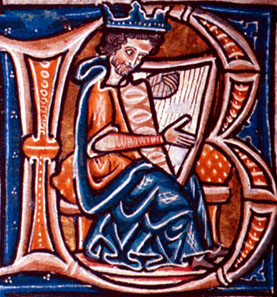
|
|
David, Med. illum MS. |
|
|
David, Med. illum MS. |
Translation
by Luke Dysinger,
O.S.B.
(translation in public domain)
Greek text formerly based on Migne (PG), Pitra (AS),
and the collation of M.-J. Rondeau: MS.
Vat.
Gr. 754.[1].
Thanks to the diligent labors and kind assistance of
Joel Kalvesmaki
[http://evagriusponticus.net/]
this webpage is being (slowly) updated
according to the 2021 critical edition in Sources Chrétiennes § 615.
|
|
|
|
() |
|
|
|
|
|
v. 4.2. And my bones are parched like firewood 1. But elsewhere it is said: All my bones shall say: Lord, Lord, who is like you? (Ps 34.10) |
4.2.καὶ τὰ ὀστᾶ μου ὡσεὶ φρύγιον συνεφρύγισαν §1. Ἀλλαχοῦ δέ φησι· Πάντα τὰ ὀστᾶ μου ἐροῦσιν· Κύριε, κύριε, τίς ὅμοιός σοι. |
|
v.5 I am stricken like grass, and my heart is withered 2. Withered is the nous shut off from the spiritual water that flows from the springs of life. (cf Ps 35.10; Rev 21.6) |
5.1.ἐπλήγην ὡσεὶ χόρτος καὶ ἐξηράνθη ἡ καρδία μου §2. Ξηραίνεται νοῦς ὕδατος πνευματικοῦ ἀπορῶν τοῦ ῥέοντος ἐκ τῆς πηγῆς τῆς ζωῆς. |
|
v. 7.1. I have become like the desert pelican 3. The pelican is said to revive with its own blood those of its young who have died. |
7.1.ὡμοιώθην πελεκᾶνι ἐρημικῷ §3. Τὸν πελεκᾶνα τοῦτόν φασιν τῷ οἰκείῳ αἵματι ἐγείρειν τὰ τεθνηκότα τῶν τέκνων. |
|
v. 8. I kept watch and became like a lonely sparrow on a roof 4. Nothing makes the intellect so buoyant as keeping watch. |
8.ἠγρύπνησα καὶ ἐγενήθην ὡσεὶ στρουθίον μονάζον ἐπὶ δώματι §4. Οὐδὲν ἄλλο τὸν νοῦν οὕτως ἀπεργάζεται κοῦφον ὡς ἀγρυπνία. |
|
v.10 For I ate ashes as if it were bread, and mixed my drink with weeping. 5. This saying is useful for those who at the time of drinking make merry with flutes and songs. |
101·10. ὅτι σποδὸν ὡσεὶ ἄρτον ἔφαγον καὶ τὸ πόμα μου μετὰ κλαυθμοῦ ἐκίρνων 5. χρήσιμον τὸ ῥητὸν πρὸς τοὺς παρὰ τὸν καιρὸν τοῦ πότου αὐλοῖς καὶ ᾠδαῖς τερπομένους.[͂PG 12.1557] |
|
v. 12.1. My days have faded like a shadow 6. For our life on earth is a shadow. (Job 8.9) |
12.1.αἱ ἡμέραι μου ὡσεὶ σκιὰ ἐκλίθησαν §6. Σκιὰ γάρ ἐστιν ὁ βίος ἡμῶν ἐπὶ τῆς γῆς |
|
v. 13. But you, Lord, you remain unto the age, and your memorial, from generation to generation 7. For I am temporary and mortal, while you are eternal and immortal. |
13.σὺ δέ, κύριε, εἰς τὸν αἰῶνα μένεις καὶ τὸ μνημόσυνόν σου εἰς γενεὰν καὶ γενεάν §7. Ἐγὼ μὲν πρόσκαιρος καὶ θνητός· σὺ δὲ ἀΐδιος καὶ ἀθάνατος. |
|
v. 14 You will arise and have compassion on Zion. 8. Here ‘Zion’ means the reasoning nature naturally disposed to behold the things of heaven. |
14. Σὺ ἀναστὰς οἰκτειρήσεις τὴν Σιὼν 8. νῦν τὴν Σιὼν τὴν φύσιν λέγει τὴν λογικὴν τὴν πεφυκυῖαν σκοπεύειν τὰ ἐπουράνια.῟ [P 101.14̓ ] |
|
v. 15.2. And they will take pity on its dust 9. That is, “of his men made of dust.” (cf ICor 15.47-49) |
15.2.καὶ τὸν χοῦν αὐτῆς οἰκτιρήσουσι |
|
v. 17.1. Because the Lord will build Zion 10. [That is,] if one builds on this foundation, made of gold, silver, [and] precious stones. (1Cor 3.12) |
17.1.ὅτι οἰκοδομήσει κύριος τὴν Σιών §10. Εἴ τις ἐπιοικοδομεῖ ἐπὶ τὸν θεμέλιον τοῦτον, χρυσόν, ἄργυρον, λίθους τιμίους. |
|
v. 19.2. And the people who will be created will praise the Lord 11. If anyone is in Christ, he is a new creation. (2Cor 5.17) |
19.2.καὶ λαὸς ὁ κτιζόμενος αἰνέσει τὸν κύριον §11. Εἴ τις ἐν Χριστῷ, καινὴ κτίσις. |
|
v. 21.2. To release the sons of those condemned to death 12. Sinful men are the sons of those condemned to death. |
21.2.τοῦ λῦσαι τοὺς υἱοὺς τῶν τεθανατωμένων §12. Οἱ ἁμαρτωλοὶ ἄνθρωποί εἰσιν υἱοὶ τῶν τεθανατωμένων. |
|
v. 25.1.Do not take me away in the midst of my days 13. Days produced by the Sun of righteousness. (Mal 3.20) |
25.1.μὴ ἀναγάγῃς με ἐν ἡμίσει ἡμερῶν μου §13. Τῶν γινομένων ἡμερῶν ὑπὸ τοῦ ἡλίου τῆς δικαιοσύνης. |
|
v. 26-27. And the heavens are the work of your hands; they will disappear, but you remain 14. The heavens will disappear not according to essence, but according to shape, for the shape of this world will pass away, says the Apostle. (1Cor 7.31) |
26.2.καὶ ἔργα τῶν χειρῶν σού εἰσιν οἱ οὐρανοί 27.1.αὐτοὶ ἀπολοῦνται, σὺ δὲ διαμένεις §14. Ἀπολοῦνται οἱ οὐρανοὶ οὐ κατ' οὐσίαν, ἀλλὰ κατὰ τὸ σχῆμα· Παράγει γάρ, φησὶν ὁ ἀπόστολος, τὸ σχῆμα τοῦ κόσμου τούτου. |
|
|
|
|
|
|
|
|
|
|
v. 1.2 Bless the Lord, my soul, and all that is within me, bless his holy name 1. All that is within the inner man are the noetic, intellectual, visual and instinctive power, as well as the imaginative [power] and that of memory. (cf Rom 7.22; Eph 3.16) |
1.2.Εὐλόγει, ἡ ψυχή μου, τὸν κύριον 3.καὶ πάντα τὰ ἐντός μου, τὸ ὄνομα τὸ ἅγιον αὐτοῦ §1. Τὰ ἐντὸς τοῦ ἔσω ἀνθρώπου ἐστὶν ἡ νοητικὴ δύναμις καὶ διανοητικὴ καὶ ἐπιβλεπτικὴ καὶ ὁρμητική, καὶ ἡ φανταστικὴ καὶ ἡ μνημονευτική. |
|
v. 3.2. The one who cures all your diseases 2. He heals illnesses, as physician of souls. |
3.2.τὸν ἰώμενον πάσας τὰς νόσους σου §2. -Ἰᾶται τὰς νόσους ὡς ἰατρὸς τῶν ψυχῶν. |
|
v. 4.1. He who redeems your life from corruption 3. He redeems, as a king. |
4.1.τὸν λυτρούμενον ἐκ φθορᾶς τὴν ζωήν σου §3. Λυτροῦται ὡς βασιλεύς. |
|
v. 4.2. He who crowns you with mercy and compassion 4. He crowns, as judge of the contest. |
4.2.τὸν στεφανοῦντά σε ἐν ἐλέει καὶ οἰκτιρμοῖς §4. Στεφανοῖ ὡς ἀγωνοθέτης. |
|
v. 5.1. The one who fills your desire with good things. 5. He fills us with good things, as [a] wealthy [person]. |
5.1.τὸν ἐμπιπλῶντα ἐν ἀγαθοῖς τὴν ἐπιθυμίαν σου §5. Ἐμπίμπλησιν ἡμᾶς ἀγαθῶν ὡς πλούσιος. |
|
5.2. renewed like the eagle’s shall be your youth. 6. The eagle strips off old age, just as a man strips off the old man, corrupt according to deceitful desires. (Eph. 4:22). |
5.2.ἀνακαινισθήσεται ὡς ἀετοῦ ἡ νεότης σου §6. Τὸ γῆρας ἀποδύεται ὁ ἀετὸς ὡς καὶ ὁ ἄνθρωπος τὸν παλαιὸν ἄνθρωπον ἀποδύεται τὸν φθειρόμενον κατὰ τὰς ἐπιθυμίας τῆς ἀπάτης. [SC= PG 12.1560̓ |
|
v. 9. He will not become angry forever or hold a grudge unto the age [to come] 7. From this we learn that anger is one thing and resentment another. |
9.οὐκ εἰς τέλος ὀργισθήσεται οὐδὲ εἰς τὸν αἰῶνα μηνιεῖ. §7. Ἐντεῦθεν γινώσκομεν ὅτι ἄλλο ὀργὴ καὶ ἄλλο μῆνις. |
|
v. 11. Because, according to the height of the sky from the earth, the Lord has strengthened his mercy on those who fear him 8. As he exalted those in heaven, so he took mercy on those who fear him on earth. |
11.ὅτι κατὰ τὸ ὕψος τοῦ οὐρανοῦ ἀπὸ τῆς γῆς ἐκραταίωσεν κύριος τὸ ἔλεος αὐτοῦ ἐπὶ τοὺς φοβουμένους αὐτὸν §8. Ὥσπερ ὕψωσε τοὺς ἐν οὐρανοῖς, οὕτως ἠλέησε τοὺς ἐπὶ γῆς φοβουμένους αὐτόν. |
|
v. 15.1. Man - his days are like grass; like the flower of the field, so it will bloom 9. Here man indicates nature in general, for all man is temporary and mortal. |
15.ἄνθρωπος, ὡσεὶ χόρτος αἱ ἡμέραι αὐτοῦ ὡσεὶ ἄνθος τοῦ ἀγροῦ, οὕτως ἐξανθήσει §9. Ἐνταῦθα ὁ ἄνθρωπος τὴν καθόλου φύσιν δηλοῖ· πᾶς γὰρ ἄνθρωπος πρόσκαιρος καὶ θνητός, |
|
v. 16,1. Because a breath passed through him, and there will be no more 10. After death, the soul does not exist in this life. |
16.1.ὅτι πνεῦμα διῆλθεν ἐν αὐτῷ καὶ οὐχ ὑπάρξει §10. Μετὰ τὸν θάνατον ἡ ψυχὴ οὐχ ὑπάρχει ἐν τῷ βίῳ τούτῳ. |
|
v. 16.2. And he will no longer recognize his place, but the mercy of the Lord is from age to age on those who fear him 11. The life of the senses is not eternal, while the mercy of the Lord is. |
16.2.καὶ οὐκ ἐπιγνώσεται ἔτι τὸν τόπον αὐτοῦ 17.1.τὸ δὲ ἔλεος τοῦ κυρίου ἀπὸ τοῦ αἰῶνος καὶ ἕως τοῦ αἰῶνος ἐπὶ τοὺς φοβουμένους αὐτὸν §11. Ἡ μὲν αἰσθητὴ ζωὴ οὐκ ἀΐδιος, τὸ δὲ ἔλεος κυρίου ἀΐδιον. |
|
v. 17.2. And his righteousness is upon the sons of the sons 12. Sons of sons are those who have been found worthy of the same spirit of adoptive sonship. (Rom 8.15) |
17.2.καὶ ἡ δικαιοσύνη αὐτοῦ ἐπὶ υἱοὺς υἱῶν §12. Υἱοὶ υἱῶν εἰσιν οἱ τοῦ αὐτοῦ πνεύματος τῆς υἱοθεσίας κατηξιωμένοι. |
|
v. 18.2. And on those who remember his commandments to do them 13. He remembers the commandments who lives according to them. |
18.2.καὶ μεμνημένοις τῶν ἐντολῶν αὐτοῦ τοῦ ποιῆσαι αὐτάς §13. Οὗτος μέμνηται τῶν ἐντολῶν ὁ ζῶν κατ' αὐτάς. |
|
v. 19. The Lord has prepared his throne in heaven and his kingship governs all beings 14. His kingship as creator governs all, while his kingship according to knowledge does not govern all who are on earth, but rather all who are in heaven. |
19.κύριος ἐν τῷ οὐρανῷ ἡτοίμασεν τὸν θρόνον αὐτοῦ καὶ ἡ βασιλεία αὐτοῦ πάντων δεσπόζει §14. Ἡ μὲν δημιουργικὴ αὐτοῦ βασιλεία πάντων δεσπόζει· ἡ δὲ κατὰ γνῶσιν βασιλεία οὐ πάντων τῶν ἐπὶ γῆς, πάντων δὲ τῶν ἐν οὐρανοῖς δεσπόζει |
|
v. 20. Bless the Lord, all his angels, mighty in strength, when you carry out his word, to listen to the sound of his words 15. He is mighty who does the word of God. But at the same time it is also necessary to know that even the angels listen to certain words that instruct them. And they, indeed, have languages which are adapted to them, by which they transmit commands to one another: If I should speak in the tongues of the angels, says Paul. (1Co 13.1) |
20.εὐλογεῖτε τὸν κύριον, πάντες οἱ ἄγγελοι αὐτοῦ δυνατοὶ ἰσχύι, ποιοῦντες τὸν λόγον αὐτοῦ, τοῦ ἀκοῦσαι τῆς φωνῆς τῶν λόγων αὐτοῦ §15. Οὗτος δυνατὸς ὁ ποιῶν τὸν λόγον τοῦ θεοῦ. Ἅμα δὲ καὶ τοῦτο ἰστέον ὅτι καὶ οἱ ἄγγελοι λόγον ἀκούουσίν τινων διδασκόντων αὐτούς. Καὶ γὰρ αὐτοὶ διαλέκτους ἁρμοζούσας αὐτοῖς ἔχουσι δἰ᾿ ὧν τὰ προστάγματα ἀλλήλοις σημαίνουσιν· Ἐὰν ταῖς γλώσσαις, φησὶν ὁ Παῦλος, τῶν ἀγγέλων λαλῶ. |
|
|
|
|
|
|
|
|
|
|
v. 2.1. By draping you in light as ina cloak 1. Cloak of the Lord - true knowledge; the one who puts on this [cloak] will be illuminated by it. |
2.1.ἀναβαλλόμενος φῶς ὡς ἱμάτιον §1. Ἱμάτιον κυρίου γνῶσις ἀληθής· ὁ δὲ ἐνδυόμενος αὐτὸ φωτισθήσεται ὑπ' αὐτοῦ. |
|
v. 2.2. Stretching the sky like a skin 2. Why did he not say “having stretched out the sky”, but “stretching it out”? Perhaps he only stretched it once according to essence, while he still stretches it according to providence. Such is also this passage from Job: He who makes the Pleiades, the evening star, the Bear and the granaries of the south wind. (Job 8.9) |
2.2.ἐκτείνων τὸν οὐρανὸν ὡσεὶ δέρριν §2. Διὰ τί οὐκ εἶπεν ἐκτείνας τὸν οὐρανὸν, ἀλλ' ἐκτείνων; Ἢ ἅπαξ μὲν αὐτὸν κατ' οὐσίαν ἐξέτεινεν, ἀεὶ δὲ αὐτὸν ἐκτείνει κατὰ τὴν πρόνοιαν. Τοιοῦτόν ἐστι καὶ τὸ παρὰ τῷ Ἰὼβ κείμενον τὸ ὁ ποιῶν πλειάδα καὶ ἕσπερον καὶ ἀρκτοῦρον καὶ ταμιεῖα νότου. |
|
v. 4. He who makes spirits of his angels and his ministers, a burning fire 3. To Abraham the angels appeared as spirits (cf Gen 18.1-9), but to the inhabitants of Sodom (cf Gen 19.24), as burning fire. |
4.Ὁ ποιῶν τοὺς ἀγγέλους αὐτοῦ πνεύματα καὶ τοὺς λειτουργοὺς αὐτοῦ πῦρ φλέγον §3. Τῷ μὲν Ἀβραὰμ οἱ ἄγγελοι ὡς πνεύματα ἐπεφάνησαν· τοῖς δὲ Σοδομίταις ὥσπερ πῦρ φλέγον. |
|
v. 5.1. He founded the earth on her sure foundation 4. Job said: Having suspended the earth on nothing (Job 26.7), and David: having founded her on her sure foundation. Both reject the idea that there is any other body beneath to support it, for stability is not an essence, but an art of God, holding the earth motionless within the sphere. |
5.1.ἐθεμελίωσεν τὴν γῆν ἐπὶ τὴν ἀσφάλειαν αὐτῆς §4. Ὁ μὲν Ἰὼβ εἶπεν· Κρεμάσας τὴν γῆν ἐπ' οὐδενός· ὁ δὲ Δαυίδ· ἐπὶ τὴν ἀσφάλειαν αὐτῆς θεμελιώσας αὐτήν. Ἑκάτεροι δὲ ἀναιροῦσι τὸ εἶναι σῶμά τι ἕτερον βαστάζον αὐτὴν ὑποκάτω· ἡ γὰρ ἀσφάλεια οὐκ ἔστιν οὐσία, ἀλλὰ τέχνη θεοῦ, ἀκίνητον τὴν γῆν ἐν τῇ σφαίρᾳ διαφυλάττουσα. |
|
v. 6.1. The abyss, like a cloak, envelopes her 5. Through the abyss he presents the incomprehensibility of the knowledge of God. |
6.1.ἄβυσσος ὡς ἱμάτιον τὸ περιβόλαιον αὐτοῦ §5. Τὸ ἀκατάληπτον τῆς γνώσεως τοῦ θεοῦ διὰ τῆς ἀβύσσου παρίστησιν. |
|
v. 6.2. The waters will stand on the mountains 6. On those who are in ignorance knowledge will stand. |
6.2.ἐπὶ τῶν ὀρέων στήσονται ὕδατα §6. Ἐπὶ τῶν ἐν ἀγνοίᾳ ὄντων στήσεται ἡ γνῶσις |
|
v. 8.1. They leap on the mountains and go down the plains 7. By these words, he hints at certain reasoning natures. |
8.1.ἀναβαίνουσιν ὄρη καὶ καταβαίνουσιν πεδία §7. Λογικάς τινας διὰ τῶν λόγων τούτων αἰνίττεται φύσεις. |
|
9. You have set a boundary that they may not pass; nor shall they return again to cover the earth. 8. This is said in reference to the subterranean demons. (cf Sch 1 on Ps 55.3) |
9. Ὅριον ἔθου ὃ οὐ παρελεύσονται, οὐδὲ ἐπιστρέψουσιν καλύψαι τὴν γῆν. η´. Περὶ τῶν καταχθονίων δαιμόνων ταῦτα λέγεσθαί φασι. |
|
v. 10.1. He who returns the springs to the ravines 9. He who gives knowledge to those who have been hollowed out by ignorance and scraped out like ravines by vice. |
10.1.ὁ ἀποστέλλων πηγὰς ἐν φάραγξιν §9. Ὁ διδοὺς γνῶσιν τοῖς κενωθεῖσιν ὑπὸ τῆς ἀγνοίας καὶ δίκην φαράγγων κοιλανθεῖσιν ὑπὸ τῆς κακίας. |
|
v. 12. The birds of the sky will roost on them 10. The birds of the sky roost on them because they had faith like a mustard seed (cf Mt 17.20; cf Mt 13.21-22). |
12.ἐπ' αὐτὰ τὰ πετεινὰ τοῦ οὐρανοῦ κατασκηνώσει. §10. Κατασκηνοῖ ἐπ' αὐτοὺς τὰ πετεινὰ τοῦ οὐρανοῦ ἐπειδὴ ἔσχον πίστιν ὡς κόκκον σινάπεως. |
|
v. 13.1. Giving drink to the mountains from her regions superior 11. The higher regions of God are the pure natures who give drink to those who are most elevated in heart. |
13.1.ποτίζων ὄρη ἐκ τῶν ὑπερῴων αὐτοῦ §11. Ὑπερῷα θεοῦ φύσεις καθαραὶ ποτίζουσαι τοὺς ὑψηλοτέρους τὴν καρδίαν. |
|
v. 13.2. With the fruit of your works the earth will be satisfied 12. The fruit of works is the contemplation of beings. |
13.2.ἀπὸ καρποῦ τῶν ἔργων σου χορτασθήσεται ἡ γῆ §12. Καρπὸς τῶν ἔργων ἐστιν ἡ θεωρία τῶν γεγονότων. |
|
v. 14.1. Growing grass for the cattle and greenery at the service of men 13. For the weak eat vegetables (Rom 14.2). |
14.1.ἐξανατέλλων χόρτον τοῖς κτήνεσιν2.καὶ χλόην τῇ δουλείᾳ τῶν ἀνθρώπων §13. Ὁ γὰρ ἀσθενῶν λάχανα ἐσθίει. |
|
v. 1. The trees of the plain will be sated 14. Just as there are trees of paradise (cf Ez 31.9), so there are there are also trees of the plain. |
16.1.χορτασθήσεται τὰ ξύλα τοῦ πεδίου §14. Ὥσπερ ἔστι τινὰ ξύλα τοῦ παραδείσου, οὕτω καὶ ξύλα τοῦ πεδίου. |
|
v. 17.1. There the sparrows will nest 15. If anyone has become like a sparrow through fasting and asceticism, he can also become the father of fledglings. |
17.1.ἐκεῖ στρουθία ἐννοσσεύσουσιν §15. Εἴ τις ἀπὸ ἀγρυπνίας καὶ ἀσκήσεως γέγονεν ὡς στρουθίον, οὑτος δύναται καὶ νεοσσῶν γενέσθαι πατήρ. |
|
v. 18.2. The rock will serve as a refuge for the porcupines 16. He who has the condition of the porcupine, let him take refuge near the spiritual rock that accompanied and watered Israel in the desert (1Cor 10.4; cf. Ex 17.6; Num 20.7-11). |
18.2.πέτρα καταφυγὴ τοῖς χοιρογρυλλίοις §16. Ὁ χοιρογρυλλίου ἔχων κατάστασιν προσφευγέτω τῇ πνευματικῇ πέτρᾳ τῇ ἀκολουθούσῃ ἐν τῇ ἐρήμῳ καὶ ποτιζούσῃ τὸν Ἰσραήλ. |
|
v. 19.2. The sun knows its setting 17. The Sun of Justice (Mal 3.20) now knows those upon whom he once went down. |
19.2.ὁ ἥλιος ἔγνω τὴν δύσιν αὐτοῦ §17. Ὁ ἥλιος τῆς δικαιοσύνης ἔγνω νῦν τοὺς ἐν οἷς ἔδυ ποτε. |
|
v. 21. Lion cubs roaring to seize and seek their food from God 18. And the demons in the Gospels reclaimed the pigs! (cf Mt 8.30-32) |
21.σκύμνοι ὠρυόμενοι ἁρπάσαι καὶ ζητῆσαι παρὰ τοῦ θεοῦ βρῶσιν αὐτοῖς §18. Καὶ οἱ δαίμονες ἐν τοῖς εὐαγγελίοις τοὺς χοίρους ἐξῃτήσαντο. |
|
v. 22. The sun came up and they gathered and they will lie down in their dens 19. Those on whom the Sun of Justice rises (Mal 3.20) , with them the vices also potentially exist. |
22.ἀνέτειλεν ὁ ἥλιος καὶ συνήχθησαν καὶ ἐν ταῖς μάνδραις αὐτῶν κοιτασθήσονται §19. Ἐν οἷς ἀνατέλλει ὁ ἥλιος τῆς δικαιοσύνης, ἐν τούτοις καὶ αἱ κακίαι κατὰ δύναμιν ἐνυπάρχουσιν. |
|
v. 23.1. The man will go out for his work and for his activity, until the evening 20. He now calls matter itself “work” that concerns his activity, while activity is the art exercised on matter. |
23.ἐξελεύσεται ἄνθρωπος ἐπὶ τὸ ἔργον αὐτοῦ καὶ ἐπὶ τὴν ἐργασίαν αὐτοῦ ἕως ἑσπέρας §20. Ἔργον νῦν λέγει αὐτὴν τὴν ὕλην περὶ ἣν ἡ ἐργασία· ἐργασίαν δὲ αὐτὴν τὴν τέχνην τὴν περὶ ὕλην γινομένην. |
|
v. 25.1. Behold the sea great and vast 21. This sea designates this life. |
25.1.αὐτὴ ἡ θάλασσα ἡ μεγάλη καὶ εὐρύχωρος. §21. Αὕτη ἡ θάλασσα τὸν βίον τοῦτον σημαίνει. |
|
25(2). There are reptiles there without number 22. Of the men [made] reptilian through vices there is no number, for it says, Who numbers the number of the stars: and calls them all by their names. (cf. sch 2 On Ps 146.4) |
25.2.ἐκεῖ ἑρπετὰ ὧν οὐκ ἔστιν ἀριθμὸς §22. Τῶν ἑρπετῶν ἀνθρώπων διὰ τὴν κακίαν οὐκ ἔστιν ἀριθμός· Ὁ γὰρ ἀριθμῶν, φησί, πλήθη ἄστρων καὶ πᾶσιν αὐτοῖς ὀνόματα καλῶν. |
|
v. 29.2. You'll make their spirit disappear, and they'll faint and they will return to their dust 23. Those who are deprived of the Spirit given to them by God become dust. |
29.2.ἀντανελεῖς τὸ πνεῦμα αὐτῶν, καὶ ἐκλείψουσιν3.καὶ εἰς τὸν χοῦν αὐτῶν
ἐπιστρέψουσιν |
|
v. 30.2. And you will renew the face of the earth 24. What St. Paul called resurrection (Phil 3.11), David has called renewal. |
30.2.καὶ ἀνακαινιεῖς τὸ πρόσωπον τῆς γῆς §24. Ἣν Παῦλος ὁ ἅγιος ἐξανάστασιν εἴρηκεν, ταύτην Δαυὶδ ἀνακαινισμὸν προσηγόρευσεν. |
|
v. 32. He who casts his eyes on the earth and makes it shudder, he who touches the mountains, and they smoke 25. The smoldering mountains reject evil, when the spiritual fire that was cast down on the earth touches them. (cf Lk 12.49) |
32.ὁ ἐπιβλέπων ἐπὶ τὴν γῆν καὶ ποιῶν αὐτὴν τρέμειν, ὁ ἁπτόμενος τῶν ὀρέων καὶ καπνίζονται §25. Τὰ καπνιζόμενα ὄρη ἀποβάλλει τὴν κακίαν, ἁπτομένου αὐτῶν τοῦ πνευματικοῦ πυρὸς τοῦ βληθέντος ἐπὶ τὴς γῆς. |
|
v. 35.1. Let them disappear from the earth, sinners and the iniquitous, so that they no longer exist 26. Not so that they no longer exist, but so that they no longer exist as sinners . |
35.1.ἐκλίποισαν ἁμαρτωλοὶ ἀπὸ τῆς γῆς 2.καὶ ἄνομοι, ὥστε μὴ ὑπάρχειν αὐτούς §26. Οὐχὶ μὴ ὑπάρχειν αὐτούς, ἀλλὰ μὴ ὑπάρχειν αὐτοὺς ἁμαρτωλούς. |
|
|
|
|
|
|
|
|
|
|
[104.] v. 2. Tell all his wonders 1. Those who have acquired all the science of God, those can relate all his marvels. |
2.διηγήσασθε πάντα τὰ θαυμάσια αὐτοῦ §1. Ὁ κτησάμενοι πᾶσαν τὴν γνῶσιν τὴν τοῦ θεοῦ, οὗτοι δύνανται διηγήσασθαι πάντα τὰ θαυμάσια αὐτοῦ. |
|
[104.] v. 4.1. Seek the Lord and be strengthened 2. He who fulfills the commandments of God - he [it is who] seeks God. |
4.1.ζητήσατε τὸν κύριον καὶ κραταιώθητε §2. Ὁ τὰς ἐντολὰς ποιῶν τοῦ θεοῦ, οὗτος ζητεῖ τὸν θεόν. |
|
[104.] v. 4.2. Constantly seek his face 3. He tells us to look for that face that the angels constantly see. (Mt 18.10) |
4.2.Ζητήσατε τὸ πρόσωπον αὐτοῦ διαπαντός §3. Τοῦτο λέγει τὸ πρόσωπον ζητεῖν ἡμᾶς ὅπερ οἱ ἄγγελοι βλέπουσι διαπαντός. |
|
[104.] v. 6.1. Seed of Abraham, his servants 4. Those who are of the seed of Abraham are potentially elect. |
6.1.σπέρμα Ἀβραὰμ δοῦλοι αὐτοῦ |
|
[104.] v. 6.2. Sons of Jacob, his chosen ones 5. Many are called, but few are chosen. (Mt 22.14) |
6.2.υἱοὶ Ιακωβ ἐκλεκτοὶ αὐτοῦ §5. Πολλοὶ μὲν κλητοί· ὀλίγοι δὲ ἐκλεκτοί. |
|
[104.] v. 8. He remembered for the age of his covenant, the word he commanded for a thousand generations 6. Some thought the thousand generations was a question of many generations, others of those who are circumscribed by this number. |
8.ἐμνήσθη εἰς τὸν αἰῶνα διαθήκης αὐτοῦ λόγου οὗ ἐνετείλατο εἰς χιλίας γενεάς §6. Τὰς χιλίας γενεὰς οἱ μὲν τὰς πολλὰς αὐτὸν λέγειν γενεὰς ἐνόμισαν, οἱ δὲ τὰς ὑπὸ τούτου τοῦ ἀριθμοῦ περιγραφομένας. |
|
[104.] v. 7. Saying: To you I will give the land of Canaan 7. Before the coming of Christ, the Canaanites occupied our souls without letting us produce spiritual fruits. |
11.1.λέγων· σοὶ δώσω τὴν γῆν Χαναὰν §7. Πρὸ τῆς ἐπιδημίας τῆς τοῦ Χριστοῦ οἱ Χαναναῖοι κατεῖχον ἡμῶν τὰς ψυχὰς, μὴ ἐῶντες ἡμᾶς καρποὺς ἐκφέρειν πνευματικούς. |
|
[104.] v. 12. While they were few in number, sparse and foreign resident on her 8. Foreign residents are those who believe that none of the goods of this world belong to them. |
12.ἐν τῷ εἶναι αὐτοὺς ἀριθμῷ βραχεῖς, ὀλιγοστοὺς καὶ παροίκους ἐν αὐτῇ §8. Πάροικοί εἰσιν οἱ μηδὲν ἴδιον τῶν τοῦ κόσμου τούτου νομίζοντες. |
|
[104.] 14. He suffered no man to wrong them: 9 From this we know that those wronged by men are wronged according to abandonment by God |
14.1.οὐκ ἀφῆκεν ἄνθρωπον ἀδικῆσαι αὐτοὺς §9. Ἐντεῦθεν γινώσκομεν ὅτι οἱ ἀδικούμενοι ὑπὸ ἀνθρώπων κατ' ἐγκατάλειψιν ἀδικοῦνται θεοῦ. [= PG 12.1564̓ |
|
[104.] 15. Do not touch my anointed ones 10. Because those who are ‘Christ’ [anointed] partake of Christ they are called ‘Christ’; whereas the Christ who partakes of the Father is called ‘Christ’ [anointed]. By ‘Christ’ I mean the Lord who, with God the Word, has come among [us]. [cf. Sch.7 on Ps.44.8] |
15.1.μὴ ἅπτεσθε τῶν χριστῶν μου §10. Οὗτοι οἱ χριστοὶ Χριστοῦ μετέχοντες λέγονται χριστοί· ὁ δὲ Χριστὸς τοῦ πατρὸς μετέχων λέγεται Χριστός· Χριστὸν δέ φημι τὸν μετὰ τοῦ θεοῦ λόγου ἐπιδημήσαντα κύριον. ῟PG 12.1564̓ [cf Clem Strom 2.4.18.3.1; 6.17.149.5; Didymus d.Trin 39.712.6; old NT variant: become chrēstoi, like heavenly father] |
|
[104.]
v. 19 until his
word came. 11. The devil bring many temptations upon the holy ones until the word of the Lord comes which inflames and purifies their hearts. |
19.μέχρι τοῦ ἐλθεῖν τὸν λόγον αὐτοῦ, τὸ λόγιον κυρίου ἐπύρωσεν αὐτόν §11. πολλοὺς πειρασμοὺς ἐπάγει τοῖς ἁγίοις ὁ διάβολος μέχρι τοῦ ἐλθεῖν τὸν λόγον τοῦ θεοῦ τὸν πυροῦντα καὶ καθαρίζοντα τὰς καρδίας αὐτῶν. [= Pitra 104·19̔1̓̓ |
|
[104.] v. 12. And Israel entered Egypt and Jacob sojourned in the land of Ham 12. From this we learn that the Law is really spiritual (Rom 7.14) and that the events of that time happened to Joseph symbolically (cf Ps 104.16-23). And in fact wheat designates, it seems, knowledge, and famine, ignorance; as for Egypt, it indicates this world (cf Ps 104.16), for Pharaoh has been interpreted by many as the designation of the devil (cf Jn 12.31; 16.11). |
23.καὶ εἰσῆλθεν Ἰσραὴλ εἰς Αἴγυπτον καὶ Ἰακὼβ παρῴκησεν ἐν γῇ Χαμ §12. ἐντεῦθεν γινώσκομεν ὅτι πνευματικὸς ὄντως ὁ νόμος ἐστί, καὶ τὰ πραττόμενα τότε συμβολικῶς Ἰωσὴφ ἐγίνετο. Καὶ γὰρ ὁ σῖτος ὡς ἔοικεν γνῶσιν σημαίνει καὶ ὁ λιμὸς ἀγνωσίαν καὶ ἡ Αἴγυπτος τὸν κόσμον τοῦτον δηλοῖ· ὁ γὰρ Φαραὼ τὸν διάβολον ὑπὸ πολλῶν ἡρμηνεύθη σημαίνειν. |
|
[104.] v. 24.2. And (God) made him mightier than his enemies 13. Without the virtue and knowledge of God, no one would become stronger than their enemies. |
24.2.καὶ ἐκραταίωσεν αὐτὸν ὑπὲρ τοὺς ἐχθροὺς αὐτοῦ §13. Χωρὶς ἀρετῆς καὶ γνώσεως θεοῦ οὐκ ἄν τις γένοιτο τῶν ἐχθρῶν ἰσχυρότερος. |
|
[104.] v. 26. He sent Moses his servant, Aaron whom he had chosen; 27 he placed in them the reasons for his signs and wonders in the land of Cham 14. Only Moses and Aaron knew the logoi of signs and wonders. |
26.ἐξαπέστειλεν Μωϋσῆν τὸν δοῦλον αὐτοῦ, Ἀαρὼν ὃν ἐξελέξατο αὐτόν·2.7.ἔθετο ἐν αὐτοῖς τοὺς λόγους τῶν σημείων αὐτοῦ καὶ τῶν τεράτων ἐν γῇ Χάμ §14. Μωσῆς καὶ Ἀαρὼν μόνοι ᾔδεσαν τοὺς λόγους τῶν σημείων καὶ τῶν τεράτων. |
|
[104.] v. 28.2 And they embittered his words 15. Those who hear the words of God and do not put them into practice - these embitter his words. (Cf. Lk 6, 46-47) |
28.2.καὶ παρεπίκραναν τοὺς λόγους αὐτοῦ §15. Οἱ ἀκούοντες τῶν λόγων τοῦ θεοῦ καὶ μὴ ποιοῦντες αὐτοὺς, παραπικραίνουσι τοὺς λόγους αὐτοῦ. |
|
[104.] v. 31.1. He said, and the dog fly came 16. The Hebrews translate by kunomuia a multitude of wild and carnivorous animals of all kinds, but the Greeks call kunomuia the [dog]fly of the barking dog. |
31.1.εἶπεν καὶ ἦλθε κυνόμυια §16. Τὴν κυνόμυιαν οἱ Ἑβραῖοι ἑρμηνεύουσιν πλῆθος πάμμικτον ἀγρίων καὶ σαρκοβόρων θηρίων· οἱ δὲ Ἕλληνες λέγουσι κυνόμυιαν τὴν τοῦ κυνὸς τοῦ ὑλακτοῦντος μυῖαν. |
|
[104.] v. 33.1. He smote their vines and their fig trees 17. For their vines came from the vineyard of Sodom, and their branches from Gomorrah. (Dt 32.32) |
33.1.καὶ ἐπάταξεν τὰς ἀμπέλους αὐτῶν καὶ τὰς συκᾶς αὐτῶν §17. Ἐκ γὰρ ἀμπέλου Σοδόμων ἦσαν αἱ ἄμπελοι αὐτῶν καὶ αἱ κληματίδες αὐτῶν ἐκ Γομόρρας.3 |
|
[104.] v. 34.1. He said, and the grasshopper came 18. This grasshopper devours the evil seed. |
34.1.εἶπεν καὶ ἦλθεν ἀκρίς §18. Ἡ ἀκρὶς αὕτη κατεσθίει τὸ σπέρμα τὸ πονηρόν. |
|
[104.] v. 37.1. And he brought them out in silver and gold 19. That is, “with silver and gold,” which are symbols of exterior [secular/exothen] wisdom. |
37.1.καὶ ἐξήγαγεν αὐτοὺς ἐν ἀργυρίῳ καὶ χρυσίῳ §19. Ἀντὶ τοῦ μετὰ ἀργυρίου καὶ χρυσίου, ἅπερ σύμβολά ἐστι τῆς ἔξωθεν σοφίας. |
|
[104.] v. 39. He sent a cloud to shelter them and a fire to light them at night. 20. The cloud indicates a holy nature and the pillar of fire likewise indicates an intelligible (noetic) power. |
39.διεπέτασεν νεφέλην εἰς σκέπην αὐτοῖς καὶ πῦρ τοῦ φωτίσαι αὐτοῖς τὴν νύκτα §20. Ἡ νεφέλη φύσιν ἁγίαν δηλοῖ καὶ ὁ στύλος τοῦ πυρὸς ὁμοίως δύναμιν σημαίνει νοηράν. |
|
[104.] v. 40.2. And he filled them with bread from heaven 21. I am the bread that came down from heaven, he says in the Gospels (Jn 6.41). |
40.2.καὶ ἄρτον οὐρανοῦ ἐνέπλησεν αὐτούς §21. Ἐγώ εἰμι ὁ ἄρτος ὁ ἀπὸ τοῦ οὐρανοῦ καταβὰς, ἐν τοῖς εὐαγγελίοις φησίν. |
|
[104.] v. 43. And he brought out his people in exultation and his elect in rejoicing 22. If the people went out in exultation and his elect in rejoicing, rejoicing is better than exultation, since the elect are better than the people. |
43.καὶ ἐξήγαγεν τὸν λαὸν αὐτοῦ ἐν ἀγαλλιάσει καὶ τοὺς ἐκλεκτοὺς αὐτοῦ ἐν εὐφροσύνῃ §22. Εἰ ὁ λαὸς ἐξῆλθεν ἐν ἀγαλλιάσει, οἱ δὲ ἐκλεκτοὶ αὐτοῦ ἐν εὐφροσύνῃ, μεῖζον ἡ εὐφροσύνη τῆς ἀγαλλιάσεως, ἐπεὶ καὶ μείζονες οἱ ἐκλεκτοὶ τοῦ λαοῦ. |
|
[104.] v. 44.2. And they inherited the sorrows of the peoples 23. Here he has named the product of pain “pain.” |
44.2.καὶ πόνους λαῶν ἐκληρονόμησαν §23. Νῦν τὸ ἀποτέλεσμα τοῦ πόνου πόνον ὠνόμασεν. |
|
[104.] v. 45.2 And so that they seek his law 24. If the Law is spiritual, it needs to be sought if it is to be known. (Rom 7, 14) |
45.2.καὶ τὸν νόμον αὐτοῦ ἐκζητήσωσιν §24. Εἰ ὁ νόμος πνευματικός ἐστι, χρῄζει πρὸς τὸ γνῶχθηναι ζητήσεως. |
|
|
|
|
|
|
|
|
|
|
v. 2.1. Who will tell the dominions of the Lord? 1. Here the interrogative “which” does not indicate impossibility, but rarity. But sometimes it designates impossibility, as in the verse: Who will tell his generation? (Is 53.8) |
2.1.τίς λαλήσει τὰς δυναστείας τοῦ κυρίου §1. Τὸ τίς ἐνταῦθα οὐ τὸ ἀδύνατον, ἀλλὰ τὸ σπάνιον δηλοῖ· ἐστὶ δ' ὅτε καὶ τὸ ἀδύνατον σημαίνει, ὡς τὸ τὴν γενεὰν αὐτοῦ τίς διηγήσεται; |
|
v. 3. Blessed are those who keep judgment, and do justice at all times! 2. The words “at all times” must be said of each virtue, practicing temperance, practicing courage at all times, practicing charity, long-suffering, and the same for the other [virtues]. |
3.μακάριοι οἱ φυλάσσοντες κρίσιν καὶ ποιοῦντες δικαιοσύνην ἐν παντὶ καιρῷ. §2. Ἐφ' ἑκάστης ἀρετῆς τὸ ἐν παντὶ καιρῷ λεκτέον ποιοῦντες σωφροσύνην, ποιοῦντες ἀνδρείαν ἐν παντὶ καιρῷ, ποιοῦντες ἀγάπην, μακροθυμίαν, καὶ ἐπὶ τῶν ἄλλων ὡσαύτως. |
|
v. 5.3. To be praised with your inheritnce 3. He is worthy of praise who has inherited the nature of God: My soul will be praised in the Lord, that is to say: my soul will be praised in justice, wisdom, knowledge and charity . Indeed, our Lord receives all these names according to [His] title. (Ps 33, 3) |
5.3.τοῦ ἐπαινεῖσθαι μετὰ τῆς κληρονομίας σου §3. Οὗτος ἐπαινετὸς ὁ κληρονομήσας τὴν φύσιν τὴν τοῦ θεοῦ· Ἐν τῷ κυρίῳ ἐπαινηθήσεται ἡ ψυχή μου, τουτέστιν ἐν δικαιοσύνῃ ἐπαινηθήσεται ἡ ψυχή μου, καὶ ἐν σοφίᾳ, καὶ ἐν γνώσει καὶ ἐν ἀγάπῃ· Ταῦτα γὰρ πάντα ὁ κύριος ἡμῶν κατ' ἐπίνοιαν ὀνομάζεται. |
|
v. 8. And he saved them because of his name to make known his dominion 4. The Lord saves us in order to grace us with the knowledge of his dominion. |
8.καὶ ἔσωσεν αὐτοὺς ἕνεκεν τοῦ ὀνόματος αὐτοῦ τοῦ γνωρίσαι τὴν δυναστείαν αὐτοῦ §4. Διὰ τοῦτο σῴζει ἡμᾶς ὁ κύριος, ἵνα γνῶσιν ἡμῖν τῆς δυναστείας αὐτοῦ χαρίσηται. |
|
v. 9.1. He rebuked the Red Sea and it dried up 5. And in the Gospels, Christ rebuked the wind and the sea, and there was a great calm. (Mt 8.26) |
9.1.καὶ ἐπετίμησεν τῇ ἐρυθρᾷ θαλάσσῃ καὶ ἐξηράνθη §5. Καὶ ἐν τοῖς εὐαγγελίοις ὁ Χριστὸς ἐπετίμησεν τῷ ἀνέμῳ καὶ τῇ θαλάσσῃ, καὶ ἐγένετο γαλήνη μεγάλη |
|
v. 11. And the water covered their oppressors, none of them were left 6. Blessed is he for whom none of the enemies are left! |
11.καὶ ἐκάλυψεν ὕδωρ τοὺς θλίβοντας αὐτούς, εἷς ἐξ αὐτῶν οὐχ ὑπελείφθη §6. Μακάριος οὗτος ᾧ μηδεὶς τῶν ἐχθρῶν ὑπολείπεται. |
|
v. 13. Very quickly, they forgot his works, they did not wait for his decision; 14.1 and they were seized with desire in the wilderness 7. They did not wait for his grace, but forgot his works and were seized with an evil desire. (Col.3, 5) |
13.ἐτάχυναν ἐπελάθοντο τῶν ἔργων αὐτοῦ, οὐχ ὑπέμειναν τὴν βουλὴν αὐτοῦ·14.1.καὶ ἐπεθύμησαν ἐπιθυμίαν ἐν τῇ ἐρήμῳ §7. Οὐκ ἀνέμειναν τὴν χάριν αὐτοῦ, ἀλλ' ἐπελάθοντο τῶν ἔργων αὐτοῦ καὶ ἐπεθύμησαν ἐπιθυμίαν κακήν. |
|
v. 16. And they angered Moses in the camp ‘and Aaron the saint of the Lord 8. Those who transgress the commandments of God anger Moses, and those who reject the faith anger Aaron, for one denotes action, the other contemplation.[cf. Sch.4 on Ps. 132, 2; Schol.14 on Ps.104,26-27]
|
16.Καὶ παρώργησαν Μωϋσῆν ἐν τῇ παρεμβολῇ καὶ Ἀαρὼν τὸν ἅγιον κυρίου §8. Οἱ τὰς ἐντολὰς τοῦ θεοῦ παραβαίνοντες τὸν Μωϋσῆν παροργίζουσιν· οἱ δὲ τὴν πίστιν ἀθετοῦντες τὸν Ἀαρὼν παροξύνουσιν· ὁ μὲν γὰρ πρᾶξιν, ὁ δὲ θεωρίαν σημαίνει. |
|
v. 20. And they exchanged their glory for a representation of a calf that browses the grass
9.
Those who
glorify the creature instead of the creator
(Rom 1.25)
, these
exchange their glory: And they exchanged, says Paul, the
glory of the incorruptible God for a representation of corruptible man,
birds, quadrupeds and reptiles
b. (Rom 1,23). |
20.καὶ ἠλλάξαντο τὴν δόξαν αὐτῶν ἐν ὁμοιώματι μόσχου ἔσθοντος χόρτον §9. Οἱ δοξάζοντες κτίσμα παρὰ τὸν κτίσαντα, οὗτοι ἀλλάσσουσι τὴν δόξαν αὐτῶν· Καὶ ἤλλαξαν, φησὶν ὁ Παῦλος, τὴν δόξαν τοῦ ἀφθάρτου θεοῦ ἐν ὁμοιώματι φθαρτοῦ ἀνθρώπου, καὶ πετεινῶν καὶ τετραπόδων καὶ ἑρπετῶν. |
|
v. 23.1. And he spoke of exterminating them 10. Now extermination means the change of those who come forth from this life. |
23.1.καὶ εἶπεν τοῦ ἐξολοθρεῦσαι αὐτούς §10. Ἡ ἐξολέθρευσις νῦν τὴν μετάθεσιν τῶν ἐκ τοῦ βίου τούτου σημαίνει. |
|
v. 23.4. To divert his anger so that he does not exterminate 11. It should be noted that even a single saint like Moses is able to divert the anger that spreads over all the people. |
23.4.τοῦ ἀποστρέψαι τὴν ὀργὴν αὐτοῦ τοῦ μὴ ἐξολοθρεῦσαι §11. Σημειωτέον ὅτι καὶ εἷς ἅγιος ὡς ὁ Μωσῆς δυνατός ἐστιν ἀποστρέψαι ὀργὴν φερομένην ἐπ' ἔθνος ὅλον. |
|
v. 24.1. And they despised the desired land 12. The desired land is the kingdom of heaven. |
24.1.καὶ ἐξουδένωσαν γῆν ἐπιθυμητὴν §12. Ἡ γῆ ἡ ἐπιθυμητὴ ἡ βασιλεία ἐστὶν τῶν οὐρανῶν. |
|
v. 1. And he raised his hand to them 13. He calls His powers of punishment “hand”. |
26.1.καὶ ἐπῆρεν τὴν χεῖρα αὐτοῦ αὐτοῖς §13. Χεῖρα λέγει τὰς κολαστικὰς αὐτοῦ δυνάμεις |
|
v. 28.1. And they were initiated into Belphegor 14. They held ceremonies in honor of Belphegor after being initiated into his mysteries. |
28.1.καὶ ἐτελέσθησαν τῷ Βεελφεγώρ §14. Τελετὰς ἤγαγον τῷ Βεελφεγὼρ μυηθέντες ἐν τοῖς μυστηρίοις αὐτοῦ. |
|
v. 29.2. And the fall multiplied among them 15. Instead of “those who fall”. |
29.2.καὶ ἐπληθύνθη ἐν αὐτοῖς ἡ πτῶσις §15. Ἀντὶ τοῦ οἱ πίπτοντες. |
|
v. 30.1. And Phinees arose and intervened, and the slaughter ceased 16. Above it says that Moses arose and averted the wrath [of God] (cf. Ps 105.23), while here that Phinehas arose and he did not avert the slaughter; but the slaughter stopped . |
30.καὶ ἔστη Φινεὲς καὶ ἐξιλάσατο καὶ ἐκόπασεν ἡ θραῦσις §16. Ἀνωτέρω μὲν λέγει ὅτι ἔστη Μωϋσῆς καὶ ἀπέστρεψε τὴν ὀργὴν αὐτοῦ· ἐνταῦθα δὲ ὅτι ἔστη Φινεὲς καὶ οὐχὶ ἀπέστρεψε τὴν θραῦσιν, ἀλλ' ἐκόπασεν ἡ θραῦσις. |
|
v. 33.2. And he disagreed with his lips 17. . Instead of: “he clashed against God”. |
33.2.καὶ διέστειλεν ἐν τοῖς χείλεσιν αὐτοῦ §17. Ἀντὶ τοῦ προσέκρουσε θεῷ. |
|
v. 34. They did not destroy the nations that the Lord told them 18. He who has cast off the passions - he has destroyed the nations of which the Lord has spoken. |
34.οὐκ ἐξωλέθρευσαν τὰ ἔθνη ἃ εἶπεν κύριος αὐτοῖς §18. Ὁ ἀποθέμενος τὰ πάθη οὗτος ἐξωλέθρευσεν τὰ ἔθνη ἃ εἶπεν κύριος. |
|
v. 35.1 And they mingled with the nations [...] 36.1 and they served their carved images 19. We mingle with the nations when we serve carved images. |
35.1.καὶ ἐμίγησαν ἐν τοῖς ἔθνεσιν [...]36.1.καὶ ἐδούλευσαν τοῖς γλυπτοῖς αὐτῶν §19. Μίγνυταί τις τοῖς ἔθνεσι δουλεύων γλυπτοῖς. |
|
v. 39.2. And they prostituted themselves in their doings 20. The soul prostitutes itself when it receives seeds from the opposing power and gives birth to evil children. |
39.2.καὶ ἐπόρνευσαν ἐν τοῖς ἐπιτηδεύμασιν αὐτῶν §20. Πορνεύει ψυχὴ σπέρματα λαμβάνουσα παρὰ τῆς ἀντικειμένης δυνάμεως καὶ τίκτουσα τέκνα πονηρά. |
|
v. 40.2. And [the Lord regarded] his inheritance as an abomination 21. Inheritance of the Lord - reasoning souls. |
40.2.καὶ ἐβδελύξατο τὴν κληρονομίαν αὐτοῦ §21. Κληρονομία κυρίου ψυχαὶ λογικαί. |
|
v. 41.2. And those who hated them ruled them, 42.1 and their enemies oppressed them 22. Demons are those who hate us and oppress our souls. |
41.2.καὶ ἐκυρίευσαν αὐτῶν οἱ μισοῦντες αὐτοὺς, καὶ ἔθλιψαν αὐτοὺς οἱ ἐχθροὶ αὐτῶν §22. Οἱ δαίμονές εἰσιν οἱ μισοῦντες ἡμᾶς καὶ θλίβοντες τὰς ψυχὰς ἡμῶν. |
|
v. 45.2. And He repented according to abundance of his mercy 23. By this we learn that the Lord also makes us worthy of mercy |
45.2.καὶ μετεμελήθη κατὰ τὸ πλῆθος τοῦ ἐλέους αὐτοῦ §23. Ἐντεῦθεν γινώσκομεν ὅτι καὶ τοῦ ἐλεεῖσθαι ἀξίους ὁ κύριος ἡμᾶς ἀπεργάζεται. |
|
v. 47.1. And gather us from the nations 24. Those whom God gathers from the nations are those whom he removes from vice and ignorance. |
47.Καὶ ἐπισυνάγαγεν ἡμᾶς ἐκ τῶν ἐθνῶν· τοῦ ἐξομολογήσασθαι τῷ ὀνόματί σου τῷ ἁγίῳ. τοῦ ἐγκαυχᾶσθαι ἐν τῇ αἰνέσει σου. §24. Τούτους συνάγει ἀπὸ τῶν ἐθνῶν ὁ θεὸς οὓς ἀφίστησιν ἀπὸ κακίας καὶ ἀγνωσίας. |
|
v. 47.2. For us to boast of your praise 25. Our Lord is praise, since he who boasts must boast in the Lord. (1Cor 1.31; 2Cor 10,17). |
47.2 τοῦ ἐγκαυχᾶσθαι ἐν τῇ αἰνέσει σου. §25. Ὁ κύριος ἡμῶν ἡ αἴνεσίς ἐστιν, εἴ γε ὁ καυχώμενος, ἐν κυρίῳ καυχάσθω. |
|
|
|
|
|
|
|
|
|
|
+1. [Among the Hebrews, Book IV goes to Psalm 105.] |
§+1 [Παρ' Ἑβραίοις ἡ τετάρτη βίβλος ἵσταται μέχρι τοῦ ρεʹ ψαλμοῦ.] |
|
[106.] v. 3. he gathered them from the east and west, north and the sea 1. He who came forth from the east is one who ceased to covet and to be angry, because he attained apatheia; he who was gathered from the west abstains from adultery and murder (cf. Mt 15.19), as well as from the actual sins which he had been committing until then. But if anyone keeps away from the north and the sea, that one, because he has his being in true doctrines, is no longer tossed about by every wind of teaching (Ep 4.14) nor is he shipwrecked with regard to faith (1Tim 1.19), because he acquired divine navigation (cf Pr 1.5) by the grace of Christ. |
3.ἐκ τῶν χωρῶν συνήγαγεν αὐτοὺς ἀπὸ ἀνατολῶν καὶ δυσμῶν καὶ βορρᾶ καὶ θαλάσσης §1. Ὁ μὲν ἀπὸ ἀνατολῶν ἐξελθὼν οὗτος πέπαυται τοῦ ἐπιθυμεῖν καὶ ὀργίζεσθαι, ἀπαθὴς γεγονώς· ὁ δὲ ἀπὸ δυσμῶν συναχθεὶς ἀπέχεται μοιχείας καὶ φόνου καὶ τῶν κατ' ἐνέργειαν τέως ἁμαρτιῶν· εἰ δέ τις τοῦ βορρᾶ καὶ τῆς θαλάσσης ἀπήλλακται, οὗτος ἐν ἀληθέσι δόγμασιν ὢν, οὐκέτι περιφέρεται παντὶ ἀνέμῳ τῆς διδασκαλίας οὐδὲ περὶ τὴν πίστιν ναυαγεῖ, κυβέρνησιν θείαν κτησάμενος διὰ τῆς χάριτος τοῦ Χριστοῦ. |
|
[106.] v. 4. They wandered in the desert, in (a place) without water; they did not find the way to a city of habitation 2. The city of habitation is the knowledge of God. |
4.ἐπλανήθησαν ἐν τῇ ἐρήμῳ ἐν ἀνύδρῳ, ὁδὸν πόλεως κατοικητηρίου οὐχ εὗρον §2. Πόλις κατοικητηρίου ἐστὶν ἡ γνῶσις τοῦ θεοῦ. |
|
[106.] v. 9.1. Because (the Lord) has filled the empty soul 3. The empty soul is one that is deprived of virtues and knowledge. |
9.1.ὅτι ἐχόρτασε ψυχὴν κενήν §3. Ψυχὴ κενή ἐστιν ἡ ἀρετῶν καὶ γνώσεων ἐστερημένη. |
|
[106.] v.10. Sitting in darkness and the shadow of death, chained by poverty and iron 4. They sit in darkness and the shadow of death who live in ignorance: chained with iron are those who pass their time in vice. |
10.καθημένους ἐν σκότει καὶ σκιᾷ θανάτου, πεπεδημένους ἐν πτωχείᾳ καὶ σιδήρῳ §4. Κάθηνται ἐν σκότει καὶ σκιᾷ θανάτου οἱ ἀγνοίᾳ συζῶντες, πεπέδηνται σιδήρῳ οἱ ἐν κακίᾳ διάγοντες. |
|
[106.] v. 11.2. And because they irritated the will of the Most High 5. As certain intelligible powers are called [the] “eye” and “hand” of the Lord, so also a holy nature that is angry with sinners is called “will” of the Lord. |
11.2.καὶ τὴν βουλὴν τοῦ ὑψίστου παρώξυναν §5. Ὥσπερ ὀφθαλμὸς κυρίου καὶ χεῖρες ὀνομάζονται δυνάμεις τινὲς νοεραί, οὕτω καὶ βουλὴ κυρίου λέγεται φύσις ἁγία ἡ παροξυνομένη ἐπὶ τοῖς ἁμαρτάνουσιν. |
|
[106.] v. 14. And he brought them out of darkness and the shadow of death, and he broke their bonds 6. Insofar as [He] is light (cf Jn 8.12), the Lord brings us out of darkness, insofar as [He] is is life (cf Jn 11.25; 14.6), [He brings us] out of death, and again as mighty (cf Ps 23.8; 77.65; 88.9) He will break [our] bonds. |
14.καὶ ἐξήγαγεν αὐτοὺς ἐκ σκότους καὶ σκιᾶς θανάτου καὶ τοὺς δεσμοὺς αὐτῶν διέρρηξεν §6. Καθὸ φῶς ἐστιν ὁ κύριος ἐξάγει ἡμᾶς ἐκ σκότους, καθὸ δὲ ζωὴ ἐκ θανάτου καὶ πάλιν ὡς δυνατὸς διαρρήξει δεσμούς. |
|
[106.] v. 16. Because he broke the bronze doors and broke the iron bolts 7. He calls “doors of bronze” either the vices or the demons who produce them, while by the “bolt” I think is indicated the resistance of the ruling faculty (hégemonikon) to virtue. [cf KG 5.80; 5.77] |
16.ὅτι συνέτριψεν πύλας χαλκᾶς καὶ μοχλοὺς σιδηροῦς συνέθλασεν §7. Πύλας χαλκᾶς ἤτοι τὰς κακίας λέγει ἢ τοὺς ἐνεργοῦντας αὐτὰς δαίμονας· διὰ δὲ τοῦ μοχλοῦ τὸ δυσκαμπὲς πρὸς τὴν ἀρετὴν τοῦ ἡγεμονικοῦ δεδηλῶσθαι νομίζω. |
|
[106.] v. 18.1. Their soul felt disgust for all food 8. Just as the sick feel disgust for all food, so the impure reject all knowledge. |
18.1.πᾶν βρῶμα ἐβδελύξατο ἡ ψυχὴ αὐτῶν §8. Ὥσπερ οἱ νοσοῦντες πᾶν βρῶμα βδελύσσονται, οὕτως οἱ ἀκάθαρτοι πᾶσαν γνῶσιν ἀπωθοῦνται. |
|
[106.] v. 20.1. He sent his word and healed them 9. The Word healed them according to His intention as physician. |
20.1.ἀπέστειλεν τὸν λόγον αὐτοῦ καὶ ἰάσατο αὐτοὺς §9[ 8?]. Ἰάσατο αὐτοὺς ὁ λόγος κατὰ τὴν ἐπίνοιαν τοῦ ἰατροῦ. |
|
v. [106.] 21-22. Let them acknowledge His mercies to the Lord 10. The one who understands the logoi of providence - he glorifies the Lord’s mercies. |
21.ἐξομωλογησάσθωσαν τῷ κυρίῳ τὰ ἐλέη αὐτου §10. ὁ τοὺς περὶ προνοίας ἐπιστάμενος λόγους οὗτος δοξάζει τὰ ἐλέη κυρίου. [cf Pitra 106·21-22̔1̓] |
|
[106.] v. 22.1. Let them offer a sacrifice of praise 11. Abolition of legal[istic] worship. |
22.1.καὶ θυσάτωσαν θυσίαν αἰνέσεως §11. Ἀναίρεσιν νομικῆς λατρείας. |
|
[106.] v. 23. Those who go down to sea in boats, doing their work on abundant waters, they have seen the works of the Lord 12. All those who fall into many and varied temptations because of the work of virtue, they see the works of the Lord: that is, the logoi of the events that have happened and are happening. |
23.οἱ καταβαίνοντες εἰς τὴν θάλασσαν ἐν πλοίοις ποιοῦντες ἐργασίαν ἐν ὕδασι πολλοῖς, 24.1.αὐτοὶ εἴδοσαν τὰ ἔργα κυρίου §12. Ὅσοι πειρασποῖς πολλοῖς καὶ ποικίλοις διὰ τὴν τῆς ἀρετῆς ἐργασίαν περιπίπτουσιν, οὗτοι ὁρῶσι τὰ ἔργα κυρίου, τουτέστι τοὺς λόγους τῶν γεγονότων καὶ γινομένων. |
|
[106.] v. 25.2-26.2. And the waves of (the sea) arose. 26.1-2 They ascend to the heavens and they descend to the abyss 13. If the waves are the temptations, and if among the temptations some compel us to blaspheme God, while others [compel us] to sin against both the living and the dead, it is well said that the waves ascend to the heavens and descend to the abyss. But some say David is speaking hyperbolically here. |
25.2.καὶ ὑψώθη τὰ κύματα αὐτῆς·26.1.ἀναβαίνουσιν ἕως τῶν οὐρανῶν2.καὶ καταβαίνουσιν ἕως τῶν ἀβύσσων §13. Εἰ τὰ κύματά εἰσιν οἱ πειρασμοί, τῶν δὲ πειρασμῶν οἱ μὲν ἀναγκάζουσιν ἡμᾶς βλασφημεῖν τὸν θεόν, οἱ δὲ καὶ εἰς ζῶντας καὶ εἰς νεκροὺς ἐξαμαρτάνειν, καλῶς λέγεται τὰ κύματα ἀναβαίνειν ἕως τῶν οὐρανῶν καὶ καταβαίνειν ἕως τῶν ἀβύσσων· τινὲς δὲ ταῦτά φασιν ὑπερβολικῶς λαλεῖν τὸν Δαυίδ. |
|
[106.] v. 27.2. And all their wisdom was swallowed up 14. The wisdom of God is swallowed up by vice, but the righteousness of the Lord destroys vice. |
27.2.καὶ πᾶσα ἡ σοφία αὐτῶν κατεπόθη §14. Σοφίαν θεοῦ καταπίνει κακία· δικαιοσύνη δὲ κυρίου διαφθείρει κακίαν. |
|
[106.] v. 29.2. And its waves are silent 15. He named the destruction of temptations the silence of the waves . |
29.2.καὶ ἐσίγησαν τὰ κύματα αὐτῆς §15. Σιγὴν τῶν κυμάτων τὴν φθορὰν ὠνόμασε τῶν πειρασμῶν. |
|
[106.] v. 30.2. And he guided them to the port of their choice 16. Port of the soul - apatheia; port of the nous - knowledge of bodies and incorporeals. |
30.2.καὶ ὡδήγησεν αὐτοὺς ἐπὶ λιμένα θελήματος αὐτῶν §16. Λιμὴν μὲν ψυχῆς ἡ ἀπάθεια· λιμὴν δὲ νοῦ γνῶσις σωμάτων καὶ ἀσωμάτων. |
|
[106.] v. 33. He placed the rivers in the desert 17. These rivers are those of which the Savior spoke in the Gospels, those that destroy the house of the fool who had built on sand. (cf. Mt 7,26-27) |
33. ἔθετο ποταμοὺς εἰς ἔρημον 17. οὗτοι οἱ ποταμοί εἰσιν περὶ ὧν εἶπεν ὁ σωτὴρ ἐν τοῖς εὐαγγελίοις οἱ καταστρεφόντες τὴν οἰκίαν τοῦ μωροῦ τοῦ οἰκοδομήσαντος ἐπὶ τῆς ψάμμου. [cf. Pitra 106.33] |
|
[106.] v. 34. The fruit-bearing land into a salty land, because of the vice of its inhabitants 18. As can be seen from the verse, we learn that the land often does not bear fruit because of the vice of its inhabitants. |
34.γῆν καρποφόρον εἰς ἅλμην ἀπὸ κακίας τῶν κατοικούντων ἐν αὐτῇ §18. Ὅσον ἐκ τοῦ ῥητοῦ, γινώσκομεν ὅτι οὐ καρποφορεῖ πολλάκις ἡ γῆ διὰ τὴν κακίαν τῶν κατοικούντων ἐν αὐτῇ. |
|
[106.] v. 37-38. And they sowed the fields and planted the vines and they made fruit to be harvested. 38.1 And he blessed them, and they multiplied greatly 19. It is not always those who cultivate sensible fruits who are blessed, but rather those who produce spiritual fruits, for the fruit of the Spirit is charity, joy, peace, long-suffering, faith, gentleness, abstinence (Gal 5.22). |
37.καὶ ἔσπειραν ἀγροὺς καὶ ἐφύτευσαν ἀμπελῶνας καὶ ἐποίησαν καρπὸν γενήματος· 38.1.καὶ εὐλόγησεν αὐτούς, καὶ ἐπληθύνθησαν σφόδρα §19. Οὐ πάντως οἱ γεωργοῦντες καρποὺς αἰσθητοὺς εὐλογοῦνται, ἀλλ' οἱ ποιοῦντες καρποὺς πνευματικούς· ὁ γὰρ καρπὸς τοῦ πνεύματός ἐστιν ἀγάπη, χαρά, εἰρήνη, μακροθυμία, πίστις, πραΰτης, ἐγκράτεια. |
|
[106.] v. 40.2. And he made them wander in an impassable place and not on a path 20. He let them wander and did not protect them because of their vice. (cf Ps 106.17) |
40.2.καὶ ἐπλάνησεν αὐτοὺς ἐν ἀβάτῳ καὶ οὐχ ὁδῷ §20. Ἐγκατέλιπεν αὐτοὺς πλανωμένους καὶ οὐκ ἀντελάβετο αὐτῶν διὰ τὴν κακίαν αὐτῶν. |
|
[106.] v. 41.2. He made him families like sheep 21. So we become sheep when the Lord becomes our shepherd. (cf Jn 10.11) |
41.2.καὶ ἔθετο ὡς πρόβατα πατριάς §21. Τότε ἡμεῖς γινόμεθα πρόβατα ὅταν καὶ ὁ κύριος γένηται ἡμῶν ποιμήν. |
|
[106.] v. 42.2. And all iniquity will stop his mouth 22. He calls the iniquitous “iniquity”. |
42.2.καὶ πᾶσα ἀνομία ἐμφράξει τὸ στόμα αὐτῆς §22. Τὸν ἄνομον ἀνομίαν ὠνόμασεν. |
|
|
|
|
|
|
|
|
|
|
v. 2. My heart is ready, God, my heart is ready 1. He who has rid himself of the passions - he has made his heart ready for God. |
2.ἑτοίμη ἡ καρδία μου, ὁ θεός, ἑτοίμη ἡ καρδία μου §1. Ὁ ἀποθέμενος τὰ πάθη, οὗτος ἡτοίμασεν τῷ θεῷ τὴν καρδίαν αὐτοῦ. |
|
v.3. Awake, psalter[y] and harp; I will arise at dawn 2. The symbol of the nous is the psalter[y]; that of the soul, the harp. And the nous rejecting ignorance awakens, [likewise] the soul [rejecting] vice. But I call ‘soul’ the portion of the soul subject to passion, which is the thumikon and the epithumetikon. |
3.1.ἐξεγέρθητι, ψαλτήριον καὶ κιθάρα §2. Τοῦ νοῦ μὲν σύμβολόν ἐστι τὸ ψαλτήριον, τῆς δὲ ψυχῆς ἡ κιθάρα. Καὶ νοῦς μὲν ἐγείρεται ἀποβάλλων ἄγνοιαν, ψυχὴ δὲ κακίαν· ψυχὴν δὲ λέγω τὸ παθητικὸν μέρος τῆς ψυχῆς, ὅπερ ἐστὶ τὸ θυμικὸν καὶ τὸ ἐπιθυμητικόν. [͂ Pitra 107·3̔1̓] |
|
v.5 And your truth [reaches] to the clouds 3. The reasoning clouds know the truth of God; [and] they are commanded, “do not shower down rain upon the sinners” (Is 5.6). |
5.2.καὶ ἕως τῶν νεφελῶν ἡ ἀλήθειά σου §3. Τὴν τοῦ θεοῦ ἀλήθειαν αἱ λογικαὶ νεφέλαι γινώσκουσιν αἷς ἐντέλλεται μὴ βρέξαι ἐπὶ τοὺς ἁμαρτωλοὺς ὑετόν. [Pitra 5] |
|
v. 8.1. God spoke in his holy [place] 4. The holy [place] of God is the Christ. |
8.1.ὁ θεὸς ἐλάλησεν ἐν τῷ ἁγίῳ αὐτοῦ §4. Ὁ ἅγιος τοῦ θεοῦ ἐστιν ὁ Χριστός. |
|
v. 9. To me Gilead and to me Manasseh and Ephraim the protection of my head, Judah my king 4+. Gilead [means] “repentance of the testimony, of the wise testimony”. Manasseh has been called “calculation”. Ephraim, “growth, bearing fruit.” Judah, “confessing.” |
9.ἐμός ἐστιν Γαλαάδ, καὶ ἐμός ἐστιν Μανασσῆς, καὶ Ἐφραῒμ ἀντίλημψις τῆς κεφαλῆς μου, Ἰούδας βασιλεύς μου· §4b. [Γαλαὰδ μετοικία μαρτυρίας, σοφοῦ μαρτυρίας· Μανασσῆς ἐπιλογισμὸς ἐκλήθη· Ἐφραῒμ αὔξησις, καρποφορία· Ἰούδας ἐξομολογούμενος.] |
|
v. 10.1. Moab, cauldron of my hope 5. The cauldron is he who is boiling in spirit (cf Ac 18.5; cf Rom 12.11) and puts his hope in the Lord, which hope does not disappoint him who hopes. (Rom 5.5) |
10.1.Μωὰβ λέβης τῆς ἐλπίδος μου §5. Λέβης ἐστὶν ὁ τῷ πνεύματι ζέων καὶ ἐλπίζων ἐπὶ τὸν κύριον, ἥτις ἐλπὶς οὐ καταισχύνει τὸν ἐλπίζοντα. |
|
v. 10.2. At Idumea I will spread my sandal 6. The sandal of Christ is the flesh that the Lord used to come into the lives of men. |
10.2.ἐπὶ τὴν Ἰδουμαίαν ἐκτενῶ τὸ ὑπόδημά μου §6. Ἡ σάρξ ἐστι τὸ ὑπόδημα τοῦ Χριστοῦ, ᾗ χρησάμενος ὁ κύριος ἐπεδήμησεν τῷ βίῳ τῶν ἀνθρώπων. |
|
v. 10.3. Strangers have been submitted to me 7. If the prince of this world has been cast out by the Savior (cf Jn 12,31), how much more the demons who are under his command |
10.3.ἐμοὶ ἀλλόφυλοι ὑπετάγησαν §7. Εἰ ὁ ἄρχων τοῦ κόσμου τούτου ἐξεβλήθη ὑπὸ τοῦ σωτῆρος ἔξω, πόσῳ μᾶλλον οἱ ἀρχόμενοι δαίμονες ὑπ' αὐτοῦ. |
|
v. 13.2. And vain (is) the salvation of man 8. The salvation of the rational nature is spiritual science. This is why he was right to write that salvation from men is vain. |
13.2.καὶ ματαία σωτηρία ἀνθρώπου §8. Ἡ σωτηρία τῆς λογικῆς φύσεως πνευματικὴ γνῶσίς ἐστι· διὸ καλῶς γέγραπται ὅτι ἡ παρὰ τῶν ἀνθρώπων σωτηρία ματαία ἐστίν. |
|
|
|
|
|
|
|
|
|
|
v. 3.1. And they surrounded me with words of hate 1. He called “words of hatred” either those which are uttered out of hatred, or those which make us hateful before God. |
3.1.καὶ λόγοις μίσους ἐκύκλωσάν με §1. Λόγους μίσους ὠνόμασεν ἤτοι τοὺς ἀπὸ μίσους προφερομένους ἢ τοὺς μισητοὺς ἡμᾶς ποιοῦντας παρὰ θεῷ. |
|
v. 4. In exchange for my love, they slandered me, but I prayed 2. By this we learn that when we are defamed in something we should pray for our enemies (cf Mt 5.44), so that we do not fall into resentment and become detached from knowledge. |
4.ἀντὶ τοῦ ἀγαπᾶν με, ἐνδιέβαλλόν με, ἐγὼ δὲ προσευχόμην §2. Ἐντεῦθεν γινώσκομεν ὅτι τι κακηγουμένους ἡμᾶς δεῖ προσεύχεσθαι ὑπὲρ τῶν ἐχθρῶν, ἵνα μήποτε μνησικακίᾳ περιπεσόντες ἐκκρουσθῶμεν ἀπὸ τῆς γνώσεως. |
|
v. 6.2. And let the devil stand at his right 3. Satan stands at the right of those whose right actions he cuts off. But in Zechariah the devil stood at the right of Joshua, not merely [standing], but opposing him. (Zach 1) |
6.2.καὶ διάβολος στήτω ἐκ δεξιῶν αὐτοῦ §3. Ὧν ἐκκόπτει ὁ σατανᾶς τὰ ἔργα τὰ δεξιὰ τούτων ἕστηκεν ἐκ δεξιῶν· ἐν δὲ τῷ Ζαχαρίᾳ τῷ Ἰησοῦ εἱστήκει ἐκ δεξιῶν ὁ διάβολος, οὐχ ἁπλῶς, ἀλλὰ τῷ ἀντικεῖσθαι αὐτῷ. |
|
v. 7.2. And let his prayer become sin 4. When we ask for earthly goods and not heavenly goods, our prayer becomes sin. |
7.2.καὶ ἡ προσευχὴ αὐτοῦ γενέσθω εἰς ἁμαρτίαν. §4. Ὅταν αἰτῶμεν ἐπίγεια καὶ οὐκ ἐπουράνια ἡ προσευχὴ ἡμῶν γίνεται εἰς ἁμαρτίαν |
|
v. 8.1. May his days become few 5. Few days are those produced by the noetic Sun of justice (Ma13.20), for concerning Abraham there is this: Abraham died full of days (Gn 25.8), and in turn David said, Do not take me away in the middle of my days (Ps 101.25). |
8.1.γενηθήτωσαν αἱ ἡμέραι αὐτοῦ ὀλίγαι. §5. Ἡμέραι ὀλίγαι αἱ ὑπὸ τοῦ νοητοῦ ἡλίου τῆς δικαιοσύνης γινόμεναι· περὶ γὰρ τοῦ Ἀβραὰμ ἔχει ὅτι ἀπέθανεν Ἀβραὰμ πλήρης ἡμερῶν· καὶ πάλιν ὁ Δαυὶδ λέγει· Μὴ ἀναγάγῃς με ἐν ἡμίσει ἡμερῶν μου. |
|
v.8.2. And let another take leadership 6. Peter applied this verse to Judas in the Acts of the Apostles. (cf Ac 1.20) |
8.2.καὶ τὴν ἐπισκοπὴν αὐτοῦ λάβοι ἕτερος §6. Τοῦτον τὸν στίχον ἐπὶ τοῦ Ἰούδα ὁ Πέτρος τέθεικεν ἐν ταῖς Πράξεσι τῶν ἀποστόλων. |
|
v. 9. May his sons become orphans and his wife a widow 7. It seems to me that the righteous do not utter a curse, but make a prayer, for the Apostle says: Bless your enemies, bless and do not curse (Rom 12, 14). Therefore, the orphans are the evil [tempting-]thoughts that buried Satan their father, while the widow is the soul that no longer receives seeds from the devil. The sequence is thus respected: for it first cuts off the actual sins, and then also the vile thoughts (noémata) that cause them. |
9.Γενηθήτωσαν οἱ υἱοὶ αὐτοῦ ὀρφανοὶ καὶ ἡ γυνὴ αὐτοῦ χήρα §7 [or6?]. Οὐ καταρᾶσθαι ὁ δίκαιος, ἀλλὰ προσεύχεσθαί μοι δοκεῖ· Εὐλογεῖτε γὰρ τοὺς ἐχθροὺς ὑμῶν, φησὶν ὁ ἀπόστολος, εὐλογεῖτε καὶ μὴ καταρᾶσθε. Ὀρφανοὶ τοίνυν εἰσὶν λογισμοὶ πονηροὶ τὸν ἑαυτοῦ θάψαντες πατέρα τὸν σατανᾶν· χήρα δὲ ψυχὴ ἡ μηκέτι λαμβάνουσα σπέρματα παρὰ τοῦ διαβόλου. Εὖ δὲ καὶ ἡ τάξις ἔχει· πρότερον μὲν γὰρ περιαιρεῖ τὰς κατ' ἐνέργειαν ἁμαρτίας, ἔπειτα δὲ καὶ τὰ τούτων φαῦλα νοήματα. |
|
v. 12.2. And let no one pity his orphans 8. No one will pity the shoots [that arise] from the subsequently-sown weeds. (cf. Mt 13.25) |
12.2.μηδὲ γενηθήτω οἰκτίρμων τοῖς ὀρφανοῖς αὐτοῦ §8. Μηδεὶς ἐλεήσει τὰ ἐκ τῶν ἐπισπειρομένων ζιζανίων γεννήματα. |
|
v. 13. May his children be doomed to extermination, may his name be blotted out in a single generation 9. From Matthew the tax-collector and evangelist there was blotted out in a single generation the evil name (i.e. “tax-collector”) that declared his very bad state, for he had no children to succeed him in his vice. |
13.γενηθήτω τὰ τέκνα αὐτοῦ εἰς ἐξολέθρευσιν, ἐν γενεᾷ μιᾷ ἐξαλειφθήτω τὸ ὄνομα αὐτοῦ §9. Ματθαίου τοῦ τελώνου καὶ εὐαγγελιστοῦ ἐν γενεᾷ μιᾷ ἐξηλείφθη τὸ πονηρὸν ὄνομα, ὅπερ τὴν χειρίστην κατάστασιν ἐδήλου· οὐ γὰρ ἔσχε τέκνα διάδοχα τῆς κακίας αὐτοῦ. |
|
v. 14.2. And may his mother’s sin not be erased 10. [Namely, that “sin”] for which, after childbirth, a pair of doves or two young doves are offered - one for the sin and one for the burnt offering. (Lev 12.8; cf Lk 2.24) |
14.2.καὶ ἡ ἁμαρτία τῆς μητρὸς αὐτοῦ μὴ ἐξαλειφθείη §10. Ὑπὲρ ἧς ἁμαρτίας, μετὰ τὸν τοκετόν, προσφέρει ζεῦγος τρυγόνων ἢ δύο νεωσσοὺς περιτερῶν, τὴν μίαν ὑπὲρ ἁμαρτίας καὶ τὴν μίαν εἰς ὁλοκάρπωσιν. |
|
v. 16. Because he did not remember to give alms and he persecuted the needy and poor man 11. This verse should be applied to people without mercy. |
16.1.ἀνθ' ὧν οὐκ ἐμνήσθη τοῦ ποιῆσαι ἔλεος2.καὶ κατεδίωξεν ἄνθρωπον πένητα καὶ πτωχὸν §11. Χρηστέον τούτῳ τῷ ῥητῷ πρὸς τοὺς ἀνελεήμονας. |
|
v. 17. And he loved the curse, and it will return to him; he did not want the blessing, and it will depart from him 12. If the curse returns to the one who loves the curse, it is also evident that blessing returns the one who loves blessing; and conversely, if the blessing does not come to the one who does not want the blessing, the curse also does not come to the one who does not want the curse. And who wants the curse to come to him? No one, in a word; but it is by their deeds that they will the curse, because if they did not will it, they would not perform any deeds that deserve the curse. We must remember that the same applies to wanting the blessing, because it is not he who wants the blessing in words who is blessed, but he who makes himself worthy of the blessing in the eyes of the Lord by his good deeds. |
17.Καὶ ἠγάπησεν κατάραν καὶ ἥξει αὐτῷ· καὶ οὐκ ἐθέλησεν εὐλογίαν καὶ μακρυνθήσεται ἀπ' αὐτοῦ §12. Εἰ τῷ ἀγαπῶντι τὴν κατάραν ἔρχεται ἡ κατάρα, καὶ τῷ ἀγαπῶντι δηλονότι τὴν εὐλογίαν ἔρχεται ἡ εὐλογία· καὶ πάλιν, εἰ τῷ μὴ θέλοντι τὴν εὐλογίαν, οὐκ ἔρχεται ἡ εὐλογία, καὶ τῷ μὴ θέλοντι τὴν κατάραν οὐκ ἔρχεται ἡ κατάρα. Καὶ τίς οὖν θέλει ἐλθεῖν αὐτῷ κατάραν; Οὐδεὶς μὲν τῷ λόγῳ, πλὴν δὲ δι' ὧν πράττουσι θέλουσι τὴν κατάραν· εἰ γὰρ μὴ ἤθελον, οὐκ ἄν τι τῶν κατάρας ἀξίων κατειργάσαντο. Ὡσαύτως καὶ ἐπὶ τοῦ θέλειν τὴν εὐλογίαν νοητέον· οὐ γὰρ ὁ λόγῳ θέλων τὴν εὐλογίαν οὗτος εὐλογεῖται, ἀλλ' ὁ παρέχων ἑαυτὸν ἄξιον τῆς εὐλογίας κυρίῳ δι' ἔργων ἀγαθῶν. |
|
v. 18. And he put on cursing like a cloak 13. Just as Satan clothes with vices those who have stripped off Christ, so also Christ clothes with the virtues those who have stripped off the curse. (cf Rom 13.14; Gal 3.27) |
18.καὶ ἐνεδύσατο κατάραν ὡς ἱμάτιον §13. Ὥσπερ τοὺς Χριστὸν ἐνδυσαμένους διὰ τῶν κακιῶν ἐκδύει ὁ σατανᾶς, οὕτως καὶ τοὺς κατάραν ἐνδυσαμένους διὰ τῶν ἀρετῶν ἐκδύει ὁ Χριστός. |
|
v. 19. And like a belt, which is always girded 14. This belt designates the irrational burning of the concupiscible part. |
19.2.καὶ ὡσεὶ ζώνη ἣν διαπαντὸς περιζώννυται §14. Αὕτη ἡ ζώνη σημαίνει τὴν τοῦ ἐπιθυμητικοῦ ἄλογον πύρωσιν. |
|
v. 20. This is the work of those who slander me before the Lord and who speak evil against my soul 15. If those who speak evil against the soul of the Savior put on cursing as a cloak (Ps 108.18), and if it is heretics who speak evil against the soul of Christ, arguing against it; then the latter put on cursing as a cloak (Ps 108.18) and their shame as a double cloak (Ps 108.29) |
20.τοῦτο τὸ ἔργον τῶν ἐνδιαβαλλόντων με παρὰ κυρίου καὶ τῶν λαλούντων πονηρὰ κατὰ τῆς ψυχῆς μου §15. Εἰ ἐνδύονται κατάραν ὡς ἱμάτιον οἱ λαλοῦντες πονηρὰ κατὰ τῆς ψυχῆς τοῦ σωτῆρος, οἱ δὲ αἱρετικοί εἰσιν οἱ λαλοῦντες πονηρὰ κατὰ τῆς ψυχῆς τοῦ Χριστοῦ, ἀναιροῦντες αὐτήν, οὗτοι ἄρα ἐνδύονται κατάραν ὡς ἱμάτιον καὶ διπλοΐδα αἰσχύνην αὐτῶν. |
|
v. 24 My knees are weakened from fasting, and my flesh is changed from [lack of] oil. 16. The saying is to be directed towards those who are contemptuous of temperance. |
24.τὰ γόνατά μου ἠσθένησαν ἀπὸ νηστείας καὶ ἡ σάρξ μου ἠλλοιώθη δι' ἔλαιον §16. Χρηστέον τῷ ῥητῷ πρὸς τοὺς καταφρονοῦντας τῆς ἐγκρατείας. [͂PG 12-1568-1569] Αντ 1.18 |
|
v. 25. And I became a reproach to them; they saw me, they shook their heads 17. This happened on the occasion of the cross, for the Jews shook their heads (Mt 27.39) saying: He saved others and he cannot save himself. (Mt 27.42) |
25.καὶ ἐγὼ ἐγενήθην ὄνειδος αὐτοῖς· εἴδοσάν με, ἐσάλευσαν κεφαλὰς αὐτῶν §17. Τοῦτο γέγονε κατὰ τὸν καιρὸν τοῦ σταυροῦ· ἐκίνουν γὰρ οἱ Ἰουδαῖοι τὰς κεφαλὰς αὐτῶν λέγοντες· Ἄλλους ἔσωσεν, ἑαυτὸν οὐ δύναται σῶσαι. |
|
v. 28. They will curse and you will bless 18. The Lord blesses him whom adversaries curse. |
§28. 1.καταράσονται αὐτοί, καὶ σὺ εὐλογήσεις §18. Τοῦτον εὐλογεῖ κύριος ὃν ἀντικείμενοι καταρῶνται. |
|
29. Let those who falsely accuse me be clothed with shame, and let them cover themselves with their shame as with a cloak. 19. While Samuel was clothed in a cloak (1Sam 2:19) which the Jerusalem above which is our mother (Gal 4:26) made for him, sinners are clothed in [the] cloak of their own shame [cf Sch. 8 on Ps 118; Sch 5 on Ps 118] |
29.ἐνδυσάσθωσαν οἱ ἐνδιαβάλλοντές με ἐντροπὴν καὶ περιβαλέσθωσαν ὡσεὶ διπλοΐδα αἰσχύνην αὐτῶν §19. ὁ μὲν Σαμουὴλ ἐνδύεται διπλοΐδα ἣν πεποίηκεν αὐτῷ ἡ ἄνω Ἱερουσαλήμ, ἥτις ἐστὶ μήτηρ ἡμῶν· οἱ δὲ ἁμαρτωλοὶ ἐνδύονται διπλοΐδα αἰσχύνης αὐτῶν. [.῾cf. P29-31̔2̓̓ ] |
|
v. 31. Because he stood at the right [hand] of the needy 20. If someone is the right [hand], he also always stands at the right [hand] of the just, but if someone stands at the right [hand] of another, it is not in always at the right [hand]. And indeed it is said: Let the devil stand at his right [hand], that is, of Judas. (Ps 108, 6) |
31.1.ὅτι παρέστη ἐκ δεξιῶν πένητος §20. Εἴ τις ἐστὶ δεξιός, οὗτος πάντως καὶ ἐν δεξιᾷ παρίσταται τῷ δικαίῳ· εἴ δέ τις ἐν δεξιᾷ παρίσταταί τινι, οὗτος οὐ πάντως ἐστὶ καὶ δεξιός. Καὶ γὰρ ὁ διάβολος, φησί, στήτω ἐκ δεξιῶν αὐτοῦ, τουτέστι τοῦ Ἰούδα. |
|
|
|
|
|
|
|
|
|
|
v. 1.2. The Lord said to my Lord: Sit at my right [hand] +1. None of the fathers ever called his own son his Lord, but David called Christ his Lord, so Christ is not David’s son. |
1.2.εἶπεν ὁ κύριος τῷ κυρίῳ μου· κάθου ἐκ δεξιῶν μου §+1 Οὐδεὶς τῶν πατέρων τὸν ἴδιον υἱὸν κύριον ἑαυτοῦ εἶπέν ποτε, ὁ δὲ Δαυὶδ τὸν Χριστὸν κύριον ἑαυτοῦ εἶπεν, οὐκ ἄρα ὁ Χριστὸς υἱός ἐστι τοῦ Δαυίδ. |
|
v. 3,1. With you is the beginning in the day of your strength 1. If the beginning of the son is the father, while the beginning was with the Christ; then it is well said in the Gospels: “Not I alone, but I and the Father Who sent me.” (Jn 8.16) Day of power means the day of the cross or the day of the Incarnation. |
3.1.μετὰ σοῦ ἡ ἀρχὴ ἐν ἡμέρᾳ τῆς δυνάμεώς σου §1. Εἰ ἀρχὴ τοῦ υἱοῦ ὁ πατήρ, ἡ δὲ ἀρχὴ ἦν μετὰ Χριστοῦ, ὁ πατὴρ ἦν μετὰ τοῦ Χριστοῦ. Καλῶς τοίνυν λέγει ἐν τοῖς εὐαγγελίοις τό οὐκ εἰμὶ μόνος, ἀλλ' ἐγὼ καὶ ὁ πέμψας με πατήρ. Ἡμέραν δὲ δυνάμεως εἶπεν τὴν ἡμέραν τοῦ σταυροῦ ἢ τῆς ἐνανθρωπήσεως. |
|
v. 3.3. From the womb, before the Morning Star I fathered you 2. Instead of: “before all reasoning nature I fathered you”. Indeed, to scrutinize more deeply the begetting of Christ and that of the Morning Star (Lucifer?) is beyond our reach, for the logos concerning this subject is abundant and difficult to contemplate. |
3.3.ἐκ γαστρὸς πρὸ ἑωσφόρου ἐξεγέννησά σε §2. Ἀντὶ τοῦ πρὸ πάσης λογικῆς φύσεως ἐγέννησά σε· τὸ γὰρ βαθύτερον περιεργάζεσθαι τὴν γέννησιν τοῦ Χριστοῦ καὶ τοῦ ἑωσφόρου οὐ τῆς ἡμετέρας ἐστὶ δυνάμεως· πολὺς γὰρ ὁ περὶ τούτου λόγος καὶ δυσθεώρητος. |
|
v. 6.1. He will judge among the nations, he will complete [the number of] corpses 3. He completes the [number of] corpses of the old man corrupted by deceitful desires. (Eph 4.22) |
6.1.κρινεῖ ἐν τοῖς ἔθνεσιν, πληρώσει πτώματα §3. Πληροῖ πτώματα τοῦ παλαιοῦ ἀνθρώπου τοῦ φθειρομένου κατὰ τῆς ἐπιθυμίας τῆς ἀπάτης. |
|
v. 7.1. he will drink from the torrent by the wayside, that’s why he will lift up his head 4. If Christ lifted up his head because he had drunk water from the torrent by the wayside, perhaps torrent designates his death in this life: [namely,] the one he calls “cup” in the Gospels when he says, Father, if it be possible, let this cup pass me by (Mt 26. 39). And again, When I am lifted up, says the Savior, I will draw all things to myself. (Jn 12.32) |
7.ἐκ χειμάρρου ἐν ὁδῷ πίεται· διὰ τοῦτο ὑψώσει κεφαλήν §4. Εἰ διὰ τοῦτο ὑψώσει τὴν κεφαλὴν αὑτοῦ ὁ Χριστὸς, ἐπειδὴ ἐκ τοῦ χειμάρρου τοῦ ἐν τῇ ὁδῷ ἔπιεν ὕδωρ, τάχα ὁ χείμαρρος τὸν ἐν τῷ βίῳ τούτῳ θάνατον αὐτοῦ σημαίνει, ὃν ἐν τοῖς εὐαγγελίοις ποτήριον ὀνομάζει, πάτερ λέγων εἰ δυνατόν, παρελθάτω τὸ ποτήριον τοῦτο· καὶ πάλιν· Ὅταν ὑψωθῶ, φησὶν ὁ σωτήρ, πάντας εἱλκύσω πρὸς ἐμαυτόν. |
|
|
|
|
|
|
|
|
|
|
v. 2.1. Great, the works of the Lord 1. He calls the works of the Lord “great” because of the wisdom stored up in them. |
2.1.μεγάλα τὰ ἔργα κυρίου §1. Μεγάλα τὰ ἔργα κυρίου διὰ τὴν ἀποκειμένην ἐν αὐτοῖς σοφίαν ὠνόμασεν. |
|
v. 3.2. And his justice remains unto the ages of the ages 2. If his justice endures unto the ages of ages, and the just are called just because of justice, then they also endure unto the ages of ages. Paul, too, was therefore right to say, But we will always be with the Lord. (cf 1Thes 4.17) |
3.2.καὶ ἡ δικαιοσύνη αὐτοῦ μένει εἰς τὸν αἰῶνα τοῦ αἰῶνος §2. Εἰ ἡ δικαιοσύνη αὐτοῦ μένει εἰς τὸν αἰῶνα τοῦ αἰῶνος, οἱ δὲ δίκαιοι διὰ τὴν δικαιοσύνην ὀνομάζονται δίκαιοι, καὶ αὐτοὶ ἄρα μένουσιν εἰς τὸν αἰῶνα τοῦ αἰῶνος. Καλῶς οὖν καὶ ὁ Παῦλος εἶπεν· Ἡμεῖς δὲ πάντοτε σὺν κυρίῳ ἐσόμεθα. |
|
v. 5.1. He gave food to those who fear him 3. The food of those who fear the Lord is the wisdom of God, for the fear of the Lord is the beginning of wisdom. (cf Ps 110.10; Pr 1.7, 9.10) |
5.1.τροφὴν ἔδωκεν τοῖς φοβουμένοις αὐτὸν §3. Ἡ τροφὴ τῶν φοβουμένων τὸν κύριον ἡ σοφία ἐστὶν ἡ τοῦ θεοῦ· Ἀρχὴ γὰρ σοφίας φόβος κυρίου. |
|
v. 6.1. He announced the strength of his works to his people 4. He calls the contemplation of beings “strength of his works”, but science is called “strength” because it deposits a force in rational nature. |
6.1.ἰσχὺν ἔργων αὐτοῦ ἀνήγγειλεν τῷ λαῷ αὐτου §4. Τὴν θεωρίαν τῶν γεγονότων ἰσχὺν ἔργων αὐτοῦ ὀνομάζει· ἰσχὺς δὲ εἴρηται ἡ γνῶσις διὰ τὸ ἰσχὺν ἐντιθέναι τῇ φύσει τῇ λογικῇ. |
|
v. 7. The works of his hands are truth and judgment, all his commandments are faithful 5. Truth is seen in right doctrines, and judgment in practice. He calls the commandments “faithful”, instead of “trustworthy”, because what they promise they also do. Now to those who keep them they promise the purification of the reasoning soul. |
7.ἔργα χειρῶν αὐτοῦ ἀλήθεια καὶ κρίσις· πισταὶ πᾶσαι αἱ ἐντολαὶ αὐτοῦ §5. Ἡ μὲν ἀλήθεια ἐν τοῖς ὀρθοῖς δόγμασι θεωρεῖται, ἡ δὲ κρίσις ἐν τῇ πρακτικῇ. Πιστὰς δὲ εἶπεν τὰς ἐντολὰς ἀντὶ τοῦ πίστεως ἀξίας· ὃ γὰρ ὑπισχνοῦνται, τοῦτο καὶ ποιοῦσιν· ὑπισχνοῦνται δὲ κάθαρσιν ψυχῆς λογικῆς τοῖς φυλάττουσιν αὐτάς |
|
v. 10.1. The fear of the Lord is the beginning of wisdom, good understanding for all who practice it 6. Good understanding is given to those who practice it: [namely,] the beginning of wisdom. |
10.1.ἀρχὴ σοφίας φόβος κυρίου,2.σύνεσις ἀγαθὴ πᾶσι τοῖς ποιοῦσιν αὐτήν §6. Σύνεσις ἀγαθὴ δίδοται τοῖς ποιοῦσι δηλονότι τὴν ἀρχὴν τῆς σοφίας. |
|
|
|
|
|
|
|
|
|
|
v. 1.3. In his commandments he will delight ("will") greatly 1. He delights (“wills”) greatly in his commandments, who keeps them with all precision. |
PSALM 111 §1. Οὗτος θέλει ἐν ταῖς ἐντολαῖς αὐτοῦ σφόδρα ὁ μετὰ πάσης ἀκριβείας φυλάσσων αὐτάς. |
|
v. 3.1. Glory and wealth in his house 2. The wisdom of God, insofar as it generously lavishes contemplation, is called “wealth”: insofar as it prepares men to glorify him who possesses it, is called “glory.” |
3.1.δόξα καὶ πλοῦτος ἐν τῷ οἴκῳ αὐτοῦ §2. Ἡ σοφία τοῦ θεοῦ, καθὸ μὲν παρέχει ἀφθονίαν θεωρημάτων, πλοῦτος καλεῖται, καθὸ δὲ παρασκευάζει τοὺς ἀνθρώπους δοξάζειν τὸν κεκτημένον αὐτήν, ὀνομάζεται δόξα. |
|
v. 4.1. He caused a light to arise in the darkness for the upright 3. In the Gospels, the Savior tells His disciples: What you have heard in the darkness, speak in the light. (Mt 10.27) |
4.1.ἐξανέτειλεν ἐν σκότει φῶς τοῖς εὐθέσιν §3. Ὁ σωτὴρ ἐν τοῖς εὐαγγελίοις πρὸς τοὺς μαθητάς φησιν· Ὃ ἠκούσατε ἐν τῇ σκοτίᾳ, εἴπατε ἐν τῷ φωτί. |
|
[111]:
v.5.
Kindly is
the man that shows mercy and lends; 4. This saying is to be directed towards those who thoughtlessly disclose the mysteries of the sacred scriptures without discernment: and so Paul says, ‘Let a man thus account us as ministers of Christ and stewards of the mysteries of God.’ (1Cor. 4:1). |
5.χρηστὸς ἀνὴρ ὁ οἰκτίρων καὶ κιχρῶν οἰκονομήσει τοὺς λόγους αὐτοῦ ἐν κρίσει §4. Χρηστέον τῷ ῥητῷ πρὸς τοὺς ἀπερισκέπτως ἐκφέροντας τὰ μυστήρια τῆς θείας γραφῆς ἀδιακρίτως. Καὶ γὰρ ὁ Παῦλός φησιν· Οὕτως ἡμᾶς λογιζέσθω ἄνθρωπος ὡς ὑπηρέτας Χριστοῦ καὶ οἰκονόμους τῶν μυστηρίων θεοῦ. [͂Pitra 111·5̔2̓; cf PG 12.1572] |
|
v. 7.1. he will not be afraid of evil tidings 5. “Tiding” instead of “rumor”, as it is also written in the Gospel: The tiding which he made spread throughout all Syria (Mt 4.24) , and again. You will hear wars and tidings of wars, instead of “rumors of wars”. (Mt 24.6) |
7.1.ἀπὸ ἀκοῆς πονηρᾶς οὐ φοβηθήσεται §5. Ἀκοῆς ἀντὶ τοῦ φήμης, ὡς καὶ ἐν τῷ εὐαγγελίῳ γέγραπται· Ἐξῆλθεν ἡ ἀκοὴ αὐτοῦ εἰς ὅλην τὴν Συρίαν· καὶ πάλιν· Μέλλετε ἀκούειν πολέμους καὶ ἀκοὰς πολέμων, ἀντὶ τοῦ φήμας πολέμων |
|
v. 9.3. His horn will be lifted high in glory 6. Satan fears nothing so much as a nous that has been lifted high in the knowledge of God. |
9.3.τὸ κέρας αὐτοῦ ὑψωθήσεται ἐν δόξῃ §6. Οὐδὲν οὕτω φοβεῖται ὁ σατανᾶς ὡς νοῦν ὑψωθέντα ἐν γνώσει θεοῦ. |
|
v. 10.3 The desire of sinners will disappear 7. If the desire of sinners will disappear and the desire of sinners is vice, then the vice of sinners will disappear. |
10.3.ἐπιθυμία ἁμαρτωλῶν ἀπολεῖται §7. Εἰ ἡ ἐπιθυμία τῶν ἁμαρτωλῶν ἀπολεῖται, ἡ δὲ τῶν ἁμαρτωλῶν ἐπιθυμία ἡ κακία ἐστίν, ἡ κακία ἄρα ἀπολεῖται τῶν ἁμαρτωλῶν. |
|
|
|
|
|
|
|
|
|
|
v. 3. From sunrise to sunset, praise the name of the Lord 1. The sunrise are the noetic natures on whom the Sun of justice rises (Ma13.20), and the sunset, are the souls of men on whom the spiritual and celestial sun once set. |
3.ἀπὸ ἀνατολῶν ἡλίου μέχρι δυσμῶν αἰνεῖτε τὸ ὄνομα κυρίου §1. Ἀνατολαὶ μέν εἰσι αἱ φύσεις αἱ νοεραὶ ἐν αἷς ὁ τῆς δικαιοσύνης ἥλιος ἀνατέλλει, δυσμαὶ δὲ αἱ τῶν ἀνθρώπων ψυχαὶ ἐν αἷς ἔδυ ποτὲ ὁ πνευματικὸς καὶ ἐπουράνιος ἥλιος. |
|
v. 5-6. Who is like the Lord our God, who is dwelling in the heights and is looking upon the low [things] in heaven and on the earth 2. For God dwells in the holy powers: he exercises providence over lowly human beings, so that ‘his will may be done, as in heaven, so also on the earth.’ (Mt 6:10). |
5.τίς ὡς κύριος ὁ θεὸς ἡμῶν ὁ ἐν ὑψηλοῖς κατοικῶν6.καὶ τὰ ταπεινὰ ἐφορῶν ἐν τῷ οὐρανῷ καὶ ἐν τῇ γῃ §2. Οἰκεῖ μὲν ὁ θεὸς ἐν ταῖς ἁγίαις δυνάμεσι, προνοεῖται δὲ τῶν ταπεινῶν ἀνθρώπων, ἵνα γένηται τὸ θέλημα αὐτοῦ ὡς ἐν οὐρανῷ καὶ ἐπὶ γῆς. [͂PG 12.1572] |
|
v. 7.1. He who raises the poor from the earth 3. God raises the soul from vice to virtue and moves the nous from ignorance to knowledge. |
7.1.ὁ ἐγείρων ἀπὸ γῆς πτωχόν §3. Ψυχὴν μὲν ἐγείρει ἀπὸ κακίας ἐπ' ἀρετὴν ὁ θεός· νοῦν δὲ ἀπὸ ἀγνωσίας εἰς γνῶσιν προτρέπεται. |
|
v. 9. He who takes into his home the barren, rejoices the mother of children 4. Rejoice, barren, you who do not give birth, lift up your voice and cry, you who do not know the pains of childbirth, for the children of the forsaken are more than those of the one who has a husband (Is 54.1; Gal 4.27) And the soul becomes barren when abandoned by God; but [it becomes] a mother when He is active. |
9.ὁ κατοικίζων στεῖραν ἐν οἴκῳ μητέρα τέκνων εὐφραινομένην §4. Εὐφράνθητι, στεῖρα ἡ οὐ τίκτουσα, ῥῆξον καὶ βόησον, ἡ οὐκ ὠδίνουσα, ὅτι πολλὰ τὰ τέκνα τῆς ἐρήμου μᾶλλον ἢ τῆς ἐχούσης τὸν ἄνδρα.Καὶ στεῖρα μὲν ἐγκαταλιπόντος τοῦ θεοῦ γίνεται ψυχή, μήτηρ δὲ ἐνεργοῦντος. |
|
|
|
|
|
|
|
|
|
|
v. 2 Judea became his sanctuary, Israel his authority. 1. If Judea is God’s sanctuary and the word “Judea” is translated as “confessing”, every soul who confesses is God’s sanctuary. He named “authority” Israel, which is subject to his authority. And indeed, we call “royalty” both the dignity itself, the subjects of a king and the country in which the subjects of a king live. |
2.ἐγενήθη Ἰουδαία ἁγίασμα αὐτοῦ, Ἰσραὴλ ἐξουσία αὐτοῦ. §1. Εἰ ἁγίασμα τοῦ θεοῦ ἡ Ἰουδαία ἐστίν, ἡ δὲ Ἰουδαία ἐξομολογουμένη ἑρμηνεύεται, πᾶσα ἐξομολογουμένη ψυχὴ ἁγίασμά ἐστι τοῦ θεοῦ. Τὸν δὲ ἐξουσιαζόμενον Ἰσραὴλ ἐξουσίαν ὠνόμασεν. Καὶ γὰρ βασιλεία λέγεται καὶ αὐτὸ τὸ ἀξίωμα καὶ οἱ βασιλευόμενοι καὶ ἡ χώρα ἐν ᾖ διάγουσιν οἱ βασιλευόμενοι. |
|
v. 4 The mountains skipped like rams, and the hills like lambs of the flock. 2. The mountains and the hills are noetic natures that rejoice at the salvation of Israel. For if those in heaven rejoice at one [sinner] who repents (Lk 15.10), how much more at the many myriads who journey from vice to virtue, and from ignorance to knowledge of God? [cf. KG 6.19; Ll 15.7-10] |
4.τὰ ὄρη ἐσκίρτησαν ὡσεὶ κριοὶ καὶ οἱ βουνοὶ ὡς ἀρνία προβάτων §2. Τὰ ὄρη καὶ οἱ βουνοὶ νοεραὶ φύσεις εἰσὶ χαίρουσαι ἐπὶ τῇ σωτηρίᾳ τοῦ Ἰσραήλ· εἰ γὰρ χαίρουσιν οἱ ἐν τοῖς οὐρανοῖς ἐπὶ ἑνὶ μετανοοῦντι, πόσῳ μᾶλλον ἐπὶ τοσαύταις μυριάσιν ὁδευούσαις ἀπὸ κακίας πρὸς ἀρετὴν καὶ ἀπὸ ἀγνωσίας ἐπὶ γνῶσιν θεοῦ. [PG 12.1572] |
|
v. 1. Of the one who turned the rock into sheets of water 3. According to the story, he changed the rock only once in the desert and gave drink to Israel (Ex 17.6; Num 20.7), but according to the spirit, He always changes the rock — which is Christ — (cf 1Co 10.4) and [always] gives drink to Israel. |
8.1.τοῦ στρέψαντος τὴν πέτραν εἰς λίμνας ὑδάτων §3. Ὡς πρὸς μὲν τὴν ἱστορίαν ἅπαξ ἐν τῇ ἐρήμῳ στρέψας τὴν πέτραν ἐπότισε τὸν Ἰσραήλ· ὡς δὲ πρὸς τὸ πνεῦμα ἀεὶ στρέφει τὴν πέτραν, ἥτις ἐστὶν ὁ Χριστός, καὶ ποτίζει τὸν Ἰσραήλ. |
|
v. 1. Where is their God? 4. Insofar as there is a “where?”, there is also [the question] “when?”; because one signifies place, the other time. But if time [can]not be said of God - because he is the author of times - the question “where?” thus [can]not be said of him either; because He is also the creator of places, if it is also true that “place” itself pertains to corporeal nature. |
10.2.ποῦ ἐστιν ὁ θεὸς αὐτῶν; §4. Ἔνθα τὸ ποῦ λέγεται, ἐκεῖ καὶ τὸ ποτέ· Τὸ μὲν γὰρ τόπου ἐστὶ σημαντικόν, τὸ δὲ χρόνου. Εἰ δὲ χρόνος οὐ λέγεται ἐπὶ θεοῦ, ποιητὴς γὰρ χρόνων ἐστίν, οὐκοῦν οὐδὲ τὸ ποῦ ῥηθήσεται ἐπ' αὐτοῦ, δημιουργὸς γὰρ καὶ τόπων ἐστίν, εἴγε καὶ ὁ τόπος αὐτὸς τῆς σωματικῆς ἐστι φύσεως. |
|
v. 1. Everything he willed, he did 5. From this we learn that whatever God wills He is also capable [of doing] , for it states, “Everything that God willed, he has done”; but it is not the case that He wishes [to do] everything of which he is capable. He is able to raise the dead now, but He does not wish to; and he could become incarnate again, but He does not wish to. |
11.3.πάντα ὅσα θέλησεν ἐποίησεν §5. Ἐντεῦθεν γινώσκομεν ὅτι ὅσα βούλεται ὁ θεός, ταῦτα καὶ δύναται· πάντα γάρ, φησίν, ὁ θεὸς ἃ ἠθέλησεν ἐποίησεν· οὐκ εἴ τι δὲ δύναται, τοῦτο πάντως καὶ βούλεται. Νεκρῶν μὲν ἀνάστασιν δύναται ποιῆσαι νῦν, οὐ βούλεται δὲ καὶ πάλιν ἐνανθρωπῆσαι, ἀλλ' οὐ βούλεται. |
|
v. 12-15 The idols of the nations are silver and gold, the works of men's hands. 13They have a mouth, but they cannot speak; they have eyes, but they cannot see: 14 they have ears, but they cannot hear; they have noses, but they cannot smell; 15 they have hands, but they cannot handle; they have feet, but they cannot walk: they cannot speak through their throat. 6. The organ of sense is not the same thing as sensation nor is the one who senses the [same as the thing] sensed. For sense is the power by which we lay hold of matters; the sense organ is the member in which the sense resides; the one who senses is the living being who possesses the senses; the [thing] sensed is what is apprehended by the senses. But it is not thus with the idols, for they are deprived of all these: they possess only an imitation of the organs of sense, such as eyes and ears, and noses, and so forth. [= KG 1.36] |
12.τὰ εἴδωλα τῶν ἐθνῶν ἀργύριον καὶ χρυσίον, ἔργα χειρῶν ἀνθρώπων·13. στόμα ἔχουσιν καὶ οὐ λαλήσουσιν, ὀφθαλμοὺς ἔχουσιν καὶ οὐκ ὄψονται, 14.ὦτα ἔχουσιν καὶ οὐκ ἀκούσονται, ῥῖνας ἔχουσιν καὶ οὐκ ὀσφρανθήσονται, 15. χεῖρας ἔχουσιν καὶ οὐ ψηλαφήσουσιν, πόδας ἔχουσιν καὶ οὐ περιπατήσουσιν, οὐ φωνήσουσιν ἐν τῷ λάρυγγι αὐτῶν §6. Οὐ ταὐτὸν αἴσθησις καὶ αἰσθητήριον οὐδὲ αἰσθητικόν τε καὶ αἰσθητόν. Αἴσθησις μὲν γάρ ἐστιν ἡ δύναμις καθ' ἣν εἰώθαμεν ἀντιλαμβάνεσθαι τῶν ὑλῶν· αἰσθητήριον δὲ τὸ ὄργανον ἐν ᾧ καθίδρυται αὕτη· αἰσθητικὸν δὲ τὸ ζῷον αὐτὸ τὸ κεκτημένον τὰς αἰσθήσεις· αἰσθητὸν δὲ τὸ πεφυκὸς ταῖς αἰσθήσεσιν ὑποπίπτειν. Ἀλλ' οὐχ οὕτως ἐπὶ τῶν εἰδώλων· πάντων μὲν γὰρ τούτων ἐστέρηνται, μόνα δὲ ἔχει τὰ τῶν φυσικῶν αἰσθητηρίων μιμήματα, οἷον ὀφθαλμοὺς καὶ ὦτα καὶ ῥῖνα καὶ τὰ ἑξῆς. |
|
v. 1. He blessed those who fear the Lord, the little with the great 7. It is not the great who are blessed with the little, but the little with the great, so that they too may become great. Here it is necessary to realize that littleness and greatness are not external but internal. |
21.εὐλόγησεν τοὺς φοβουμένους τὸν κύριον, τοὺς μικροὺς μετὰ τῶν μεγάλων §7. Οὐχ οἱ μεγάλοι μετὰ τῶν μικρῶν εὐλογοῦνται, ἀλλ' οἱ μικροὶ μετὰ τῶν μεγάλων, ἵνα καὶ αὐτοὶ γένωνται μεγάλοι. Τὸ δὲ μικρὸν ἐνταῦθα καὶ τὸ μέγα οὐκ ἐπὶ τοῦ ἐκτός, ἀλλ' ἐπὶ τοῦ ἐντὸς νοητέον. |
|
v. 1. The heaven of heaven is the Lord’s, but he gave the earth to the sons of men 8. While the noetic and holy powers have knowledge of the Lord as Lord, men also know the Lord as man. |
24.οὐρανὸς τοῦ οὐρανοῦ τῷ κυρίῳ, τὴν δὲ γῆν ἔδωκεν τοῖς υἱοῖς τῶν ἀνθρώπων §8. Τὸν μὲν κύριον ὡς κύριον αἱ νοεραὶ καὶ ἅγιαι δυνάμεις ἐπίστανται, τὸν δὲ κύριον ὡς ἄνθρωπον γινώσκουσι καὶ οἱ ἄνθρωποι. |
|
v. 1. It’s not the dead who will praise you, Lord 9. The dead cannot praise the Life who said: I am the Life (Jn 11.25; 14.6) |
25.1.οὐχ οἱ νεκροὶ αἰνέσουσίν σε, κύριε §9. Οὐ δύναται νεκρὸς αἰνέσαι τὴν ζωὴν τὴν εἰποῦσαν· Ἐγώ εἰμι ἡ ζωή. |
|
v. 1. Nor all who descend into Hades 10. He did not say “those who have descended”, but “those who descend”. |
25.2.οὐδὲ πάντες οἱ καταβαίνοντες εἰς ᾅδου §10. Οὐκ εἶπεν οἱ καταβάντες, ἀλλ' οἱ καταβαίνοντες. |
|
v. 1. But we the living will bless the Lord 11. And Paul continues, We are the living who shall remain. (1Thes 4.15) |
26.1.ἀλλ' ἡμεῖς οἱ ζῶντες εὐλογήσομεν τὸν κύριον §11. Καὶ Παῦλος ἔπειτα· Ἡμεῖς οἱ ζῶντες οἱ περιλειπόμενοι. |
|
|
|
|
|
|
|
|
|
|
v. 1. And in my days I will invoke 1. He who invokes the Sun of Righteousness (Ma13.20), let him invoke it by conducting himself in the days of this sun. |
2.2.καὶ ἐν ταῖς ἡμέραις μου ἐπικαλέσομαι §1. Ὁ τὸν ἥλιον τῆς δικαιοσύνης ἐπικαλούμενος ἐν ταῖς ἡμέραις τούτου τοῦ ἡλίου διάγων ἐπικαλείσθω. |
|
v. 1. And I called on the name of the Lord [...] 51 The Lord (is) merciful and just 2. For it is said: “Whoever calls on the name of the Lord will be saved”. Therefore let the merciful call on the Mercy and the just on Justice, for in us justice is a kind of echo of the first Justice, which occurs through reflection. |
4.1.καὶ τὸ ὄνομα κυρίου ἐπεκαλεσάμην [...] 5.1.ἐλεήμων ὁ κύριος καὶ δίκαιος §2. Πᾶς γάρ, φησίν, ὃν ἂν ἐπικαλέσηται τὸ ὄνομα κυρίου σωθήσεται. Τοιγαροῦν ὁ ἐλεήμων ἐπικαλείσθω τὸν ἐλεήμονα, καὶ τὴν δικαιοσύνην ὁ δίκαιος· ἠχὼ γὰρ ὥσπερ τίς ἐστιν ἡ ἐν ἡμῖν δικαιοσύνη τῆς πρώτης δικαιοσύνης, κατὰ ἀνάκλασιν ἡμῖν ἐπισυμβαίνουσα. |
|
v. 1. Return, my soul, to your rest 3. As the sick person returns to health, so too the soul returns to its rest. But if this is so, then the soul was once at rest. And indeed the sick person was once in good health. It is similar to what the Apostle also says: I want to depart and be with Christ (Phil 1.23). Indeed, departure is the return [of those who return] to their first place. |
7.1.ἐπίστρεψον, ψυχή μου, εἰς τὴν ἀνάπαυσίν σου §3. Ὥσπερ ὁ νοσῶν ἐπιστρέφει πρὸς τὴν ὑγίειαν, οὕτω καὶ ἡ ψυχὴ εἰς τὴν ἀνάπαυσιν αὐτῆς. Εἰ δὲ τοῦτο, ἦν ἄρα ποτὲ ἐν τῇ ἀναπαύσει αὐτῆς ἡ ψυχή· Καὶ γὰρ ὁ νοσήσας ἐν τῇ ὑγιείᾳ ὑπῆρχέν ποτε. Τοῦτο τοιοῦτο καὶ ὁ ἀπόστολος λέγει τὸ θέλω ἀναλῦσαι καὶ σὺν Χριστῷ εἶναι. Ἡ γὰρ ἀνάλυσις τῶν ὑποστρεφόντων ἐπὶ τὸν πρότερον αὐτῶν τόπον ἐστίν. |
|
|
|
|
|
|
|
|
|
|
v. 1. I had faith, that is why I spoke 1. “Faith is the reasonable assent of a soul that has free will.” (Clem.Alex., Strom.V.3.2) |
1.2.ἐπίστευσα, διὸ ἐλάλησα §1. Πίστις ἐστὶ ψυχῆς αὐτεξουσίου λογικὴ συγκατάθεσις. |
|
v. 1. Every man is a liar 2. And if David is a man, then he is also a liar. If he is a liar, he lies by calling himself a liar. If he lies while claiming to be a liar, he is not a liar, but he is truthful. If he is truthful, he is truthful in calling himself a liar as a man. If he is truthful in calling himself a liar as a man, he is lying. The discourse has therefore been circumscribed to one or the other case: namely, that he is truthful if he is a man and that he is a liar. And this discourse is called among dialecticians an aporia. |
2.2.πᾶς ἄνθρωπος ψεύστης §2. Εἰ ἄνθρωπός ἐστι καὶ ὁ Δαυίδ, ψεύστης ἐστίν. Εἰ δὲ ψεύστης ἐστίν, ψεύστης ἐστὶν λέγων ἑαυτὸν ψεύστην. Εἰ δὲ ψεύστης ἐστὶν λέγων ἑαυτὸν ψεύστην, οὐκ ἔστι ψεύστης, ἀλλ' ἀληθευτής ἐστιν. Εἰ δὲ ἀληθευτής ἐστιν, ἀληθευτής ἐστι λέγων ἑαυτὸν ψεύστην ἄνθρωπος ὢν. Εἰ δὲ ἀληθευτής ἐστι λέγων ἑαυτὸν ψεύστην ἄνθρωπος ὤν, ψεύστης ἐστίν. Περιεγράφη ἄρα ὁ λόγος εἰς ἀμφότερα, καὶ εἰς τὸ εἶναι αὐτὸν ἀληθευτὴν ἐὰν ἄνθρωπος ᾖ, καὶ εἰς τὸ εἶναι αὐτὸν ψεύστην. Καὶ καλεῖται ὁ λόγος οὗτος παρὰ τοῖς διαλεκτικοῖς ἄπορος. |
|
2b. Insofar as one is a man, one is a liar, but if one abandons the fact of being a man, one is no longer a liar, but truthful. Indeed the name “man” sometimes indicates the essence, and sometimes the very bad condition, as in these passages: There was a man in the land of Ausitisa (Jb 1.1), and again: I said: you are gods and all of you sons of the Most High; but as men you die and as one of the rulers you fall’ (Ps 81.6-7). The first passage signifies the essence, the second indicates the very bad state. |
§2b.Ἐφ ὅσον ἄνθρωπός τίς ἐστι, ψεύστης ἐστίν· ἐὰν δὲ ἀποθῆται τὸ εἶναι ἄνθρωπος, οὐκέτι ψεύστης, ἀλλὰ ἀληθευτής ἐστι. Τὸ γὰρ ἄνθρωπος ὄνομα ποτὲ μὲν οὐσίαν δηλοῖ, ποτὲ δὲ χειρίστην κατάσταιν, οἶον· Ἄνθρωπός τις ἦν ἐν χώρᾳ τῇ Αὐσίτιδι· καὶ πάλιν· Ἐγὼ εἶπα· θεοί ἐστε καὶ υἱοὶ ὑψίστου πάντες, ὑμεῖς δὲ ὡς ἄνθρωποι ἀποθνῄσκετε καὶ ὡς εἷς τῶν ἀρχόντων πίπτετε. Τὸ μὲν γὰρ πρότερον οὐσίαν σημαίνει, τὸ δὲ δεύτερον ἕξιν κακίστην δηλοῖ. |
|
|
|
|
|
|
|
|
|
|
NO SCHOLION. |
|
|
|
|
|
|
|
|
|
|
|
v. 1. I will not fear what man will do to me 1. Scripture calls the devil “man” because an enemy man sowed weeds over him. (Mt 13.25) |
6.2.οὐ φοβηθήσομαι τί ποιήσει μοι ἄνθρωπος §1. Ἄνθρωπον λέγει ἡ γραφὴ τὸν διάβολον, ὅτι ἐχθρὸς ἄνθρωπος ἐπέσπειρε τὰ ζιζάνια. |
|
v. 10. All the nations surrounded me and by the name of the Lord I pushed them back 2. Among the demons, some surround it as ascetic [practitioner], others as a contemplative. And he repels the former with justice, the latter with wisdom. |
10.πάντα τὰ ἔθνη ἐκύκλωσάν με καὶ τῷ ὀνόματι κυρίου ἠμυνάμην αὐτοὺς §2. Τῶν δαιμόνων οἱ μὲν ὡς πρακτικόν, οἱ δὲ ὡς θεωρητικὸν ἐκύκλουν αὐτόν. Καὶ τοὺς μὲν προτέρους τῇ δικαιοσύνῃ, τοὺς δὲ δευτέρους τῇ σοφίᾳ ἠμύνατο. |
|
v. 17. I will not die, but I will live and I will tell of the works of the Lord 3. To tell of the works of the Lord pertains to the living. |
17.οὐκ ἀποθανοῦμαι, ἀλλὰ ζήσομαι καὶ ἐκδιηγήσομαι τὰ ἔργα κυρίου §3. Τῶν ζώντων ἐστὶ διηγεῖσθαι τὰ ἔργα κυρίου. |
|
v.19(1) Open to me the gates of justice. 4. Just as the gates of justice are opened, so also [those of] prudence and fortitude and love. For it is through these gates that the nous enters into the Kingdom of Heaven. |
19.1.ἀνοίξατέ μοι πύλας δικαιοσύνης §4. Ὡς ἀνοίγονται πύλαι δικαιοσύνης, οὕτω καὶ σωφροσύνης καὶ ἀνδρείας καὶ ἀγάπης· διὰ γὰρ τούτων τῶν πυλῶν εἰσέρχεται νοῦς εἰς τὴν βασιλείαν τῶν οὐρανῶν. [PG 12.1581; P.19-20] |
|
v.20(1) This is the gate of the Lord 5. After entering through the virtues of the praktiké [ascetical virtues] we discover the gate of knowledge, which is the contemplation of corporeal and incorporeal beings. |
20.1.αὕτη ἡ πύλη τοῦ κυρίου §5. Μετὰ τὸ εἰσελθεῖν διὰ τῶν πρακτικῶν ἀρετῶν, εὑρήσομεν τὴν πύλην τῆς γνώσεως, ἥτις ἐστὶν ἡ θεωρία τῶν γεγονότων σωμάτων τε καὶ ἀσωμάτων [PG 12.1581] |
|
v. 22. The stone that the builders rejected, it became the cornerstone 6. The corner[stone] is the teaching of our Savior Jesus Christ Who reconciles what is in heaven and what is on earth. (Col 1.20) |
22.λίθον ὃν ἀπεδοκίμασαν οἱ οἰκοδομοῦντες, οὗτος ἐγενήθη εἰς κεφαλὴν γωνίας §6. Γωνία ἐστὶν διδασκαλία τοῦ σωτῆρος ἡμῶν Ἰησοῦ Χριστοῦ τὰ ἐν οὐρανοῖς καὶ ἐπὶ γῆς εἰρηνεύουσα. |
|
v. 1. This is the day the Lord has made 7. This day was not made by the lawmakers, nor was it the prophets who made it, but rather the Sun of Justice Himself (Ma1.3.20). It calls the knowledge of Christ “day”. |
24.1.αὕτη ἡ ἡμέρα ἣν ἐποίησεν ὁ κύριος §7. Ταύτην τὴν ἡμέραν οὐ νομοθέται, οὐ προφῆται πεποιήκασιν, ἀλλ' αὐτὸς ὁ τῆς δικαιοσύνης ἥλιος· ἡμέραν δὲ λέγει τὴν γνῶσιν τοῦ Χριστοῦ. |
|
v. 1. celebrate the feast with thick branches 8. These are branches furnished with leaves and fruits: the leaves of proper conduct and the fruits of virtues. And indeed their foliage will not fall, and they will bear fruit in their season, because they have become trees planted beside the streams of waters. (Ps 1.3) |
27.2.συστήσατε ἑορτὴν ἐν τοῖς πυκάζουσιν. §8. Οὗτοι πυκάζουσιν οἱ φύλλοις καὶ καρποῖς κομῶντες, φύλλοις μὲν τοῖς καθήκουσι, καρποῖς δὲ ταῖς ἀρεταῖς. Καὶ γὰρ τὸ φύλλον αὐτῶν οὐκ ἀπορρυήσεται καὶ τὸν καρπὸν αὐτῶν δώσουσιν ἐν καιρῷ αὐτῶν,διὰ τὸ γεγενῆσθαι αὐτοὺς ξύλα πεφυτευμένα παρὰ τὰς διεξόδους τῶν ὑδάτων. |
|
|
|
|
|
|
|
|
|
|
v.1 Blessed are the undefiled in the way, [who walk in the law of the Lord.] 1. It is not through being undefiled that a person is called blessed, but rather through the knowledge of God which is acquired through being undefiled: for, “Blessed are the pure of heart, for they shall see God.” (Mt 5:8). . |
1. Μακάριοι οἱ ἄμωμοι ἐν ὁδῷ, οἱ πορευόμενοι ἐν νόμῳ κυρίου. α´. Οὐ διὰ τὴν ἀμωμότητα μακάριος ἄνθρωπος ὀνομάζεται, ἀλλὰ διὰ τὴν γνῶσιν τὴν τοῦ Θεοῦ, ἢν μέλλει κτᾶσθαι διὰ τῆς ἀμωμότητος· ̧ Μακάριοι γὰρ οἱ καθαροὶ τῇ καρδία, ὅτι αὐτοὶ τὸν Θεὸν ὄψονται. ς [PG 12.1588] |
|
v.3. For those who
work lawlessness 2. If those who work lawlessness are not those who walk in the ways of God, it follows that those who work justice are those who will walk in the ways of the Lord. Therefore the ways of the Lord are the contemplations of what has come into being, ‘in which we shall walk, accomplishing justice’. (cf.Ps 14:2) But if our justice is the Christ ‘for he has become our wisdom from God, our justice and sanctification and redemption’, (1Cor 1:30) Solomon says well in Proverbs that wisdom is the ‘beginning of the ways’ (Prov. 8:22) of the Lord - [for] this [wisdom] is the Christ. And I call ‘Christ’ the Lord who, with God the Word, has come among [us]. |
118.3. οὐ γὰρ οἱ ἐργαζόμενοι τὴν ἀνομίαν 2. εἰ οἱ ἐργαζόμενοι τὴν ἀνομίαν ἐν ταῖς ὁδοῖς τοῦ Θεοῦ οὐ πορεύονται, οἱ ἐργαζόμενοι δηλονότι τὴν δικαιοσύνην ἐν ταῖς ὁδοῖς τοῦ θεοῦ πορευθήσονται. οὐκοῦν ὁδοὶ τοῦ θεοῦ εἰσιν αἱ θεωρίαι τῶν γεγονότων ἐν αἷς πορευσόμεθα δικαιοσύνην κατεργαζόμενοι. εἰ δὲ ἡ δικαιοσύνη ἡμῶν ἐστιν ὁ Χριστὸς, ̧ ἐγενήθη γὰρ ἡμῖν σοφία παρὰ θεοῦ, δικαιοσύνη τε καὶ ἁγιασμὸς, καὶ ἀπολύτρωσις, ς καλῶς λέγει ἐν ταῖς Παροιμίαις ὁ Σολομὼν τὴν σοφίαν ̧ ἀρχὴν ς εἶναι τῶν ̧ ὁδῶν ς τοῦ Κυρίου, ἥτις ἐστὶν ὁ Χριστός. λέγω δὲ Χριστὸν τὸν μετὰ τοῦ θεοῦ λόγου ἐπιδημήσαντα Κύριον.῾cf PG 12.1588̓. |
|
v.4 You have commanded that your commandments be diligently kept. 3. The one who is not sinning in his mind diligently keeps the commandments of God. |
4. Σὺ ἐνετείλω τὰς ἐντολάς σου γ´.Ὁ μὴ κατὰ διάνοιαν ἁμαρτάνων σφόδρα φυλάσσει τὰς ἐντολὰς τοῦ Θεοῦ. |
|
6. Then I will not be ashamed, when I look attentively at all your commandments. 4. If one who performs all the commandments “but stumbles in one [of them] becomes guilty of all “(Ja 11:10), then it is well-written, Then I will not be ashamed, when I look attentively at all your commandments. For one disregarded commandment can result in shame for us. |
6. Τότε οὐ μὴ αἰσχυνθῶ, ἐν τῷ με ἐπιβλέπειν ἐπὶ πάσας τὰς ἐντολάς σου, κ. τ. ἑ. δ´. Εἰ ὁ πάσας ποιήσας τὰς ἐντολὰς, πταίσας δὲ ἐν μιᾷ γίνεται πάντων ἔνοχος, καλῶς γέγραπται· ̧ Τότε οὐ μὴ αἰσχυνθῶ ἐν τῷ με ἐπιβλέπειν ἐπὶ πάσας τὰς ἐντολάς σου· ς οἶδε γὰρ καὶ μία παραμεληθεῖσα ἐντολὴ αἰσχύνης ἡμῖν γίνεσθαι πρόξενος. |
|
5. He glorifies God in uprightness of heart - the one who has learned from the Lord the logoi concerning judgment: the reason why ‘the heaven of heavens belong to the Lord, while the earth he has given to the sons of men’; (Ps 113:16) |
7. ἐξομολογήσομαί σοι, κύριε, ἐν εὐθύτητι καρδίας, ἐν τῷ μεμαθηκέναι με τὰ κρίματα τῆς δικαιοσύνης σου. 5. οὗτος ἐν εὐθύτητι καρδίας δοξάζει τὸν Θεὸν ὁ τοὺς περὶ κρίσεως λόγους παρὰ κυρίου μεμαθηκώς, τίνος χάριν ὁ οὐρανὸς μὲν τοῦ οὐρανοῦ τῷ κυρίῳ, τὴν δὲ γῆν ἔδωκε τοῖς υἱοῖς τῶν ἀνθρώπων |
| and what the logos is of the subterranean demons and why they have not become human beings; what the origin is of Hades; | καὶ τίς ὁ λόγος τῶν καταχθονίων δαιμόνων καὶ διὰ τί μὴ οὗτοι γεγόνασιν ἄνθρωποι, τίς τε ἡ αἰτία τοῦ ᾅδου, |
| and what Paradise is; and what ‘the Jerusalem above’ is (Gal 4:26) [Jerusalem = contempl.incorp. KG 6.49]; and [what] its Zion is, from which the Christ is said to come [Zion=Trinity KG 6.49], for it says, ‘there shall come from Zion the Deliverer, and he will turn back impiety from Jacob’ (Is 59:20); and what the logos is of Israel’s falling away and of the gentiles’ substitution [for Israel] ; | καὶ τίς ὁ παράδεισος, καὶ τίς πάλιν ἡ ἄνωἹερουσαλήμ καὶ ἡ ταύτης Σιὼν, ἀφ' ἧς λέγεται ἔρχεσθαι ὁ Χριστός, ἥξει γὰρ, φησὶν, ἐκ Σιὼν ὁ ῥυόμενος καὶ ἀποστρέψει ἀσεβείας ἀπὸἸακώβ, καὶ τίς ὁ λόγος τοῦ ἐκπεσόντος Ἰσραὴλ, καὶ τῶν ἀντεισαχθέντων ἐθνῶν· |
| the reason why not all men, called from the beginning, receive the law of Moses; why we have become the portion of the angels, while Israel [became] ‘the portion of the Lord’ instructed [by him] and ‘the measuring-line of his inheritance’; (Deut 32:9) how ‘the inheritance of the angels’ had believed; and how, in contrast, ‘the portion of the Lord’ comprehended; | τίνος χάριν μὴ πάντες ἄνθρωποι ἐκλήθημεν ἀπ' ἀρχῆς, τὸν τοῦ Μωσέως νόμον δεξάμενοι, ἀλλ' ἡμεῖς μὲν ἀγγέλων γεγόναμεν κλῆροι, ὁ δὲ Ἰσραὴλ μερὶς ἐχρημάτισε τοῦ κυρίου καὶ σχοίνισμα κληρονομίας αὐτοῦ, πῶς οὖν ἡ κληρονομία τῶν ἀγγέλων πεπίστευκεν, ἡ δὲ μερὶς τοῦ Κυρίου ἠπίστησεν· |
| and the reason David says, ‘Your judgments are a great abyss’ ; (Ps 35:7) and [why] Paul says, ‘O the depth of the riches and wisdom and knowledge of God! How unsearchable are his judgments and how inscrutable his ways!’ (Rom 11:33) | καὶ διὰ τί νῦν λέγει καὶ ὁ Δαυίδ· τὰ κρίματά σου ἄβυσσος πολλή· καὶ Παῦλός φησιν· ὦ βάθος πλούτου σοφίας καὶ γνώσεως Θεου· ὡς ἀνεξερεύνητα τὰ κρίματα αὐτοῦ καὶ ἀνεξιχνίαστοι αἱ ὁδοὶ αὐτοῦ. [Pitra 119.7] |
|
v.11 In my heart I have hidden your words, so that I may not sin against you 6. It is proper to hide the commandments of the Lord in the heart, on account of the demons snatching at them. |
11. ἐν τῇ καρδίᾳ μου ἔκρυψα τὰ λόγιά σου, ὅπως ἂν μὴ ἁμάρτω σοι, 6. κρύπτειν δεῖ τὰς ἐντολὰς τοῦ κυρίου ἐν τῇ καρδίᾳ διὰ τοὺς ἁρπάζοντας αὐτὰς δαίμονας· τὸ δ' αὐτὸ καὶ ὁ Σολομὼν ἐν ταῖς Παροιμίαις παραινεῖ· ὑιέ, φησίν, . . . |
|
(but Gnostikos?) |
ΤΗΙΣ ΤΕΧΤ ΙΣ ΝΟΤ̔·̓ ΙΝ ΡΟΝΔΕΑΥ |
|
v.11 In my heart I have hidden your words, so that I may not sin against you, It is dangerous not only to speak lies, but also the truth when it is not fitting to proclaim everything. For, “It is not proper to throw pearls before swine, nor to give holy things to the dogs.” (Mt 7:6) |
11.Ἐν τῇ καρδίᾳ μου ἔκρυψα τὰ λόγιά σου, ὅπως ἂν μὴ ἁμάρτω σοι, κ. τ. ἑ. Κίνδυνος γὰρ οὐ μόνον τὸ τὰ ψευδῆ λέγειν, ἀλλὰ καὶ τὸ τἀληθῆ, ἐπὰν ὅλως μὴ δεῖ ἀπαγγέλλειν. Οὐ γὰρ δεῖ τοὺς μαργαρίτας βάλλεσθαι ἔμπροσθεν τῶν χοίρων, οὐδὲ διδόναι τὰ ἅγια τοῖς κυσί. [PG 12.1589] |
|
v.18 Unveil my
eyes: 8. The law’s uncovering indicates: ‘the commandment of the law is clear’. (Ps 18:9) And law in this instance denotes the spiritual alleorizing of the historical [level] of the Scriptures. This is what Paul was doing when he wrote in the letter to the Galatians: ‘tell me’ he says, ‘you who wish to be under the law, do you not hear the law? for it is written that Abraham had two sons, one by a slave and one by a free woman’ (Gal 4:21-22).. And so allegorizing, he spiritually elevates the whole historical [meaning] up to the ‘heavenly Jerusalem.’ (Gal 4:26) [In Ps 19 on 108; 5 on 118] |
18. ἀποκάλυψον τοὺς ὀφθαλμούς μου,καὶ κατανοήσω τὰ θαυμάσια ἐκ τοῦ νόμου σου 8. ὁ νόμος ἀποκαλύψεως δεῖται· ἡ γὰρ ἐντολὴ Κυρίου τηλαυγής ἐστιν. νόμον δὲ ἐνταῦθα ὠνόμασε τὴν πνευματικῶς ἀλληγορουμένην τῆς γραφῆς ἱστορίαν· ὅπερ καὶ Παῦλος πεποίηκεν ἐν τῇ πρὸς Γαλάτας ἐπιστολῇ γράφων· ̧ Λέγετέ μοι, φησὶν, οἱ ὑπὸ νόμον θέλοντες εἶναι, τὸν νόμον οὐκ ἀναγινώσκετε; γέγραπται γὰρ, ὅτιἈβραὰμ δύο υἱοὺς ἔσχεν, ἕνα ἐκ τῆς παιδίσκης, καὶ ἕνα ἐκ τῆς ἐλευθέρας· ς καὶ ἀνάγει πᾶσι τὴν ἱστορίαν πνευματικῶς ἀλληγορῶν ἐπὶ τὴν ἄνωἹερουσαλήμ.῟PG 12.1592̓ |
|
v. 1. 9. |
|
|
v. 1. 10. |
|
|
v. 1. 11. |
|
|
v. 1. 12. |
|
|
v. 1. 13. |
|
|
v.32. I have run the way of your commandments, when you widened my heart. 14. The logoi of the commandments widen the contented heart, preparing the way of the praktike. |
32. ὁ δὸν
ἐντολῶν σου ἔδραμον 14. οἱ λόγοι τῶν ἐντολῶν πλατύνοντες τὴν καρδίαν εὔκολον αὐτῇ παρασκευάζουσι τῆς πρακτικῆς τὴν ὁδόν. [PG12.1593=P] |
|
v. 1. 15. |
|
|
v. 1. 16. |
|
|
v. 1. 17. |
|
|
v. 1. 18. |
|
|
v. 1. 19. |
|
|
v. 1. 20. |
|
|
v. 1. 21. |
|
|
v. 1. 22. |
|
|
v. 1. 23. |
|
|
60. I prepared myself and was not terrified [“disturbed”] at the keeping of your commands. 24. Apatheia naturally keeps the heart untroubled, which happens to us through a proper way of life and true teachings. |
60. ἡτοιμάσθην, καὶ οὐκ ἐταράχθην 24. ἡ ἀπάθεια πέφυκε ἀτάραχον τὴν καρδίαν φυλάττειν, ἥτις ἡμῖν προσγίνεται ἐκ πολιτείας ὀρθῆς καὶ δογμάτων ἀληθῶν. [cf. PG 12.1600] |
|
v. 1. 25. |
|
|
v. 1. 26. |
|
|
[118.] 62. At midnight I arose to thank you for the judgments of your righteousness. 27. This is to be said to those who are neglectful of noctunal prayers. |
118·62. μεσονύκτιον ἐξεγειρόμην τοῦ ἐξομολογεῖσθαί σοι ἐπὶ τὰ κρίματα τῆς δικαιοσύνης σου 27. λεκτέον τοῦτο πρὸς τοὺς ἀμελοῦντας νύκτωρ τῶν προσευχῶν. [͂PG 12.1600] |
|
v. 1. 28. |
|
|
v. 1. 29. |
|
|
70 curdled like milk is their heart 30. Just as there was [a time] when the curd was not a curd, so there was [a time] when the demons wer not evil. For if the milk is older than the curd, this indicates that virtue is older than vice: for David [here] likens the curd to vice. |
70. ἐτυρώθη ὡς γάλα ἡ καρδία αὐτῶν 30. ὥσπερ ὁ τυρὸς [12.1601] ἦν ὅτε οὐκ ἦν τυρὸς, οὕτω καὶ οἱ δαίμονες ἦν ποτε ὅτε οὐκ ἦσαν πονηροί. εἰ δὲ τὸ γάλα πρεσβύτερόν ἐστι τοῦ τυροῦ, δηλονότι καὶ ἡ ἀρετὴ πρεσβυτέρα τῆς κακίας ἐστίν· τυρῷ γὰρ Δαυῒδ τὴν κακίαν ἀπείκασεν.῾cf PG 12.1600Δ-1601Ἀ |
|
[118.] 83. It was good for me that you humbled me, so that I might learn your righteous deeds. 31. This saying is to be directed towards those who are abandoned by God for the benefit of [their] soul. |
118.71 ἀγαθόν μοι ὅτι ἐταπείνωσάς με, ὅπως ἂν μάθω τὰ δικαιώματά σου. 31. χρηστέον τῷ ῥητῷ τούτῳ πρὸς τοὺς ἐγκαταλειφθέντας παρὰ θεῷ εἰς ὠφέλειαν ψυχῆς·[ Pitra 118·83῾1̓] |
|
v. 1. 32. |
|
|
v. 1. 33. |
|
|
v. 1. 34. |
|
|
v. 1. 35. |
|
|
v. 1. 36. |
|
|
[118.] 85. Trangressors told me idle stories, but not according to your law, O Lord. 37. This saying is to be directed towards those who, from external [secular/exothen] wisdom, profess to teach concerning the knowledge of God. |
118·85. διηγήσαντό μοι παράνομοι ἀδολεσχίας 37. χρηστέον τούτῳ τῷ ῥητῷ πρὸς τοὺς ἐκ τῆς ἔξωθεν σοφίας περὶ γνώσεως θεοῦ ἐπαγγελλομένους διδάσκειν.[͂PG 12.1604] |
|
v. 1. 38. |
|
|
v. 1. 39. |
|
|
v. 1. 40. |
|
|
v. 1. 41. |
|
|
v. 1. 42. |
|
|
v. 1. 43. |
|
|
[118.] 100 I have insight beyond elders: for I have sought your commandments. 44. We should proclaim this saying to those seniors who consider advanced age and apatheia to be an agent of the knowledge of God. |
118·100. Ὑπὲρ πρεσβυτέρους συνῆκα, ὅτι τὰς ἐντολάς σου ἐξεζήτησα, κ. τ. ἑ. 44. χρησώμεθα τούτῳ τῷ ῥητῷ πρὸς τοὺς γέροντας τοὺς μακρῳ χρονῳ καὶ τὴν ἀπάθειαν νομίζοντας εἶναι πρόξενον τῆς γνώσεως τοῦ Θεοῦ. [cf PG 12.1608] |
|
v. 1. 45. |
|
|
v. 1. 46. |
|
|
v. 1. 47. |
|
|
v. 1. 48. |
|
|
v. 1. 49. |
|
|
v. 1. 50. |
|
|
v. 1. 51. |
|
|
v. 1. 52. |
|
|
v. 1. 53. |
|
|
v. 1. 54. |
|
|
v. 1. 55. |
|
|
v. 1. 56. |
|
|
v. 1. 57. |
|
|
v. 1. 58. |
|
|
v. 1. 59. |
|
|
v. 1. 60. |
|
|
v. 1. 61. |
|
|
v. 1. 62. |
|
|
v. 1. 63. |
|
|
v. 1. 64. |
|
|
[118.] 144. Your testimonies [are] an everlasting righteousness: instruct me and I will live. 65. Intelligence is prior to knowledge, thus the gnostikos is also intelligent: however, the intelligent [one] is not [necessarily] always also a gnostikos. |
144. Δικαιοσύνη τὰ μαρτύριά σου εἰς τὸν αἰῶνα· συνέτισόν με, καὶ ζήσομαι, κ. τ. ἑ. ̔ ξε´. Η σύνεσις προτέρα ἐστὶ τῆς γνώσεως, ὡς εἶναι τὸν γνωστικὸν καὶ συνετόν· τὸν δὲ συνετὸν οὐ πάντως καὶ γνωστικόν. |
|
v. 1. 66. |
|
|
v. 1. 67. |
|
|
v. 1. 68. |
|
|
v. 1. 69. |
|
|
v. 1. 70. |
|
|
[118.] v. 158. Behold, I have loved your commandments, O Lord: vivify me in Your mercy. 72. Let one who loves the commandments put them into practice, and live [either] in them or through them: in them because he learned the logoi of the praktiké, [or] by them because he was judged worthy of wisdom. |
118.159. ἴδε ὅτι τὰς ἐντολάς σου ἠγάπησα· κύριε, ἐν τῷ ἐλέει σου ζῆσόν με 72. Ὁ ἀγαπῶν τὰς ἐντολὰς ποιείτω αὐτὰς καὶ ζήσεται ἐν αὐταῖς ἢ δι' αὐτῶν, ἐν αὐταῖς μὲν τοὺς λόγους τῆς πρακτικῆς ἐγνωκώς, δι' αὐτῶν δὲ σοφίας καταξιωθείς. |
|
v. 1. 73. |
|
|
v. 1. 74. |
|
|
v. 1. 74. |
|
|
v. 1. 75. |
|
|
[118.] 164. Seven times a day I praised You [for the justice of Your judgments] 76. Just as the eighth is a symbol of the Age to come, encompassing the power of resurrection, so the seventh is a symbol of this world. (Skem.6) Perhaps David, knowing the logoi of the just judgments of this present sensible world, [thus] praised the Lord. In KG 4.44 the six years of praktike correspond to the askesis of human life prior to death; the seventh (sabbath) corresponds to the comparatively restful transformations (judgments) after death; and the eighth year (or day) is the Eschaton. See KG 5.8 and KG 6.66 for significance of the sixth, seventh, and eighth days/years. For symbolic circumcision of the eighth day see KG 6.7; for circumcision on the sixth, seventh and eighth days, KG 5.83. |
118:164. Ἑπτάκις τῆς ἡμέρας ᾔνεσά σοι· [ἐπὶ τὰ κρίματα τῆς δικαιοσύνης σου] 76. Ὥσπερ ἡ ὀγδόη σύμβολόν ἐστι τοῦ μέλλοντος αἰῶνος, δύναμιν ἀναστάσεως περιέχουσα, οὕτως ἡ ἑβδόμη σύμβολόν ἐστι τούτου τοῦ κόσμου. Μήποτε οὖν τοὺς περὶ δικαιοκρισίας λόγους τοῦ κόσμου τούτου τοῦ αἰσθητοῦ γινώσκων ὁ Δαυῒδ, ᾔνει τὸν Κύριον. [=PG 12.1624] |
|
v. 1. 77. |
|
|
v. 1. 78. |
|
|
[118.] 171. My lips shall utter a hymn, when You will teach me Your just deeds. 79. Just as it pertains to those who are cheerful to sing psalms, as it is written, Is any cheerful? Let them sing psalms (Jas 5.3), so hymn-singing pertains to those who contemplate the logoi of just deeds. For while human beings [chant the] harmony of psalms, the singing of hymns pertains to angels or those who have almost [attained] the angelic state. For the shepherds keeping watch by night thus did not hear the angels singing psalms, but rather singing a hymn, saying Glory to God in the highest and peace to men of good will (Lk 2.14). For cheerfulness is the soul’s apatheia produced by the commandments of God and true teaching, while a hymn is glorification with astonishment at what God has brought into being. Hymn: sch.5 on Ps.39.4(2); 1 on 148.1; 6 on 148.4(2); [cf. sch 3 on 70.8]; Psalm: 4 on 9.12; 4 on 12.6; 4 on 46.7; 1 on 48.5; 9 on 70.22; 1 on 137.1; |
171. Ἐξερεύξονται τὰ χείλη μου ὕμνον, ὅταν διδάξῃς με τὰ δικαιώματά σου 79´. Ὥσπερ τῶν εὐθυμούντων ἐστὶ τὸ ψάλλειν, εὐθυμεῖ γάρ τις, φησὶν, ἐν ὑμῖν, ψαλλέτω, οὕτω τὸ ὑμνεῖν τῶν θεωρούντων τοὺς λόγους τῶν δικαιωμάτων ἐστίν. Ἀλλὰ τὸ μὲν ψάλλειν ἀνθρώποις ἁρμόζει, τὸ δὲ ὑμνεῖν ἀγγέλοις, ἢ τοῖς ἔχουσι σχεδὸν ἀγγελικὴν κατάστασιν· οὕτω καὶ οἱ ἀγραυλοῦντες ποιμένες οὐκ ἤκουσαν ψαλλόντων τῶν ἀγγέλων, ἀλλ' ὑπνούντων καὶ λεγόντων· Δόξα ἐν ὑψίστοις Θεῷ καὶ ἐπὶ γῆς εἰρήνη ἑν ἀνθρώποις εὐδοκία. εὐθυμία τοίνυν ἐστὶν ἀπάθεια ψυχῆς ἀπὸ τῶν ἐντολῶν τοῦ Θεοῦ καὶ τῶν ἀληθινῶν δογμάτων προσγινομένη· ὕμνος δέ ἐστι δοξολογία μετ' ἐκπλήξεως ἐπὶ τῇ θεωρίᾳ τῶν γενομένων ὑπὸ Θεοῦ. |
|
v. 1. 80. |
|
|
v. 1. 81. |
|
|
v. 1. 82. |
|
|
|
|
|
|
|
|
|
|
|
4. For there
ascended the tribes, 1. [the text] prophecies concerning the tribes yet to come, ascending to virtue and knowledge of God. For Israel was at first called up to Jerusalem, and up to the house of the Lord; but now all the tribeswill attain to virtue and to the knowledge of God. |
4-5. ἐκεὶ γὰρ ἀνέβησαν αἱ φυλαὶ, 1. προφητεύει περὶ τῶν μελλουσῶν φυλῶν ἀναβαίνειν ἐπὶ τὴν ἀρετὴν καὶ γνῶσιν τὴν τοῦ Θεοῦ. πρότερον γὰρ ὁἸσραὴλ ἐκάλει τὸ ἐπὶ τὴν Ἱερουσαλὴμ καὶ ἐπὶ τὸν οἶκον κυρίου, νυνὶ δὲ καὶ πᾶσαι αἱ φυλαὶ τετυχήκασι τῆς ἀρετῆς καὶ τῆς γνώσεως τοῦ Θεου. [cf PG 12.1633] |
|
|
|
|
|
|
|
|
|
|
1. To you I have lifted up
my eyes, 1. God dwells as creator in the corporeal heavens through his ‘richly-diverse wisdom’ (Eph 3:10), and in the noetic (spiritual)[ heavens] as justice and knowledge and wisdom. |
1. Πρὸς σὲ ᾖρα τοὺς ὀφθαλμούς μου 1. ὁ θεὸς ἐν μὲν τοῖς σωματικοῖς οὐρανοῖς ὡς δημιουργὸς κατοικεῖ διὰ τῆς πολυποικίλου σοφίας αὐτοῦ, ἐν δὲ τοῖς νοητοῖς ὡς δικαιοσύνη καὶ γνώσει καὶ σοφία. [͂PG 12.1633] |
|
|
|
|
PSALM 123 |
|
|
|
|
|
|
|
|
PSALM 124 |
|
|
|
|
|
|
|
|
PSALM 125 |
|
|
|
|
|
v.1. When the Lord [over]turned the captivity of Zion, we became as comforted ones. 1. “Captivity” is the change in the reasoning nature from virtue and knowledge to vice and ignorance. |
1 Ἐν τῷ ἐπιστρέψαι Κύριον τὴν αἰχμαλωσίαν Σιὼν, ἐγενήθημεν ὡσεὶ παρακεκλημένοι, κ. τ. ἑ. α´. Αἰχμαλωσία ἐστὶ φύσεως λογικῆς ἀπὸ ἀρετῆς καὶ γνώσεως ἐπὶ κακίαν καὶ ἀνοησίαν μετάβασις. |
|
v.2(b). Then would they say among the gentiles, the Lord has done great things among them.” 2. “Afterwards he showed himself on earth and conversed with men.” (Baruch 3:38) |
22. Τότε ἐροῦσιν ἐν τοῖς ἔθνεσιν·Ἐμεγάλυνε Κυριος [1641] τοῦ ποιῆσαι μετ' αὐτῶν. β´. ̧ Μετὰ ταῦτα γὰρ ἐπὶ τῆς γῆς ὤφθη, καὶ τοῖς ἀνθρώποις συνανεστράφη.ς |
|
v. 5. Those that sow in tears shall reap in joy. 3. Those who labor at the praktike with painful effort and tears are sowing in tears; those who effortlessly receive a share in knowledge are reaping with rejoicing. One must additionally note in this saying that we come into [this] life posessing all the seeds of the virtues. And Just as [tears] fall with the seeds, so with the sheaves there is joy. |
5. Οἱ σπείροντες ἐν δάκρυσιν ἐν ἀγαλλιάσει θεριοῦσιν. 3. οἱ μὲν τὴν πρακτικὴν μετὰ πόνου καὶ δακρύων κατεργαζόμενοι ἐν δάκρυσι σπείρουσιν· οἱ δὲ τῆς γνώσεως ἀπόνως μεταλαμβάνοντες ἐν ἀγαλλιάσει θεριοῦσι. πλὴν τούτῳ τῷ ῥητῷ προσεκτέον ὅτι πάντες ἔχοντες σπέρματα τῶν ἀρετῶν ἐπιδημοῦμεν τῷ βίῷ. καὶ ὥσπερ ἕπεται τοῖς σπέρμασι δάκρυα, οὕτω τοῖς δράγμασιν ἡ χαρά. [cf PG 12.1641] |
|
|
|
|
PSALM 126 |
|
|
|
|
|
1. Useful is this saying for the [tempting-] thought of pride. |
126.1. ἐὰν μὴ Κύριος οἰκοδομήσῃ οἶκον, εἰς μάτην ἐκοπίασαν οἱ οἰκοδομοῦντες· ἐὰν μὴ Κύριος φυλάξῃ πόλιν, εἰς μάτην ἠγρύπνησεν ὁ φυλάσσων 1.· χρήσιμον τὸ ῥητὸν πρὸς τοὺς τῆς ὑπερηφανίας λογισμούς.. [῀ PG 24.20; cf PG 12.1641] Αντ 8.30 |
|
2. Insofar as the soul may be compared to a house, it possesses the Christ within as housemaster; if it then becomes a city it possesses the Christ within enthroned as king. And if it then becomes a temple, it is possible for it to possess the Christ within as God. For [it is] through the praktiké [that] it acquires him as housemaster, through natural contemplation as king; and finally through theologia as God. And the third requires of necessity the [first] two, just as the second [requires] the first: but the first does not necessarily [result in] the second and the third. |
2. ἐφ' ὅσον οἶκός ἐστιν ἡ ψυχὴ, οἰκοδεσπότην ἔχει ἐν ἑαυτῇ τὸν Χριστόν· ἐὰν δὲ γένηται πόλις, ὡς βασιλέα καθεζόμενον ἔχει ἐν ἑαυτῇ τὸν Χριστόν. ἐὰν δὲ γένηται καὶ ναός, ὡς Θεὸν ὑπάρχοντα ἔχει ἐν ἑαυτῷ τὸν Χριστόν. καὶ διὰ μὲν πρακτικῆς κτᾶται ὡς οἰκοδεσπότην αὐτὸν, διὰ δὲ φυσικῆς θεωρίας ὡς βασιλέα, καὶ πάλιν διὰ θεολογίας ὡς Θεόν. καὶ τῷ μὲν τρίτῳ ἕπεται ἐξ ἀνάγκης τὰ δύο, ὥσπερ καὶ τῷ δευτέρῳ τὸ πρῶτον· τῷ δὲ πρώτῳ νῦν οὐκ ἐξ ἀνάγκης τὸ δεύτερον καὶ τὸ τρίτον. [cf PG 12.1641-1644] |
|
v.2[4] It is vain for you to rise early: you rise up after resting, you who eat the bread of grief; for He gives sleep to His beloved 3. Just as sleep withdraws sensation from us, in the same way the contemplation of God separates us from sensible things. |
2[4] [εἰς μάτην ὑμῖν ἐστιν τοῦ ὀρθρίζειν, ἐγείρεσθαι μετὰ τὸ καθῆσθαι,] [οἱ ἔσθοντες ἄρτον ὀδύνης,] ὅταν δῷ τοῖς ἀγαπητοῖς αὐτοῦ ὕπνον. 3. ὥσπερ ὁ ὕπνος ἀφίστησιν ἡμᾶς τῶν αἰσθητῶν, οὕτω καὶ ἡ τοῦ θεοῦ θεωρία χωρίζει ἡμᾶς τῶν αἰ̓σθητῶν. [VG 754] |
|
3(2). Just as during sleep we do not know that we are sleeping, so also while contemplating we do not know that we have entered contemplation. |
3[2] ωσπερ ὑπνοῦντες οὐδ' αὐτὸ τοῦτο γινώσκομεν ὅτι ὑπνοῦμεν, οὕτω καὶ οἱ θεωροῦντες οὐδ’ αὐτὸ τοῦτο γινώσκομεν, ὅτι ἐν θεωρίᾳ γεγόναμεν. [= PG 12.1644] |
|
3(3) If the praktiké has the meaning of bread, while sleep means knowledge, then rightly does [it say] He gives us sleep with the bread of grief: for it is only the knowledge of God that naturally relieves the weary toil of the praktiké. |
3[3] εἰ ἡ πρακτικὴ ἄρτου λόγον ἐπέχει, ὁ δὲ ὕπνος τῆς γνώσεως, καλῶς μετὰ τὴν βρῶσιν τοῦ ἀρτου τῆς ὀδύνης δίδοται ἡμῖν ὁ ὕπνος· μόνη γὰρ ἡ γνῶσις τοῦ θεοῦ πέφυκε λύειν τὸν κάματον τῆς πρακτικῆς. [VG 754] |
|
|
|
|
|
|
|
|
|
|
|
|
|
|
|
|
|
|
|
Many a time have they warred against
me from my youth, let Israel now say (Psa 129:1 LXA) Sorely have they afflicted me from my youth, yet they have not prevailed against me (Psa 129:2 RSV)v. 1. L 1. |
1.πλεονάκις ἐπολέμησάν με ἐκ νεότητός μου, εἰπάτω δὴ Ἰσραήλ 2.πλεονάκις ἐπολέμησάν με ἐκ νεότητός μου, καὶ γὰρ οὐκ ἠδυνήθησάν μοι 1. Τὸν νῦν μάρτυρα καλεῖ τὸν μηδέποτε ἡττηθέντα καὶ διὰ τοῦτο Ἰσραὴλ ὀνομαζόμενον.
|
|
they prolonged their iniquity
(Psa 129:3 LXA) v. 1. L 1. |
3.2.ἐμάκρυναν τὴν ἀνομίαν αὐτῶν 2.Μακρύνουσι τὴν ἀνομίαν αὐτῶν οἱ ἐχθροὶ συνεχεῖς πειρασμοὺς ἐπιπέμποντες ἤτοι κατὰ διάνοιαν διὰ τῶν λογισμῶν ἢ καὶ ἐκ τῶν ἔξωθεν ὡς ἐπὶ τοῦ Ἰώβ. |
|
Let all that hate Sion be put to shame and turned back. (Psa 129:5 LXA) v. 1. L 1. |
5.αἰσχυνθήτωσαν καὶ ἀποστραφήτωσαν εἰς τὰ ὀπίσω πάντες οἱ μισοῦντες Σιών 3. Αἰσχυνθήτωσαν πάντες οἱ μισοῦντες τὴν σοφίαν ἢ τὸν σοφόν. |
|
Wherewith the reaper fills not his
hand, nor he that makes up the sheaves, his bosom.
(Psa 129:7 LXA) Neither do they that go by say, The blessing of the Lord be upon you: (Psa 129:8 LXA) v. 1. L 1. |
7.οὗ οὐκ ἐπλήρωσεν τὴν χεῖρα αὐτοῦ ὁ θερίζων καὶ τὸν κόλπον αὐτοῦ ὁ τὰ δράγματα συλλέγων, 8.1.καὶ οὐκ εἶπαν οἱ παράγοντες· εὐλογία κυρίου ἐφ' ὑμᾶς 4.Ταῦτα τὰ δράγματα τῶν ζιζανίων ἐστὶ καὶ οὐ πληροῖ τὸν νοῦν· οὐ γάρ ἐστιν ἐκ τοῦ πληρώματος τοῦ τὰ πάντα ἐν πᾶσι πληρουμένου· διόπερ καὶ οἱ ἅγιοι οὓς παράγοντας εἶπεν τὸν κόσμον τοῦτον οὐκ εὐλογοῦσι τοὺς τὰ δράγματα ταῦτα συνάγοντες· ἐστὶ γὰρ δράγματα κακίας καὶ ἀγνωσίας. |
|
|
|
|
|
|
|
|
|
|
Out of the depths have I cried to
thee, O Lord. (Psa 130:1 LXA) v. 1. L 1. |
1.ἐκ βαθέων ἐκέκραξά σε, κύριε 1. Ὁ τὰ βάθη ἐρευνῶν τοῦ θεοῦ, οὗτος ἐκ βαθέων κράζει πρὸς κύριον. |
|
If thou, O Lord, shouldest mark
iniquities, O Lord, who shall stand? (Psa 130:3 LXA) v. 1. L 1. |
3.ἐὰν ἀνομίας παρατηρήσῃ, κύριε, κύριε, τίς ὑποστήσεται; 2. Ἐὰν αἱ κατὰ διάνοιαν ἁμαρτίαι τὸν νοῦν ἀκάθαρτον ποιοῦσαι τῆς τοῦ θεοῦ γνώσεως αὐτὸν ἀφιστῶσιν, οὐδεὶς ἀνθρώπων καταξιωθήσεται γνώσεως· Τίς γὰρ καυχήσεται ἁγνὴν ἔχειν καρδίαν; Ἢ τίς παρρησιάσεται καθαρὸς εἶναι ἀπὸ ἁμαρτιῶν; Καὶ Οὐδείς, φησί, καθαρὸς ἀπὸ ῥύπου, οὐδ' ἂν ἐν μιᾷ ἡμέρᾳ ἡ ζωὴ αὐτοῦ. |
| O Lord, my heart is not exalted, neither have mine eyes been
haughtily raised: v. 1. L 1. |
5.1.ἕνεκεν τοῦ νόμου σου ὑπέμεινά σε, κύριε 3. Ἕνεκεν, ὡσεὶ ἔλεγεν, τῆς γνώσεώς σου ὑπέμεινά σε, κύριε. |
| My soul has hoped in the Lord v. 1. L 1. |
6.1.ἤλπισεν ἡ ψυχή μου ἐπὶ τὸν κύριον 4. Ἡ ἐλπὶς ἐκ δοκιμῆς πέφυκε γίνεσθαι, ἡ δὲ δοκιμὴ ἐκ τῆς ὑπομονῆς, ἡ δὲ ὑπομονὴ ἐκ τῆς θλίψεως, ἡ δὲ θλῖψις ἐκ τῆς ἐγκρατείας καὶ τῶν πειρασμῶν. Τούτων δ' αἴτιος ὁ φόβος τοῦ θεοῦ ὅστις τῇ ὀρθῇ πίστει συνέζευκται· πίστις δέ ἐστιν ἡ πρὸς τὰ μὴ κατειλημμένα συγκατάθεσις. |
|
And he shall redeem Israel from all
his iniquities. (Psa 130:8 LXA) v. 1. L 1. |
8.καὶ αὐτὸς λυτρώσεται τὸν Ἰσραὴλ ἐκ πασῶν τῶν ἀνομιῶν αὐτοῦ 5. Τὸ τηνικαῦτα ὁ νοῦς ἀπαλλάττεται τῶν κατὰ διάνοιαν ἁμαρτιῶν, ὁπηνίκα ἂν γνώσεως καταξιωθῇ· ἡ γὰρ πρακτικὴ οὐ τὰ νοήματα τῆς καρδίας περιαιρεῖ, ἀλλὰ τὰ ἐμπαθῆ νοήματα· ἡ δὲ γνῶσις καὶ τὰ νοήματα περικόπτει. Ἴδια γὰρ λοιπὸν ὁ νοῦς κτησάμενος θεωρήματα τοὺς παρὰ τῶν ἀντικειμένων πεμπομένους λογισμοὺς ἀπωθεῖται. |
|
|
|
|
|
|
|
|
|
| v. 1.2 O Lord, my heart is not exalted, nor have mine eyes been raised up: 1. The passion of pride is named [a] blameworthy exaltation of the heart and raising up of the eyes. |
1.2.κύριε, οὐχ ὑψώθη μου ἡ καρδία 3.οὐδὲ ἐμετεωρίσθησαν οἱ ὀφθαλμοί μου 1.Τὸ τῆς ὑπερηφανίας πάθος καρδίας ψεκτὸν ὕψωμα καὶ ὀφθαλμῶν μετεωρισμὸν ὠνόμασεν. |
|
v. 2,3. like a weaned child upon his mother 2. If you do not become again like the little ones is it said, you shall not enter the kingdom of heaven (Mt 18.3): that is, If you do not possess apatheia, you will not be not worthy of receiving knowledge. |
2.3.ὡς τὸ ἀπογεγαλακτισμένον ἐπὶ τὴν μητέρα αὐτοῦ 2. Ἐὰν μὴ στραφῆτε καὶ γένησθε ὡς τὰ παιδία, οὐ μὴ εἰσέλθητε, φησίν, εἰς τὴν βασιλείαν τῶν οὐρανῶν, τουτέστιν ἐὰν μὴ ἀπάθειαν κτήσησθε, γνώσεως οὐ καταξιωθήσεσθε. |
|
|
|
|
[SC 502-513] |
|
|
|
|
|
v. 1. Lord, remember David and all his gentleness, 1. The Lord remembers the one in whom He has come to be; and He does not remember the one in whom He is not. But if the Lord remembers gentleness, great absence of anger is required to receive the Lord; for gentleness is untroubled thumos, [resulting] from deprivation of corruptible pleasures. |
1.
μνήσθητι, κύριε, τοῦ Δαυὶδ 1. Ἐκείνου μνημονεύει ὁ κύριος τοῦ ἐν ᾧ γίνεται· κἀκείνου οὐ μνημονεύει ἐν ᾧ οὐ γίνεται. Εἰ δὲ πραΰτητος μνημονεύει ὁ κύριος, πολλῆς ἀοργησίας χρεία, ἵνα τις δέξηται τὸν κύριον. Πραΰτης γάρ ἐστιν ἀταραξία θυμοῦ κατὰ στέρησιν ἡδονῶν προσγινομένη φθαρτῶν. [SC 502] |
|
v. 5. Until I find a place for the Lord 2. Place of the Lord is the pure nous. |
5. ἕως οὗ εὕρω τόπον τῷ κυρίῳ 2. Τόπος Κυρίου ὁ νοῦς καθαρός. [͂ PG 12.1649] |
|
v. 6.1. We heard of it in Ephratha 3. According to Hebrews, Ephratha signifies ‘Mary’. |
6̔1̓. ἰδοὺ ἠκούσαμεν αὐτὴν ἐν Ἐφραθᾷ 3. Παρ' Ἑβραίοις το`Ἐφραθὰ Μαρία σημαίνει. |
|
v. 6.2. We found it in the plains of [entry to] the woods 4. [The text] speaks prophetically concerning wisdom, which is the Christ. |
6̔2̓. εὕρομεν αὐτὴν ἐν τοῖς πεδίοις τοῦ δρυμοῦ 4. Περὶ τῆς σοφίας λέγει προφητικῶς, ἥτις ἐστὶν ὁ Χριστός. [͂ PG 12.1649;῀ Pitra 131·6̔1̓] |
|
v. 7.2 Let us worship in the place where his feet stood 5. We adore the flesh of the Savior not because of its nature, but because the Christ is in it. The flesh is adorable because of the Christ; the Christ [is adorable] because of God the Word within him. By ‘Christ’ I here mean the reasoning and holy soul who came with God the Word into the life of men: for the flesh alone cannot naturally receive God, because our God is wisdom. Now it is in a good heart that Solomon says wisdom will rest (cf Prov. 13:43): and while nothing of what is constituted by the four elements is able to receive knowledge, what is known to us is God. [KG 4.80; 5.48] |
131·7̔2̓. προσκυνήσωμεν εἰς τὸν τόπον, οὗ ἔστησαν οἱ πόδες αὐτοῦ 5. Προσκυνοῦμεν τὴν σάρκα τοῦ σωτῆρος οὐ διὰ τὴν φύσιν, ἀλλ' ἐπειδὴ ὁ Χριστός ἐστιν ἐν αὐτῇ· καὶ ἡ μὲν σὰρξ προσκυνητὴ διὰ τὸν Χριστόν, ὁ δὲ Χριστὸς διὰ τὸν θεὸν Λόγον τὸν ἐν αὐτῷ. Χριστὸν δὲ ἐνταῦθά φημι τὴν λογικὴν καὶ ἁγίαν ψυχὴν τὴν μετὰ τοῦ θεοῦ λόγου ἐπιδημήσασαν τῷ βίῳ τῶν ἀνθρώπων· μόνη γὰρ σὰρξ οὐ πέφυκε δέχεσθαι θεὸν, διότι ὁ θεὸς ἡμῶν σοφία ἐστίν. ἐν δὲ καρδίᾳ ἀγαθῇ, φησὶ Σαλομὼν, ἀναπαύσεται σοφία· οὐδὲν δὲ τῶν συνεστώτων ἐκ τῶν τεσσάρων στοιχείων γνώσεώς ἐστι δεκτικόν, γνωστὸς δὲ ἡμῶν ἐστιν ὁ θεός. |
|
v.8 Go up, Lord to your rest; you and the ark of your sanctification. 6. Now the flesh is the ark of the Christ, while the ark of God is the Christ, since ‘God was in Christ, reconciling the world to himself.’ (2Cor 5:9). |
131·8. ἀνάστηθι, κύριε, εἰς τὴν ἀνάπαυσίν σου, σὺ καὶ ἡ κιβωτὸς τοῦ ἁγιάσματός σου. 6. ἡ σὰρξ μέν ἐστι κιβωτὸς τοῦ Χριστοῦ· κιβωτὸς δὲ Θεοῦ ὁ Χριστὸς, εἴπερ ὁ Θεὸς ἦν ἐν Χριστῷ κόσμον καταλλάσσων ἑαυτῷ. |
|
v. 9.1. Your priests will clothe themselves in justice 7. Just as they are clothed, as it were, in justice, so also in temperance, fortitude, love, patient endurance, and the other virtues. For this is is the ‘wedding garment’ [written of] in the Gospels. (Mt. 22:11-12) [cf. Thoughts 22; schοl.4 on Ps. 136, 7; p.257; on Prov. 23, 21.] |
9̔1̓. οἱ ἱερεῖς σου ἐνδύσονται δικαιοσύνην 7. ὥσπερ ἐνδύεταί τις δικαιοσύνην, οὕτω καὶ σωφροσύνην καὶ ἀνδρείαν καὶ ἀγάπην καὶ μακροθυμίαν καὶ τὰς λοιπὰς ἀρετάς. Καὶ τοῦτό ἐστι τὸ ἐν τοῖς εὐαγγελίοις ἔνδυμα γάμου. [͂ PG 12.1649; Pitra 130·9] |
|
v. 11.1. The Lord swore [in] truth to David, and he will not annul it. 8. It calls ‘oath’ the non-deceptive character of the promise. Men, indeed, swear by what is greater, but God cannot swear by anyone greater (Heb.6.13) , therefore God does not swear. |
11.1 ὤμοσεν κύριος τῷ Δαυὶδ ἀλήθειαν καὶ οὐ μὴ ἀθετήσει αὐτήν 8. Τὸ ἀψευδὲς τῆς ἐπαγγελλίας ὅρκον ὠνόμασεν. Ἄνθρωποι μὲν γὰρ κατὰ τοῦ μείζονος ὀμνύουσιν, ὁ δὲ θεὸς κατ' οὐδενὸς ἔχει μείζονος ὀμόσαι, οὐκ ἄρα ὄμνυσι θεός. |
|
v. 11.2. From the fruit of your body I will set a king upon your throne 9. ‘And He will give him’, said Gabriel to Mary, ‘the throne of David his father.’ (Lk 1:32) |
11̔2̓. ἐκ καρποῦ τῆς κοιλίας σου θήσομαι ἐπὶ τὸν θρόνον σου 9. καὶ δώσει αὐτῷ, φησὶ Γαβριὴλ τῇ Μαριάμ, ὁ θεὸς τὸν θρόνον Δαυὶδ τοῦ πατρὸς αὐτοῦ. [͂Pitra 131·11̔2̓] |
|
10. While the throne of God is the reasoning nature, the throne of Christ is the contemplation of the ages which have been and are yet to be. |
10. θρόνος μέν ἐστι τοῦ θεοῦ ἡ φύσις ἡ λογική· θρόνος δὲ Χριστοῦ ἡ θεωρία τῶν γεγονότων καὶ γενησομένων αἰώνων. [͂Pitra 131·11̔2̓] |
|
v.11. I will providently provide her with prey, I will fill her poor with bread. 11. The deceiver of Proverbs will miss this prey: But from this prey will come the food brought to Isaac by Jacob his son. |
15. τὴν θήραν αὐτῆς εὐλογῶν εὐλογήσω, τοὺς πτωχοὺς αὐτῆς χορτάσω ἄρτων 11. Ταύτης τῆς θήρας ὁ ἐν ταῖς Παροιμίαις οὐκ ἐπιτεύξεται δόλιος· ἐκ ταύτης δὲ τῆς θήρας ἦν καὶ τὸ προσενεχθὲν βρῶμα τῷ Ἰσαὰκ ὑπὸ Ἰακὼβ τοῦ παιδὸς αὐτοῦ. |
|
v.16. I wil clothe her priests with salvation, and her holy ones will greatly exult. 12. Prey (victims/abused), poor, priests, holy ones - these are the four kinds of dwellers in Zion. |
16 τοὺς ἱερεῖς αὐτῆς ἐνδύσω σωτηρίαν καὶ οἱ ὅσιοι αὐτῆς ἀγαλλιάσει ἀγαλλιάσονται 12. Θήρα, πτωχοί, ἱερεῖς, ὅσιοι, τέσσαρα εἴδη τῶν οἰκείων τῆς Σιών. |
|
v.17.2 I have prepared a lamp for my anointed. 13. He [i.e. John the Baptist] was a burning and shining lamp (Jn. 5.35). |
17.2 ἡτοίμασα λύχνον τῷ χριστῷ μου 13. Ἐκεῖνος ἦν ὁ λύχνος ὁ καιόμενος καὶ φαίνων. [SC 513] |
|
|
|
|
PSALM 132 |
|
|
|
|
|
v. 1. See, what is so beautiful or so pleasant as brothers living together! 1. Those who live together are they who are of the same mind in the Lord (Phil 4.2). |
1.ἰδοὺ δὴ τί καλὸν ἢ τί τερπνὸν ἀλλ' ἢ τὸ κατοικεῖν ἀδελφοὺς ἐπὶ τὸ αὐτό 1. Οὗτοι κατοικοῦσιν ἐπὶ τὸ αὐτὸ οἱ τὸ αὐτὸ ἐν κυρίῳ φρονοῦντες. |
|
v.2.1 Like myrrh upon the head that runs down on the beard. 2. Your name is myrrh poured out (Song 1.3). |
2.1.ὡς μύρον ἐπὶ κεφαλῆς τὸ καταβαῖνον ἐπὶ πώγωνα 2. Μύρον ἐκκενωθὲν ὄνομά σου. |
|
v.2.2. The beard of Aaron. 3. This beard is worn by the one who has attained to mature (perfect) manhood, to the measure of the stature of the fullness of Christ (Eph 4.13). |
2.2. τὸν πώγωνα τὸν Ἀαρών 3. Τοῦτον τὸν πώγωνα φέρει ὁ καταντήσας εἰς ἄνδρα τέλειον, εἰς μέτρον ἡλικίας τοῦ πληρώματος τοῦ Χριστοῦ |
|
v.2.3. That descends upon the corner of his vestment. 4. If the vestment of the priests is righteousness — for it is said: Your priests shall be vested in righteousness (Ps 131.9) —and if Aaron was a priest, then his vestment was righteousness. On such a beard and on such a vestment descends the celestial myrrh, which is the knowledge of God. (cf. KG 4 many on priestly vestments) |
2.3. τὸ καταβαῖνον ἐπὶ τὴν ᾤαν τοῦ ἐνδύματος αὐτοῦ 4. Εἰ τὸ ἔνδυμα τῶν ἱερέων δικαιοσύνη ἐστίν — οἱ ἱερεῖς σου γάρ, φησίν, ἐνδύσονται δικαιοσύνην —, ἱερεὺς δὲ ἦν ὁ Ἀαρών, τὸ ἔνδυμα αὐτοῦ ἦν ἄρα δικαιοσύνη.Ἐπὶ οὖν τὸν τοιοῦτον πώγωνα καὶ τὸ ἔνδυμα τὸ τοιοῦτον ἔρχεται τὸ οὐράνιον μύρον, ὅ ἐστιν γνῶσις ἡ τοῦ θεοῦ. |
|
v.3.1. The Like the dew of Hermon coming down on the mountains of Zion.
5.
In Deuteronomy, Moses names
this mountain The editors of the critical edition (SC 616) note (pp. 516-519) that this scholion is not typical of Evagrius, and may be an interpolation or a citation.. The reference is to the Book of Enoch, which may have inspired Evagrius' notion of subterranean demons. |
3.1. ὡς δρόσος Ἀερμὼν ἡ καταβαίνουσα ἐπὶ τὰ ὄρη Σιών 5. Ἐν τῷ Δευτερονομίῳ Μωσῆς μὲν τὸ ὄρος τοῦτο ὀνομάζει Ἀερμών· οἱ Φοίνικες δὲ καλοῦσιν αὐτὸ Σανιώρ, οἱ δὲ Ἀμμοραῖοι Σανίρ· ἔστι δὲ πέραν τοῦ Ἰορδάνου. Λόγος δὲ τοὺς ἀποστατήσαντας τῶν ἀγγέλων ἐπὶ τούτου τοῦ ὄρους ἐσκέφθαι περὶ τῆς ἀποστασίας καὶ συνθήκας πεποιηκέναι. |
|
|
|
|
PSALM 133 |
|
|
|
|
|
v. 1.3. Who stand in the house of the Lord, in the courts of the house of our God 1. While the contemplatives are in the house of the Lord, the [ascetical ] practitioners are in the courts of the house of our God. |
1.3.οἱ ἑστῶτες ἐν οἴκῳ κυρίου, 4.ἐν αὐλαῖς οἴκου θεοῦ ἡμῶν 1. Οἱ μὲν θεωρητικοὶ ἐν οἴκῳ κυρίου εἰσίν· οἱ δὲ πρακτικοὶ ἐν αὐλαῖς οἴκου θεοῦ ἡμῶν. |
|
|
|
|
|
|
|
v.5. For I know that the Lord is great. 1. Useful is this knowledge for contemplating the majesty of the Lord. |
5. Ὅτι ἐγὼ ἔγνων ὅτι μέγας ὁ κύριος 1. γνώσεως χρεία πρὸς τὸ θεωρῆσαι τὴν μεγαλειότητα τοῦ κυρίου.῟Pitra 134·5-6̔1̓̓ |
|
[134.]
6. all that the
Lord willed he did 2. Just as Heaven is a dwelling for the holy powers, so is the earth for human beings. For [Scripture] says, “The heaven of heavens belong to the Lord, but the earth He has given to human beings.” (Ps 113:16) And just as in the figuratively-interpreted “seas” dwell the demons which oppose us; within them as well is “the dragon you made to play in them.” (Ps 103:26) So also in the allegorically-interpreted depths there are the subterranean demons, to which the terrestrial demons pleaded that Christ would not send [them] in the gospels. (cf Mt 8:31) The more accurate knowledge of their worlds and their various bodies is stored up in the logoi concerning judgment. |
134.6. πάντα ὅσα ἠθέλησεν ὁ κύριος ἐποίησεν 2. ὥσπερ ὁ οὐρανὸς ἁγίων δυνάμεών οἰκητήριον, οὕτω καὶ ἡ γῆ τῶν ἀνθρώπων· ̧Ὁ οὐρανὸς γὰρ, φησὶ, τοῦ οὐρανοῦ τῷ Κυρίῳ, τὴν δὲ γῆν ἔδωκε τοῖς υἱοῖς τῶν ἀνθρώπων. ς καὶ ὥσπερ ἐν ταῖς τροπικῶς λεγομέναις θαλάσσαις οἰκοῦσιν οἱ ἀντικείμενοι ἡμῖν δαίμονες, ἐν αἷς καὶ ὁ δράκων ἐπλάσθη τοῦ ἐμπαίζειν αὐτοῖς, οὕτως καὶ ἐν ταῖς ἀλληγορικῶς λεγομέναις ἀβύσσοις οἱ καταχθόνιοι δαίμονες πρὸς οὓς μὴ πεμφθῆναι παρεκάλουν τὸν Χριστὸν ἐν τοῖς εὐαγγελίοις οἱ ἐπίγειοι δαίμονες· ἡ δὲ τούτων τῶν κόσμων καὶ τῶν διαφόρων σωμάτων ἀκριβεστέρα γνῶσις ἐν τοῖς περὶ κρίσεως λόγοις ἀπόκειται. [cf PG 12.1653¨ Π5-6̔3̓] |
|
v. 7(1) Who brings up clouds from the extremity of the earth: 3. Cloud is the reasoning nature [which] has been entrusted with the logoi concerning providence. |
134.7̔1̓. Ἀνάγων νεφέλας ἐξ ἐσχάτου τῆς γῆς 3. νεφέλη ἐστιν̀ φύσις λογικὴ τοὺς περὶ προνοίας λόγους πεπιστευμένη. [cf PG 12.1653] |
|
v. 7(2) he has made lightnings for the rain. 4. Lightning is the spiritual teaching bringing the reasoning souls forth from vice. |
134.7̔2̓. ἀστραπὰς εἰς ὑετὸν ἐποίησεν 4. ἀστραπή ἐστιν διδασκαλία πνευματικὴ λογικὰς ψυχὰς ἀπὸ κακίας ἐπανάγουσα. [cf PG 12.1653] |
|
v. 7(3). He brings forth winds from his treasuries. 5. the symbolically designated winds send forth the soul’s ‘ears’ from the ‘buds’ so that ‘those who sowed in tears may reap with rejoicing’ (Ps 125:5) |
134.7̔3̓. ἐξάγων ἀνέμους ἐκ θησαυρῶν αὐτοῦ 5. οἱ τροπικῶς νῦν λεγόμενοι ἄνεμοι τοὺς τῆς ψυχῆς στάχυς ἐκ τῶν καλύκων προβάλλουσιν, ἵν' οἱ σπείροντες ἐν δάκρυσιν, ἐν ἀγαλλιάσει θερίσωσιν. [͂Pitra 134·7] |
|
5 bis. Wind is reasoning nature transferring the nous, elevated from the praktiké to the most perfect knowledge. |
5βισ. ἄνεμός ἐστι φύσις λογικὴ τὸν ἀπὸ πρακτικῆς ὑψωθέντα νοῦν ἐπὶ τὴν τῆς γνώσεως μεταφέρουσα τελειότητα. |
|
v. 12(1). He gives them the earth for [a] heritage.
6.
6. If our heritage is the knowledge of God, how |
12.1. καὶ ἔδωκεν τὴν γῆν αὐτῶν κληρονομίαν 6. Εἰ ἡ κληρονομία ἡμῶν ἡ γνῶσίς ἐστιν ἡ τοῦ Θεου, πῶς λέγονται κατέχειν ταύτην οἱ ἀντικείμενοι; Καὶ ζητήσεις μήποτε λέγονται κατέχειν αὑτήν, οὐχ ὡς γινώσκοντες, ἀλλ' ὡς κωλύοντες ἡμᾶς ἐισελθεῖν πρὸς αὐτήν. |
|
6 bis. If the kingdom of heaven is the contemplation of beings, and this [kingdom] is, according to the Lord, within us, (Lk 17.21); and if the interior is under the domination of demons, it is properly said that that foreigners are said to occupy the Promised Land. |
6b. Εἰ ἡ βασιλεία τῶν οὐρανῶν ἡ θεωρία τῶν γεγονότων ἐστίν, αὔτη δὲ κατὰ τὸν κύριον ἐντὸς ὑμῶν ἐστιν, τὰ δὲ ἐντος ὑπὸ δαιμόνων κεκράτηται, καλῶς λέγονται οἱ ἀλλόφυλοι τὴν γῆν τῆς ἐπαγγελίας κατέχειν. |
|
v. 15. The idols of the nations (are) silver and gold, works of human hands. 16 They have a mouth and do not speak, they have eyes and do not see, 17 they have ears and do not hear [...]. 18 May they be like them - all who make them and all who put their trust in them. 7. So that they cast off the blameworthy senses because of the movements which cause them to believe that the idols are gods and that thus they find divine sensation. Because in my opinion, this is a curse of the sort pronounced by the holy psalmist. |
15. τὰ εἴδωλα τῶν ἐθνῶν ἀργύριον καὶ χρυσίον, ἔργα χειρῶν ἀνθρώπων·16. στόμα ἔχουσιν καὶ οὐ λαλήσουσιν, ὀφθαλμοὺς ἔχουσιν καὶ οὐκ ὄψονται.17.1. .ὦτα ἔχουσιν καὶ οὐκ ἐνωτισθήσονται [...]18 ὅμοιοι αὐτοῖς γένοιντο πάντες οἱ ποιοῦντες αὐτὰ καὶ πάντες οἱ πεποιθότες ἐπ' αὐτοῖς 7. Ἵνα τὰς αἰσθήσεις ἀποβάλωσι τὰς ψεκτὰς καθ' ἃς κινούμενοι τὰ εἴδωλα θεοὺς εἶναι νομίζουσιν καὶ οὕτω θείαν εὕρωσιν αἴσθησιν· οὕτω γὰρ πείθομαι καταρᾶσθαι τὸν ἅγιον ψαλμῳδόν. |
|
v. 21. He gives them the earth for [an] inheritance. 8. Wind is reasoning |
21.εὐλογητὸς κύριος ἐκ Σιὼν ὁ κατοικῶν Ἱερουσαλήμ 8. ὁ ἐν καθαρᾷ καρδίᾳ κατοικῶν κατοικεῖ ἐνἹερουσαλήμ |
|
|
|
|
|
|
|
|
|
|
v. 1. Confess to the Lord, because he is good, because his mercy is forever 1. Those who are miserable forever are likely to also need mercy in the [coming[ age. |
1. ἐξομολογεῖσθε τῷ κυρίῳ, ὅτι χρηστός, ὅτι εἰς τὸν αἰῶνα τὸ ἔλεος αὐτοῦ 1. Οἱ ταλαιπωροῦντες ἐν τῷ αἰῶνι εἰκότως χρῄζουσι καὶ τοῦ ἐλέους ἐν τῷ αἰῶνι. |
|
2. In Scripture, confession denotes glorification and thanksgiving, but it is also applied to confession of sins in the Gospels, where those who were baptized by John confessed their sins (cf Mt 3.6). |
2. Ἡ ἐξομολόγησις ἐν τῇ γραφῇ τὴν δοξολογίαν καὶ εὐχαριστίαν σημαίνει· κεῖται δὲ καὶ ἐπὶ τῆς ἐξομολογήσεως τῆν ἁμαρτιῶν ἐν τοῖς εὐαγγελίοις, ἐνθα οἱ βαπτιζόμενοι ὑπὸ Ἰωάννου ἐξωμολογοῦντο τὰς ἁμαρτίας αὑτῶν |
|
v. 6 Who establishes the earth firm on the waters; for unto the ages [forever] is his mercy 3. If the earth is the base of the waters, how is the earth made firm upon the waters? And how can Job speak the truth in saying ‘he hangs the earth over the void’ (Job 26:7)? |
135.6. Τῷ στερεώσαντι τὴν γῆν ἐπὶ τῶν ὑδάτων [ὅτι εἰς τὸν αἰῶνα τὸ ἔλεος αὐτου] 3. εἰ τοῦ ὕδατός ἐστι βάσις ἡ γῆ, πῶς ἡ γῆ ἐπὶ τῶν ὑδάτων ὑδάτων ἐστερεώθη; πῶς δὲ καὶ ὁ Ἰὼβ ἀληθεύει λέγων, « τὸ κρεμάσας τὴν γῆν ἐπ' οὐδενός; » |
| And on no account is the earth beneath the deeps (Gen 1:2, 1.7) that hang over the void - upon which we also are dwelling; for He established the earth above the waters of the deep as if the deep were in the midst of earth, surrounding it as if in a vessel. | καὶ μήποτε ἡ μὲν ὑποκάτω γῆ τῆς ἀβύσσου κρέμαται ἐπ' οὐδενὸς, ἡ δὲ ἐπάνω γῆ τῆς ἀβύσσου ἐφ' ἧς ἡμεῖς κατοικοῦμεν͂ ἐπὶ τῶν ὑδάτων τῆς ἀβύσσου ἐστερεώθη ὡς εἶναι τὴν ἄβυσσον ἐν μέσῳ τῆς γῆς περιεχομένην ὡς ἐν ἀγγείῳ. |
| And while these [observations] are helpful from the perspective of the historical [sense], according to reason it says, ‘praise Him who established the reasoning nature upon true knowledge.’ | καὶ ταῦτα μὲν εἴ τις βούλοιτο τῇ ἱστορίᾳ συναγωνίζεσθαι, πρὸς δὲ διάνοιαν δοξολογεῖτε, φησὶ, τὸν στερεώσαντα τὴν φύσιν τὴν λογικὴν ἐπὶ τῆς ἀληθοῦς γνώσεως. |
| For in the gospels the Lord calls the reasoning souls earth, and knowledge water, which is learned from the seed which falls upon the good earth (Mt 13.8)’; and from the river from the heart of the believer flows living water. (cf Jn 7:38) | ὅτι δὲ ἐν τοῖς εὐαγγελίοις ὁ κύριος γῆν λέγει τὰς λογικὰς ψυχὰς, καὶ ὕδωρ τὴν γνῶσιν, ἐκ τοῦ σπόρου τοῦ πεσόντος ἐπὶ τὴν γῆν τὴν καλὴν ἔστι μαθεῖν· καὶ ἐκ τοῦ ῥέοντος ποταμοῦ ἐκ τῆς κοιλίας τοῦ πεπιστευκότος ὕδατος ζῶντος. |
| And the remainder of the psalm follows the second interpretation, in which moon and stars illuminate that [part of] the earth which persists in ignorance, unable to be illuminated by the sun of justice. And abandoning Egypt is in turn a symbol of the vices indicated [spiritually] by the destruction of the firstborn. | καὶ τὰ ἑξῆς δὲ τοῦ ψαλμοῦ ἀκολουθεῖ τῇ δευτέρᾳ ἐξηγήσει, ἐν οἷς σελήνη καὶ ἀστέρες φωτίζουσι ταύτην τὴν γῆν ἐν ἀγνοίᾳ τέως διάγουσαν καὶ μήπω δυναμένην φωτισθῆναι ὑπὸ τοῦ τῆς δικαιοσύνης ἡλίου· καὶ πάλιν Αἴγυπτος καταλιμπάνεται σύμβολον οὖσα κακίας, τῶν κατὰ διάνοιαν πρωτοτόκων φθαρέντων· |
| And Pharaoh is punished by dying in the spiritual waters; and Israel goes the way of the desert, hungering, thirsting and being tempted, which is a symbol of the praktiké , striving for the promised land, which I consider to be the knowledge of God. | καὶ κολάζεται Φαραὼ τοῖς πνευματικοῖς ἐναποπνιγόμενος ὕδασιν, καὶ ὁ Ἰσραὴλ ὁδεύει τὴν ἔρημον πεινῶν καὶ διψῶν καὶ πειραζόμενος, ἥτις ἐστὶ σύμβολον [12.1657] τῆς πρακτικῆς, σπεύδων ἐπὶ τὴν γῆν τῆς ἐπαγγελίας, ἥντινά φασὶν εἶναι τὴν γνῶσιν τὴν τοῦ Θεοῦ. |
|
v.23.1. Because the Lord remembers us in our humiliation.
4. When
the Lord remembers us as being impure, he remembers us
according to the attribute of Justice; when (he remembers us) again
as pure, it is |
23.1.ὅτι ἐν τῇ ταπεινώσει ἡμῶν ἐμνήσθη ἡμῶν ὁ κύριος 4. Ὅταν μὲν ὡς ἀκαθάρτων ἡμῶν ὄντων μνημονεύει ἡμῶν ὁ κύριος, κατὰ τὴν ἐπίνοιαν τῆς δικαιοσύνης ἡμῶν μνημονεύει· ὅταν δὲ πάλιν ὡς καθαρῶν, κατὰ τὴν ἐπίνοιαν τῆς σοφίας. Πλὴν τοῦτο ἰστέον ὅτιπερ αὗται αἱ ἐπίνοιαι κατὰ τῆς τῶν γεγονότων θεωρίας κατηγοροῦνται, ἥτις ὡς δημιουργὸν παρίστησιν τὸν Χριστόν. |
|
v. 1. Who gives nourishment to all flesh 5. The flesh nourished by God will see the salvation of God (Is 40.5). |
25.1.ὁ διδοὺς τροφὴν πάσῃ σαρκί 5. Ἡ τρεφομένη σὰρξ παρὰ τοῦ θεοῦ αὕτη ὄψεται τὸ σωτήριον τοῦ θεοῦ. |
|
|
|
|
|
|
|
|
|
|
v. 1. To David +1. In the [version of] Eusebius, there is only the title “To David” and, apart from him, it is untitled among the Three and in the Tetraselidon. similarly, “To David” is given as a title only in the Septuagint.] |
1.τῷ Δαυίδ +1. [Εἰς τὸ Εὐσεβίου τῷ Δαυίδ μόνον ἐπεγέγραπτο καὶ ἔξω ἀνεπίγραφος παρὰ τοῖς γʹ καὶ ἐν τῷ τετρασελίδῳ· ὁμοίως τῷ Δαυίδ ἐπεγέγραπτο παρὰ μόνοις τοῖς οʹ.] |
|
v. 2. To the willows, in its midst, we hung up our instruments 1. All souls established in vice and ignorance have the significance of barren willows, for they have hung up the instruments that contribute to [ascetical] practice. |
2.ἐπὶ ταῖς ἰτέαις ἐν μέσῳ αὐτῆς ἐκρεμάσαμεν τὰ ὄργανα ἡμῶν 1. Ὅσαι ψυχαὶ κάθηνται ἐν κακίᾳ καὶ ἀγνωσίᾳ λόγον ἰτεῶν ἀκάρπων ἐπέχουσιν, τὰ ὄργανα κρεμάσασαι τὰ συντελοῦντα πρὸς τὴν πρακτικήν. |
|
v. 3.1. For there, those who had taken us captive demanded of us words of hymns 2. I also know demons who force people to recite psalms and spiritual canticles (Eph 5.19; Col 3.16) wherein is found the very commandment we transgressed after having been deceived; so that when they hear them, they laugh at us because we say [something] but do not [do it]. This is also why David said: Do not let the proud rejoice over me (Pss 24.2 & 118.22). [cf Antir. 5.13] |
3.1. ὅτι ἐκεῖ ἐπηρώτησαν ἡμᾶς οἱ αἰχμαλωτεύσαντες ἡμᾶς λόγους ᾠδῶν 2. Ἔγνων ἐγὼ καὶ δαίμονας ἀναγκάζοντας λέγειν ψαλμοὺς καὶ ᾠδὰς πνευματικὰς ἐν αἷς κεῖται τοιαύτη τις ἐντολὴ ἣν ἀπαντηθέντες παρέβημεν, ἵν' ἀκούσαντες καταγελάσωσιν ὡς λεγόντων ἡμῶν καὶ μὴ ποιούντων. Διὸ καὶ Δαυὶδ λέγει· Μὴ καταγελασάτωσάν μου ὑπερήφανοι. |
|
v. 4. How would we sing the song of the Lord in a foreign land? 3. He who lives in vice is in a foreign land, therefore he cannot say: I will sing to the Lord who has been my benefactor (Ps 12.6). For it is to those who came out of vice that it may be said: Let us sing to the Lord, for he has gloriously covered himself with glory; he rushed horse and rider into the sea (Ex 15.1). |
4. πῶς ᾄσωμεν τὴν ᾠδὴν κυρίου ἐπὶ γῆς ἀλλοτρίας; 3. Ὁ ἐν κακίᾳ διάγων ἐπὶ γῆς ἐστιν ἀλλοτρίας· διὸ οὐ δύναται εἰπεῖν· ᾌσω τῷ κυρίῳ τῷ εὐεργετήσαντί με. Τῶν γὰρ ἐξελθόντων ἐστὶν ἀπὸ κακίας τὸ λέγειν· ᾌσωμεν τῷ κυρίῳ· ἐνδόξως γὰρ δεδόξασται· ἵππον καὶ ἀναβάτην ἔρριψεν εἰς θάλασσαν. |
|
4. The [text] demolish it, demolish it down to its foundation is given as if said by the enemies: [it] signifies the wrestlers piercing us and touching the natural seeds of virtue which are symbolically called foundation , which [foundation] from the beginning was ‘broken down’ within the soul itself, so that the nous, having completely forfeited virtue should, as the proverb says ‘go about as naked as a pestle [or club]’ (Prov 23:31), neither clothed in Christ (Rom 13:14), nor having a wedding garment (Mt 22:11). |
7. μνήσθητι, Κύριε, τῶν υἱῶνἘδὼμ τὴν ἡμέραν Ἱερουσαλὴμ τῶν λεγόντων· ἐκκενοῦτε, ἐκκενοῦτε, ἕως ὁ θεμέλιος ἐν αὐτῇ 4. Τὸ ἐκκενοῦτε, ἐκκενοῦτε ἕως οὗ ὁ θεμέλιος ἐν αὐτῇ ὡς παρὰ τῶν ἐχθρῶν λεγόμενον τέθειται· δηλοῖ δὲ τοὺς παλαίοντας ἡμῖν πειρᾶσθαι καὶ τῶν φυσικῶν τῆς ἀρετῆς ἅπτεσθαι σπερμάτων, ἅπερ τροπικῶς ὠνόμασε θεμέλιον ἀπ' ἀρχῆς καταβεβλημένον ἐν τῇ ψυχῇ, ἵνα παντάπασιν ὁ νοῦς ἀρετῆς ἐκπεσὼν κατὰ τὴν παροιμίαν περιπατήσῃ γυμνότερος ὑπέρου, μὴ ἐνδυσάμενος τὸν Χριστὸν μηδὲ ἔχων ἔνδυμα γάμου. |
|
v.9. Blessed are those who smash your infants on the rock 5. All who, according to the teaching of Christ, destroy the vile thoughts (noémata) of the soul - these smash the infants of Babylon against the rock. [cf Sch 14 on Ps 67.21; see also ORIGEN: Hom on Numbers 20, 2, 4 (SC 461, p. 30-31); Hom on Joshua 15, 3 (SC 71, p. 342-343) ; Contra Celsum 7, 22 (SC150, p. 64-67) ;JEROME,,De psalmis 136, 81-82 & 140, 134-136. Rule of Benedict, Prol.28 ] |
9. Μακάριος ὃς κρατήσει καὶ ἐδαφιεῖ τὰ νήπιά σου πρὸς τὴν πέτραν 5. Ὅσοι κατὰ τὴν διδασκαλίαν τὴν τοῦ Χριστοῦ τὰ φαῦλα νοήματα διαφθείρουσι τῆς ψυχῆς, οὗτοι τὰ νήπια τῆς Βαβυλῶνος ἐδαφίζουσι πρὸς τὴν πέτραν. |
|
|
|
|
PSALM 137 |
|
|
|
|
|
1̔3̓ καὶ ἐναντίον ἀγγέλων ψαλῶ σοι |
|
|
1. To chant psalms before the angels is to sing psalms without distraction: either our mind is imprinted solely by the realities symbolized by the psalm, or else it is not imprinted. Or perhaps he who chants psalms before the angels is apprehending the meaning of the psalms. for human psalm vs. angelic hymn: sch 70 on ps 118.171. |
1. ἐναντίον ἀγγέλων ψάλλειν ἐστὶν τὸ ἀπερισπάστως ψάλλειν, ἤτοι τυπουμένου τοῦ ἡγεμονικοῦ ἡμῶν μόνοις τοῖς σημαινομένοις πράγμασιν ὑπὸ τοῦ ψαλμοῦ, ἢ καὶ μὴ τυπουμένου· ἢ τάχα οὗτος ἐναντίον ἀγγέλων ψάλλει ὁ νοῶν τὴν δύναμιν τῶν ψαλμῶν.[SC 541 cf. Pitra 137·1] |
|
v. 5. And let them sing in the paths of the Lord, for great (is) the glory of the Lord 2. Paths of the Lord are the virtues that lead to the knowledge of God. |
5. καὶ ᾀσάτωσαν ἐν ταῖς ὁδοῖς κυρίου, ὅτι μεγάλη ἡ δόξα κυρίου 2. Ὁδοὶ κυρίου εἰσὶν αἱ ἀρεταὶ αἱ φέρουσαι ἐπὶ τὴν γνῶσιν τὴν τοῦ θεοῦ |
|
6. For the Lord is high, and observes the lowly; and the exalted he knows from afar off. |
6. Οτι ὑψηλὸς Κύριος, καὶ τὰ ταπεινὰ ἐφορᾷ, καὶ τὰ ὑψηλὰ ἀπὸ μακρόθεν γινώσκει.ς |
|
3. The Lord observes the lowly through the virtues; those who are exalted in mind he knows through wisdom. For this observing and knowing is said of those in whom the Lord indwells. (cf. Wis 7:24) And he does not observe or know those whom he does not indwell. And this is completely attested in all the Sacred Scriptures. |
3.
Τοὺς μὲν ταπεινοὺς ὁ κύριος διὰ τῶν ἀρετῶν ἐφορᾷ· τοὺς δὲ κατὰ
διάνοιαν ὑψηλοὺς διὰ τῆς σοφίας γινώσκει. Τούτους γὰρ ἐφορᾶν καὶ
γινώσκειν λέγεται ὁ θεὸς τοὺς ἐν οἷς χωρεῖ καὶ τούτους μὴ ἐφορᾶν
μηδὲ γινώσκειν τοὺς ἐν οἷς οὐ χωρεῖ· καὶ τοῦτο καθόλου σημειωτέον
καὶ ἐν πάσῃ τῇ θείᾳ
|
|
7a. Though I should walk in the midst of affliction, you will give me life. 4. If “affliction produces endurance, and endurance produces character, and character produces hope” (Rom 5:3-4), and the end of hope is the knowledge of God, then this is called our life, properly written, Though I should walk in the midst of affliction, you will give me life. |
7α. ̧̓Εὰν πορευθῶ ἐν μέσῳ θλίψεως, ζήσεις με.ς 4. Εἰ ἡ θλῖψις ὑπομονὴν κατεργάζεται, ἡ δὲ ὑπομονὴ δοκιμήν, ἡ δὲ δοκιμὴ ἐλπίδα, πέρας δὲ τῆς ἐλπίδος ἐστὶν ἡ γνῶσις ἡ τοῦ θεοῦ, ἥτις λέγεται ἡμῶν εἶναι ζωή, καλῶς γέγραπται τὸ ἐὰν πορευθῶ ἐν μέσῳ θλίψεως, ζήσεις με. |
|
|
|
|
|
|
|
|
|
|
v. 2(1) You know my sitting and my rising. 1. Seat is the best state of the reasoning soul, according to which it becomes hard to move towards vice: while rising is the change from affairs of the senses to those of the nous. [KG 6.21] |
2[1] σὺ ἔγνως τὴν καθέδραν μου καὶ τὴν ἔγερσίν μου 1. Καθέδρα ἐστὶν ἕξις ἀρίστη λογικῆς ψυχῆς καθ' ἣν δυσκίνητος γίνεται πρὸς κακίαν· ἔγερσίς ἐστιν ἀπὸ τῶν αἰσθητῶν πραγμάτων ἐπὶ τὰ νοητὰ μετάβασις. [=Pitra .138.2] |
|
v. 4. For there is no word on my tongue 2. Tongue symbolically signifies the heart. |
4. ὅτι οὐκ ἔστιν λόγος ἐν γλώσσῃ μου 2. Γλῶσσαν τροπικῶς τὴν καρδίαν ὠνόμασεν |
|
v. 7. Where could I walk away from your spirit, and where shall I flee from your face, ? 3. There is no place that is without the knowledge of God and the logoi of beings. And, indeed, if the nous flees from bodies, it will fall upon their logoi; but if it exceeds these last, it will not then escape incorporeal nature, but it will see in it the creator: if the nous also surpasses the logoi of the incorporeal nature, it will see again the Holy Trinity, which is infinite knowledge and essential wisdom. |
7.
ποῦ πορευθῶ ἀπὸ τοῦ πνεύματός σου καὶ απὸ τοῦ
3. Οὐκ ἔστι τόπος ἔνθα μή ἐστιν ἡ γνῶσις ἡ τοῦ θεοῦ καὶ οἱ λόγοι τῶν γεγονότων. Κἂν γὰρ τὰ σώματα διαφύγῃ ὁ νοῦς, ἀλλ' εἰς τοὺς λόγους αὐτῶν ἐμπεσεῖται· εἰ δὲ καὶ τούτους παρέλθοι, τὴν γοῦν ἀσώματον οὐ διαφεύξεται φύσιν, ἀλλ' ἐν ἀυτῇ ὄψεται τὸν δημιουργόν· εἰ δὲ καὶ τοὺς λόγους τῆς ἀσωμάτου φύσεως ὁ νοῦς ὑπερβαίη, ὄψεται πάλιν τὴν ἁγίαν τριάδα, ἥτις γνῶσίς ἐστιν ἀπέραντος καὶ οὐσιώδης σοφία. |
|
v. 11. And I said: So the darkness is trampling on me and the night (will be) an illumination in my delights, 12.because the darkness will not be darkened by you, and the night will be illuminated as the day; as is its darkness, so also its light. 4. If ignorance of the heart is darkness, for it is said: Their ignorant heart has been darkened (Rom 1.21), so the one who causes us this darkness is also quite rightly called “darkness”, [namely,] he who chooses to darken the delights that we find in knowledge: whereas God does not allow it, but rather illuminates the darkness; for the light shines in the darkness and the darkness has not overcome it (Jn 1.5). Just as we have acquired ignorance through vice,we have also received knowledge through virtue. |
11. καὶ εἶπα· ἄρα σκότος καταπατήσει με καὶ νὺξ φωτισμὸς ἐν τῇ τρυφῇ μου 12 ὅτι σκότος οὐ σκοτισθήσεται ἀπὸ σοῦ, καὶ νὺξ ὡς ἡμέρα φωτισθήσεται· ὡς τὸ σκότος αὐτῆς, οὕτως καὶ τὸ φῶς αὐτῆς. 4. Εἰ ἡ ἄγνοια καρδίας σκότος ἐστίν, ἐσκοτίσθη γάρ, φησίν, ἡ ἀσύνετος αὐτῶν καρδία, εἰκότως ἄρα ὁ αἴτιος ἡμῖν τοῦ σκότους τούτου γινόμενος καὶ αὐτὸς ὀνομάζεται σκότος, ὅστις ἡμῶν τὴν ἐν γνώσει τρυφὴν προαιρεῖται σκοτίζειν, τοῦ θεοῦ μὴ συγχωροῦντος, ἀλλὰ τὸ σκότος φωτίζοντος· Τὸ γὰρ φῶς ἐν τῇ σκοτίᾳ φαίνει καὶ ἡ σκοτία αὐτὸ οὐ κατέλαβεν. Ὡς γὰρ τὴν ἄγνοιαν διὰ τῆς κακίας ἐπεκτησάμεθα, οὕτω καὶ τὴν γνῶσιν διὰ τῆς ἀρετῆς προσελάβομεν. |
|
v. 13.1.For you possessed my kidneys, Lord 5. Let the one whose kidneys the Lord possesses, say: “Lord, before you is all my desire.” |
13.1. ὅτι σὺ ἐκτήσω τοὺς νεφρούς μου, κύριε 5. Οὗτινος τοὺς νεφροὺς κτᾶται ὁ κύριος, λεγέτω τὸ κύριε, ἐναντίον σου πᾶσα ἡ ἐπιθυμία μου. |
|
v. 15 My bone[s] were not hidden from you, which [bones] you made in secret, nor my substance in the lowest parts of the earth. 6. ‘Bone[s]’ here indicates the soul , which God alone made, free from evil. But later, [evil] came into being ‘in the lowest parts of the earth,’ that is, in ultimate impurity: but nevertheless the Lord also foresaw the coming to pass of his own suffering, and by means of providence it is also recorded in [this] same book. |
[138]15. 15.οὐκ ἐκρύβη τὸ ὀστοῦν μου ἀπὸ σοῦ, ὃ ἐποίησας ἐν κρυφῇ, καὶ ἡ ὑπόστασίς μου ἐν τοῖς κατωτάτοις τῆς γῆς 6. Ὁστοῦν τὴν ψυχὴν ὠνόμασε νῦν ἣν ἐποίησεν μόνος ὁ θεὸς κακίας ἐκτός, ὕστερον δὲ γέγονεν ἐν τοῖς κατωτάτοις τῆς γῆς, τουτέστιν ἐν ἐσχάτῃ ἀκαθαρσίᾳ, ἀλλ' ὅμως καὶ τοῦτο μέλλουσαν αὐτὴν πάσχειν προεῖδεν ὁ κύριος καὶ διὰ τῆς προνοίας πάλιν τῷ ἰδίῳ βιβλίῳ αὐτὴν ἐγκατέγραψεν. |
|
v. 16. Your eyes saw my unformed [substance], 7. ‘Unformed [substance]’ - the soul which is unformed by virtue and knowledge. |
16[1]. Τὸ ἀκατέργαστόν μου εἶδον οἱ ὀφθαλμοί σου, 7. Ἀκατέργαστος ψυχὴ ἡ μὴ δι' ἀρετῆς μορφωθεῖσα καὶ γνώσεως. |
|
v. 16 And in your book all shall be written 8. The book of God is the contemplation of bodies and incorporeal [beings] in which the pur[ified] nous comes to be written through knowledge. For in this book are written the logoi of providence and judgment, through which book God is known as creator, wise, provident, and judging: creator through the things that have come from non-being into being; wise through his concealed logoi; provident, through what is accomplished for our virtue and knowledge; and furthermore judge, through the variety of bodies of the reasoning beings, and through the multiform worlds and the ages they contain. |
16[2]. καὶ ἐπὶ τὸ βιβλίον σου πάντες γραφήσονται 8. Βιβλίον θεοῦ ἐστιν ἡ θεωρία σωμάτων καὶ ἀσωμάτων, ἐν ᾧ πέφυκε διὰ τῆς γνώσεως γράφεσθαι νοῦς καθαρός· ἐν δὲ τούτῳ τῷ βιβλίῳ εἰσὶ γεγραμμένοι καὶ οἱ περὶ προνοίας καὶ κρίσεως λόγοι, δι' οὗ βιβλίου γινώσκεται ὁ θεὸς ὡς δημιουργὸς καὶ σοφὸς καὶ προνοητὴς καὶ κριτής· καὶ δημιουργὸς μὲν διὰ τὰ γεγονότα ἀπὸ τοῦ μὴ ὄντος εἰς τὸ εἶναι· σοφὸς δὲ διὰ τοὺς ἀποκειμένους λόγους αὐτοῖς· προνοητὴς δὲ διὰ τὰ συντελοῦντα πρὸς ἀρετὴν ἡμῖν καὶ γνῶσιν· κριτὴς δὲ πάλιν διὰ τὰ διάφορα σώματα τῶν λογικῶν καὶ τοὺς ποικίλους κόσμους καὶ τούς περιέχοντας τούτους αἰῶνας. [SC 552; cf PG 12.1662] |
|
v. 16. By day they will be fashioned, and none among them [will left behind] 9. They will be fashioned in knowledge and no one will be outside of knowledge, so that God will become all in all (1Cor 15.28). |
16.3. ἡμέρας πλασθήσονται, καὶ οὐθεὶς ἐν αὐτοῖς 9. Ἐν γνώσει πλασθήσονται καὶ οὐδεὶς ἔσται γνώσεως ἐκτός, ὅπως γένηται ὁ θεὸς τὰ πάντα ἐν πᾶσιν. |
|
v. 18. I awakened and I am still with you 10. [Scripture] says, Awake, you who sleep, arise from the dead, and Christ will shine upon you (Eph 5.14). This is why the awakening of the soul is the return from vice to virtue. |
18.2. ἐξηγέρθην καὶ ἔτι εἰμὶ μετὰ σοῦ 10. Ἔγειρε, φησίν, ὁ καθεύδων καὶ ἀνάστα ἐκ τῶν νεκρῶν και ἐπιφαύσει ὁ Χριστός· διὸ ἔγερσίς ἐστι ψυχῆς ἡ ἀπὸ κακίας ἐπ' ἀρετὴν ἐπάνοδος. |
|
v. 20.2.They will take your cities for vanity 11. The reasoning souls are the cities of God that are naturally made to receive the law of God and God Himself; it is they that the enemies take for vanity and the exercise of vice. |
20.2. λήμψονται εἰς ματαιότητα τὰς πόλεις σου 11. Αἱ λογικαὶ ψυχαὶ πόλεις εἰσὶ τοῦ θεοῦ, πεφυκυῖαι δέχεσθαι νόμον θεοῦ καὶ αὐτὸν τὸν θεόν, ἅστινας λαμβάνουσιν οἱ ἐχθροὶ πρὸς ματαιότητα καὶ ἐργασίαν κακίας. |
|
v. 22.1. I hated them with a perfect hatred 12. The If he who has perfectly hated the Evil One abstains from all evil, he who participates in some way in his vice did not perfectly hate the Evil One. |
22.1. τέλειον μῖσος ἐμίσουν αὐτοὺς
12.
Εἰ ὁ τελείως μισήσας
|
|
v. 23.1. Test me, God, and know my heart 13. If our God is a burning fire (Heb.12, 29; Dt.4,24), it is evidently under the aspect of fire he tests the souls of men. |
23.1. δοκίμασόν με, ὁ θεός, καὶ γνῶθι τὴν καρδίαν μου 13. Εἰ ὁ θεὸς ἡμῶν ἐστι πῦρ καταναλίσκον, διὰ τῆς ἐπινοίας δηλονότι τοῦ πυρὸς δοκιμάζει τὰς ψυχὰς τῶν ἀνθρώπων. |
|
|
|
|
PSALM 139 |
|
|
|
|
|
v. 3. They who have calculated injustices in the heart, all day they engaged in fights 1. Demons fight us through logismoi, by sometimes setting in motion concupiscence, sometimes anger, and again at other times, both irascibility and concupiscence at the same time, by which is produced the logismos that is said to be complex; but this only happens at the time of acedia. The others occur at intervals following each other, while the thought of acedia is not followed that day by any other thought, first because it lasts, then because it contains almost all the logismoi within it. |
3. οἵτινες ἐλογίσαντο ἀδικίας ἐν καρδίᾳ, ὅλην τὴν ἡμέραν παρετάσσοντο πολέμους 1. Διὰ τῶν λογισμῶν οἱ δαίμονες ἡμῖν παρατάσσονται, ποτὲ μὲν ἐπιθυμίαν κινοῦντες, ποτὲ δὲ ὀργὴν, καὶ ἄλλοτε πάλιν ἐν τῷ αὐτῷ θυμὸν καὶ ἐπιθυμίαν, δι' ὧν γίνεται ὁ λεγόμενος πεπλεγμένος λογισμός, ἀλλ' οὗτος ἐν καιρῷ τῆς ἀκηδίας συμβαίνει μόνον. Οἱ δὲ ἄλλοι ἐκ διαλειμμάτων ἐπέρχονται ἀλλήλους διαδεχόμενοι· τὸν δὲ τῆς ἀκηδίας λογισμὸν κατ' ἐκείνην τὴν ἡμέραν οὐδεὶς διαδέχεται λογισμός, πρῶτον μὲν ὅτι καὶ χρονίζει, ἔπειτα δὲ ὅτι καὶ σχεδὸν πάντας τοὺς λογισμοὺς ἔχει ἐν ἑαυτῷ. |
|
v. 4.They have sharpened their tongue like [that of] a serpent 2. He describes the very keen logismos as sharp like that of the serpent. Such also is the logismos that snatches away the nous to blaspheme God. |
4.1. ἠκόνησαν γλῶσσαν αὐτῶν ὡσεὶ ὄφεως 2. Τὸν ὀξύτατον λογισμὸν ἠκονημένον ὡς ὄφεως λέγει. Τοιοῦτος δέ ἐστι καὶ ὁ λογισμὸς ὁ πρὸς βλασφημίαν θεοῦ τὸν νοῦν ἐξαρπάζων. |
|
v. 6.The proud have hidden a trap from me and they set ropes, snares for my feet; along the way they laid a stumbling-stone for me 3. This is said with an excellent sense of observation, because the vile thoughts (noémata) are often not implanted in us by naked demons, lest the nous immediately discover their irrational character and reject the logismoi; but [they are implanted] instead by certain other thoughts (noémata) that appear good, thus sowing the bad thoughts (noémata) (cf Mt 15.25). And they only do this to the perfect who have no passions, for to the impure they openly suggest the thoughts they are unable to push away because of the passions, even when they recognize their character irrational. In this way it was said to Eve: You will be like gods knowing good and evil (Gen 3.5). |
6. ἔκρυψαν ὑπερήφανοι παγίδα μοι καὶ σχοινία διέτειναν, παγίδας τοῖς ποσίν μου, ἐχόμενα τρίβου σκάνδαλον ἔθεντό μοι 3. Πάνυ τετηρημένως τέθεικε τοῦτο· τὰ γὰρ φαῦλα νοήματα πολλάκις οὐ γυμνὰ ἐναποτίθενται ἡμῖν οἱ δαίμονες, ἵνα μὴ ὁ νοῦς ἄντικρυς τὸ ἄλογον αὐτῶν θεασάμενος τοὺς λογισμοὺς ἀπορρίψῃ, ἀλλὰ μετά τινων ἄλλων χρηστοφανῶν νοημάτων, καὶ τὰ πονηρὰ νοήματα ἐπισπείρουσι. Καὶ τοῦτο μόνον ἐπὶ τῶν τελείων ποιοῦσι τῶν μὴ ἐχόντων πάθη· τοῖς γὰρ ἀκαθάρτοις καὶ φανερῶς ἐμβάλλουσι τοὺς λογισμοὺς οὓς ἀπώσασθαι διὰ τὰ πάθη ἀδυνατοῦσι κἂν τὴν ἀλογίαν αὐτῶν ἐπιγνῶσιν· οὕτω καὶ τῇ Εὔᾳ φησίν· Ἔσεσθε ὡς θεοὶ γινώσκοντες καλὸν καὶ πονηρόν. |
|
v. 9.They drew plans against me: do not abandon me lest they rise high 4. The higher the enemies rise when they are victorious, the lower they fall when they are defeated. |
9. διελογίσαντο κατ' ἐμοῦ, μὴ ἐγκαταλίπῃς με, μήποτε ὑψωθῶσιν 4. Ὅσον ὑψοῦνται νικῶντες οἱ ἐχθροί, τοσοῦτον ἡττώμενοι ταπεινοῦνται. |
|
v. 10.1.The head of their encirclement 5. It called encirclement the encircling battalion, and head either the devil who commands this battalion, or the associated thought (noéma) that first forms in the heart, about which God also says in Genesis: You will take guard for his head and he will disturb your heel (Gn 3, 15). |
10.1. ἡ κεφαλὴ τοῦ κυκλώματος αὐτῶν 5. Κύκλωμα εἶπεν τὸ κυκλῶσαι αὐτὸν τάγμα· κεφαλὴν δὲ ἤτοι τὸν προεστῶτα διάβολον τοῦ τάγματος τούτου ἢ τὸ πρῶτον ἐν τῇ καρδίᾳ πονηρὸν συνιστάμενον νόημα, περὶ οὗ εἶπεν καὶ ὁ θεὸς ἐν τῇ Γενέσει τό σὺ τηρήσεις αὐτοῦ κεφαλήν καὶ αὐτός σου τηρήσει πτέρναν. |
|
v. 11.1. Burning coals will fall on them, by fire you will cut them down 6. With burning coals this fire consumes wood, hay, straw, by devouring the perverse states. (1 Co 3) |
11.1. πεσοῦνται ἐπ' αὐτοὺς ἄνθρακες, 2. ἐν πυρὶ καταβαλεῖς αὐτούς 6. Τοῦτο τὸ πῦρ μετὰ τῶν ἀνθράκων κατακαίει ξύλα, χόρτον, καλάμην, τὰς μοχθηρὰς ἕξεις καταναλίσκον. |
|
v. 12.2. Vices will chase the unjust man until his corruption 7. The evils he does will hunt down the unjust one and punish him. |
12.2. ἄνδρα ἄδικον κακὰ θηρεύσει εἰς διαφθοράν 7. Θηρεύσει τὸν ἄδικον τὰ κακοῦντα αὐτὸν καὶ κολάζοντα. |
|
v. 13. [I] know the Lord will judge the poor and give justice for the day-laborer 8. He knows by the prophetic spirit that concerns the incarnation of Christ. |
13. ἔγνων ὅτι ποιήσει κύριος τὴν κρίσιν τοῦ πτωχοῦ καὶ τὴν δίκην τῶν πενήτων 8. Ἔγνω τῷ προφητικῷ πνεύματι τὰ περὶ τῆς ἐνανθρωπήσεως τοῦ Χριστοῦ. |
|
v. 14.2. And the upright will dwell with your face 9. With your face, [that is,] with your wisdom which is contemplated in the beings. |
14 2 καὶ κατοικήσουσιν εὐθεῖς σὺν τῷ προσώπῳ σου 9. Σὺν τῷ προσώπῳ σου, σὺν τῇ σοφίᾳ σου τῇ θεωρουμένῃ ἐν τοῖς γεγονόσιν. |
|
|
|
|
PSALM 140 |
|
|
|
|
|
2(1) Let my prayer be set forth as incense before you. 1. His prayer is set forth like incense who is able to say: we are the fragrance of Christ to God among those who are being saved and among those who are perishing (2Cor 2:15). And one form of prayer is “a conversation of the nous with God” [de Orat 3; Clem.Alex. Strom.7.7.38.6] with the nous remaining unstamped. And by “unstamped” I mean that at the time of prayer the nous is completely without corporeal fantasies. For only words and names [of corporeal things] stamp an imprint on our nous and shape the meanings of what is sensed, while the nous at prayer ought to be completely free of what is sensed. And the concept (noema) of God necessarily leaves the nous unstamped, for He is not corporeal. (cf. Skem 6) |
2̔1̓ κατευθυνθήτω ἡ προσευχή μου ὡς θυμίαμα ἐνώπιόν σου. 1. τούτου κατευθύνεται ἡ προσευχὴ ὡς θυμίαμα, τοῦ δυναμένου εἰπεῖν· Χριστοῦ εὐωδία ἐσμὲν ἐν τοῖς σωζομένοις καὶ ἐν τοῖς ἀπολλυμένοις. καὶ ἐστὶν ἓν εἶδος προσευχῆς ὁμιλία νοῦ πρὸς Θεὸν ἀτύπωτον τὸν νοῦν διαζῴζουσα· ἀτύπωτον δὲ λέγω νοῦν τὸν μηδὲν σωματικὸν κατὰ τὸν καιρὸν τῆς προσευχῆς φανταζόμενον. μόνα γὰρ ἐκεῖνα τῶν ὀνομάτων καὶ ῥημάτων τυποῖ τὸν νοῦν ἡμῶν καὶ σχηματίζει τὰ σημαίνοντά τι τῶν αἰσθητῶν, προσευχόμενον δὲ νοῦν πάντη δεῖ τῶν αἰσθητῶν ἐλεύθερον εἶναι· τὸ δὲ τοῦ Θεοῦ νόημα διασώζει τὸν νοῦν ἀναγκαίως ἀτύπωτον· οὐ γάρ ἐστι σῶμα. [PG 12.1665¨ cf. Pitra 140·2] |
|
3 Set , O Lord, a guard before my mouth 2. Nothing so guards our heart as the fear of God, if in the fear of God all turn from evil. (Prov. 15.27) |
3[1] θοῦ, Κύριε, φυλακὴν τῷ στόματί μου 2. οὐδὲν οὕτω φυλάσσει τὴν καρδίαν ἡμῶν ὡς ὁ φόβος τοῦ Θεοῦ, εἴγε τῷ φόβῳ Κυρίου ἐκκλίνει πᾶς ἀπὸ κακοῦ. [PG 12.1665] |
|
5 (2). but let not the oil of the sinner anoint my head. 3. It calls the oil of a sinner the good deed performed not according to the knowledge of God, but rather for the “glory that comes from men” (Jn 5:41); for this is “blowing a trumpet while giving alms.” (cf.Mt. 6:2) |
5.2. ἔλαιον δὲ ἁμαρτωλοῦ μὴ λιπανάτω τὴν κεφαλήν μου 3. ἔλαιον λέγει ἁμαρτωλοῦ τὴν εὐποιΐαν τὴν μὴ διὰ τὴν γνῶσιν τοῦ Θεοῦ γινομένην, ἀλλὰ διὰ τὴν δόξαν τὴν παρὰ τῶν ἀνθρώπων. τοῦτο γάρ ἐστι καὶ τὸ σαλπίζειν τὸν τὴν ἐλεημοσύνην ποιοῦντα. (cf. PG 12.1665) |
|
7. Our bones were scattered by the side of Hades 4. The powers of the soul are called bones of the soul, because when held firm, they scatter vices and ignorance. And “were scattered” seems correct: for those who [now] exist in virtue are one in the Lord. |
7.2. διεσκορπίσθη τὰ ὀστᾶ ἡμῶν παρὰ τὸν ᾅδην 4. Τὰς δυνάμεις τῆς ψυχῆς ὀστᾶ τῆς ψυχῆς ὀνομάζει, ἅπερ διεσκορπίζεται κακίας ἐφαπτόμενα καὶ ἀγνωσίας. εὖ δὲ καὶ τὸ φάναι· διεσκορπίσθη· οἱ γὰρ ἐν ἀρετῇ ὄντες εἷς εἰσιν ἐν Κυρίῳ. (cf. Pitra 141:7) |
|
9. let the sinners fall into their own nets. 5. Net is the varied punishment let down to the unclean from the depths of vices. But while this net is for the age to come, that of the present age is the net of spiritual teaching that gathers back into virtue those who were led away from piety. |
9. πεσοῦνται ἐν ἀμφιβλήστρῳ αὐτοῦ ἀμαρτωλοι 5. ἀμφίβληστρόν ἐστι κόλασις ποικίλη ἀπὸ τῶν βυθῶν τῆς κακίας τοὺς ἀκαθάρτους ἀνειμωμένη. ἀλλὰ τοῦτο μὲν τὸ ἀμφίβληστρον τοῦ μέλλοντός ἐστιν αἰῶνος, τοῦ δὲ ἐνεστῶτος αἰῶνός ἐστιν ἀμφίβληστρον διδασκαλία πνευματικη τοὺς ἀποπλανηθέντας ἀπὸ τῆς θεοσεβείας ἐπὶ τὴν ἀρετὴν ἐπανάγουσα. (cf. PG 12.1665) |
|
|
|
|
PSALM 141 |
|
|
|
|
|
v. 4. In the very path where I was walking they hid a trap for me. 1. Our enemies plot against all the virtues. And within courage they hide the trap of cowardice; and in temperance sexual immorality; and again, stored within love is the trap of hatred; and in gentleness arrogance is brought to mind; and in regard to almsgiving, showing mercy not for God but for the sake of onlookers (cf. Mt. 6:2); and in fasting, fasting done for the sake of men (cf. Mt 6:18). And these are [only] those concerning the praktiké; what, then can be said in regard to contemplation; that the enemies conceal just as many traps in correct doctrines through the heresies |
4.3. ἐν ὁδῷ ταύτῃ ᾗ ἐπορευόμην ἔκρυψαν παγίδα μοι 1. πάσαις οἱ ἐχθροὶ ἡμῶν ἐπιβουλεύουσι ταῖς ἀρεταῖς· καὶ ἐν μὲν τῇ ἀνδρείᾳ κρύπτουσι τὴν τῆς δειλίας παγίδα, ἐν δὲ τῇ σωφροσύνῃ τὴν τῆς πορνείας καὶ πάλιν ἐν τῇ ἀγάπῃ τιθέασι τοῦ μίσους παγίδα καὶ ἐν τῇ πραΰτητι ἐμβάλλουσι τὴν θρασύτητα καὶ ἐν τῇ ἐλεημοσύνῃ τὸ μὴ διὰ τὸν Θεὸν, ἀλλὰ διὰ τοὺς ὁρῶντας ἐλεεῖν καὶ ἐν [12.1668] τῇ νηστείᾳ τὸ διὰ τοὺς ἀνθρώπους νηστεύειν. καὶ ταῦτα μὲν ὡς ἐπὶ τῆς πρακτικῆς, τί δε τις ἄν εἴποι καὶ ἐπὶ τῆς θεωρίας ὁπόσας παγίδας οἱ ἐχθροὶ διὰ τῶν αἱρέσεων τοῖς ὀρθοῖς δόγμασιν ἑναπέκρυψαν; (cf. PG 12.1665-1668) |
|
5. Flight is [utterly] lost to me. 2. One who loses this flight is not able to say, “in distress you have widened me [set me at large]” because he finds no escape from the thoughts that press upon him, which happens especially to those who do not have discernment of thoughts. And so, therefore, either truly given this grace of humility and itself abandons the flight in proportion to its state of temptation, and does not discover the logoi of the temptations confronting it: For this whole “struggle” has come to be not against flesh and blood, but against the principalities, against the powers, against the world rulers of this present darkness, against the spiritual hosts of wickedness in the heavenly places. (Eph 6:12) |
5.3. Ἀπώλετο φυγὴ ἀπ' ἐμοῦ 2. Ὁ ἀπολέσας τὴν φυγὴν ταύτην, οὐ δύναται λέγειν τὸ < ἐν θλίψει ἐπλάτυνάς μοι, > διέξοδον ἀπὸ τῶν πταιζόντων αὐτὸν λογισμῶν μὴ εὑρίσκων ὅπερ μάλιστα συμβαίνει τοῖς μὴ ἔχουσι διάκρισιν λογοσμῶν· ἐνταῦθα δὲ ἤτοι ταπεινοφροσύνης χάριν τέθειται τοῦτο ἢ ὄντως καὶ αὐτὸς ἀπώλεσε τὴν φυγὴν, κατ' ἀναλογίαν τῆς αυτοῦ καταστάσεως πειραζόμενος καὶ μὴ εὑρίσκων τοὺς λόγους τῶν προσπεσόντων αὐτῷ πειρασμῶν· πάντως γὰρ καὶ τούτῳ ἡ πάλη ἐγένετο, οὐ πρὸς αἷμα καὶ σάρκα, ἀλλὰ πρὸς τὰς ἀρχὰς, πρὸς τὰς ἐξουσίας, πρὸς τοὺς κοσμοκράτορας τοῦ σκότους τούτου, πρὸς τὰ πνευματικὰ ἐν τοῖς ἐπουρανίοις. (= PG 12.1665-1668) |
|
6(3). My portion in the land of the living. 3. If Our Lord is wisdom, and the portion of the living is the Lord, then the portion of the living is therefore that wisdom through which they receive the name “living”. |
6.3. μερίς μου εἶ ἐν γῇ ζώντων 3. Εἰ ὁ Κύριος ἡμῶν σοφία ἐστὶ, ἡ μερὶς δὲ τῶν ζώντων ὁ κυριός· ἡ μερὶς ἄρα τῶν ζώντων ἡ σοφία ἐστὶ, καθ' ἣν καὶ χρηματίζουσι ζῶντες. (cf. PG 12.1668 |
|
7. Rescue me from those who chase me 4. Clinging temptations drive the nous away from knowledge. |
7.3. Ῥῦσαί με ἐκ τῶν καταδιωκόντων με 4. Πειρασμοὶ συνεχεῖς διώκουσι τὸν νοῦν ἀπὸ γνώσεως. (cf. PG 12.1668) |
|
5. Not of everyone is it said: “cast my soul out of prison” (cf. Acts 16:37), but rather of those who through purification and separation from this present body have trained their powers on the contemplation of beings. [KG 4.70] |
8.1. Ἐξάγαγε ἐκ φυλακῆς τὴν ψυχήν μου 5. Οὐ πάντων ἐστὶ τὸ λέγειν· «Ἔκβαλε ἐκ φυλακῆς τὴν ψυχήν μου, » εἰ μὴ τῶν δυναμένων διὰ καθαρότητα καρδίας καὶ χωρὶς τοῦ σώματος τούτου ἐπιβαλεῖν τῇ θεωρίᾳ τῶν γεγονότων. (cf. PG 12.1665-1668) |
|
|
|
|
|
|
|
|
|
|
v. 2.1. And do not enter into judgment with your servant. 1. 1. And Job said, For if he would enter into judgment with him, God would not hearken to him, so that he should answer to one of his charges of a thousand (Job 9.3). |
2.1. καὶ μὴ εἰσέλθῃς εἰς κρίσιν μετὰ τοῦ δούλου σου 1. Καὶ ὁ Ἰώβ φησιν· Ἐὰν γὰρ βούληται κριθῆναι αὐτῷ, οὐ μὴ ὑπακούσῃ αὐτῷ, ἵνα μὴ ἀντείπῃ πρὸς ἕνα λόγον αὐτοῦ ἐκ χιλίων. |
|
v. 2.2. for in your sight no [one] living is justified. 2. If those who die with Christ (cf. 2Tim 2,11, Rom 6.8) are justified, those therefore who live the life opposed to this death are not justified before God. |
2.2. ὅτι οὐ δικαιωθήσεται ἐνώπιόν σου πᾶς ζῶν 2. Εἰ οἱ συναποθνῄσκοντες τῷ Χριστῷ δικαιοῦνται, οἱ ζῶντες ἄρα τὴν ζωὴν ἀντικειμένην τούτῳ τῷ θανάτῳ οὐ δικαιοῦνται ἐνώπιον τοῦ θεοῦ. |
|
v. 5.1-2. I remembered the days of old, and I meditated on all your works. 3. One who knows the logoi of beings - it is he who meditates on the works of God. |
5.1. ἐμνήσθην ἡμερῶν ἀρχαίων 2. καὶ ἐμελέτησα ἐν πᾶσι τοῖς ἔργοις σου 3. Ὁ γινώσκων τοὺς λόγους τῶν γεγονότων, οὗτος μελετᾷ ἐν τοῖς ἔργοις τοῦ θεοῦ. |
|
v. 6.2. my soul thirsts for you, like land without water. 4. The land without water is the pure soul in search of spiritual knowledge. |
6.2. ἡ ψυχή μου ὡς γῆ ἄνυδρός σοι 4. Γῆ ἄνυδρός ἐστι ψυχὴ καθαρὰ πνευματικὴν γνῶσιν ἐπιζητοῦσα. |
|
v. 8.1. Make me hear your mercy in the morning. 5. He is in search of the contemplation of the age to come, that which sacred Scripture also usually calls the kingdom of heaven; for the nous is said to hear what it knows and not hear what it does not know. The mercy of God designates a certain spiritual contemplation, since it is the nous that is judged worthy of this mercy. It calls contemplation mercy, because it relieves those who toil and bend under the burden of iniquities (Mt 11.28). And indeed, Solomon says in Proverbs: Give drunkenness to those who are in sorrow and wine to drink to those who are penniless, that they may forget their misery, that is, ignorance, — for it is the misery of the reasoning nature — and no longer remember their sorrows (Pr 31.6-7). For one who is intoxicated with fat from the house of the Lord (Ps 35.9), forgets the misery, the pains and the suffering (Pr 31.6-7). |
8.1. ἀκουστὸν ποίησόν μοι τὸ πρωῒ τὸ ἔλεός σου 5.Τὴν θεωρίαν ἐπιζητεῖ τοῦ μέλλοντος αἰῶνος, ἣν καὶ βασιλείαν οὐρανῶν ὀνομάζειν ἔθος τῇ θείᾳ γραφῇ· τοῦτο γὰρ ἀκούειν λέγεται νοῦς ὃ γινώσκει καὶ τοῦτο μὴ ἀκούειν ὃ μὴ γινώσκει. Τὸ δὲ ἔλεος τοῦ θεοῦ πνευματικήν τινα θεωρίαν σημαίνει, εἴπερ νοῦς ἐστιν ὁ τοῦ ἐλέους τούτου καταξιούμενος. Ἔλεον δὲ ὀνομάζει τὴν θεωρίαν, διότι αὕτη τοὺς κοπιῶντας ἀναπαύει καὶ πεφορτισμένους ταῖς ἀνομίαις. Καὶ γὰρ ὁ Σολομὼν ἐν ταῖς Παροιμίαις φησί· Δότε μέθην τοῖς ἐν λύπαις καὶ οἶνον πίνειν τοῖς ἐν ὀδύναις ἵν' ἐπιλάθωνται τῆς πενίας, τουτέστι τῆς ἀγνωσίας· αὕτη γὰρ ἡ πενία φύσεως λογικῆς, καὶ τῶν πόνων μὴ μνησθῶσιν ἔτι. Ὁ γὰρ μεθυσθεὶς ἀπὸ τῆς πιότητος τοῦ οἴκου κυρίου ἐπιλανθάνεται τῆς πενίας καὶ τῶν πόνων καὶ τῶν ὀδυνῶν. |
|
v. 12.1. And in your mercy you will destroy my enemies. 6. Nothing repels our enemies so much as spiritual contemplation. |
12.1. καὶ ἐν τῷ ἐλέει σου ἐξολεθρεύσεις τοὺς ἐχθρούς μου 6. Οὐδὲν οὕτως ἀποδιώκει τοὺς ἐχθροὺς ἡμῶν ὡς θεωρία πνευματική. |
|
|
|
|
|
|
|
|
|
|
1. Blessed be the Lord my God, who teaches my hands to fight, and my fingers to war. 1. One who has been taught by the Lord to fight against the opposing powers is well-versed in the logoi of virtues, vices and various tempting-thoughts, the signs of apatheia and its borders. |
1. εὐλογητὸς Κύριος ὁ Θεός μου 1. Ὁ διδαχθεὶς παρὰ κυρίου τὸν πρὸς τὴν ἀντικειμένην δύναμιν πόλεμον ἐπίσταται λόγους ἀρετῶν καὶ κακιῶν καὶ διαφορὰς λογισμῶν, γνωρίσματά τε ἀπαθείας καὶ ὅρους αὐτῆς. |
|
And he also knows the logoi of nocturnal phantasms
that occur during
sleep: i.e. which of these arise from the logistikon part of
the soul setting the memory in motion; which arise from the thumikon;
and which come from the epithumetikon. But
concerning these things I have written more in more detail in The
Monk.* *n.b. = subtitle of the Praktikos) |
Ἔτι δὲ καὶ τῶν νυκτερινῶν φαντασμάτων ἢ̀ ἐνυπνίων γινώσκει τοὺς λόγους, ὧν οἱ μὲν ἀπὸ τοῦ λογιστικοῦ μέρους γίνονται τῆς ψυχῆς κινουμένης τῆς μνήμης, οἱ δὲ ἀπὸ τοῦ θυμικοῦ, ἕτεροι δὲ ἀπὸ τοῦ ἐπιθυμητικοῦ. Ἀλλὰ περὶ μὲν τούτων ἀκριβέστερον ἐν τῷ Μοναχῳ διειλήφαμεν· |
| For such an examination of logoi is an ethical matter, whereas now we have ascended only to a certain point, with the intention of presenting the war taught by the Lord. | τῆς γὰρ ἠθικῆς πραγματείας ἡ τοιαύτη τῶν λόγων ἐξέτασις· νυνὶ δὲ ποσῶς κεκινήκαμεν τὸν ὑπὸ τοῦ κυρίου διδασκόμενον πόλεμον παραστῆσαι βουλόμενοι [SC 582; cf. PG 12.1669, Pitra πσ.147̓ ] |
|
v. 4.1. Man has become like vanity. 2. Vanity is the worst state of the reasoning soul, whereby it prefers corruptible pleasures and despises those that are eternal and incorruptible. |
4.1. . ἄνθρωπος ματαιότητι ὡμοιώθη 2. Ματαιότης ἐστὶν ἕξις χειρίστη λογικῆς ψυχῆς, καθ' ἣν τὰς φθαρτὰς ἡδονὰς προαιρουμένη τῶν ἀϊδίων καὶ ἀφθάρτων καταφρονεῖ |
|
v. 5.2. Touch the mountains, and they will smoke 3. The touch of God is the spiritual teaching that expels the smoke deposited in the reasoning souls by the vices. |
5.2. . ἅψαι τῶν ὀρέων καὶ καπνισθήσονται 3. Ἁφή ἐστι θεοῦ διδασκαλία πνευματικὴ τὸν ἐκ τῆς κακίας ἐναποκείμενον καπνὸν ταῖς λογικαῖς ψυχαῖς ἐξελαύνουσα |
|
v. 6.2. Shoot your arrows, and you will rout them 4. These arrows oppose the fiery arrows of the evil one (Eph 6.16). |
6.2. . ἐξαπόστειλον τὰ βέλη σου καὶ συνταράξεις αὐτοὺς 4. Ταῦτα τὰ βέλη ἀντίκεινται τοῖς πεπυρωμένοις βέλεσι τοῦ πονηροῦ |
|
v. 7.2. Draw me up and deliver me from many waters, from the hand of foreigners. 5. The foreign hand is the [tempting-] thought (logismos) arising in the impassioned part of the soul and constraining the nous; but this hand touches the ascetical practitioners, while the hand [that touches] contemplatives is false knowledge of the objects themselves or of their contemplations, which suggests that their creator is unjust and devoid of wisdom. |
7.2. . ἐξελοῦ με καὶ ῥῦσαί με ἐξ ὑδάτων πολλῶν 3., ἐκ χειρὸς υἱῶν ἀλλοτρίων 5. Χείρ ἐστιν ἀλλοτρία λογισμὸς μετὰ τοῦ παθητικοῦ μέρους τῆς ψυχῆς ἐγγινόμενος καὶ κατέχων τὸν νοῦν, ἀλλ' αὐτὴ μὲν ἡ χεὶρ ἅπτεται τῶν πρακτικῶν· τῶν δὲ θεωρητικῶν ἐστιν ἡ χεὶρ γνῶσις ψευδὴς αὐτῶν τῶν πραγμάτων ἢ τῆς θεωρίας αὐτῶν, ἄδικον ἢ ἄσοφον τὸν δημιουργὸν ὑποβάλλουσα |
|
v. 8.1. Whose mouth spoke vanity 6. And the prophet said: Nevertheless I will speak of the decisions with you. Why does the way of the ungodly succeed? (Jer 12.1). David replied in return: For a little, my steps would have spread, for I have been jealous of the iniquitous, considering the peace of sinners (Ps 72.2-3). |
8.1. . ὧν τὸ στόμα ἐλάλησεν ματαιότητα 6. Καὶ ὁ προφήτης φησί· Πλὴν κρίματα λαλήσω πρός σε· τί ὅτι ὁδὸς ἀσεβῶν εὐοδοῦται· καὶ πάλιν ὁ Δαυίδ φησι· Παρ' ὀλίγον ἐξεχύθη τὰ διαβήματά μου ὅτι ἐζήλωσα ἐπὶ τοῖς ἀνόμοις εἰρήνην ἁμαρτωλῶν θεωρῶν |
|
v. 15.1. They declared blessed the people to whom are these things 7. The blessedness of the unjust is life without sorrow and with abundance of wealth. |
15.1. . ἐμακάρισαν τὸν λαόν, ᾧ ταῦτά ἐστιν 7. · Μακαριότης ἀδίκων ἐστὶ βίος ἀπενθὴς μετὰ πλήθους χρημάτων |
|
v. 15.2. Blessed are the people whose Lord is their God 8. The blessedness of the just is apatheia of the soul with knowledge of God. |
15.2. . μακάριος ὁ λαός, οὗ κύριος ὁ θεὸς αὐτοῦ 8. Μακαριότης δικαίων ἐστὶν ἀπάθεια ψυχῆς μετὰ γνώσεως θεοῦ |
|
|
|
|
PSALM 144 |
|
|
|
|
|
1. I will exalt you, my God, my king 1. Spiritual exaltation is the purified nous’ thanksgiving, upon its encountering the good things from God. |
1. Ὑψώσω σε, ὁ Θεός μου ὁ βασιλεύς μου 1. ὑψωσις πνευματική ἐστι εὐχαριστία νοῦ καθαροῦ ἐπὶ τοῖς συμβᾶσιν αὐτῷ παρὰ θεοῦ ἀγαθοῖς. [cf PG 12.1672] |
|
3. and of his greatness there is no limit. 2. The contemplation of all that come into being is limited: only the knowledge of the blessed Trinity is unlimited; for it is essential wisdom. (KG 1.71) |
3. καὶ τῆς μεγαλωσύνης αὐτοῦ οὐκ ἔστι πέρας 2. πάντων μὲν τῶν γεγονότων ἡ θεωρία πεπεράτωται· μόνης δὲ τῆς ἁγίας τριάδος ἡ γνῶσίς ἐστιν ἀπέραντος· οὐσιώδης γάρ ἐστιν ἡ σοφία. [cf PG 12.1672] |
|
4(1). Generation after generation shall praise your works 3. His generation after generation is comprised of those who are begotten of virtue and knowledge. |
4(1)γενεὰ καὶ γενεὰ ἐπαινέσει τὰ ἔργα σου 3. αὕτη ἡ γενεὰ ἐκ τῶν κατ' ἀρετὴν καὶ γνῶσιν γενομένων συνίσταται. |
|
10(1). Let all your works, O lord, praise you 4. Now works mean the reasoning natures; for they naturally give praise to God. But if any of the praise is returned to embodied natures, God would then know [them] and they them selves would be [His] friends |
10(1) Ἐξομολογησάσθωσάν σοι, κύριε, πάντα τὰ ἔργα σου 4. νῦν τὰ ἔργα τὰς λογικὰς φύσεις λέγει· αὐταὶ γὰρ πεφύκασιν ἐξομολογεῖσθαι θεῳ· εἰ δὲ ἀναπέμπεταί τις ἐξομολόγησις καὶ ἀπὸ τῆς φύσεως τῆς σωματικῆς, θεὸς ἂν εἰδείη καὶ οἱ τούτου φίλοι. [cf P 10 + PG 12.1673] |
|
13. Your kingdom is a kingdom of all the ages: and your dominion through all generations of generations. 5. If the kingdom of God is the contemplation of beings and of ages to come, then it is properly said that Your kingdom is a kingdom of all the ages. And even more does generation to generation unto the ages signify that some [will] be teachers, and others students. But in the Holy Trinity generation to generation is a way of saying that all will become one in God in accordance with the prayer of Christ when He says, “Grant to them that they may be one in us, just as you and I, Father, are one” (Jn 17:21) |
13 ἡ βασιλεία σου βασιλεία πάντων τῶν αἰώνων, καὶ ἡ δεσποτεία σου ἐν πάσῃ γενεᾷ καὶ γενεᾷ 5 εἰ ἡ βασιλεία τοῦ θεοῦ ἡ θεωρία τῶν γεγονότων καὶ γενησομένων αἰώνων ἐστὶῃ, καλῶς εἴρηται ἡ βασιλεία σου, βασιλεία πάντων τῶν αἰώνων. πλὴν τοῦτο ἰστέον, ὅτι γενεὰ καὶ γενεὰ ἐν τοῖς αἰῶσιν λέγεται, τῶν μὲν διδασκόντων, τῶν δὲ μανθανόντων· ἐν δὲ τῇ ἁγίᾳ τριάδι γενεὰ καὶ γενεὰ [ου]̓ ῥηθήσεται, πάντων γεγονότων ἐν θεῷ ἓν, κατὰ τὴν προσευχὴν τοῦ Χριστοῦ λέγουσαν· « δὸς αὐτοῖς, ἵνα καὶ αὐτοὶ ἐν ἡμῖν ἓν ὦσιν, καθὼς ἐγὼ καὶ σὺ ἐσμὲν ἓν, Πάτερ. » [cf P 13(1-2) + PG 12.1673] |
|
15(2). and you give them their food in due season. 6. Like a physician of souls Christ gives them their food in due season. This saying is useful, freeing the one to whom the savior said in the Gospels: “ What is that to you and to me, woman? My hour is not yet come,” (Jn 2.4) For then the time of signs had not yet come, if indeed “the signs are not for believers but for unbelievers” (1Cor 14.22) for unbelievers become complascent after the proclamation, not at all proclaiming that the Lord comes into the kingdom of heaven, |
15. καὶ σὺ δίδως τὴν τροφὴν αὐτῶν ἐν εὐκαιρίᾳ 6. ὡς ἰατρὸς τῶν ψυχῶν ὁ Χριστὸς ἐν εὐκαιρίᾳ δίδωσιν αὐτοῖς τὴν τροφήν. χρήσει δὲ τῷ ῥητῷ τούτῳ, λύων τὸ ἐν τοῖς εὐαγγελίοις ὑπὸ τοῦ σωτῆρος λεγόμενον· « Τί ἐμοὶ καὶ σοὶ, γῦναι; καὶ οὔπω ἥκει ἡ ὥρα μου. » καὶ γὰρ ἐκεῖ καιρὸν σημείων οὐχ ἔφασκεν εἶναι, εἴπερ « τὰ σημεῖα οὐ τοῖς πιστεύουσιν, ἀλλὰ τοῖς ἀπίστοις· » ἀπιστία γὰρ μετὰ τὸ κήρυγμα εἴωθε γίνεσθαι, κηρύσσειν δὲ οὔπω ὁ κύριος ἤρξατο τὴν βασιλείαν οὐρανῶν. » [cf P 15(1)] |
|
20(2). and all the sinners he will destroy. 7.The destruction of sinners is the separation of the reasoning soul from its own concurrence with the life of vice. |
20(2) καὶ πάντας τοὺς ἁμαρτωλοὺς ἐξολοθρεύσει 7. ἐξολόθρευσις ἁμαρτωλοῦ ἐστι χωρισμὸς λογικῆς ψυχῆς ἀπὸ τῆς συμβάσης αὐτῇ κατὰ κακίαν ζωῆς.
|
|
21(2). and let all flesh bless His holy name 8.And Paul says, “not on tablets of stone, but on tablets of hearts of flesh” (2 Cor. 3:3). Thus table of flesh is the reasoning soul tranquilly receiving the law of God. And flesh is thus blameworthy, as if my spirit were not at all to remain fixed on such men, on account of their being flesh. And Paul also says, “Flesh and blood cannot inherit the kingdom of God.” (1Cor 15:50) for in this instance flesh signifies vice. |
21(2) καὶ εὐλογείτω πᾶσα σὰρξ τὸ ὄνομα τὸ ἅγιον αὐτοῦ 8. και ὁ Παῦλος φησιν· οὐκ ἐν πλαξὶ λιθίναις, ἀλλ’ ἐν πλαξὶ καρδίαις σαρκίναις. πλὰξ τοίνυν σαρκίνη ἐστὶν ψυχὴ λογικὴ εὐκόλως ὑποδεχομένη τὸν νόμον τοῦ θεοῦ. ἔστι δὲ καὶ ψεκτὴ σάρξ, ὡς τὸ οὐ μὴ καταμείῃ τὸ πνεῦμα μου ἐν τοῖς ἀνθρώποις τούτοις· διὰ τὸ εἶναι αὐτοὺς σάρκας. καὶ πάλιν ὁ Παῦλός φησι· σὰρξ καὶ αἵμα βασιλείαν θεοῦ κληρονομῆσαι οὐ δύνανται· ἐνταῦθα γὰρ ἡ σὰρξ τὴν κακίαν σημαίνει. [cf PG 12.1673] |
|
|
|
|
PSALM 145 |
|
|
|
|
|
7. Who keeps truth forever 1. Truth means dependable (truthful):. as is conventionally named the participant in the convention: thus the lover of mercy and justice is the merciful and just One (Ps 32.5). And Paul has, “Love” does not boast (1Cor 13.4), instead of “The one who has love.” According to this and from the latter conventions you will discover named the very thing procured.
|
7. Τὸν φυλάσσοντα ἀλήθειαν εἰς τὸν αἰῶνα, [ποιοῦντα κρίσιν τοῖς ἀδικουμένοις, διδόντα τροφὴν τοῖς πεινῶσιν] 1.Ἀλήθειαν εἶπε τὸν ἀληθινὸν, ἀπὸ τῆς ἕξεως ὀνομάσας τὸν μετέχοντα τῆς ἕξεως· οὕτω καὶ ἐλεημοσύνην ἀγαπᾷ κύριος καὶ κρίσιν, τουτέστι τὸν ἐλεήμονα καὶ δικαιόκριτην. Καὶ παρὰ τῷ Παύλῳ « ἡ ἀγάπη οὐ περπερεύεται, » ἀντὶ τοῦ, ὁ ἔχων τὴν ἀγάπην. κατὰ τὰ αὐτὰ δὲ καὶ ἀπὸ τῶν χειρόνων ἕξεων εὑρήσεις ὀνομαζομένους τοὺς κεκτημένους αὐτάς. [cf. PG 12.1673-1676] |
|
8. The Lord looses the fettered ones 2. Either ordinary matters fetter the nous, or intellections concerning them; or rather the intellections impassioned by ordinary matters; for the Lord made gold and created woman; and nothing God has brought into being is opposed to the salvation of man; rather, lewdness and greed fetter the the nous, compelling the intellections of ordinary things to continue in the heart |
8. κύριος λύει πεπηδημένους 2. Οὔτε τὰ πράγματα δεσμοῖ τὸν νοῦν, οὔτε τούτων νοήματα, ἀλλὰ τὰ ἐμπαθῆ τῶν πραγμάτων νοήματα. καὶ γὰρ τὸν χρυσὸν ὁ Κύριος ἔκτισεν, καὶ αὐτὸς τὴν γυναῖκα πεποίηκεν· οὐδὲν δὲ τῶν γεγονότων ὑπὸ Θεοῦ ἐναντιοῦται τῇ σωτηρίᾳ τῇ τῶν ἀνθρώπων, ἀλλ' ἡ πορνεία καὶ ἡ πλεονεξία δεσμοῦσι τὸν νοῦν, ἀναγκάζουσι χρονίζειν τὰ νοήματα τῶν πραγμάτων ἐν τῇ καρδίᾳ. |
|
For the nous fixates on ordinary matters because of impassioned intellections, just as water is to the thirsty because of thirst and bread is to the hungry because of hunger. What, then should the physician of souls do in their regard, neither destroying them since He is their creator, nor forcing the nous to cease perceiving [noein] them? |
ἵστησι γὰρ τὸν νοῦν τὰ πράγματα διὰ τῶν εμπαθῶν νοημάτων, καθάπερ καὶ τὸ ὕδωρ τὸν διψῶντα διὰ τῆς δίψης, καὶ τὸν πεινῶντα ὁ ἄρτος διὰ τῆς πείνης. τί οὖν πρὸς ταῦτα ὁ ἰατρὸς τῶν ψυχῶν οὔτε τὰ πράγματα διαφθείρει αὐτὸς γὰρ αὐτῶν ἐστι δημιουργὸς, οὔτε τὸν νοῦν μὴ νοεῖν αὐτὰ καταναγκάζει· |
|
For they come into being by perceiving [noeisthai] them; but through spiritual teaching and the commandments overturns the passions, since the intellections are distinct from the ordinary matters that are their origins; and thus the Lord always looses the fettered ones. |
τοῦ γὰρ ὑπ' αὐτοῦ νοεῖσθαι ἕνεκεν γέγονεν, ἀλλὰ διὰ τῆς πνευματικῆς διδασκαλίας καὶ τῶν ἐντολῶν ἀνατρέψας τὰ πάθη ἅπερ ἕτερά ἐστι τῶν νοημάτων καὶ τῶν πραγμάτων ἀφ' ἡμῶν ἔχοντα τὰς ἀρχὰς, ἐλεύθερον ἀφῆκε τὸν νοῦν τῶν δεσμῶν καὶ τοῦτ' ἂν εἴη τό· κύριος λύει πεπεδημένους. [cf. PG 12.1676 + P 8] |
|
8(2). The Lord gives wisdom to the blind 3. Blindness is deprivation of knowledge |
8̔[2] Κύριος σοφοῖ τυφλοὺς 3. τυφλότης ἐστὶ στέρησις γνώσεως. |
|
|
|
|
PSALM 146 |
|
|
|
|
|
2 The Lord builds up Jerusalem: he will gather together the dispersed of Israel. 1. Whoever scatters the vices - he it is who gathers virtue: therefore the Lord says in the Gospels, “He who does not gather with me scatters.” (Mt 12.30; Lk 11.23) |
2. τὰς διασπορὰς τοῦἸσραὴλ ἐπισυνάξει 1. Οὓς διασκορπίζει ἡ κακία, τούτους συνάγει ἡ ἀρετή· οὕτω καὶ ὁ κύριος ἐν τοῖς εὐαγγρλίοις φησί· καὶ ὁ μὴ συνάγων μετ’ ἐμοῦ σκορπίζει. [cf. PG 12.1676] |
|
4 Who numbers the number of the stars: and calls them all well by their names. 2. The number God uses to number the reasoning [beings] reveals the establishment of different stars and signifies by their names the different kinds of spiritual knowledge. And concerning the reptiles that are in the sea it says, “there are reptiles there without number.”(cf. sch 22 on Ps 103.25). |
4. ὁ ἀριθμῶν πλήθη ἄστρων, καὶ πᾶσιν αὐτοῖς ὀνόματα καλῶν 2. ὁ ἀριθμὸς ᾧ χρώμενος ὁ θεὸς ἀριθμεῖ τὰ λογικὰ, καταστάσεων ἄστρων μηνύει διαφορὰς καὶ ἃ τίθησιν ὀνόματα αὐτοῖς διαφόρους πνευματικὰς γνώσεις σημαίνει. περὶ δὲ τῶν ἑρπετῶν τῶν ἐν τῇ θαλάσσῃ φησίν· « ἐκεῖ ἑρπετὰ ὧν οὐκ ἔστιν ἀριθμός. » |
| For how does the spiritual number fit those who slither on their bellies and are servants to pleasure: “their anger is like that of a serpent (Ps 58.4) The poison of asps is under their lips.” (Ps 14.3; 140.3; Rm 3.13). And Solomon often speaks to those suffering from vices and of the numberless who are slain (Sch 6 on Eccl 1.15; Prov 7.26). | πῶς γὰρ ἐφαρμοσθήσεται ὁ πνευματικὸς ἀριθμὸς τοῖς ἕρπουσιν ἐπὶ γαστέρα καὶ δουλεύουσι ταῖς ἡδοναῖς ὧν « ὁ θυμὸς κατὰ τὴν ὁμοίωσιriν τοῦ ὄφεως καὶ ἰὸς ἀσπίδων ὑπὸ τὰ χείλη αὐτῶν. » καὶ πάλιν ὁ Σολομὼν πολλοὺς λέγει τοὺς τετρωμένους ὑπὸ κακίας καὶ ἀναριθμήτους τοὺς πεφονευμένους. [= PG 12.1676] |
|
9 [Who gives to beasts their food:] and [food] to the young ravens that call upon him. 3. Search out whether, understanding one thing by another, the ravens may not signify all natures that fly, so that the ravens that call upon God noetically means reasoning natures nourishing the just who have faith, and commanded to punish the unjust: if, indeed, “The eye that laughs to scorn a father, and dishonours the old age of a mother, let the ravens of the valleys pick it out, and let the young eagles devour it.”(Pro 30:17); but for Elijah they provided loaves in the morning and flesh in the evening (1Ki 17.6) |
9[2]. [Καὶ διδόντι τοῖς κτήνεσι τροφὴν αὐτῶν,] καὶ τοῖς νεοσσοῖς τῶν κοράκων τοῖς ἐπικαλουμένοις αὐτόν 3. ζητήσεις μήποτε συνεκδοχικῶς διὰ τῶν κοράκων πᾶσαν τῶν πτηνῶν τὴν φύσιν σημαίνει ὡς ἐπικαλουμένην θεόν ἢ κόρακας νῦν λέγει φύσεις λογικὰς νοητῶς τρέφειν δικαίους πεπιστευμένας καὶ κολάζειν ἀδίκους προστασσομένας, εἴπερ «τοῦ μὲν καταγελῶντος πατρὸς καὶ ἀτιμάζοντος γῆρας μητρὸς, ἐκκόπτουσι κόρακες τοὺς ὀφθαλμοὺς ἐκ τῶν φαράγγων»· τῷ δὲ Ἡλίᾳ ἄρτον κομίζουσι τὸ πρωῒ καὶ κρέα τὸ δείλης. [cf. Pitra 146.9] |
|
10 He shall not delight in the strength of the horse: nor take pleasure in the legs of a man. The Lord delights in those who fear him, and in those who hope in His mercy. 4. Vain, it says, is the power of man and swift feet. For fear of the Lord precedes knowledge and love, and good hope bestows mercy. |
10. οὐκ ἐν τῇ δυναστείᾳ τοῦ ἵππου θελήσει, οὐδὲ ἐν ταῖς κνήμαις τοῦ ἀνδρὸς εὐδοκεῖ. εὐδοκεῖ κύριος ἐν τοῖς φοβουμένοις αὐτὸν καὶ ἐν τοῖς ἐλπίζουσιν ἐπὶ τὸ ἔλεος αὐτο 4. ματαία, φησὶ, δύναμις ἀνθρώπου καὶ τάχος ποδῶν. Φόβος γὰρ Κυρίου προστίθησι γνῶσιν καὶ ἀγάθη ἐλπὶς δωρεῖται ἔλεον. [cf. Pitra 146.10] |
|
PSALM 147 |
[e1350-55; SC 606-11] |
|
1-2.1Praise the Lord, Jerusalem; Zion, praise your God, for he strengthened the bolts of your gates 1. Bolts of Jerusalem are the praktiké virtues which hinder the enemies from entering; while those of Zion are the celestial teachings and the correct faith in the adorable and Holy Trinity. Or else Jerusalem signifies the soul, while Zion signifies the nous. For ‘Jerusalem’ is translated ‘vision of peace, while Zion [means] ‘watch tower’. [cf. KG 5.80] |
1-2.1. Ἐπαίνει Ἱερουσαλήμ, τὸν κύριον, αἴνει τὸν θεόν σου, Σιών, ὅτι ἐνίσχυσεν τοὺς μοχλοὺς τῶν πυλῶν σου 1. Μοχλοὶ μὲν τῆς Ἱερουσαλήμ εἰσιν αἱ πρακτικαὶ ἀρεταὶ κωλύουσαι τοὺς ἐχθροὺς παρεισδύνειν, τῆς δὲ Σιὼν τὰ οὐράνια δόγματα καὶ ἡ ὀρθὴ πίστις τῆς προσκυνητῆς καὶ ἁγίας τριάδος, εἴπερ ἡ μὲν Ἱερουσαλὴμ τὴν ψυχὴν σημαίνει, ἡ δὲ Σιὼν τὸν νοῦν· ἑρμηνεύεται γὰρ Ἱερουσαλὴμ μὲν ὅρασις εἰρήνης, ἡ δὲ Σιὼν σκοπευτήριον [cf PG 12.1677] [e1350; SC 606] |
|
3(1) Who makes your borders peaceful 2. The Borders of peace are said to be apatheia of the soul. |
3(1). ὁ τιθεὶς τὰ ὅριά σου εἰρήνην 2. τα ὅρια τῆς εἰρήνης φασὶν εἶναι τὴν ἀπάθειαν τῆς ψυχῆς. [=PG 12.1677] [e1351; SC 606] |
|
3. and fills you with the fat of wheat 3. This wheat is from that “good seed” which was sown by the Lord in the “field” (cf.Mt.13:24-38) that signifies spiritual knowledge. |
3.2 καὶ στέαρ πυροῦ ἐμπιπλῶν σε. 3. Οὗτος ὁ πυρὸς ἐκ τοῦ σπέρματός ἐστιν ἐκείνου τοῦ καλοῦ τοῦ σπαρέντος ὑπὸ τοῦ Κυρίου ἐν τῷ ἀγρῷ, ὅπερ πνευματικὴν γνῶσιν σημαίνει. [Pitra 147.3] [e1352; SC 606] |
|
5-7 He sends snow like wool, he scatters the mist like ashes. 6 Casting forth his ice like morsels: who shall stand before his cold? 7 He shall send out his word, and melt them 4. It speaks of God giving in a twofold way, either acting or accompanying: first as agent in regard to good things; then in regard to vices as companion. Thus it is in regard to the sun as it is said, “For it is he who makes both the day and the night”: (cf. Ps 74:16) the day by shining, the night by withdrawing. But we should understand God giving according to the second interpretation if indeed the sending forth of His Word melts them [v.7] |
5-7.1 . τοῦ διδόντος χιόνα ὡσεὶ ἔριον, ὁμίχλην ὡσεὶ σποδὸν πάσσοντος, βάλλοντος κρύσταλλον αὐτοῦ ὡσεὶ ψωμούς, κατὰ πρόσωπον ψύχους αὐτοῦ τίς ὑποστήσεται; ἀποστελεῖ τὸν λόγον αὐτοῦ καὶ τήξει αὐτά 4. διττῶς λέγεται διδόναι θεὸς, ἢ ἐνεργῶν ἢ συγχωρῶν. καὶ ἑπὶ μὲν τῶν ἀγαθῶν ὡς ἐνεργῶν, ἐπὶ δὲ τῶν κακῶν ὡς συγχωρῶν, ὡς εἰ καὶ περὶ τοῦ ἡλίου τις ἔλεγεν, ὅτι αὐτός ἐστιν ὁ τὴν ἡμέραν ποιῶν καὶ τὴν νύκτα, ἀλλ' ἡμέραν μὲν λάμπων, νύκτα δὲ ὑποχωρῶν. κατὰ οὖν τὸ δεύτερον σημαινόμενον τὸ διδόναι τὸν θεὸν ἐνταῦθα νομιστέον, εἴπερ ἀποστέλλων τὸν λόγον αὐτοῦ τήκει αὐτά. [cf. PG 12.1677] [e1353; SC 608] |
|
5. The snow, the ice, the mist, and the cold arise in the reasoning nature when they are deprived of the sun of justice; and they are melted by the Word sent by God, for “I came to cast fire on the earth” (Lk 12: 49) |
5. ἡ χιὼν καὶ ὁ κρύσταλλος, καὶ ἡ ὁμίχλη καὶ τὸ ψῦχος κατὰ στέρησιν τοῦ ἡλίου τῆς δικαιοσύνης ἐπισυμβαίνει τῇ φύσει τῇ λογικῇ, ἅπερ ἔτηξεν ὁ τοῦ θεοῦ λόγος ἀποσταλείς· « Πῦρ » γὰρ, , « ἦλθον βαλεῖν ἐπὶ τὴν γῆν. » [=PG 12.1677] [e1354; SC 610] |
|
8. He sends his word to Jacob, his ordinances and judgments to Israel. 9 He has not done so to any other nation 6. If He has not done so to other nations, but rather solely to Jacob and to Israel, and we are those who out of the nations have received his words; we are and will become Jacob and Israel. |
8. ἀπαγγέλλων τὸν λόγον αὐτοῦ τῷ Ιακωβ, δικαιώματα καὶ κρίματα αὐτοῦ τῷ Ισραηλ. 9. οὐκ ἐποίησεν οὕτως παντὶ ἔθνει 6. εἰ οὐκ ἐποίησεν οὕτως παντὶ ἔθνει, ἀλλὰ μόνῳ τῷ Ἰακὼβ καὶ τῷ Ἰσραὴλ καὶ ἡμεῖς οἱ ἐξ ἐθνῶν τὰ λόγια αὐτοῦ καταδεξάμενοι Ἰακὼβ καὶ Ἰσραὴλ ἐσμεν ἐπεὶ καὶ ἡμῖν ἐποίησεν. [=PG 12.1677] [e1355; SC 610] |
|
PSALM 148 |
[e1356-61; SC 613-17] |
|
[148.] 1(2). Praise the Lord from the heavens 1. Praise is a hymn to God upon the contemplation of beings. |
1. Αἰνεῖτε τὸν Κύριον ἐκ τῶν οὐρανῶν 1. αἶνός ἐστιν ὕμνος εἰς Θεὸν ἐπὶ τῇ θεωρίᾳ τῶν γεγονότων. [=PG 12.1677] [e1356; SC 612] |
|
[148.] 4 Praise him, all the stars and the light 2. Here the light symbolically signifies the reasoning nature: for, You, he says, are the light of the world (Mt 5.14). |
3.2. αἰνεῖτε αὐτόν, πάντα τὰ ἄστρα καὶ τὸ φῶς 2. Τὸ φῶς νῦν συμβολικῶς λογικὴν φύσιν σημαίνει· Ὑμεῖς γάρ, φησίν, ἐστὲ τὸ φῶς τοῦ κόσμου. [e1357; SC 612] |
|
[148.] 4 Praise him, the heavens of heavens 3. the noetic heaven is the reasoning nature which carries within itself the sun of justice (Mt 13.20) |
4̔1̓ αἰνεῖτε αὐτὸν, οἱ οὐρανοὶ τῶν οὐρανῶν 3. οὐρανός ἐστι νοητὸς φύσις λογικὴ τὸν τῆς δικαιοσύνης ἥλιον ἐν ἑαυτῇπεριφέρουσα. [͂PG 12.1680] [e1358; SC 612] |
|
[148.] 4(2). And the waters above the heavens 4. The water above the heavens signify the reasoning natures separated from the waters which [have their] being in the heaven’. For ‘the water below the firmament’ is one thing, and [those] below the firmament (Gen 1:7) is another; so also the [the water] in the heavens differs yet again from that above the heavens which is said to praise the name of the Lord. And all of these waters signify the holy and reasoning ranks dwelling in various worlds, which the holy apostle had indicated with other names calling [them] thrones, dominions, principalities, and authorities (Col 1:16). |
4̔2̓ καὶ τὸ ὕδωρ τὸ ὑπεράνω τῶν οὐρανῶν 4. τὸ ὕδωρ τὸ ἐπάνω τῶν οὐρανῶν λογικὰς φύσεις σημαίνει κεχωρισμένας ἀπὸ τῶν ἐν τοῖς οὐρανοῖς ὄντων ὑδάτων. ἄλλο γάρ ἐστιν ὕδωρ τὸ ὑποκάτω τοῦ στερεώματος καὶ ἄλλο τὸ ἐπάνω τοῦ στερεώματος καὶ ἕτερον τὸ ἐν τοῖς οὐρανοῖς, καὶ ἄλλο πάλιν τὸ ἐπάνω τῶν οὐρανῶν, ὅπερ νῦν αἰνεῖν λέγεται τὸ ὄνομα κυρίου. ταῦτα δὲ πάντα τὰ ὕδατα σημαίνει ἅγια καὶ λογικὰ τάγματα διαφόροις ἐνδιατρίβοντα κόσμοις, ἅπερ ὁ ἱερὸς ἀπόστολος ὀνόμασιν ἑτέροις δεδήλωκεν θρόνους λέγων καὶ κυριότητας καὶ ἀρχὰς καὶ ἐξουσίας. [cf PG 12.1680¨ Π 148.4] [e1359; SC 614] |
|
[148.] 4(2). And He has exalted the horn of His people 5. Horn is the pure nous. |
14[1]. καὶ ὑψώσει κέρας λαοῦ αὐτου 5. Κέρας ἐστὶ νοῦς καθαρός. (= PG 12.1680) [e1360; SC 614] |
|
[148.] 4(2). A hymn to all His saints 6. A Hymn is astonishment with glorification at the contemplation of beings and what has been brought into being by God. |
14[2]. ὕμνος πᾶσι τοῖς ὁσίοις αὐτου 6. ὕμνος ἐστὶν ἔμπληξις μετὰ δοξολογίας ἐπὶ τῇ θεωρίᾳ τῶν γεγονότων καὶ γενομένων ὑπὸ Θεοῦ. (= PG 12.1680) [e1361; SC 614] |
|
[e1362-64; SC 617-19] |
|
|
[149] 1. Sing to the Lord a new song 1. He sings a new song who has put aside the old man corrupt through deceitful lusts (Eph 4.22) and has put on the new [man], created according to God (Eph 4.24). |
1. ᾄσατε τῷ κυρίῳ ᾆσμα καινὸν 1. Οὗτος ᾄδει ᾆσμα καινὸν ὁ τὸν παλαιὸν ἄνθρωπον ἀποθέμενος, τὸν φθειρόμενον κατὰ τὰς ἐπιθυμίας τῆς ἀπάτης, καὶ ἐνδυσάμενος τὸν νέον τὸν κατὰ Θεὸν κτισθέντα. [e1362; SC 617] |
|
[149] 6.2. And two-edged swords in their hands 2. Sword is the noetic spiritual word severing vices and ignorance from the soul. [KG 5.28] |
6.2. καὶ ῥομφαῖαι δίστομοι ἐν ταῖς χερσὶν αὐτῶν 2. Ῥομφαία ἐστὶ νοητὴ λόγος πνευμακικὸς ἐκκόπτων ψυχὴν ἀπὸ κακίας καὶ ἀγνωσίας [e1363; SC 617] |
|
[149] 8. To bind their kings with shackles 3. Noetic bond is apatheia of the reasoning soul Noetic bond is spiritual teaching that does not assent to the nous traveling on [the way of] vices Noetic bond is fear of the Lord turning aside from vices Noetic bond is spiritual love that prefers nothing to the knowledge of God Noetic bond is desire. |
8. τοῦ δῆσαι τοὺς βασιλεῖς αὐτῶν ἐν πέδαις 3. δεσμός ἐστι νοητὸς ἀπάθεια ψυχῆς λογικῆς . δεσμός ἐστι νοητὸς διδασκαλία πνευματικὴ μὴ συγχωροῦσα τὸν νοῦν ἐπὶ τὴν κακίαν ὁδεύειν. δεσμός ἐστι νοητὸς φόβος Κυρίου ἐκκλίνων ἀπὸ κακίας. δεσμός ἐστι νοητὸς ἀγάπη πνευματικὴ μηδὲν προτιμῶσα τῆς γνώσεως τοῦ Θεοῦ. δεσμός ἐστι νοητὸς ἐπιθυμία. [e1364; SC 619] |
|
PSALM 150 |
[e1365-74; SC 619-25] |
|
[150.] 3.1. Praise him with sound of trumpet 1. Trumpet is the contemplative nous or the nous entrusted with knowing spiritual teaching. [cf. Origen Hom 1 on Ps 80.5] |
3.1.αἰνεῖτε αὐτὸν ἐν ἤχῳ σὰλπιγγος 1. σάλπιγξ ἐστὶ νοῦς θεωρητικὸς ἢ νοῦς διδασκαλίαν πνευματικὴν γνῶναι πεπιστευμένος.[e1365; SC 619] |
| Prak.Prl.6; sch 3 on Ps 32.2; KG 6.46 , 6.48 , 4.72 | |
|
[150.] 3.2. praise him with psaltery and harp 2. Psalter(y). [cf sch 3 on Ps 32.2 [=pure nous]; KG 6.48 ] |
3.2.αἰνεῖτε αὐτὸν ἐν ψαλτηρίῳ, καὶ κιθάρᾳ 2. ψαλτήριον. [e1366; SC 621] |
|
3. Kithara is a praktike soul moved by the commandments of Christ. [KG 6.46] |
3. κιθάρα ἐστὶ ψυχὴ πρακτικὴ ὑπὸ τῶν ἐντολῶν τοῦ Χριστοῦ κινουμένη.[e1367; SC 621] |
|
[150.] 4.1. Praise him with drum and choir: 4. Drum is the death of the concupiscible faculty by means of Goodness [Beauty] itself. [Prak.Prl.6; KG 4.72 |
4.1. αἰνεῖτε αὐτὸν ἐν τυμπάνῳ καὶ χορῳ, 4. Τύμπανόν ἐστι νέκρωσις τοῦ ἐπιθυμητικοῦ δι' αὐτὸ τὸ καλόν. [e1368; SC 621] |
|
5. Choir is the symphony of reasoning souls saying the same thing and having no divisions among them. |
5. χορὸς ἐστι συμφωνία ψυχῶν λογικῶν τὸ αὐτὸ λεγουσῶν καὶ μὴ ἐχουσῶν σχίσματα ἐν αὐταῖς. [e1369; SC 621] |
|
[150.] 4.2. praise him with strings and organs [instuments] 6. Strings are [the] harmonious sound plucked by the virtues. |
4.2. αἰνεῖτε αὐτὸν ἐν χόρδαις καὶ ὀργάνῳ 6. Χορδαί εἰσιν συμφώνησις ἀνταναιρεθείσης φωνῆς ἀρετῶν [e1370; SC 623] |
|
7. Organ [instrument] is the church of God, composed of ascetical and contemplative souls. |
7. ὀργανόν ἐστιν ἐκκλησία Θεοῦ, ἀπὸ πρακτικῶν καὶ θεωρητικῶν συνεστῶσα ψυχῶν. [e1371; SC 623] |
|
[150.] 5.1. Praise him on melodious cymbals 8. Melodious cymbal is the ascetical [praktiké] soul struck by longing for Christ |
5.1. αἰνεῖτε αὐτὸν ἐν κυμβάλοις εὐήχοις 8.Κύμβαλόν ἐστιν εὔηχον ψυχὴ πρακτικὴ τῷ πόθῳ προσηλουμένη Χριστοῦ [e1372; SC 623] |
|
[150.] 5.2. Praise him with acclaiming cymbals 9. Acclaiming Cymbal is [the] pure nous inspired by the salvation of Christ. |
5̔2̓ αἰνεῖτε αὐτὸν ἐν κυμβάλοις ἀλαλαγμοῦ. 9. Κύμβαλόν ἐστιν ἀλαλαγμοῦ νοῦς καθαρὸς παρὰ τῆς τοῦ Χριστοῦ ἐμπνεόμενος σωτηρίας [e1373; SC 623] |
|
[150.] 6.1. let everything that breathes praise the Lord 10. If, according to the wise Solomon, the light of the Lord is The breath of men (cf Pr 20.27), then let every reasoning nature that breathes this light praise the Lord. |
6.1. πᾶσα πνοὴ αἰνεσάτω τὸν κύριον. 10. εἰ τὸ φῶς τοῦ κυρίου, κατὰ τὸν σοφὸν Σολομῶντα; ἡ πνοὴ τῶν ἀνθρώπων ἐστίν, πᾶσα λογικὴ φύσις ἀναπνέουσα τοῦτο τὸ φῶς αἰνεσάτω τὸν κύριον. [e1374; SC 625] |
|
v. 1. 1. The |
|
[1] Evagrius’ Scholia on Psalms are reconstructed according to the collation of M.-J. Rondeau, based on MS. Vaticanus Graecus 754 (10th cent., 395 ff., Psalmi et cantica cum catena, Karo-Lietzman Cat. pp. 39-41). A ‘key’ which facilitates extraction of over 95% of this collation from published sources is found in Rondeau’s article, ‘Le commentaire sur les Psaumes d’Évagre le Pontique’, Orientalia Christiana Periodica, 26 (1960), pp. 307-348, Except where otherwise indicated, Greek text is from Rondeau’s unpublished collation. In Rondeau's ket the following abbreviations are used: R = De La Rue, editor of Selecta in Psalmos , PG 12.1054 ff. ; P = Pitra, ed. Origenes in Psalmos pub. in Analecta Sacra v.2 p 444-483; v.3 p.1-364; M = Athanasius, Expositiones in Psalmos.
3.1.ἐὰν παρατάξηται ἐπ' ἐμὲ παρεμβολή, οὐ φοβηθήσεται ἡ καρδία μου·
sch2
Ὁ μὲν πρακτικὸς διὰ τῶν ἀρετῶν πολεμείτω τοῖς ἀλλοφύλοις· ὁ δὲ θεωρητικὸς τοῖς ἀληθέσι χρώμενος δόγμασι καθαιρείτω πᾶν ὕψωμα ἐπαιρόμενον κατὰ τῆς γνώσεως τοῦ θεοῦ.
3.2. ἐὰν ἐπαναστῇ ἐπ' ἐμὲ πόλεμος, ἐν ταύτῃ ἐγὼ ἐλπίζω γ́́
sch3
Τουτέστιν ἐν τῇ καρδίᾳ· ἐφωτίσθη γὰρ.
5.1. ὅτι ἔκρυψέν με ἐν σκηνῇ ἐν ἡμέρᾳ κακῶν μου, 2
ἐσκέπασέν με ἐν ἀποκρύφῳ τῆς σκηνῆς αὐτοῦ
sch4
Ἐνταῦθα σκηνὴν τὸν Χριστὸν ὀνομάζει, ἐν ᾧ καὶ κατεσκήνωσεν ὁ θεός· Ἐν τῷ ἡλίῳ γὰρ, φησίν, ἔθετο τὸ σκήνωμα αὐτοῦ. ἥλιος δὲ τῆς δικαιοσύνης ἐστὶ κατὰ τὸν προφήτην ὁ κύριος. Καὶ πάλιν ὁ Παῦλος· Διότι, φησί, θεὸς ἦν ἐν Χριστῷ κόσμον καταλλάσσων ἑαυτῷ.
6.2. ἐκύκλωσα καὶ ἔθυσα ἐν τῇ σκηνῇ αὐτοῦ θυσίαν ἀλαλαγμοῦ
sch5
Εἰ ὁ κυκλώσας θύει, θυσία δέ ἐστι πνεῦμα συντετριμμένον, ὁ συντρίψας τὴν ἑαυτοῦ ψυχὴν κύκλον αὐτὴν πεποίηκε, σχῆμα γωνίας μὴ ἔχων ἐπιδεχομένης φθορὰν καὶ τὴν ἀφροσύνην αὐτήν, ἥτις πέφυκε κατὰ τὸν Σολομῶντα ταῖς γωνίαις παρεδρεύειν· καὶ τὸ πῦρ δὲ τὸ κατελθὸν ἐπὶ τὰ παιδία τοῦ Ἰὼβ τῶν τεσσάρων ἥψατο τοῦ οἴκου γωνιῶν
.8.2. τὸ πρόσωπόν σου, κύριε, ζητήσω
sch6
Δι' ὧν καθαίρει τις ἑαυτὸν δείκνυσι ζητῶν τὸ πρόσωπον τοῦ θεοῦ, ὅπερ οἱ ἄγγελοι διαπαντὸς λέγονται βλέπειν.
9.4. καὶ μὴ ἐγκαταλίπῃς με, ὁ θεὸς ὁ σωτήρ μου,
10.1. ὅτι ὁ πατήρ μου καὶ ἡ μήτηρ μου ἐγκατέλιπόν με
sch7
Μακάριος ὁ ἐγκαταλειφθεὶς ὑπὸ τοῦ πατρὸς τοῦ διαβόλου καὶ τῆς γυναικὸς τούτου κακίας, μεθ' ἧς τίκτει τοὺς παρανόμους υἱούς· ὥσπερ γὰρ Παῦλος διὰ τοῦ εὐαγγελίου γεννᾷ τοὺς Γαλάτας, οὕτω καὶ διὰ τῆς κακίας ὁ διάβολος γεννᾷ τοὺς πονηρούς.
12.1. μὴ παραδῷς με εἰς ψυχὰς θλιβόντων με
sch8
Ἐν καιρῷ συκοφαντίας ταῦτα λεκτέον.
13. πιστεύω τοῦ ἰδεῖν τὰ ἀγαθὰ κυρίου ἐν γῇ ζώντων.
sch9
Αὐτὸς μὲν ὁ θεός ἐστιν ἐν τῷ οὐρανῷ· τὰ δὲ ἀγαθὰ αὐτοῦ ἐν τῇ γῇ τῶν ζώντων ἐστιν.
14.2. ἀνδρίζου καὶ κραταιούσθω ἡ καρδία σου
sch10
Αὕτη ἐστὶν ἀνδρεία καὶ κραταιὰ καρδία ἡ μὴ ἔχουσα λογισμοὺς ἀκαθάρτους καὶ δόγματα ψευδῆ.
This Webpage was created for a workshop held at Saint Andrew's Abbey, Valyermo, California in 1990